
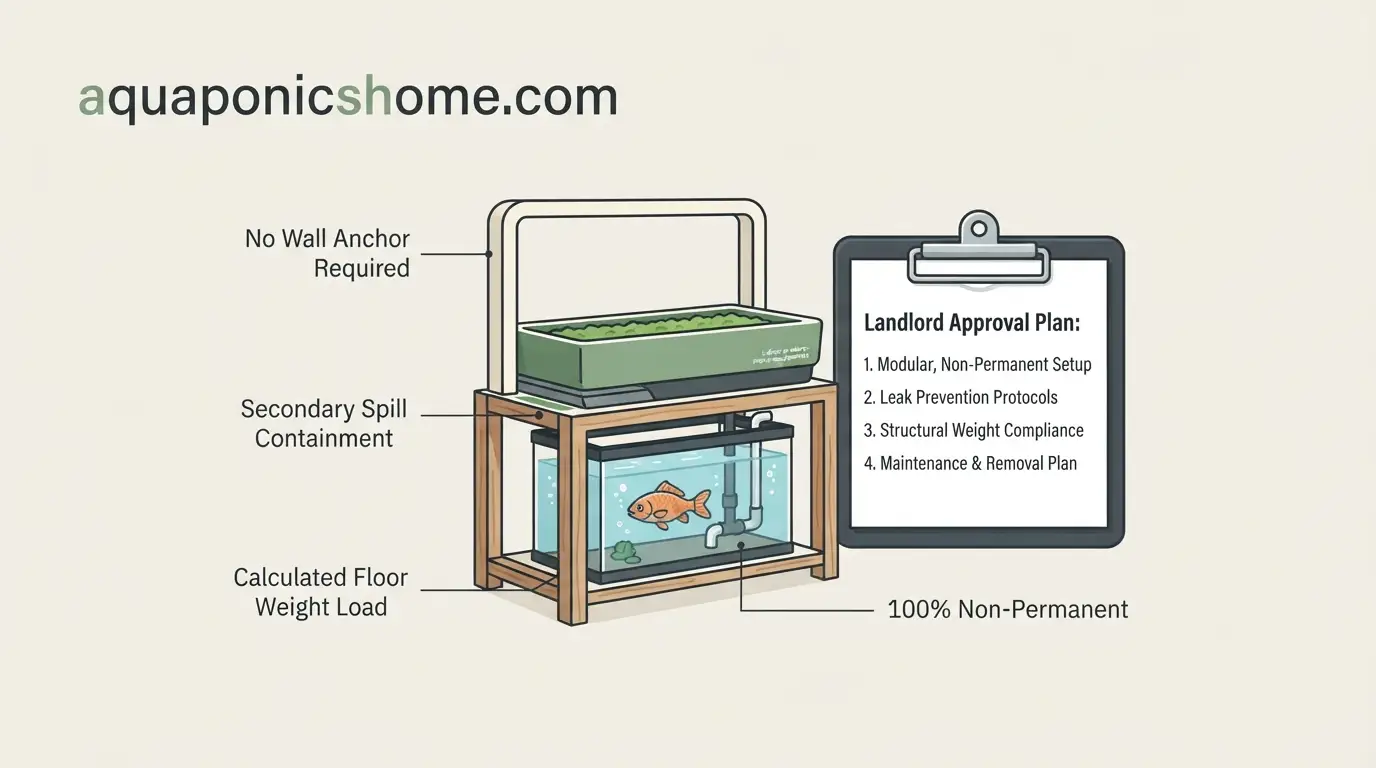
In most rentals, yes, it is worth telling your landlord before you build an aquaponics system, and having that conversation before you buy anything rather than after is what actually protects your security deposit. This is not a legal ruling: landlord-tenant law in the US is set state by state, and some cities add their own rules on top, so your own lease is the document that matters, not this article. What follows is what actually tends to be at stake, so you know what to check and what to ask.
What actually worries a landlord
A landlord who hears "aquaponics" for the first time is not picturing a nitrogen cycle. They are picturing two things: water finding its way somewhere it should not, and weight sitting on a floor they are responsible for. Everything else, the fish, the plants, the pump, barely registers by comparison.
That means the conversation goes better when you lead with those two concerns rather than defending the hobby itself. I write about the weight side of this in detail in how heavy is an aquaponics system, really?. Bring real numbers from that article to the conversation rather than a vague reassurance that it is "not that heavy."
What your lease is likely to already cover (read yours, do not assume)
Most residential leases touch this territory in one of a few standard clauses, even if none of them mentions aquaponics by name:
- Alterations or fixtures. Anything bolted, plumbed, or permanently attached to the structure (a wall-mounted grow bed, a drilled drainage line) is more likely to need sign-off than a freestanding tank.
- Water damage and liability. Almost every lease assigns responsibility for damage the tenant causes, which is exactly the risk a leak or an overflow creates.
- Pets or animals clause. This is the one that catches renters off guard.
Do not assume any of this applies to your specific lease the way it applies to someone else's. Clauses vary enormously by landlord, by property manager, and by state. Read your actual lease before you build, not after something goes wrong.
Are fish "pets"? It depends on your lease, not on logic
A lot of renters assume a no-pets clause settles the question, one way or the other. It usually does not settle anything on its own. Some leases define "pet" broadly enough to include any animal kept on the premises, fish included. Others clearly mean cats and dogs and never contemplate an aquarium at all. This is a wording question specific to your document, not a general rule this site can answer for you. If your lease has a pets clause and you are unsure whether it reaches a fish tank, that is itself a reason to ask rather than guess.
How to actually have the conversation
A short, concrete conversation beats a long defensive one. What tends to work:
- Bring the real numbers, not a feeling. How much water, roughly how heavy when full, where on the balcony or floor it will sit.
- Lead with your leak plan. What sits underneath the tank, what happens if the pump or a fitting fails overnight, and what you will do if water reaches a surface it should not. This is the single biggest thing that reassures a landlord who has dealt with a water-damage claim before.
- Offer a plan for moving out. A freestanding system a tenant can remove without repair work is a very different proposition to a landlord than a modification bolted into a wall.
- Get anything material in writing, even as simple as a text message confirming they are fine with it. It protects you as much as it protects them.
- Ask about renters insurance while you are at it. The Insurance Information Institute notes that some renter's insurance policies cover accidental water damage to the unit and to a neighbor's property; some explicitly exclude it. This is worth confirming for your own policy rather than assuming either way, and it is a separate question from what your lease requires.
As a renter myself, this is not a step I skip
I have run small aquaponics systems on a rented balcony for about three years, through two rebuilds. The practical version of all the advice above is the same rule I follow on my own setup: have the conversation before building, keep the system freestanding rather than bolted to anything, and keep the leak plan visible enough that a landlord can see it without asking. None of that removes every risk. It removes the risk of the conversation happening for the first time after something has already gone wrong, which is the version that actually costs a deposit.
What happens if you skip the conversation
Skipping it does not remove the risk, it just moves the conversation to after something has already gone wrong, which is a worse position for everyone. A leak that reaches a neighbor's ceiling, or a landlord who discovers a bolted-in system during a routine inspection, turns a five-minute conversation you could have had in advance into a dispute about your deposit or your lease. None of that is a reason to be afraid of the hobby. It is a reason to have the conversation early, while it is still easy.
FAQ
Do I legally have to tell my landlord about an aquaponics system?
That depends on your lease and on your state's landlord-tenant law, which differs from state to state and sometimes city to city. This article cannot rule on your specific situation. What is consistently true is that the practical risks (water damage, weight, and whether your lease's pets clause reaches fish) are worth checking before you build, whether or not disclosure is strictly required where you rent.
What if my lease says no pets? Does that include fish?
It depends entirely on how your specific lease defines "pet." Some do include fish, most were not written with an aquarium or aquaponics system in mind at all. Read the actual clause, and ask if it is unclear, rather than assuming either way.
Will a landlord say no to aquaponics?
Some will, particularly on upper floors or in older buildings, and that is a legitimate answer to respect. Most landlords' actual concerns are water damage and weight rather than the hobby itself, so a concrete leak-prevention plan and honest numbers on weight (see how heavy is an aquaponics system, really?) address the real objection rather than arguing around it.
What should I show my landlord to make the conversation easier?
Real numbers beat reassurance: roughly how much water, where it will sit, what is underneath it, and what you will do if something leaks or fails overnight. A plan for removing the system cleanly when you move out also helps.
Can my landlord charge me for damage even if I asked permission first?
Permission and liability are two different things, and this varies by lease and by state. Asking first does not automatically waive your responsibility for damage. It is still worth having a leak-prevention plan regardless of what your landlord says.
Does renter's insurance cover a leak from an aquaponics system?
It depends entirely on your specific policy. Some renters insurance covers accidental water damage to your own unit and to a neighbor's property; others exclude it or treat a hobby setup differently from ordinary household risk. Check your own policy's wording rather than assuming coverage either way, ideally at the same time you have the landlord conversation.
This article names categories of lease clause and risk common to US residential leases. It does not interpret any specific state's landlord-tenant law and is not legal advice. Check your own lease, and your state or city tenant-rights office, for anything binding.