
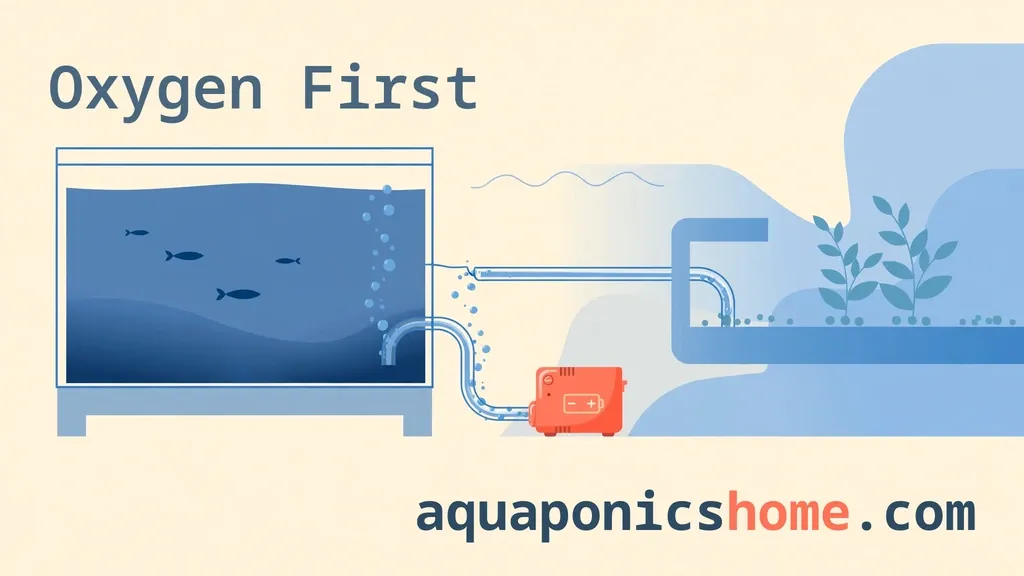
In an aquaponics power outage, oxygen is the first problem, not food and not the plants. When the pump and air pump stop, the water stops moving and the fish start using up the oxygen that is left.
Your first job is to get air back into the fish tank, with a battery air pump if you have one or by moving the water by hand if you do not. Temperature comes second and ammonia third.
How long your fish have depends on how many there are, how warm the water is and how big the tank is, and there is no single safe number of hours.
This guide covers what to do in the first minutes, what to set up now while the power is on, and how to restart the system afterwards.
Why Losing Power Is Losing Oxygen
A home aquaponics system runs on two kinds of electrical equipment. The water pump moves water from the fish tank to the grow bed and back. The air pump pushes bubbles through an air stone.
Both of them keep oxygen going into the water, because oxygen enters mostly where the water surface is broken and moving.
When the power goes out, both stop at once. The fish keep breathing. So do the beneficial bacteria in the grow bed, which also need oxygen to turn fish waste into plant food. Nothing is putting oxygen back in, so the level falls.
Florida Sea Grant put this plainly in its Q&A on keeping a fish tank safe during a power outage (October 28, 2025, read September 27, 2026).
Dr. Roy Yanong, an Extension Veterinarian and Professor in UF Fisheries and Aquatic Sciences, names the main concerns as temperature, oxygen levels and other water quality measures, and warns that high ammonia combined with low oxygen is a dangerous mix for fish.
That source is written for aquarium keepers, but a home aquaponics fish tank faces the same three problems, in the same order.
If you want the background on why oxygen matters so much, our guide to dissolved oxygen in aquaponics explains what it is and why so few people test it.
How Long Do the Fish Have?
This is the question everyone asks, and the honest answer is that it depends on your tank.
We looked for an extension source that gives a reliable number of hours for a small home system and did not find one, so we do not give one here. A number that is right for one tank can be badly wrong for another.
What we can say is which way the risk moves:
- More fish means less time. Florida Sea Grant advises against overcrowding tanks because too many fish use up the available oxygen quickly.
- Warmer water means less time. Warm water holds less dissolved oxygen than cool water, so a warm tank starts with less in reserve.
- Recent feeding adds to the load. Florida Sea Grant advises stopping feeding one to two days before an expected outage, which tells you that feed in the system is part of the problem when the pumps stop.
- A small volume means less time. A small tank has less oxygen stored in it to begin with.
So treat every outage as urgent from the first minute, even if the last one turned out fine. A crowded, warm, freshly fed tank is the worst case.
The First 15 Minutes: What to Do, in Order
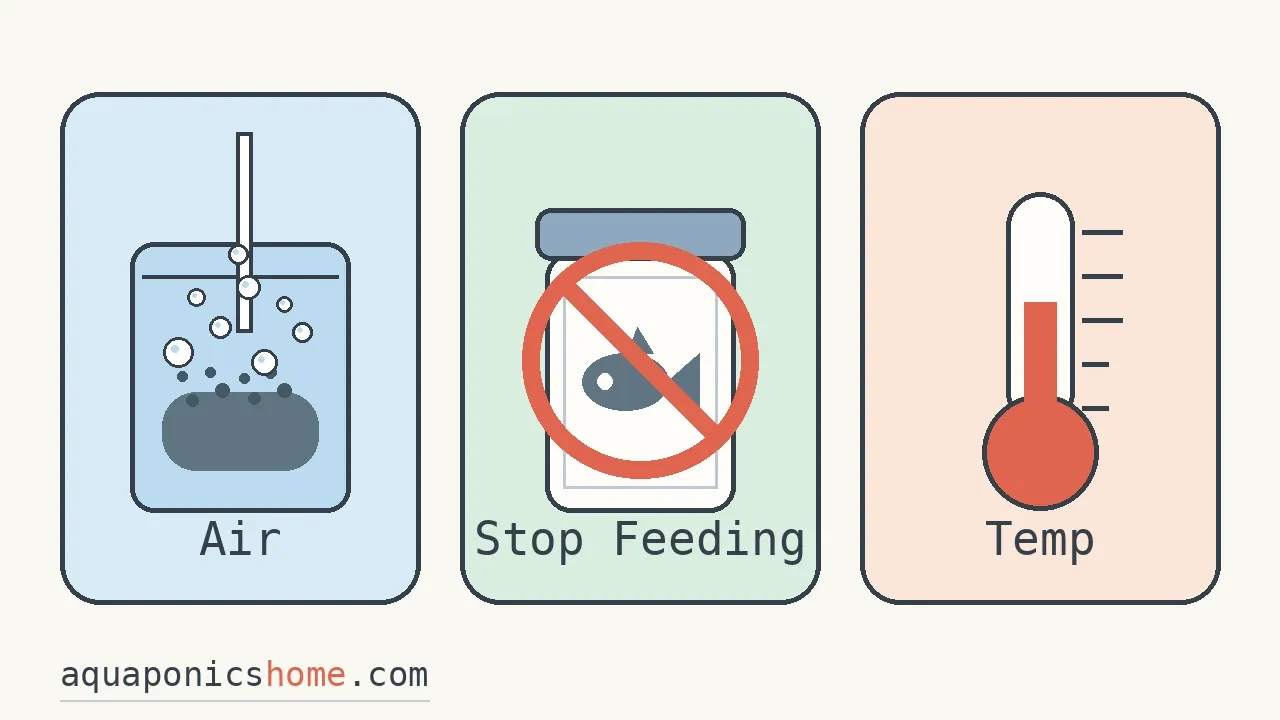
1. Get air into the fish tank
This comes before anything else. Florida Sea Grant’s advice is to keep the water surface moving with a battery-powered air pump or a small generator, because still water does not exchange oxygen well.
If you have a battery air pump, put the air stone in the fish tank, not the grow bed, and switch it on.
If you have nothing, move the water by hand. Scoop water from the tank and pour it back from a little height so it splashes and breaks the surface. It is tiring and it is not a long-term plan, but it buys time.
2. Stop feeding
Do not feed during the outage. Florida Sea Grant notes that fish can survive about a week without food, and feeding now only adds waste to water that cannot process it.
3. Check the fish
Watch for fish gathering at the surface and gulping air.
That is a common sign of low oxygen and it means aeration is not keeping up. Our guide to fish gasping at the surface covers what that behavior means and what to do.
4. Think about temperature
Florida Sea Grant says tropical fish do well between 75 and 85°F and that temperatures above 90°F cause stress and health problems.
In hot weather, it suggests a battery-powered fan over the open top of the tank for evaporative cooling, and advises against ice, which is hard to maintain and monitor.
It also notes that larger tanks cool more slowly than smaller ones. In cold weather, the concern runs the other way, and a tank that loses its heater loses heat steadily. Your species matters here, so check what a reliable source says about your fish’s temperature range.
If You Use a Generator, Read This First

A generator can keep a pump and air pump running through a long outage, but its exhaust contains carbon monoxide, a gas you cannot see or smell. That makes placement a life-safety question, not a convenience one.
The U.S. Consumer Product Safety Commission’s guide to generators and engine-driven tools (read September 27, 2026) says to never use a portable generator indoors or in a garage, basement or shed.
It says generators should always be used outside, well away from windows, doors, vents or any other opening, and that you should always have a working carbon monoxide alarm in your house.
That rules out running a generator on a balcony next to an open door or in a garage beside the tank. If the only place you could run one is close to where people sleep, a battery air pump is the safer choice for your setup.
Follow the generator maker’s manual for connecting equipment and for use in wet weather. Anything that involves connecting a generator to your home’s wiring is work for a licensed electrician, not a step to improvise during a storm.
What to Set Up Before the Next Outage
Almost everything useful in an outage has to be in place beforehand. This is the part worth doing on a calm day.
A battery air pump, tested
A battery-powered or rechargeable air pump with a spare air stone and tubing is the single most useful thing to own. Test it every few months.
A pump with flat batteries in a drawer does nothing. Keep spare batteries or a charged power bank that fits it, and check the label for how long it runs.
Stored, treated water
Florida Sea Grant suggests storing treated water equal to 10 to 20 percent of the tank’s volume for emergencies, and reminds readers that municipal tap water must be dechlorinated first because chlorine and chloramine harm fish.
That matters because the outage may also knock out your water supply, or leave you needing water for a partial change afterwards.
Our guide on how to dechlorinate water for aquaponics explains the difference between chlorine and chloramine.
A feeding plan for storm season
If an outage is forecast, such as a hurricane or a winter storm, Florida Sea Grant suggests stopping feeding one to two days beforehand. Less feed in the system means less waste building up when the pumps stop.
A stocking level with some margin
The fewer fish you keep relative to your tank, the more time you have when things go wrong. That is not a reason to stock at a specific number, and we do not give one, but it is a reason not to push your tank to its limit.
A written checklist
Tape a short list near the tank: air first, stop feeding, check fish, check temperature. In a dark room during a storm, nobody remembers the order.
Why Aquaponics Is Different From an Aquarium
Most power-outage advice is written for aquariums. An aquaponics system has two extra parts that suffer when the pump stops.
The grow bed. In a flood and drain bed, water normally rises and drains, pulling air into the media. With the pump off, the bed either sits drained or sits flooded, depending on where the cycle stopped. A bed left flooded with still water can run short of oxygen at the roots.
The biofilter. In most small aquaponics systems, the grow bed media is also the biofilter, the home of the bacteria that turn ammonia into nitrite and then nitrate.
Florida Sea Grant notes that the biofilter normally breaks down ammonia but that power loss halts the process. For aquariums, it suggests moving biofilter media into an aerated container during an outage.
In an aquaponics media bed, the bacteria are spread through the whole bed, so the practical priority is aerating the fish tank, where ammonia builds up. If you have a separate filter with removable media, the Florida Sea Grant approach applies to it directly.
If the outage is long and the bacteria take a hit, ammonia can climb after the power comes back. Our guide to an aquaponics biofilter crash covers what that looks like and how to recover.
When the Power Comes Back
Restarting is its own small risk, so take it step by step.
- Restart aeration first. Get the air pump running, then the water pump.
- Check that water is flowing where it should. A pump can lose its prime or push debris into the plumbing after sitting still. Watch the grow bed fill and drain at least once.
- Hold off on feeding. Florida Sea Grant advises not feeding for 24 hours after power is restored.
- Test the water. The same source says to test for ammonia and nitrite and to do water changes if either is above 0 ppm. Use your stored, treated water for this.
- Watch the fish for a few days. Stress after an outage does not always show on the first day. If fish are behaving abnormally or dying, contact an aquatic veterinarian or your local extension aquaculture service rather than guessing at a treatment.
Aquaponics Power Outage Plan: A Short Summary
An aquaponics power outage is an oxygen emergency first, a temperature problem second and an ammonia problem third. Get air into the fish tank, stop feeding, watch the fish, and think about heat or cold.
Keep a tested battery air pump and stored, treated water ready before you need them. Never run a generator indoors or near openings. After the power returns, restart aeration first, wait before feeding and test the water.
FAQ
What should I do first in an aquaponics power outage?
Get air into the fish tank. Florida Sea Grant advises keeping the water surface moving with a battery-powered air pump or a small generator. If you have neither, pour water back into the tank from a little height so it splashes and breaks the surface.
How long can fish survive without a pump in aquaponics?
There is no single safe number. It depends on how many fish you have, the water temperature, how recently they were fed and the size of the tank. Treat every outage as urgent from the start.
Should I feed my fish during a power outage?
No. Florida Sea Grant notes fish can survive about a week without food and advises not feeding for 24 hours after power returns. Feeding adds waste to water that cannot process it.
Can I run a generator for my aquaponics system?
Only outside, well away from windows, doors and vents, according to the U.S. Consumer Product Safety Commission. Never run one indoors or in a garage, basement or shed, and keep a working carbon monoxide alarm in the house.
Do I need to test the water after an outage?
Yes. Florida Sea Grant recommends testing for ammonia and nitrite after power is restored and doing water changes if either is above 0 ppm.