
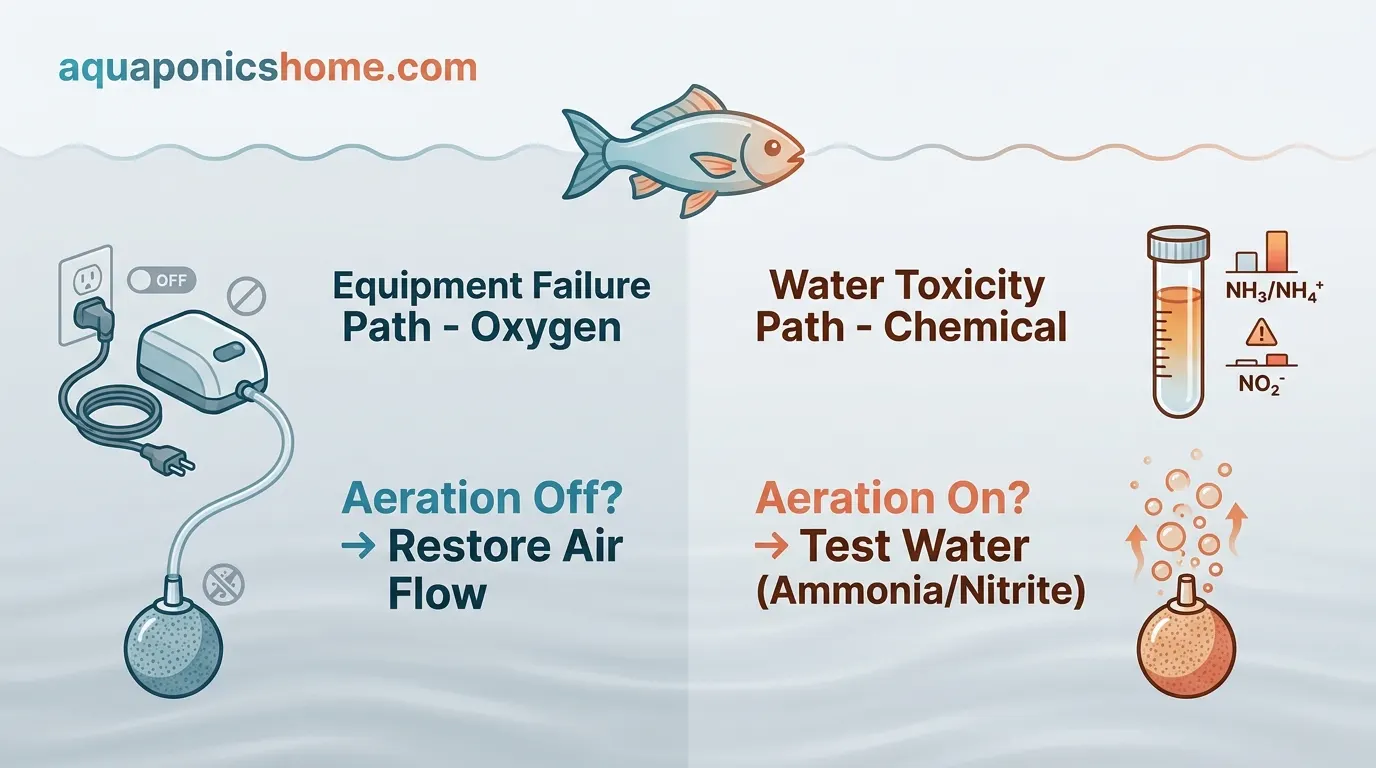
If your fish are crowded at the top with their mouths breaking the surface, treat it first as a low oxygen emergency. Check that your air pump or air stone is actually running right now, add surface agitation immediately (a splash, a spray return, anything that disturbs the surface), and do not add anything to the water while you work this out. If aeration is confirmed running and the gasping continues anyway, ammonia or nitrite becomes the more likely cause, and the next step is to test the water, not aerate harder.
I am not an aquaponics scientist, and the first time I saw my own catfish gulping at the surface, I did the wrong thing first. I checked the fish. I should have checked the pump. Three years into small-scale aquaponics on a rented balcony in Dhaka (more on how that started on my about page), that is still the lesson I come back to.
What to do in the first minute
Walk to the pump and the air stone before anything else. Look, do not assume. Is the pump humming. Is the air stone actually bubbling. A pump that looks plugged in can still have stopped, and an air stone can clog silently for weeks until the day it finally quits.
If aeration has stopped, your first job is getting air moving through the water again, safely, which the next sections cover in order. If it is running normally and fish are still gasping, do not keep adding aeration hardware as a guess. That is the point where this stops being an oxygen problem by default and becomes a question for your test kit instead.
Resist the urge to do several things at once. A panicked reader who changes the water, adds an extra air stone, and cuts feeding all in the same five minutes loses the ability to tell which action actually helped.
Is it really oxygen? The fastest check
Gasping at the surface is not unique to low oxygen. It is also the shared symptom of ammonia poisoning and of nitrite poisoning, sometimes called brown blood disease, because nitrite binds to a fish’s blood in a way that stops it carrying oxygen even when the water itself has plenty. All three can look identical from across the room: fish clustered at the top, mouths working, gill covers flaring.
The aeration check above is the fastest way to split them apart. A stopped pump or a dead air stone points hard at oxygen. Aeration confirmed running, with fish still gasping, points away from oxygen and toward ammonia or nitrite, meaning the next honest step is your test kit, not another air stone.
Oxygen, ammonia, or nitrite: telling them apart fast
| Signal | Oxygen failure | Ammonia poisoning | Nitrite poisoning |
|---|---|---|---|
| Pump or air stone | Stopped, clogged, or reduced | Usually still running | Usually still running |
| Onset | Often sudden, tied to equipment or heat | Builds over hours to a day or two | Builds after ammonia has already been climbing |
| Gills | No unusual color | Red, irritated, may look inflamed | Can look pale or, in advanced cases, brown-tinged |
| What confirms it | The pump or air stone is physically off | A test kit shows elevated ammonia | A test kit shows elevated nitrite |
| What to do | Restore aeration safely, then reassess | Test, do not guess; a “safe” ammonia number is not published on this site | Test, do not guess; a system imbalance, not a dose you self-administer |
This table is a starting point for triage, not a diagnosis. If a test kit confirms ammonia or nitrite, or fish show anything beyond gasping (lesions, unusual coloring, erratic behavior), that has moved past what a troubleshooting page should resolve, and it belongs with a named aquaculture extension service or an aquatic veterinarian.
Why oxygen crashes happen
A handful of causes show up again and again in small systems like the ones I run:
- A pump or air stone that has actually failed. The single most common reason, and the first thing to rule out, every time.
- Warm water. Warmer water holds less dissolved oxygen than cool water, so a heat wave or a poorly ventilated balcony corner raises risk even with working equipment.
- Overstocking or overfeeding. More fish and more uneaten feed both increase oxygen demand and waste that competes for the same oxygen the fish need.
- No surface movement. Oxygen enters water mainly at the surface. A still tank with no splash, no return flow, and no air stone is oxygen-starved before anything else goes wrong.
- A power interruption. If your aeration runs off an electric pump, anything that cuts power cuts oxygen delivery with it.
That last one is not theoretical for me. Load shedding is a real part of life where I keep my systems, and I have lost more sleep over an unplanned power cut than over almost anything else in three years of doing this, which is part of why I keep coming back to passive, pump-free setups for at least part of what I grow.
What raises oxygen right now, without a number to chase
There is no home test strip for dissolved oxygen the way there is for ammonia or pH, so this is not a page about hitting a target number with a dosing product, because nothing you add to the water raises oxygen directly. What actually works is moving more air through the water:
- Increase surface agitation: a spray bar, a return that splashes rather than pours smoothly underwater, or a temporary extra air stone.
- If your system is overstocked for its current aeration, reducing stocking temporarily takes real pressure off the oxygen supply while you fix the equipment.
- If heat is a factor, anything that cools the water a little (shade on the tank, moving it out of direct afternoon sun) helps, alongside aeration, not instead of it.
As reported in the FAO’s Small-Scale Aquaponic Food Production guide (Technical Paper 589, Somerville and others, 2014), dissolved oxygen in the biofilter portion of a system is generally kept above five parts per million to support both the fish and the nitrifying bacteria that turn fish waste into plant nutrients. That is reference information about how a healthy system is generally run, not a target you dose toward; nothing you can buy adds oxygen the way a product adjusts pH.
I also will not give you a countdown of how many hours fish can survive without aeration. It depends on stocking density, water temperature, and species, and a wrong number here is worse than an honest “it depends.” Act now instead of calculating how much time you have left.
The electrical safety step nobody skips past
Fixing dead aeration usually means touching an electrical device beside a full tank of water, and that deserves its own pause before you reach for the plug.
Isolate the device at the socket before you touch it. Never handle a plugged-in pump or heater with wet hands, and never reach into the water to check a device still connected to power. An outlet protected by a GFCI or RCD is the category of protection worth having near a fish tank; if you are not certain yours is protected that way, ask a licensed electrician rather than guess. Anything beyond unplugging, drying, and plugging back in, meaning any actual rewiring, belongs to a licensed electrician, not a troubleshooting article.
The fastest fix for a dead air pump is genuinely simple, and simple is exactly when people get careless around water and electricity at the same time.
When it keeps happening
If aeration checks out fine, the test kit comes back clean, and fish are still gasping, or you see anything beyond gasping, this is where a troubleshooting page should stop and a professional should start. A named university extension aquaculture service or an aquatic veterinarian can look at symptoms this article is not equipped to interpret. It is the same honest line I try to hold everywhere on this site: test on your own system first, and when something is past what you actually know, say so.
For the wider picture beyond this one emergency, the aquaponics troubleshooting pillar walks through how to work out what is wrong in the first place, and the fish dying triage checklist orders every fast-moving emergency by how quickly it can kill. Ammonia and nitrite background, including why they climb in the first place, lives on the cycling without killing your fish page rather than repeated here.
FAQ
My air pump is running but my fish are still gasping. What now?
Stop treating it as an oxygen problem by default. Confirmed aeration with continued gasping points to ammonia or nitrite, so the next step is testing the water, not adding more air stones.
How do I know if it is ammonia and not oxygen?
Check equipment first. If the pump or air stone has failed, oxygen is the likely cause. If aeration is confirmed working, test for ammonia and nitrite with a kit rather than guessing from behavior alone.
Is there a safe dissolved oxygen number I should aim for?
This site does not publish a target number to dose toward, since there is no simple home test for it. Increasing surface agitation and aeration, and temporarily reducing stocking if needed, matter more than chasing a specific figure.
How long can fish survive without aeration?
It depends on stocking density, water temperature, and species, and this site will not give you a countdown number. Treat any confirmed aeration failure as urgent and act immediately rather than estimating how much time is left.
Should I add fish medication or a water treatment while I sort this out?
No. This site does not publish medication doses or treatment schedules for fish, and gasping alone is not a diagnosis. If illness is suspected beyond an oxygen or water-quality issue, that question belongs with an aquatic veterinarian or a named extension aquaculture service.