Aquaponics solids removal is not a yes or no question. Fish waste is partly food for your plants and partly a hazard, and which one it becomes depends on where it ends up.
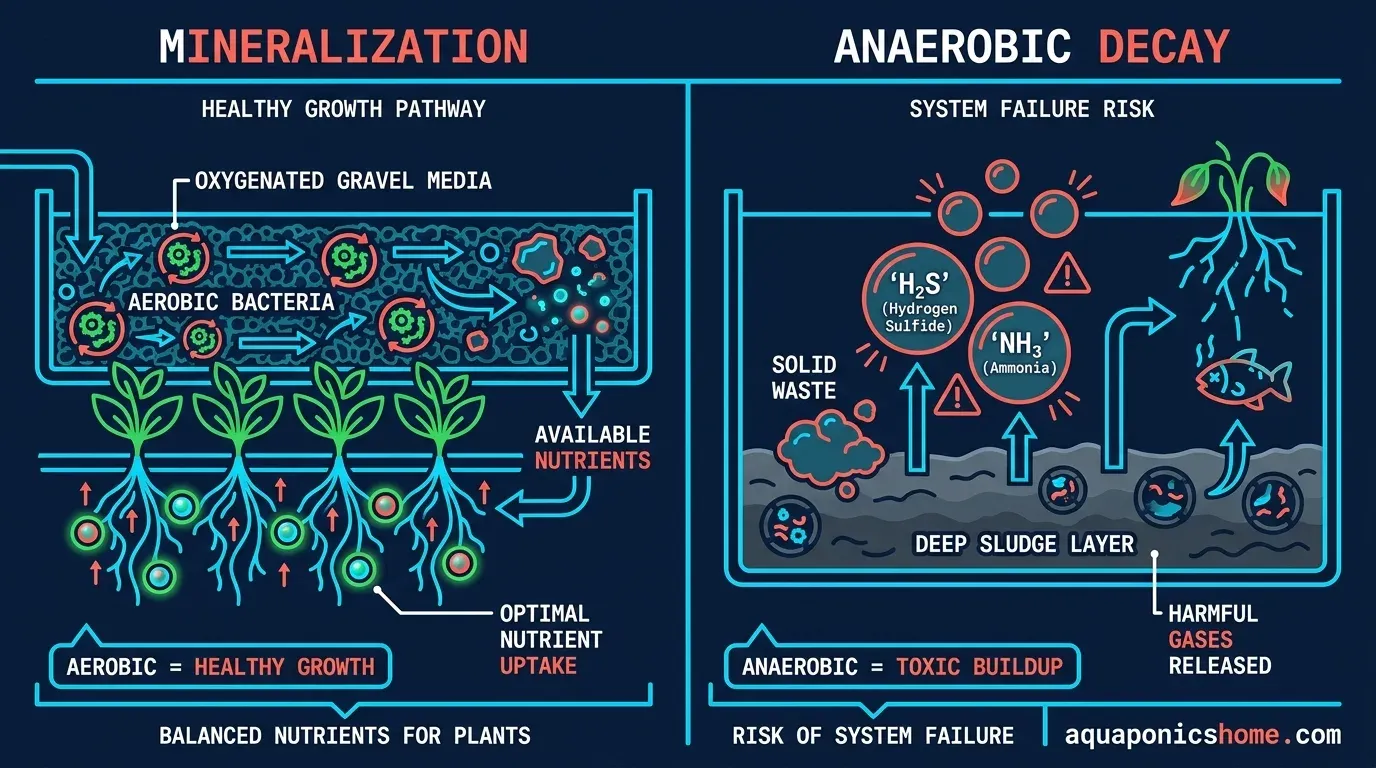
Solids that break down in a well-oxygenated gravel bed release nutrients the plants can use. Solids that pile up as deep sludge on a tank bottom, or coat the roots in a raft bed, use up oxygen and can release gases that are toxic to fish.
Whether you need a separate filter depends mostly on how much you feed compared with how much plant area you have.
This guide explains what the solids are, why they help and harm, and how to decide what your system needs.
What Counts as “Solids”
When people talk about solids in aquaponics, they mean the particles floating or settling in the water, not the dissolved nutrients.
SRAC Publication No. 454, Recirculating Aquaculture Tank Production Systems: Aquaponics, Integrating Fish and Plant Culture (Rakocy, Masser and Losordo, Southern Regional Aquaculture Center, November 2006 revision, read September 27, 2026), names three sources:
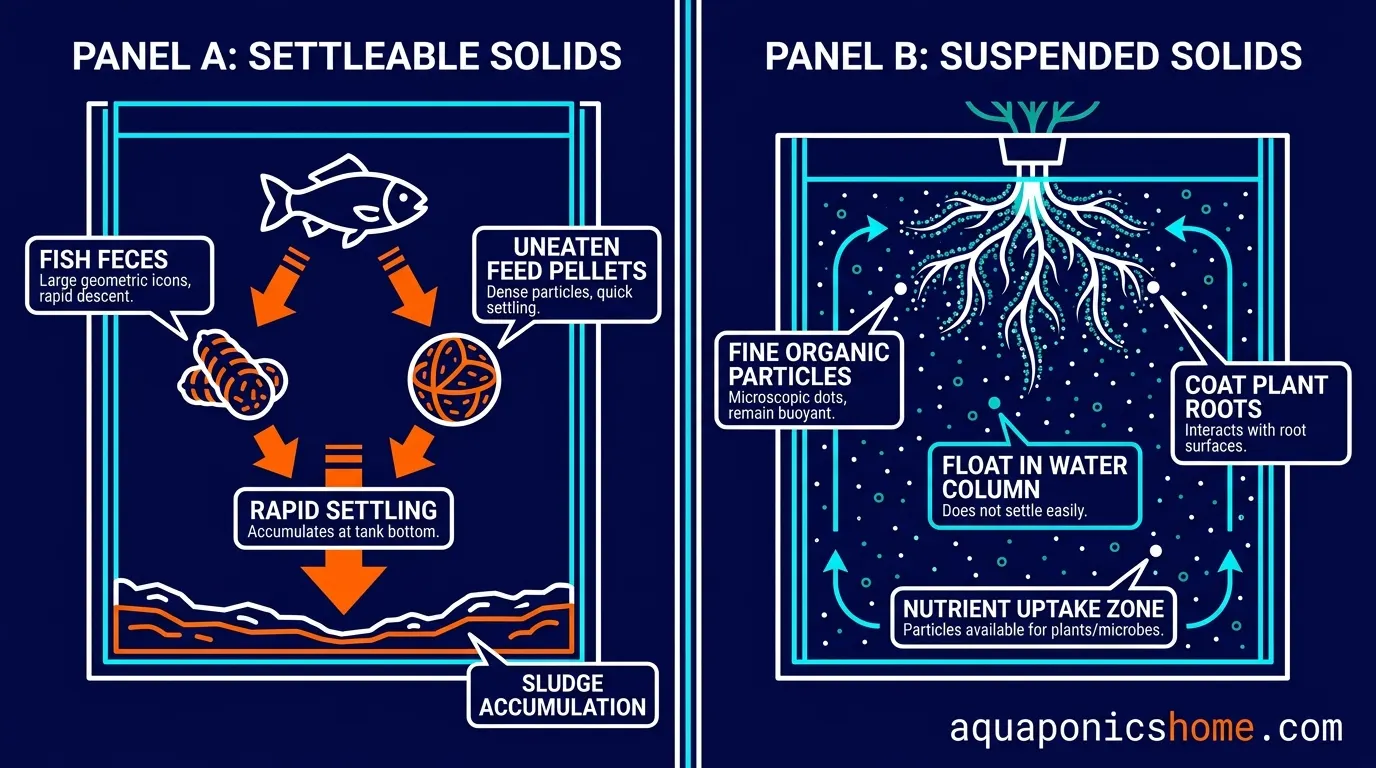
- Fish feces, the largest share.
- Uneaten feed.
- Organisms that grow in the system, which SRAC lists as bacteria, fungi and algae.
SRAC also separates two kinds. Settleable solids are heavy enough to sink when the water slows down. Suspended solids are fine enough to stay floating in the water column. The difference matters because different removal methods catch different kinds.
Why Sludge Is a Problem
SRAC is plain about what happens when solids build up: “If this organic matter accumulates in the system, it will depress dissolved oxygen (DO) levels as it decays and produce carbon dioxide and ammonia.”
It goes further: “If deep deposits of sludge form, they will decompose anaerobically (without oxygen) and produce methane and hydrogen sulfide, which are very toxic to fish.”
Hydrogen sulfide is the gas that smells of rotten eggs. If your system has started to smell like that, read our guide on why an aquaponics system smells bad alongside this one.
Oklahoma State University Extension’s fact sheet Nitrification and Maintenance in Media Bed Aquaponics (HLA-6729, October 2021, read September 27, 2026) links solids directly to ammonia problems.
It says that if solids accumulate, “denitrification can occur, which will result in ammonia concentrations increasing,” and that “Proper system management will require the periodic removal of solids from the system to reduce the chances of ammonia shock.”
If your ammonia is already high, our guide to aquaponics ammonia too high covers what to do first.
Solids also cause trouble for plants. SRAC notes that suspended solids reaching the plant roots “may accumulate on plant roots and create anaerobic zones that prevent nutrient uptake.”
Why Some Solids Are Good
This is the part most “you must filter everything” advice leaves out. SRAC explains that “some accumulation of solids may be beneficial.”
As microbes break solids down, they release nutrients into the water. This process is called mineralization. It means turning organic waste back into plain mineral nutrients that roots can take up.
SRAC names two benefits:
- Fewer nutrient top-ups. “Without sufficient solids for mineralization, more nutrient supplementation is required, which increases the operating expense and management complexity of the system.”
- Healthier roots. “the microorganisms that decompose them are antagonistic to plant root pathogens and help maintain healthy root growth.”
So the goal is not zero solids. The goal is solids that break down where oxygen is plentiful, rather than rotting in a pile where it is not.
Aquaponics Solids Removal Depends on Your Balance
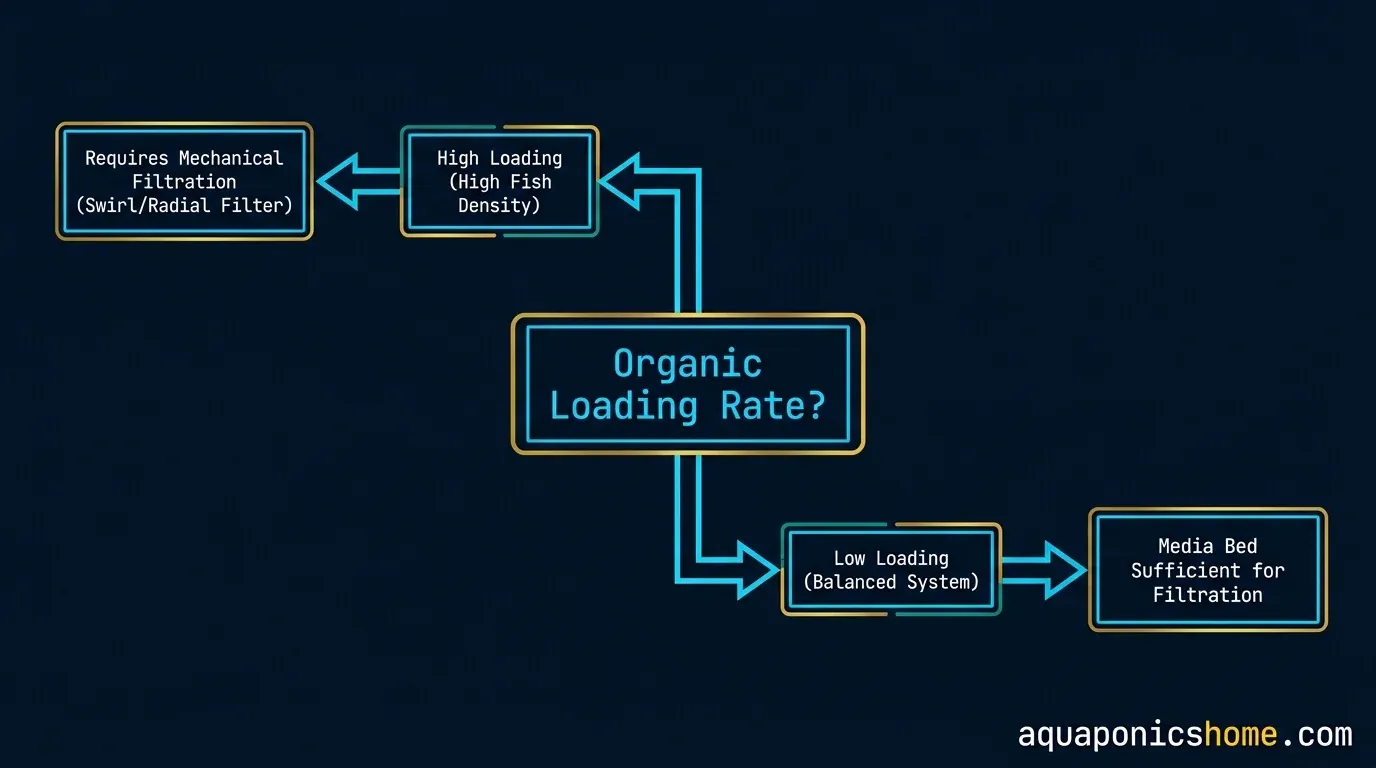
SRAC gives the clearest decision rule we found. The right approach “depends primarily on the organic loading rate (daily feed input and feces production) and secondarily on the plant growing area.”
In plain terms:
- Lots of fish and feed for the plant area: solids arrive faster than the plants and microbes can use them. SRAC says a highly efficient removal device is desirable in this case.
- Few fish and little feed for the plant area: SRAC says “solids removal may be unnecessary, as more mineralization is needed to produce sufficient nutrients for the plants.” It adds one condition: solids that have not yet broken down “should not be allowed to accumulate on the tank bottom and form anaerobic zones.”
For that lighter-loaded case, SRAC suggests a flood and drain gravel bed “may be the most appropriate device,” because the solids are spread through the gravel and exposed to air each time the bed drains.
SRAC notes that air holds far more oxygen than water. That exposure speeds up the breakdown.
How the System Type Changes the Answer
Media beds (gravel or clay)
In a flood and drain media bed, the bed itself acts as the solids filter. SRAC says sand and gravel “can remove solid waste from system water” and the solids “remain in the system to provide nutrients to plants through mineralization.”
The catch comes in the next sentence: “With the high potential of sand and gravel media to clog, bed tillage or periodic media replacement may be required.” Our guide on media bed aquaponics explains why this design is so forgiving at small scale.
SRAC also warns what happens when a gravel bed is overloaded: “If serious clogging occurs from organic matter overloading, gravel and sand filters can produce ammonia as organic matter decays, rather than remove it.”
Its fixes are to wash the media, add a solids removal step before the bed, or reduce the load by stocking fewer fish and feeding less.
Raft (deep water culture) beds
Rafts have no media to catch anything, so the roots are exposed to whatever arrives. SRAC says raft beds provide enough nitrification “if solids are removed from the flow before it reaches the hydroponic component.”
In the University of the Virgin Islands system it describes, all solids are removed. If you are considering rafts, see our guide to DWC aquaponics at home.
NFT channels
SRAC is blunt here: “In aquaponic systems that use NFT, solids must be removed so they do not accumulate and kill roots.”
The Main Types of Solids Removal
SRAC lists the devices used in recirculating systems: “settling basins, tube or plate separators, the combination particle trap and sludge separator, centrifugal separators, microscreen filters and bead filters.” It separates them into two groups:
| Type | Examples | What it catches |
|---|---|---|
| Sedimentation (settling) | Settling basins, clarifiers, tube or plate separators | Mainly heavier settleable solids |
| Filtration | Microscreen filters, bead filters | Settleable and suspended solids |
At home scale, the plain version of a settling device is a container placed between the fish tank and the grow bed. It slows the water down enough for heavier waste to sink so it can be drained off. The UVI system shows why a single stage is not always enough.
SRAC reports that its cone-shaped clarifiers remove about 50 percent of particulate solids. Filter tanks filled with orchard netting remove the remaining 50 percent.
What to Do With What You Remove
Removed sludge still needs somewhere to go. SRAC says solids “must be disposed of appropriately,” and describes several routes. Sludge can be stored and applied to land once it has stabilized.
The solid part can be composted with vegetable waste from the system. Or it can go to a sewer where local rules allow it. On a balcony or in a flat, the practical options are composting or using it on ornamental plants in soil, within your building’s rules.
A Simple Routine
OSU’s fact sheet reproduces a routine management checklist that includes these solids tasks:
- Daily: “Clear dead fish/plant materials from the system” and “Remove solids from the clarifier and rinse filters,” if you have them.
- Weekly: “Clear fish waste from the bottom of fish tanks and in the biofilter.”
- Monthly: “Clean the biofilter, clarifier and all other filters.”
Scale it to your system. A lightly stocked media bed with no separate filter mainly needs the daily removal of dead material and uneaten feed, plus a regular look at the tank bottom and at how well the bed drains.
Clean carefully. Scrubbing everything at once can remove the helpful bacteria along with the waste.
FAQ
Do I need a solids filter in aquaponics?
It depends on your balance of fish to plants and on your system type. SRAC Publication No. 454 says solids removal may be unnecessary when feeding is low relative to plant area. It also says raft and NFT systems need solids removed before the water reaches the plants.
Is fish sludge good or bad for aquaponics plants?
Both. Broken down in an oxygen-rich bed, it releases nutrients through mineralization. Piled up as deep sludge, it uses up oxygen and can produce gases that SRAC describes as very toxic to fish.
Can a gravel grow bed handle all the solids?
In a lightly loaded system, often yes, because the gravel traps solids and the draining cycle brings in air to break them down. SRAC warns that an overloaded gravel bed can clog and start producing ammonia instead of removing it.
How often should I remove sludge from the fish tank?
OSU Extension’s routine checklist includes clearing fish waste from the tank bottom weekly and cleaning filters monthly. Adjust that to how quickly waste builds up in your system.
What should I do with removed fish waste?
SRAC describes land application after the waste has stabilized, composting the solid fraction, or sewer disposal where local rules allow it. At home, composting is the practical choice.