
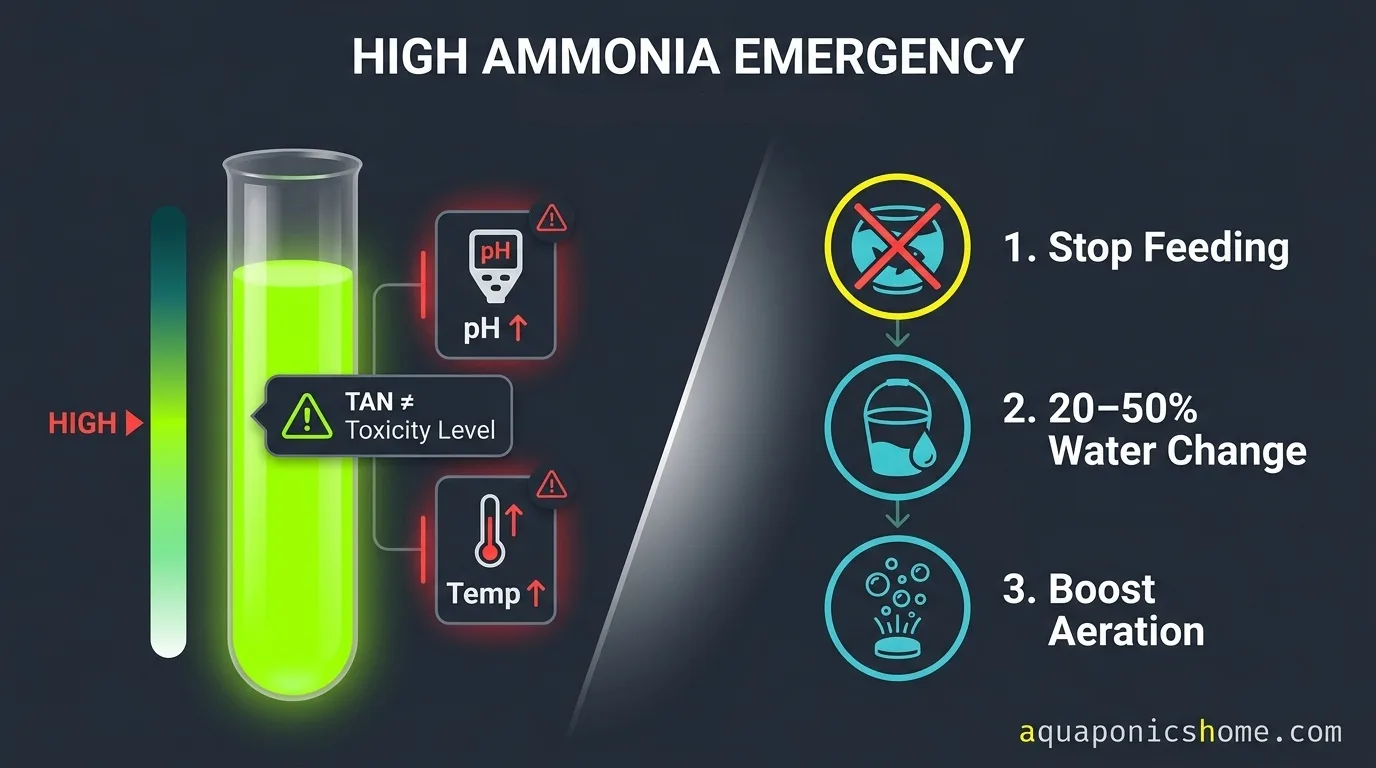
If your ammonia test just came back high, stop feeding, change roughly 20 to 50 percent of the water with dechlorinated, temperature-matched water, and boost aeration. Before comparing that reading to any number online: a test kit measures total ammonia, but only the un-ionized fraction actually poisons fish, and how much of your reading is that toxic fraction depends on your pH and water temperature. Test both alongside ammonia.
I write this having watched my own first batch of catfish die from exactly this, on a rented balcony in Dhaka (the longer version is on my about page). I had scrubbed the system too well and starved the bacteria that were supposed to be handling the waste, and ammonia climbed with nothing left to stop it. I am not a scientist. What follows is sourced to people who are.
Why Your Ammonia Number Doesn’t Tell You How Scared to Be
This is the part most emergency guides skip, and it changes how you read every figure below. A liquid or strip test kit measures total ammonia nitrogen (TAN), which is the combined amount of two chemically different things in your water: ionized ammonium (NH4+), which is essentially harmless, and un-ionized ammonia (NH3), which is the form that actually damages fish. According to the University of Florida IFAS guide to ammonia in aquatic systems (Francis-Floyd, Watson, Petty and Pouder), un-ionized ammonia is roughly 100 times more toxic to fish than the ionized form, and damage can begin at concentrations as low as 0.05 mg/L of that toxic fraction. The same guide is explicit that a TAN reading on its own reveals nothing about danger to your fish: you need your water’s pH and temperature to work out how much of that total is actually the dangerous form, because a higher pH and a warmer tank both push more of your total ammonia into the toxic un-ionized state. So before anything else, test your pH and temperature, not just ammonia. A high pH turns a moderate TAN reading into a serious one.
What to Do Right Now, in Order
Work through these five steps before you do anything else, including before you go looking for a number to compare against:
- Stop feeding. Uneaten food breaks down into more ammonia, which is the last thing your system needs while it is already in trouble. Both the UF/IFAS guide and Oklahoma State University’s HLA-6729 aquaponics fact sheet list this as the first action, before any water change.
- Do a partial water change. Swap out a portion of the tank for dechlorinated, temperature-matched water. Do not guess at the percentage: UF/IFAS reports 25 to 50 percent as a workable emergency range, and Oklahoma State’s HLA-6729 recommends immediately changing a third to a half of the system’s water when ammonia or nitrite reads above 1 ppm. Treat 20 to 50 percent as the sourced range, and lean toward the higher end if fish already look distressed.
- Maximize aeration. Add an air stone, point your pump’s outflow at the surface, or otherwise get more air moving through the water. Your fish need the oxygen, and so does the bacterial colony you are trying to help catch up.
- Test pH and temperature alongside ammonia. Not after. A TAN reading without these two numbers cannot tell you how dangerous your water actually is, for the reasons above.
- Retest. Check ammonia again a few hours after the water change, and keep testing daily until the readings settle. One good reading is not the same as a solved problem.
Only after these five steps should you start diagnosing why this happened.
The Ammonia Numbers, and Who Actually Said Them
Skip any page that hands you a single round number for “safe ammonia” with nobody’s name attached to it. Here is what the named sources actually report, and nothing beyond it.
Oklahoma State University Extension’s fact sheet HLA-6729, “Nitrification and Maintenance in Media Bed Aquaponics” (October 2021), states that to avoid fish stress or potential death, total ammonia nitrogen should be maintained within 0 to 0.25 ppm. That same fact sheet’s troubleshooting table treats ammonia or nitrite above 1 ppm as the trigger for immediate action: stop feeding, remove uneaten food or dead fish, and change a third to a half of the system’s water right away.
The University of Florida IFAS guide (FA16) adds the mechanism behind that number: un-ionized ammonia damage can start as low as 0.05 mg/L of the toxic fraction, and the danger rises sharply as more of your total reading shifts into that form with higher pH and warmer water.
The FAO’s small-scale aquaponics manual (Somerville et al., 2014, FAO Fisheries and Aquaculture Technical Paper 589) treats ammonia and nitrite as toxic above 1 mg/liter in general, noting that fish like tilapia and carp can show poisoning symptoms at that level, with the risk compounding where pH runs high, because more of any detectable ammonia is sitting in the toxic un-ionized form.
None of these sources agree on a single tidy line you can memorize, and that disagreement is itself the honest answer: your specific pH, your specific temperature, and your specific fish matter more than any number a blog post could hand you. Read your own test kit’s documentation alongside these sources rather than trusting a bare figure out of context.
Why This Is Probably Happening: A New or Recently Disturbed System
If your system is young, or if you recently scrubbed the tank, rinsed the media, or did a thorough clean, that is very likely your answer. Nitrifying bacteria live on surfaces, mostly your grow bed media and biofilter, not floating free in the water. Strip those surfaces clean and you strip out the workforce that was quietly turning ammonia into something less dangerous.
That is exactly what happened to my first batch of catfish. I cleaned the system too thoroughly because it looked like the responsible thing to do, and I washed away the bacteria that were keeping the water safe. Ammonia climbed with nothing left to process it, and the fish did not survive the month. If that sounds like your situation, read cycling a system without killing your fish for how that bacterial colony actually works and how long it genuinely takes to rebuild, and the fish dying triage checklist if fish are already showing distress right now, not just the water.
When It Might Not Be the Water at All
If your ammonia, nitrite, pH and temperature all check out and fish are still struggling, with symptoms like white spots, frayed fins, ulcers, or only some fish affected while the rest look fine, that points toward possible illness rather than a water chemistry problem. This page will not diagnose that, and neither will this site anywhere else. The honest next step is an aquatic veterinarian or your local university’s cooperative extension aquaculture service, not a guess at a treatment.
What This Page Will Not Tell You
It will not give you a single number to treat as universally safe, because that number does not exist without your own pH and temperature attached to it. It will not give you a medication, a dosing schedule, or a bottled fix. In a system you plan to eat food from, an unmeasured treatment is a food-safety question as much as a fish-welfare one. For the fuller sorting system if you are not sure ammonia is even your actual problem, start at the aquaponics troubleshooting hub and work down from there.
FAQ
My ammonia test went dark green. Does that mean my fish will die?
Not necessarily, and a color alone cannot answer that. Match your kit’s reading against its own chart to get a TAN number in ppm, then test pH and temperature. A high TAN at a low pH is far less dangerous than the same TAN at a high pH, because pH controls how much of that reading is the toxic un-ionized form.
How much water should I actually change?
Treat 20 to 50 percent as the sourced range: UF/IFAS reports 25 to 50 percent, and Oklahoma State’s HLA-6729 recommends a third to a half once ammonia or nitrite passes 1 ppm. Always use dechlorinated, temperature-matched water, and lean toward the higher end if fish are visibly distressed.
Can I just do a full water change to be safe?
No. A full volume of replacement water is a full volume of chlorine or chloramine to get wrong, and a sudden swing in water chemistry can stress fish that are already struggling. Stick to a partial change and repeat it, retesting between each one.
When can I feed my fish again?
Once your ammonia and nitrite readings have come down and stayed down across a couple of retests, not after a single good number. Feed lightly at first and keep testing daily for a few more days.
Is food from my system safe to eat after an ammonia spike?
It depends on whether that water ever touched the part of the plant you eat, and whether a fish died and was not removed promptly. See is aquaponics food safe for how that risk actually works before you harvest anything you were planning to eat soon.