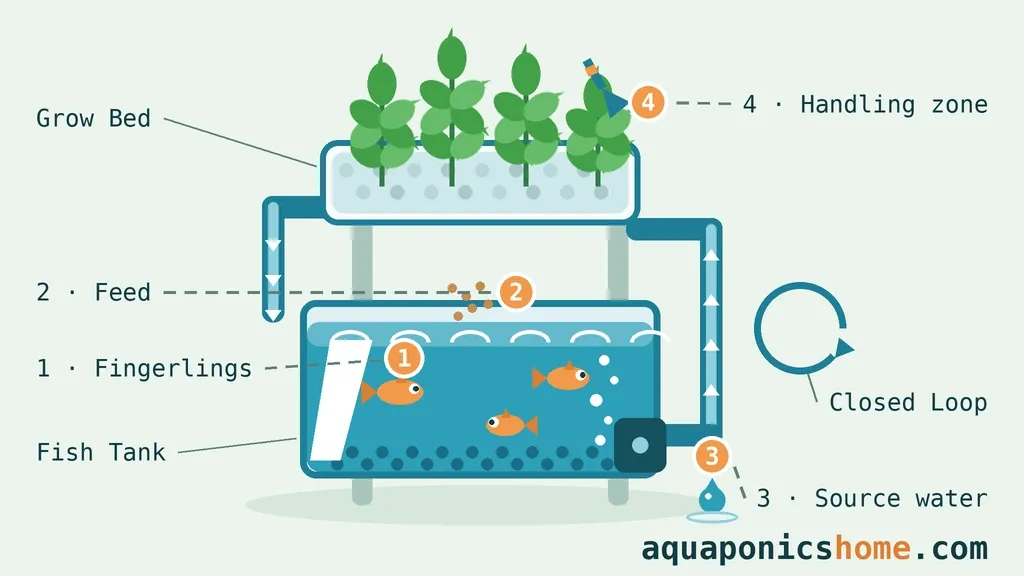
Aquaponics contamination risk does not come from one place. A 2025 review of leafy greens grown in soilless systems names six routes by which harmful microorganisms can get into an aquaponics system: contaminated fingerlings (young fish), fish feed, recirculating contaminated water, pest intrusion, improper handling and poor worker hygiene.
So the answer to “is it the fish, the water or me?” is that it can be any of them. Researchers also say plainly that understanding of these risks is still limited, so no one can tell you which route matters most in your home system.
This guide walks through each route, what the sources say about it, and where the evidence runs out.
Why an Aquaponics System Is Different
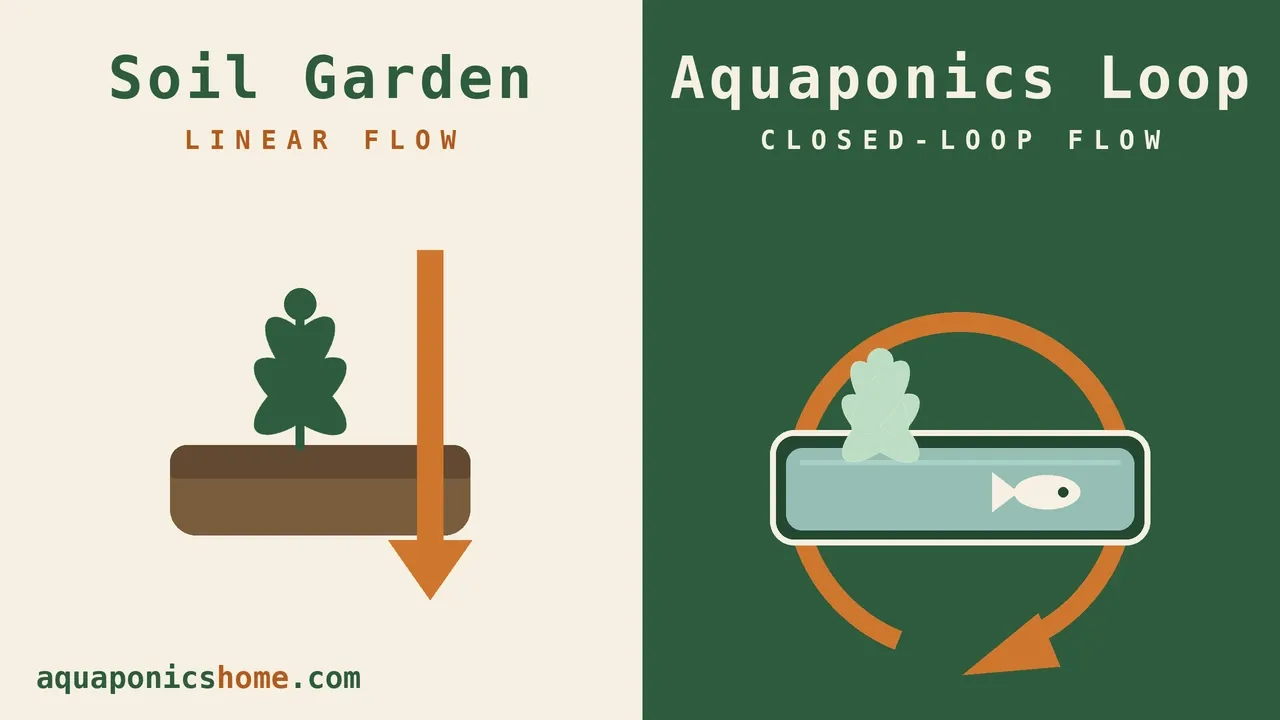
In a soil garden, rain and irrigation water pass through once. In aquaponics, the same water goes round and round, carrying fish waste to the plants and back to the fish.
The review, Microbial Quality of Leafy Greens Grown Under Soilless Production Systems (Robert Korir Cheruiyot and Abraham Fikru Mechesso, Pathogens, 2025, read September 27, 2026), explains why that matters.
It notes that closed systems may promote the accumulation of organic matter, creating favorable conditions for pathogenic microorganisms to persist and spread, and that a closed-loop water system can facilitate the continuous spread and growth of microorganisms.
In other words, something that gets in does not necessarily wash out. That is the reason to understand each route, rather than focusing on just one.
If you are still deciding whether to grow food this way at all, start with our pillar guide on whether food from a home aquaponics system is safe to eat.
Aquaponics Contamination Risk: Six Routes Named in the Research
The review lists these routes together. It does not rank them, and we do not either. The order below is simply the order a home grower meets them.
1. Fingerlings: what comes in with the fish
Young fish arrive with their own water and whatever lives in it. The review names contaminated fingerlings as one route into the system. For a home grower, that means where the fish come from matters, and so does the water they arrive in.
What we cannot tell you is how often fish bought from a supplier carry organisms that matter for human health. The review does not give a figure, and we found no source that does for home systems.
If you have questions about the health of fish you are buying, an aquatic veterinarian or your local extension aquaculture service is the right place to ask.
2. Fish feed: what the fish eat
Fish feed is the only input most home systems receive every day, and the review names it as a route. Feed is a manufactured product that is stored, opened and handled repeatedly, often in a garage, shed or on a balcony where animals may be able to reach it.
The source does not say how often feed becomes contaminated, so we do not suggest a figure. The general point is that feed is part of the chain that ends in what you eat, not just a supply for the fish.
3. Recirculating water: what is already in the system
This is the route specific to aquaponics. The review names recirculating contaminated water as a route and explains, as above, that a closed loop can spread and sustain microorganisms.
It also describes external root colonization, internalization and subsequent translocation to edible plant tissues as a pathway, and cites research on E. coli O157:H7 entering spinach through damaged roots.
That means the question of whether system water touches the part you eat is not the whole story. Research is still working out how often organisms move from roots into leaves in real growing conditions, and it has not given a home-scale answer.
4. Source water: what you top up with
The water you add to replace evaporation is its own route. The review mentions untreated groundwater, surface water and partially treated reclaimed wastewater as potential entry points, and elsewhere names stormwater retention ponds among likely contamination sources.
For a home grower in the US or Canada, top-up water usually comes from a municipal supply, a private well or collected rainwater. Each raises different questions.
Municipal tap water is treated for drinking but may contain chlorine or chloramine, which harm fish; our guide on how to dechlorinate water for aquaponics covers that side. If you use well water or rainwater, your local health department or extension office can tell you how to have it tested.
5. Pests and animals: what gets in from outside
The review names pest intrusion as a route. The FDA’s summary of the FSMA Final Rule on Produce Safety (page dated November 13, 2024, read September 27, 2026) also addresses domesticated and wild animals as a contamination concern for produce farms.
It requires covered farms to take all measures reasonably necessary to identify and not harvest produce that is likely to be contaminated, which at minimum means visually examining growing areas and produce before harvest.
That rule is written for commercial farms, not home growers, but the principle carries over. Birds, rodents, pets and insects can all reach an open tank or grow bed, and where you put the system affects how easily they can.
Our guide on where to put an aquaponics system at home covers placement.
6. Handling and hygiene: what you bring to it
The last two routes in the review are improper handling and poor worker hygiene. In a home system, the worker is you and anyone else who helps.
The FDA’s Produce Safety Rule summary covers the same ground for farms. It requires personnel to notify supervisors if they may have a health condition that could contaminate covered produce or food contact surfaces, and requires training on topics including the importance of hygiene.
It also sets standards for the appropriate storage, maintenance and cleaning of equipment and tools, and for facilities including toilet and hand-washing facilities.
At home, the same ideas become ordinary habits: clean hands before handling produce, harvest tools kept separate from tools used on the fish tank, and nobody handling the harvest while ill. We do not publish a sanitizing recipe or a cleaning protocol; that is a question for a food-safety authority, not a hobby site.
What About Dead Fish and Sick Fish?
A dead fish left in the tank adds decaying organic matter to recirculating water, which is the kind of condition the review links to microorganisms persisting. Take dead fish out promptly. Our guide to dead fish in aquaponics covers the first steps.
Whether the plants are still fit to eat after a fish has died or been sick is a separate question, and the answer depends on the cause, which we cannot judge from a distance. If you are unsure, the cautious choice is not to eat the harvest and to ask your local extension service.
What the Research Does Not Yet Settle
This is the part many articles skip. The review states that a limited understanding of the microbiological quality and potential food safety risks of leafy greens grown in these systems remains.
It also notes that chemical sanitizers come with limitations in closed systems, where they can harm the beneficial microbes the system depends on.
So there are things we do not know, and neither does anyone else yet:
- Which of the six routes contributes most in a home system
- How often organisms move from roots into leaves under normal growing conditions
- A water-treatment approach that protects both the harvest and the biofilter
We do not publish a safe bacterial count, because no source we read gives one for home systems, and a number without a source is worse than none.
Who Should Be Most Careful
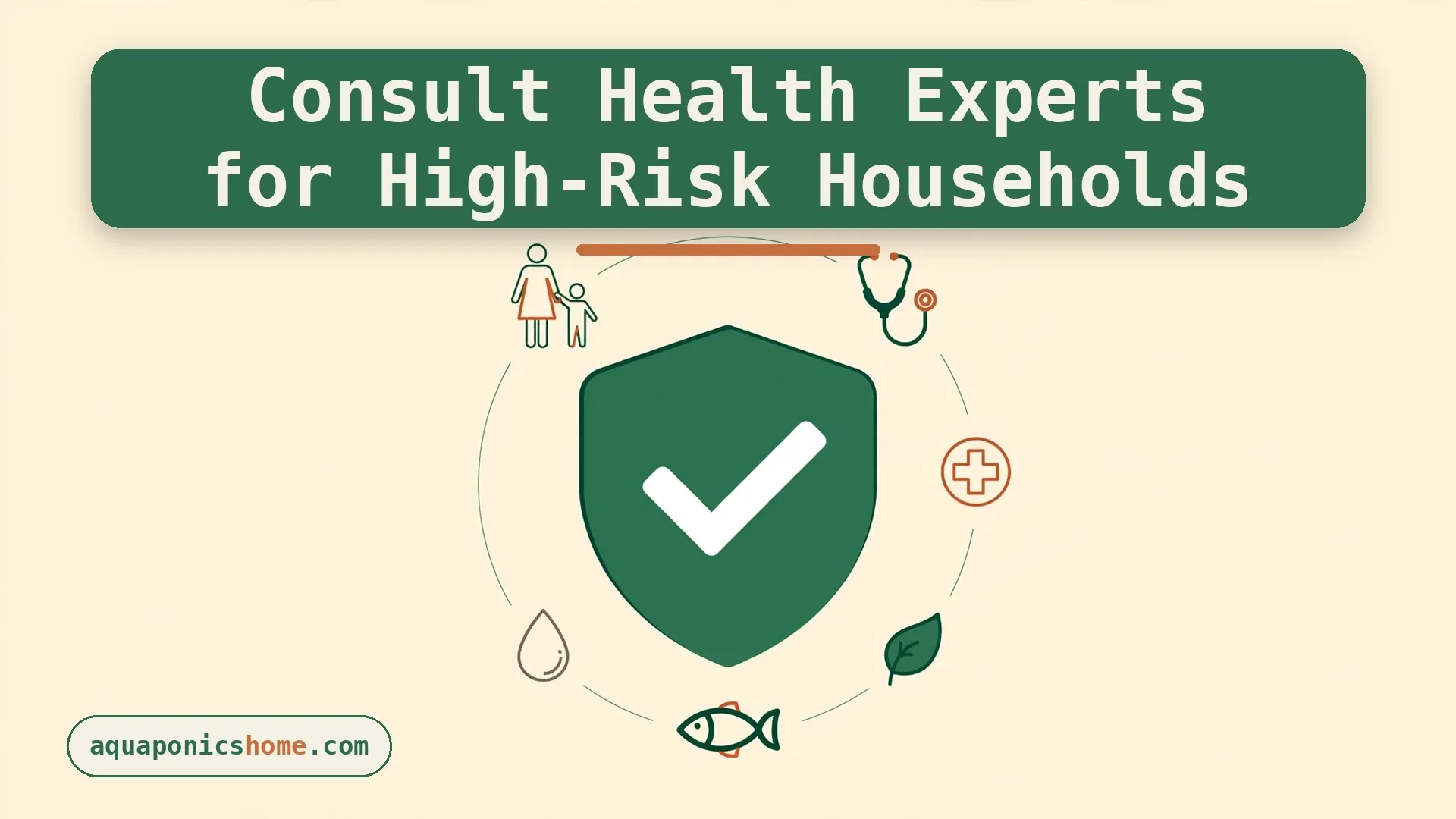
The CDC’s page on groups at higher risk for food poisoning (dated January 31, 2025, read September 27, 2026) lists people aged 65 and older, children under age 5, people with weakened immune systems and pregnant women as being at increased risk.
If someone in your household is in one of those groups, their doctor or another qualified health professional is the right person to ask before serving them raw produce from a home system.
If anyone becomes ill after eating what you grew, a health professional should know where the food came from.
FAQ
Where does contamination in aquaponics come from?
A 2025 review in Pathogens names six routes: contaminated fingerlings, fish feed, recirculating contaminated water, pest intrusion, improper handling and poor worker hygiene. It also discusses top-up water from untreated sources as a potential entry point.
Is the fish water the main aquaponics contamination risk?
No source we read ranks the routes, so we do not either. Recirculating water matters because a closed loop can spread and sustain microorganisms, but feed, fish, pests and handling are also named routes.
Can bacteria get from the roots into the leaves?
The review describes root colonization, internalization and movement into edible tissue as a pathway, and cites research on E. coli O157:H7 entering spinach through damaged roots. How often this happens in home systems is not settled.
Is there a safe bacteria level for aquaponics water?
We found no source that gives one for home systems, so we do not publish one. Your local extension service or health department can advise on testing.
Does washing the harvest remove the contamination risk?
No source we read says washing removes it, and the research on sanitizers in soilless systems is still developing. For household members at higher risk of food poisoning, ask a qualified health professional before serving raw produce.