
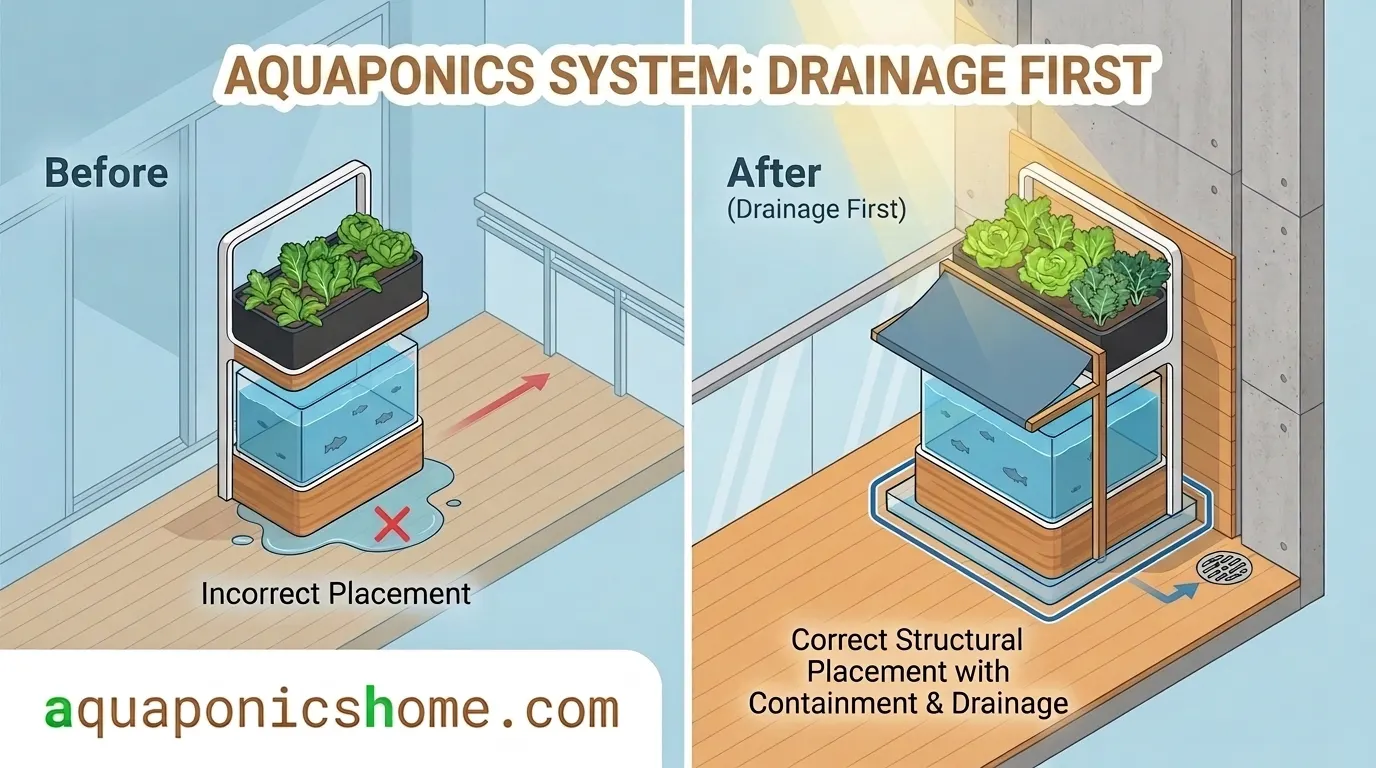
Short answer: choose the spot by what happens when it fails, not by where the sun falls. In priority order: what is underneath it (the drainage path, and whoever lives below), what it stands on (the load), whether your lease or HOA allows it there, then daily sunlight, then summer heat and winter freeze, then wind and rain, then how far you are from an outlet and a tap.
I know that order looks backwards. Every guide I read before my first build put sunlight first, so that is what I optimized for. I picked the sunniest corner of my balcony, which was also the corner furthest from the drain. A siphon failed overnight, and I found out where the water went: under the door, across the floor, onto the ceiling of the flat below mine. I then had a conversation with my downstairs neighbor that I would like you to never have. I am not an aquaponics scientist. I am just someone who has moved a working system twice.
The first question is not sun, it is what is underneath
Water leaves the system eventually. A siphon sticks, a fitting loosens, a hose pops off while you are at work. Then gravity decides the rest, and your job at siting time is to make that decision boring in advance.
Stand in each candidate spot and ask three things. Where does spilled water go from here? What can it reach on the way? And if it went through the floor, whose ceiling is it? On a ground-floor patio the answer might be “the lawn.” On a third-floor balcony or an upstairs deck, the answer is a person who did not sign up for your hobby.
A spot near a floor drain, sloping toward it, beats a sunnier spot that drains toward a doorway. If your best spot drains the wrong way, that is fixable with a tray and some planning, covered in what happens when an aquaponics system leaks. It is far harder to fix once everything is plumbed in.
The siting table: what each factor decides, and the cheap test
Each factor decides something specific, and each has a test you can run in a day, before you spend anything.
| Factor | What it decides | The cheap test |
|---|---|---|
| Sun | Which crops are realistic, and whether you need grow lights | Photograph the spot hourly through one clear day, and count the frames with direct sun on the grow bed |
| Summer heat | How hard the water is to keep stable, and how much shade to add | Leave a sealed jug of water there all day. Feel it at 4pm, then compare with your shadiest option |
| Winter cold | Whether it runs year round, drains seasonally, or moves indoors | Ask the building or a previous tenant whether pipes on that wall have ever frozen |
| Rain and runoff | Whether rain overtops the tank, and what washes in from above | Put an open bucket there through one storm. Note how much it caught, and what else landed in it |
| Wind | Whether covers, netting and taller plants stay put | Tape a sheet of paper to a stake for a windy afternoon. If the paper fails, shade cloth will too |
| Power access | Whether the pump runs on a safe circuit, and what an outage does | Plug a lamp into the nearest outlet. Needing a cord across a walkway means a different spot, not a longer cord |
| Water access | Whether topping up is a two minute job or a bucket relay | Time one round trip with a full watering can, then multiply by how often you will do it |
| Drainage path | Where a failure ends up, and how bad it gets | Pour a gallon (about 4 liters) on the floor there and watch where it travels |
| Neighbors | Whether pump noise and drips become somebody else’s problem | Stand where the neighbor stands and listen, then look up at the spot from below |
| Load | Whether the surface can carry a full system at all | Not a home test. See the load section below |
The jug test and the drainage test are the two that changed my mind about a spot.
Sunlight: two extension services, two different answers
There is no single agreed number here, and anyone who hands you one without a source is guessing. This site published an unsourced sunlight figure once and had to correct it, so here are the two sourced positions instead.
NC State Extension’s beginner’s guide to vegetable gardening (Banks and Bradley, revised October 2023) reports that most vegetables need at least eight hours of direct sunlight. It makes an exception for plants grown for their leaves, such as lettuce, kale, chard and spinach, and for storage roots such as radishes and beets: those can be grown in as little as six hours but do much better with eight or more. Plants grown for their fruit, including tomatoes, squash and cucumbers, need at least eight and do better with ten.
The UC Master Gardeners of Placer County (UC ANR) set the bar lower for greens. They report that with as little as three hours of sun you may successfully grow leafy vegetables such as lettuce, spinach, kale and chard, and that four hours makes radishes, beets, carrots and broccoli worth trying. On fruiting crops they broadly agree with NC State: tomatoes, peppers, eggplants and squash optimally want eight to ten hours, and it is “probably unwise” to attempt any of them where the site gets less than six hours a day.
That is a real disagreement between two land-grant extension services, and I am not going to average it into a tidy number. What both agree on is the shape: leaves and roots tolerate shade, fruit does not. If your spot is dim, plan on greens and herbs. If your heart is set on tomatoes, the honest read of both sources is that the site is the problem, not your technique.
Heat: why full sun is not automatically the win
Sun that helps the plants also lands on the water. The U.S. Geological Survey’s water science pages (2018) state the physics plainly: cold water can hold more dissolved oxygen than warm water. The hotter your tank runs, the less oxygen is available to the fish, in exactly the season they want more of it.
So separate the two. Shade the fish tank and give the light to the grow bed, which also cuts the algae that direct sun feeds. In a hot region, morning sun with afternoon shade often beats all-day exposure even though it scores lower on the sunlight count. If your only spot is a heat trap, that argues for a larger water volume, one of the few places where bigger is genuinely easier: see what size tank a first system should be.
Cold: the other half of the map
In the northern US or southern Canada, the July version of your spot decides nothing. The January version does, and thin exposed plumbing is the first thing to go in a hard freeze.
Siting for cold means asking whether the spot is sheltered, whether it can be covered, whether the plumbing can be drained, and whether the system is small enough to move indoors. Decide that before you build, because “it comes inside in November” changes the size and weight you should pick. A sunroom or a garage window is often the honest year-round answer, with supplementary light in the dark months.
Rain, runoff and wind
Rain does two things: it overtops the tank and pushes water out, and it carries whatever is above you into your fish. Look up. A metal roof, a gutter, an air conditioner condensate line or a neighbor’s planter draining above the spot all end up in your water. An overflow standpipe fixes the level. Only a cover fixes the contamination.
Wind gets underestimated because it does not show up in photos. It lifts shade cloth, tips light grow beds and shreds tall plants. Secure anything on a balcony rail or a rooftop on the assumption that a storm will test it while you are out.
Power and water: the boring factors that keep you in the hobby
The nearest outlet decides more than it should. A cord running across a doorway is a spot you will eventually stop using. On a balcony you want a properly protected outdoor-rated outlet, and if you rent, you cannot add one yourself.
Reliability matters too. We get power cuts here, and a pump-dependent system is only as dependable as the grid behind it. If outages are common where you live, that pushes you toward a design that survives them, which is the argument in running a system without a pump. Water access is the quiet one: if topping up means carrying cans through a living room, you will do it less often than you should.
What I will not tell you: whether that surface can carry it
Do the weight arithmetic yourself. Water is about 8.34 pounds per US gallon (about 1 kg per liter), so a 40 gallon tank holds roughly 334 pounds (about 151 kg) of water before you add the tank, the stand, the grow bed, the media and the water sitting in the bed. Wet media is heavy. Run the numbers for the system you actually plan to build.
What I cannot tell you, and will not guess at, is whether your balcony, deck, floor or roof can safely carry that. It is a structural question, it depends on the specific building, and a number from a forum is worth nothing. The people who can answer it are a qualified structural engineer, your building’s own construction drawings, or your building management. The full walkthrough, and where it stops, is in how heavy a small aquaponics system really is.
Two precautions apply regardless: spread the load over a wider footprint rather than concentrating it, and keep weight near a load-bearing wall rather than at the edge of a balcony. Neither replaces an engineer’s answer.
Whether you are allowed to put it there
Siting is a permission question too. Leases restrict what goes on balconies. HOA and condo bylaws restrict what is visible from outside and what can be fixed to a rail. Local rules can cover standing water, drainage or keeping fish.
I will not tell you what your rules say, because the answer differs by state, province and city. Read your own lease, ask your building management or HOA in writing, and check with your local authority if fish or standing water are involved. Asking first is much cheaper than moving a full system later. That conversation is covered in talking to your landlord about aquaponics, and the wider renter picture is in the pillar on balcony aquaponics in a rented flat.
FAQ
Does an aquaponics system need full sun?
Not necessarily. NC State Extension (Banks and Bradley, 2023) reports leaf and storage-root crops grow in as little as six hours but do much better with eight or more, while UC Master Gardeners of Placer County put leafy greens as low as three hours. Both agree fruiting crops want far more, with UC ANR calling less than six hours probably unwise for them.
Should the fish tank be in sun or shade?
Shade in most cases, with the light going to the grow bed. Direct sun on the tank feeds algae and warms the water, and the USGS notes cold water holds more dissolved oxygen than warm water.
Can I put an aquaponics system indoors or in a garage?
Yes, and in a cold region it may be the only year-round option. You trade a sunlight problem for a lighting cost, a humidity question and a much less forgiving spill, so indoor spots need the drainage-path test more than outdoor ones, not less.
How do I know if my balcony can hold the weight?
Calculate the weight yourself, then ask a qualified structural engineer or your building management whether the structure can take it. Do not accept a capacity figure from a blog or a forum, including this one.