
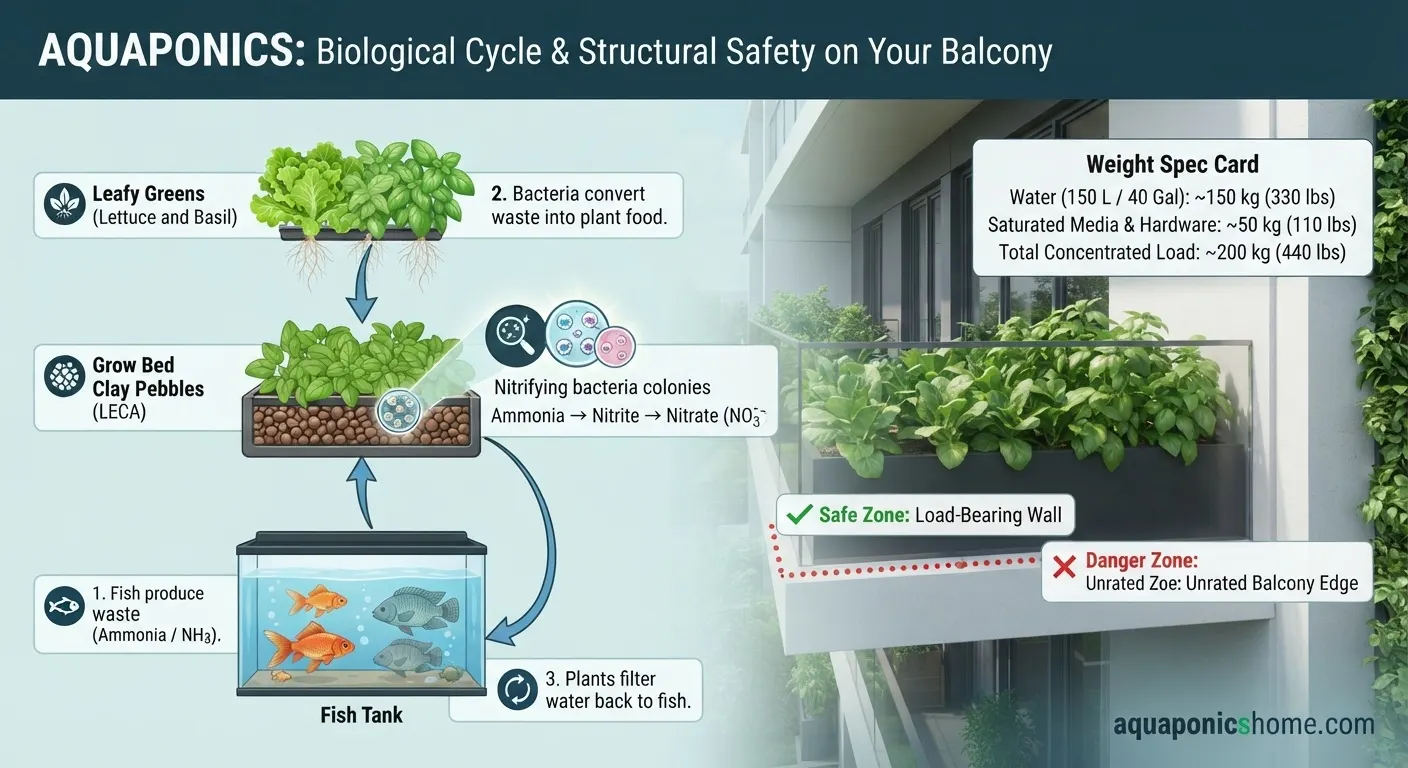
Balcony aquaponics combines a small fish tank with a grow bed where fish waste feeds your plants, and it is genuinely doable in a small space if you start small and cycle the system before you add any fish. You keep hardy fish in a tank, a pump moves their waste-rich water up to a grow bed, bacteria living in that bed turn the waste into plant food, and the cleaned water drains back down to the fish. It works on a rented balcony. But a loaded system is heavy, and it is a living thing that needs steady attention, not a set-and-forget planter.
I have run small aquaponics setups on a rented balcony in Dhaka for about three years now. This guide is the one I wish I had before I filled a tank, killed my first batch of catfish, and mopped up an overnight flood. I will walk you through how the system actually works, whether your balcony can take it, what to grow and what to stock, the one step almost every beginner skips, and the parts that no one selling you a shiny kit will mention.
How balcony aquaponics actually works: fish, bacteria, plants
There are only three moving ideas here, and once you see them the whole thing stops being intimidating.
- The fish live in a tank and produce waste, mostly ammonia, which builds up in the water.
- The bacteria are the quiet engine. Two groups of nitrifying bacteria colonize the grow bed and convert ammonia first into nitrite, then into nitrate. Nitrate is the form of nitrogen plants can actually use as fertilizer.
- The plants sit in the grow bed with their roots in that nitrate-rich water. They take up the nitrate as food, and in doing so they clean the water, which then drains back to the fish.
That loop is the entire principle: fish feed the bacteria, bacteria feed the plants, plants clean the water for the fish. The bacteria are the part beginners forget, and they are the reason a new system cannot take fish on day one. More on that below, because it is the single most important thing on this page.
The three parts you actually need
A working balcony system needs a tank to hold fish and water, a grow bed to hold plants and media, and a pump to move water between the two. That is it. Everything else, timers, air stones, auto-siphons, fancy media, is an upgrade, not a requirement. You can add those once the basics are stable. If you already own a fish tank, you can even start there. I cover that path in converting an aquarium into an aquaponics system.
What actually decides if it works, versus what beginners worry about
Most people ask me the wrong questions first. They worry about the parts that turn out to be easy and shrug off the parts that actually sink a balcony system. Here is the honest reframe, ranked by what really matters:
| What beginners worry about | How much it actually matters | The real risk to watch |
|---|---|---|
| "The fish will be hard to keep alive" | Low, if you pick hardy fish and stock lightly | Skipping cycling, not the fish themselves |
| "My balcony is too small" | Low, small is fine | Going too tiny: nano tanks swing fast and kill fish |
| "It will smell or breed mosquitoes" | Low for a healthy, moving system | A stalled or uncycled system, or still open water |
| "It needs to be high-tech and expensive" | Medium, the gear itself is simple | The ongoing attention, and the running cost of the pump |
| "Will my landlord allow it?" | Medium, usually a short conversation | Weight on the slab and a leak reaching the flat below |
| "Can my balcony physically take it?" | High, this is the one to check first | A heavy loaded system on an unrated slab or edge |
Notice the pattern: the scary-sounding worries (fish, mosquitoes, smell) are mostly manageable, while the two things people rarely ask about, weight and cycling, are the ones that actually decide whether your balcony system lives or fails. The rest of this guide is organized around that reality.
Can your balcony take the weight?
This is the question the pretty photos never answer, and it is the one that matters most on a balcony.
Water is heavy. One liter of water weighs about 1 kilogram, and one US gallon weighs about 8.3 pounds (3.8 kg). Now add the tank, the grow bed, and the growing media, which is usually gravel or expanded clay and can weigh as much as the water itself when saturated.
Here is a realistic picture. A modest 150-liter (roughly 40-gallon) system holds about 150 kg of water alone. Once you add media, the tank, the bed, the frame, and the plants, a loaded setup can easily reach 200 kg or more, concentrated on a small patch of floor. A larger 50-gallon (about 190-liter) system, fully loaded, can exceed 300 kg (about 660 pounds). That is a lot of load sitting in one corner of a balcony that was designed to hold a few people and some chairs.
What this means in practice:
- Spread the load. Do not put everything on one small footprint. A wider frame spreads weight over more of the slab.
- Keep it near the wall. The edge of a cantilevered balcony carries less than the section next to the building wall. Position heavy items close to the wall side.
- Ask before you commit. If you are unsure about your balcony's rated load, and most renters have no idea what it is, ask the building owner, the caretaker, or, for anything large, a structural engineer. This is not a step to skip on an upper floor.
If you rent, this is also a landlord conversation. A tank that leaks, drips onto the flat below, or stains the floor is the kind of thing that costs you a deposit. Start small, keep it tidy, and it is an easy thing to get permission for.
What kind of system fits a balcony, and what size to start with
For a balcony, a simple media bed system is the friendliest starting point: a grow bed filled with clay pebbles or gravel sitting above a fish tank, with a pump between them. It is forgiving, it hides most of the plumbing, and the media itself houses your bacteria. Vertical towers and barrel builds also work in tight spaces and are worth exploring later, but a single media bed over a tank is the easiest thing to get right first.
On size, resist the urge to go tiny. It feels safer to start with a nano tank, but small volumes of water swing fast: temperature, pH, and ammonia all spike quickly when there is less water to dilute them, and those swings are exactly what kills fish. A larger volume is more stable and more forgiving of beginner mistakes.
How large depends on what you want out of the system, and this is where a lot of balcony advice quietly oversells. For ornamental fish, a tank around 150 liters (40 gallons) is the size Clemson Cooperative Extension uses for its small educational aquaponics setup. If you want to eat the fish, the bar is much higher: the FAO's 2014 small-scale aquaponics manual reports that it is not recommended to grow fish for consumption in a tank smaller than 500 liters, and describes a household-scale unit as roughly 1,000 liters of fish tank with about 3 square meters of growing space. Water weighs about a kilogram per liter, so 500 liters is 500 kilograms (about 1,100 pounds) before you add media, and that lands straight back on the load question above. Know which system you are actually building before you buy a tank, not after.
I go into what a starter setup involves, and where it is worth spending versus saving, in what a small aquaponics system really costs. The short honest version: aquaponics is not the cheapest way to grow a few vegetables, and I will not pretend it is.
Sunlight, heat, monsoon, and power cuts
A balcony is an exposed place, and your plants and fish both feel the weather.
Sunlight. Sun hours are what balcony growers misjudge most. As reported by NC State Extension's beginner vegetable guide (2023), leaf and root crops can be grown in as little as six hours of sunlight but do better with eight or more, while fruiting crops need at least eight and do better with ten. The UC Master Gardeners of Placer County set the floor for greens lower, reporting that with as little as three hours of sun you may successfully grow lettuce, spinach, kale, chard, and other leafy vegetables, and calling it unwise to attempt fruiting vegetables on a site that gets less than six. Watch your balcony across a whole day before you build, because a wall or a neighboring building can steal more light than you think.
Heat. In a hot climate the real risk is the water getting too warm. Warm water holds less dissolved oxygen, which stresses fish. Shade the fish tank from direct afternoon sun even while the grow bed sits in the light. A tank in full sun on a hot balcony can climb to a temperature your fish cannot cope with.
Monsoon and rain. Heavy rain can overflow an open tank or grow bed, dilute your water, and wash in whatever is on your balcony floor. Give the system a way to shed excess water safely, and think about a partial cover for the worst of the season.
Power cuts. This one catches people out. Your pump, and any air pump, runs on electricity. In an area with load-shedding, a long outage means no water movement and no aeration, and fish in a small tank can run short of oxygen faster than you would expect. A battery-backed air pump is cheap insurance. Know how long your fish can sit without power before you stock a lot of them.
Fish that put up with a balcony
For a first system, pick a fish that tolerates mistakes, because you will make some.
- Goldfish are one of the most forgiving choices. They are hardy, handle imperfect water better than most, and suit a cooler or ornamental setup. New Mexico State University Extension groups goldfish with the warmwater species and reports that these prefer temperatures from 65 to 85°F (about 18 to 29°C). They are ornamental, not food, which for many balcony growers is exactly the point, and it is also what lets you get away with the smaller tank discussed above.
- Tilapia are the classic edible aquaponics fish and are famously tough: they tolerate crowding, low oxygen, and water-quality swings that would stress other species. The FAO's 2014 aquaponics manual reports an ideal range of 27 to 30°C (81 to 86°F) for good growth rates, and adds that tilapia briefly tolerate extremes of 14 and 36°C, do not feed or grow below 17°C, and die below 12°C. That suits a hot climate. Two catches: in many places tilapia farming or keeping is regulated, so check your local rules before you stock them, and as food fish they belong in the 500 liter and up tank the FAO recommends, not in a starter nano setup.
Whatever you choose, stock lightly at first. Fewer fish means less waste, more stable water, and far more room for error while you learn. Overstocking a young system is one of the fastest ways to end up reading a page like my what to do when your aquaponics fish are dying at 2 a.m.
Plants that forgive a beginner
Start with leafy greens and herbs. Lettuce, spinach, kale, and herbs like mint and basil are low-nutrient, fast, and hard to kill, and they are what a young system can actually support. Leafy greens are also the crops I keep coming back to after three years, because they suit the modest nutrient level of a small setup and the light on a typical balcony.
Save the fruiting crops, tomatoes, peppers, strawberries, for later. They need more light, more nutrients, and a mature system with a healthy fish load behind it. Trying to grow them on day one is setting yourself up to feel like a failure when the problem was just timing.
Because aquaponics grows food you will eat, keep the basics of food safety in mind: wash your harvest, keep pets and runoff out of the system, and do not use anything toxic near the water, since it ends up in both the fish and the plants.
The step almost every beginner skips: cycling
Here is the part the balcony guides tend to leave out, and it is the part that will save your fish.
You must cycle a new system before you add fish. Cycling is the process of growing that colony of nitrifying bacteria so it is ready to convert fish waste before there are any fish producing it. A brand-new system has no established bacteria, so if you add fish immediately, the ammonia they produce has nothing to break it down. It builds up, and it poisons them. This is the same nitrogen cycle any aquarium keeper has to establish, and it is not optional.
The common method is a fishless cycle: you add a source of ammonia to an empty, running system and let the bacteria build up over time. You track the water with a simple test kit. Ammonia appears first, then nitrite, then nitrate.
On the dose, the FAO manual reports adding ammonia to reach 1 to 2 mg/liter, and doing a water exchange if the level ever goes above 3 mg/liter. On knowing when you are finished, it defines the end of cycling as the point where nitrate is steadily increasing, nitrite reads 0 mg/liter, and ammonia is below 1 mg/liter. New Mexico State University Extension describes the same finish line in slightly different numbers: once nitrates are detectable and both ammonia and nitrite have dropped to 0.5 ppm or lower, the system is fully cycled. Note that neither one gives you a target nitrate number to hit, so if a guide tells you to wait for a specific nitrate reading, ask where that came from.
How long does it take? The FAO manual reports about 25 to 40 days in good conditions, roughly 3 to 5 weeks, and warns that cool water can stretch complete cycling out to two months. Temperature is the lever: the FAO gives 17 to 34°C as the working range for nitrifying bacteria, and New Mexico State University Extension reports they perform optimally between 77 and 86°F (25 to 30°C). There is one legitimate shortcut. If you can get media or filter material from an established system, the FAO recommends sharing part of the biofilter as a seed of bacteria and reports that this greatly decreases the time needed, though it does not put a number on the saving, and I have not found a credible source that does. Treat it as faster, not as a fixed schedule. Either way this is a wait, it is boring, and skipping it is the mistake I have seen beginners pay for most often. I cover the whole process step by step in how to cycle an aquaponics system without killing your fish.
Ongoing care: what a living system asks of you
Once fish are in, aquaponics is not a set-and-forget garden. It is a small ecosystem, and it needs a light but consistent hand:
- Feed the fish daily, and only what they finish in a few minutes. Uneaten food rots and spikes ammonia.
- Test the water regularly, especially in the early weeks. A simple kit for ammonia, nitrite, nitrate, and pH tells you what your eyes cannot.
- Do not over-clean. This is the mistake that cost me my first fish. Scrubbing everything sterile strips out the bacteria doing all the work. The system is supposed to look a little lived-in.
- Watch the fish. Gasping at the surface, sluggishness, or lost appetite are early warnings worth acting on the same day.
Ten minutes a day and a proper check once a week is roughly the rhythm. Miss it for a fortnight and a small tank can go wrong quietly.
What nobody selling you a kit will tell you
I want to be straight with you, because the marketing rarely is.
It is not the cheapest way to grow vegetables. Between the tank, pump, media, and the electricity to run the pump around the clock, a small aquaponics setup costs more than a few pots of soil would. What you get is the loop, the fish, and the fun of running a tiny ecosystem, not a bargain on greens.
A balcony system is weight-limited and weather-limited. You are working inside what your slab can carry and what your climate throws at the water. That caps how big you can sensibly go and how much you can grow.
You must cycle it first, every time, like any aquarium. There is no product that skips the biology. The bacteria take the time they take.
It is a living system that needs attention. It rewards a consistent, curious owner and punishes neglect. If you travel a lot or forget things easily, go in knowing that.
None of this is a reason not to do it. It is the reason to start small, start honest, and enjoy the learning. That is the whole spirit of this site, and you can read more about how I got here on my about page.
The mistakes I actually made
Two stories, because they are more useful than any warning.
The first is the over-cleaning one. Early on I scrubbed my system spotless because that felt responsible. I was starving the very bacteria keeping my fish alive, and I lost my first batch of catfish before I understood why. Clean the visible gunk, leave the biology alone.
The second I call The Great Flood. A siphon failed overnight and the system drained water onto the balcony while I slept. Nobody was hurt and the fish survived, but it taught me to plan for the failure, not just the success: know where water goes when something breaks, and never run a system your downstairs neighbor would feel.
You will have your own version of both. That is normal. Start small enough that your mistakes are cheap, and you will be fine.
FAQ
Do I need my landlord's permission for balcony aquaponics?
For a small, tidy system, usually a quick conversation is enough, and it is worth having. The real concerns for a landlord are weight and water: a heavy tank on the slab and the risk of a leak dripping to the flat below. Start small, keep it neat, and position it near the wall, and permission is rarely a problem.
Will a balcony aquaponics system attract mosquitoes?
Moving water and fish work in your favor. Fish eat mosquito larvae, and a pump keeps the water circulating, which mosquitoes dislike for laying eggs. The risk comes from still, uncovered water, so keep the pump running and do not leave open standing water sitting around the setup.
What happens to my fish during a long power cut?
The pump stops, so water stops moving and oxygen stops replenishing. In a small tank, fish can run short of oxygen during a long outage, especially in warm weather. A battery-operated air pump is cheap and buys you hours. Stock lightly so your fish have more oxygen headroom to begin with.
Does a balcony system smell?
A healthy, balanced system does not smell bad. It has a faint earthy, pond-like scent at most. A genuine foul smell is a warning sign, usually rotting uneaten food, a dead fish, or a system that has not cycled properly. If it stinks, something is wrong and worth checking that day.
Can I run aquaponics on a balcony in a hot climate?
Yes, and warm weather even suits warm-water fish like tilapia. The thing to manage is water temperature: shade the fish tank from direct afternoon sun so the water does not overheat and lose oxygen, while letting the grow bed catch the light your plants need.
Sources for the technical points on this page include the Oklahoma State University Extension fact sheet on nitrification in media bed aquaponics, and general nitrogen-cycle guidance from established aquaponics references. Fish temperature ranges reflect commonly published tolerances for goldfish and tilapia. Everything about running a system on a small Dhaka balcony is from my own three years of doing it.