
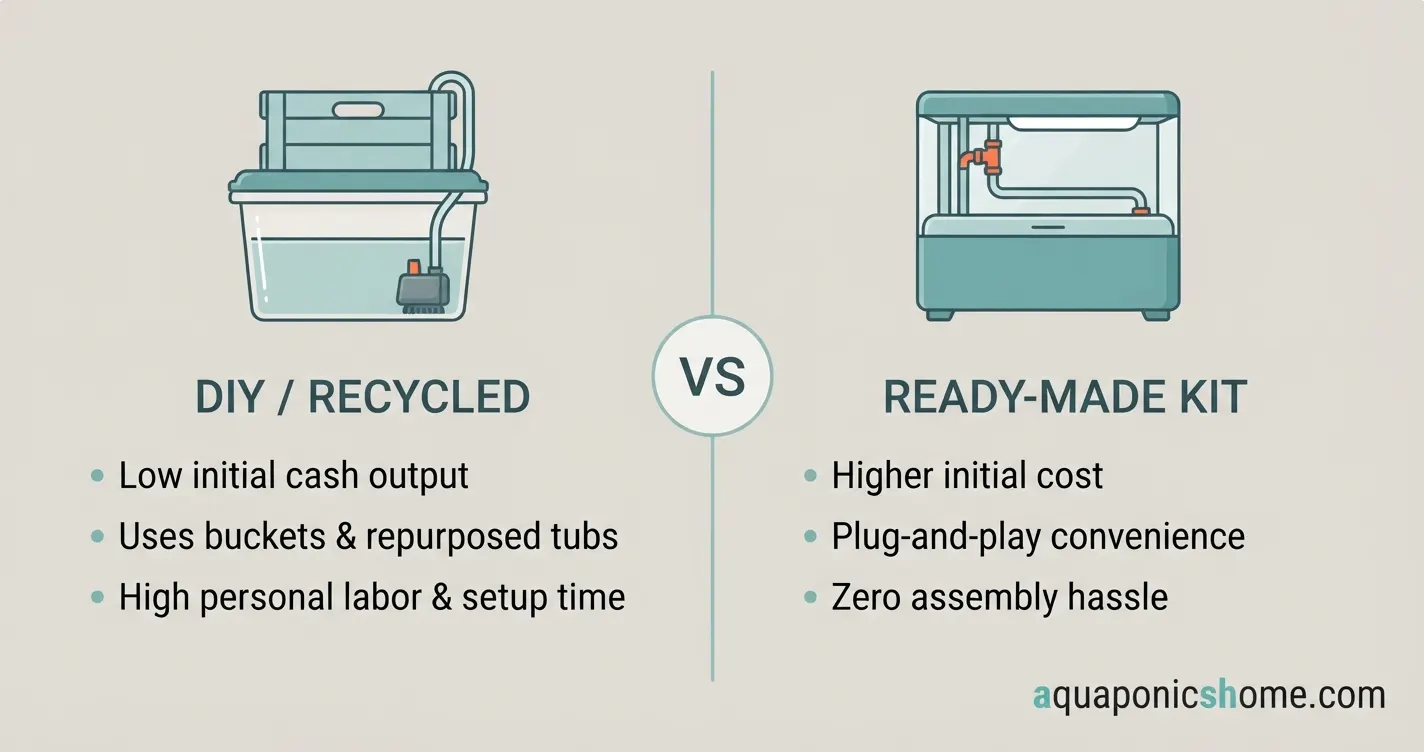
A small aquaponics system can cost almost nothing or quite a lot, and the honest answer is that it depends on one choice: do you build it yourself from recycled containers, or do you buy a ready-made kit? A DIY balcony setup made from a spare tub, a small pump, and a plastic crate is the cheapest way in. A boxed kit costs a good deal more, because you are paying for convenience and design. And whichever you pick, there are running costs people forget: the pump runs day and night, and the fish need feeding every day.
I have built and rebuilt small systems on my rented balcony in Dhaka twice now, so this is less a price list and more a map of where the money actually goes. I will not put numbers on anything, because prices change with your city, your currency, and what you already have lying around. What does not change is the shape of the cost. Once you can see the shape, you can decide whether this is a hobby you want to start.
The short answer: three cost tiers
Most people are really asking one thing before they spend anything: is this a small weekend expense or a serious purchase? Here is the honest range, in plain tiers rather than figures.
| Tier | What it looks like | Where the money goes | Who it suits |
|---|---|---|---|
| DIY / recycled | Buckets, a storage tub, a secondhand pump, a plastic crate for a grow bed | Almost all effort, very little cash | Anyone testing whether they enjoy it |
| Kit | A boxed, all-in-one desktop or balcony unit | You pay mostly for convenience and a finished design | People short on time or DIY confidence |
| Larger / comfortable | A bigger tank, a better pump, a proper timer, extra grow space | Quality-of-life upgrades on top of the basics | Committed hobbyists staying in |
The gap between the DIY tier and the kit tier is large, and it is almost entirely a convenience tax. A kit does not grow better food. It just saves you a Saturday of measuring, cutting, and swearing at a pipe that will not seal. That trade can be worth it. Just know that is what you are buying.
Where the one-time money goes
Whatever tier you land in, the first spend breaks into the same handful of parts. This is the whole "small aquaponics system cost" question stripped to its bones.
The fish tank or container. This is your water body. On a DIY build it can be a food-safe storage tub or a spare aquarium, which is why so many people start by converting an old fish tank instead of buying new. The container itself is one of the cheaper parts if you improvise, and one of the pricier parts if you buy a purpose-made one.
The pump. This is the heart of the system and the one part I beg you not to treat as an afterthought. The pump moves water from the fish to the plants and back. A weak or unreliable pump is not a saving, it is a slow disaster, which I will come back to.
The grow bed and media. The grow bed holds your plants. The media is what sits inside it, usually a lightweight expanded clay, to anchor roots and, as Oklahoma State University Extension explains, house the good bacteria. Media is a real line of cost that first-timers forget, because a bucket looks free until you have to fill it.
The plumbing. A bit of pipe, some fittings, maybe a simple bell siphon. Individually cheap, collectively fiddly. This is the part where a DIY build eats your time rather than your wallet.
The fish. Livestock is a cost too, and a small one at the start. It does not stay a one-time cost, though, which is the part nobody puts in the shopping list.
The running costs nobody puts on the list
Here is the section most cost guides skip, and the reason so many beginners feel ambushed a month in. Aquaponics is not a thing you buy once. It is a thing that quietly costs a little every single day.
Electricity, running all day and night. Your pump does not switch off. It runs twenty-four hours a day, because the moment it stops, your fish start running out of oxygen and your plants stop being fed. A small pump does not draw much on its own, but "a little, forever" adds up in a way a one-time purchase never warns you about. If you add an air pump or a heater for cold months, that daily draw grows. This is the single biggest reason to choose an efficient pump over the cheapest one on the shelf.
Water top-ups. As Rutgers Cooperative Extension notes, aquaponics recirculates water, so it uses far less than a normal garden. But it is not zero. Evaporation and the plants drinking mean you top the tank up regularly, and on a hot Dhaka balcony you top up more than you would expect.
Fish feed. Your fish eat every day, and their waste is literally the fertilizer that feeds your plants. Feed is a modest ongoing cost, but it is a real one, and it never stops.
Replacement parts. Pumps wear out. Siphons clog. A pipe fitting cracks in the sun. Budget, in your head, for the fact that something small will need replacing every so often.
The dead-fish tax. This is the cost line no seller will print. When you are learning, you will lose some fish. My first batch of catfish died because I over-cleaned the tank and starved the bacteria that keep the water safe. Replacing fish, and sometimes replacing the water and starting the cycle again, is a genuine early cost. It is not a sign you failed. It is tuition. You can shrink this bill a lot by cycling the system properly before you add fish, which is the single best money-saving move a beginner can make.
Where NOT to cheap out
I am the budget-farmer type. I will reuse a cracked bucket and argue about the price of clay pellets. So please believe me when I say there are two places where saving money costs you more.
The first is the pump. A cheap, underpowered, or unreliable pump is the classic false economy. When it fails overnight, and the cheap ones do, you can wake up to dead fish and a stalled system. I have lived through my own version of this, a siphon failure I still call "The Great Flood," and cleaning up after a preventable failure is not saving money. Buy a pump you can trust and, if you can, keep a cheap backup air pump on hand.
The second is the test kit and water treatment. A basic kit to read your water, and a dechlorinator so tap water does not poison your tank, cost very little and prevent the most expensive mistakes there are. Skipping them to save a small amount is how a "cheap" setup turns into a fish graveyard. A cheap system that kills its fish is not cheap. It is just a slower, sadder way to spend the same money.
So, does aquaponics actually save you money?
I will be honest, because no affiliate site will: at this small, balcony scale, aquaponics does not really save you money against just buying vegetables at the market. Between the gear, the daily electricity, the feed, and the odd replacement, the greens you grow are not cheaper than a trip to the bazaar.
What you are actually buying is different. You are buying fresh food a few steps from your kitchen, a genuinely absorbing hobby, and the quiet satisfaction of a working little ecosystem on a rented balcony. That is worth a lot to me. It is just not a grocery discount, and anyone who tells you otherwise is selling something.
If you are still deciding whether the whole thing fits your space and your life, start with the full balcony aquaponics guide, which walks through the setup end to end before you spend on anything.
FAQ
What is the cheapest way to start a small aquaponics system?
Build it yourself from recycled, food-safe containers: a spare tub or old aquarium for the fish, a plastic crate for the grow bed, and a small but reliable pump. The DIY route trades your time and effort for a much lower cash cost, and it is the best way to test whether you enjoy the hobby before spending more.
What are the ongoing monthly costs of aquaponics?
The recurring costs are electricity for the pump running around the clock, occasional water top-ups, and daily fish feed, plus the odd replacement part. None is large on its own, but together they mean aquaponics is a small daily cost, not a one-time purchase.
Is a kit worth it, or should I build my own?
A kit costs noticeably more, and that extra is almost entirely a convenience fee for a finished, ready-to-run design. It does not grow better food. If you are short on time or nervous about DIY, a kit is fair value. If you enjoy building and want the lowest cost, DIY wins.
Is aquaponics cheaper than buying vegetables?
At small balcony scale, honestly no. Once you count the gear, the daily electricity, and the feed, your greens are not cheaper than the market. You do it for fresh food at home and for the hobby, not to cut your grocery bill.
Can I use secondhand gear to save money?
Yes, for most parts. A used tank, crate, or pipe is fine as long as it held nothing toxic. The one place to be careful is the pump: a tired secondhand pump that fails overnight can cost you a whole tank of fish, so this is the part worth buying reliable.