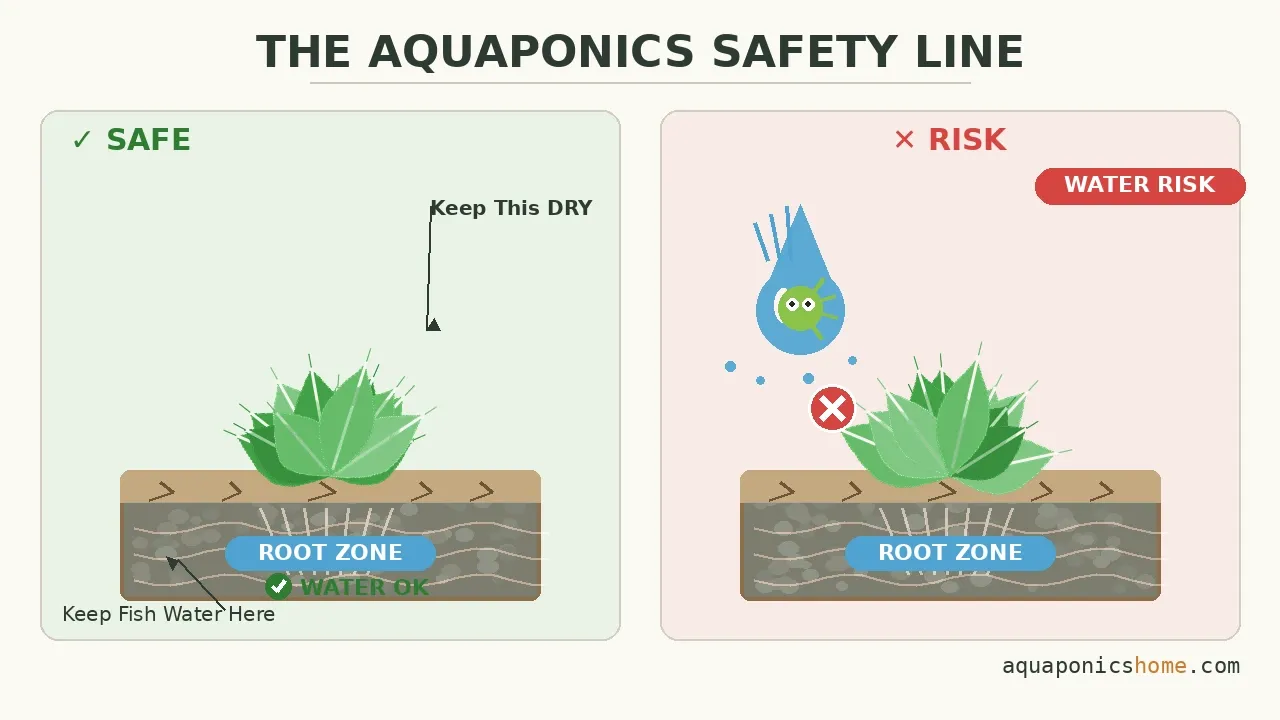
When people ask about aquaponics water contact, edible produce is the part that matters most. The short answer: fish water belongs on the roots, not on the leaf, stem or fruit you eat.
University research has found harmful E. coli in fish waste, in system water and on root surfaces, and US produce safety guidance treats water that touches the harvestable part of a plant far more strictly than water that does not. Your system design and your harvest habits decide which side of that line you are on.
This article explains why that line exists, what “contact” really means in a small home system, how each common system type handles it, and where the honest answer is still “nobody has measured this at home scale.”
Why the Leaf Touching the Water Is the Question That Matters
Aquaponics water is not clean water. It carries fish waste by design, because that waste is what feeds the plants. The question is never whether bacteria are in the system. They are. The question is whether the water carrying them reaches the part of the plant that goes into your mouth, usually raw.
Two sources frame this clearly. A Purdue University study published in Horticulturae (researchers Hye-Ji Kim, Yi-Ju Wang and Amanda Deering, announced April 6, 2020) found Shiga toxin-producing E. coli in fish feces, in the recirculating water and on the root surfaces of lettuce, basil and tomato.
In that study the bacteria did not move into the leaves or fruit. The same release warns that damaged roots or water splashing during harvest could carry pathogens onto the parts people eat.
That is the whole problem in one sentence: the edible part can stay clean while the water is dirty, but only as long as the water stays away from it.
For the bigger picture of where this fits, our guide on whether food from a home aquaponics system is safe to eat walks through the full risk framework.
What the Produce Safety Rules Say about Water Contact
In the United States, the FDA Food Safety Modernization Act (FSMA) Produce Safety Rule is the regulation that covers growing fresh produce.
It is written for farms rather than home gardens. It is still the clearest statement of how regulators think about this exact risk, and it is worth understanding.
University of Vermont Extension’s Northeast Center to Advance Food Safety (NECAFS), in its guidance on produce safety in hydroponic and aquaponic operations (read September 28, 2026), explains that the nutrient solution in these systems counts as agricultural water under the rule.
When crops are harvested with roots attached and the water contacts the produce, that water is held to the rule’s strictest microbial standard for generic E. coli.
The same guidance says tools that touch production water should be treated as food contact surfaces, meaning they need cleaning and sanitizing before they touch produce again.
The practical lesson for a home grower is not a lab number to chase. It is that regulators treat “water touches the harvestable part” as a different, higher-risk category.
If the commercial rule draws the line there, a family growing salad on a balcony has good reason to draw it there too.
What “Contact” Means In a Home System
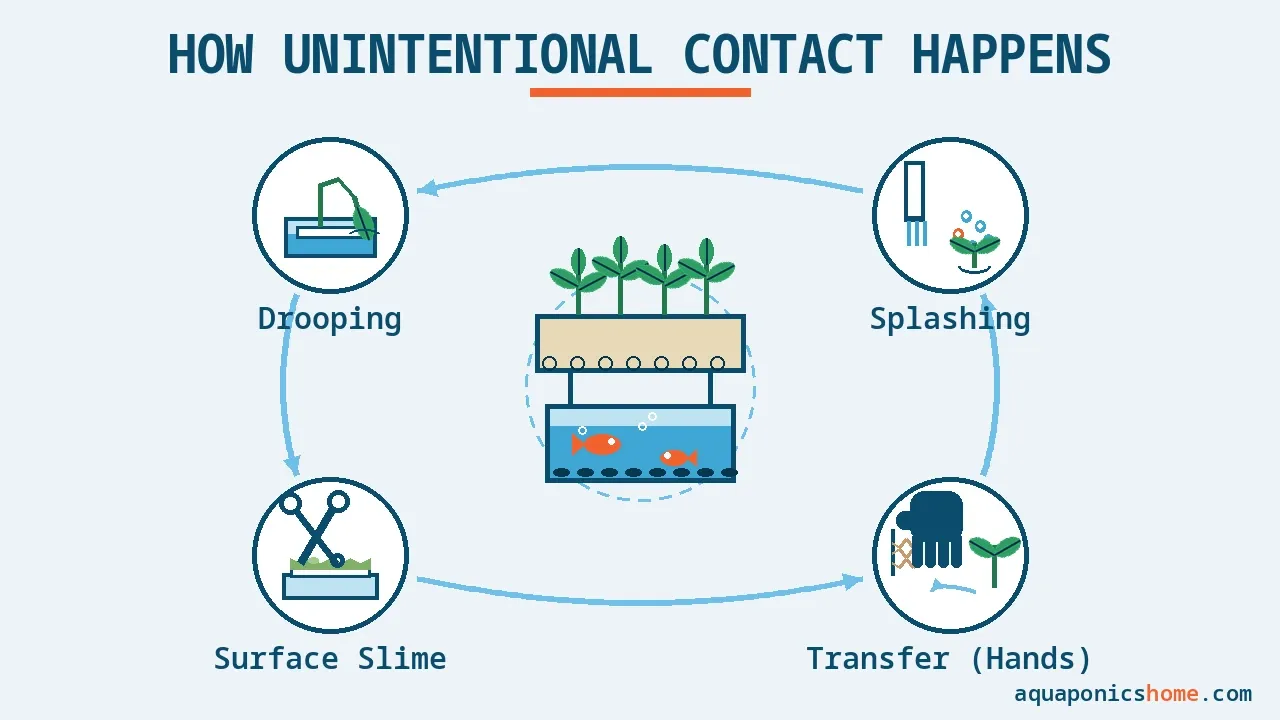
Contact is broader than a leaf sitting in the water. In a small home setup, system water can reach the edible part in several ways:
- Direct immersion. A leaf or stem that droops into a raft channel or sits below the flood level of a grow bed.
- Splash. Water thrown up by a return pipe, a bell siphon draining, or an air stone bubbling hard near young plants.
- Your hands. Adjusting roots, clearing a clogged pipe or netting a fish, then touching leaves without washing first.
- Tools and containers. Scissors, nets, test tubes and buckets that have been in system water, then used at harvest.
- Raft and pipe surfaces. The Agricultural Marketing Resource Center’s aquaponics page (read September 28, 2026) notes that the slime on the sides and bottom of a floating raft can harbor organisms that cause foodborne illness, and warns against letting it touch the plants during harvest.
- Spills and overflows. A blocked drain that floods a bed over the top, or a leak that sprays across a planter.
Each of these is a route. Designing well removes the first two. Habits handle the rest.
Aquaponics Water Contact: Edible Produce by System Type
Different system layouts put the waterline in different places relative to the leaf. None of them is automatically safe or unsafe, but each has its own weak point.
Media beds
In a media bed, plants grow in gravel or expanded clay that floods and drains. A media bed is normally built so the flood stops short of the surface, leaving a dry top layer where the crown and leaves sit.
That dry layer is a natural barrier, as long as it stays dry. Our explainer on why media bed aquaponics is the usual starting point covers how flood levels are set.
The weak point is a bed that floods too high, or a low-growing crop whose leaves rest on damp media.
Deep water culture rafts
In deep water culture (DWC), plants float on rafts with roots hanging in the water. The crown sits just above the surface, which makes this the layout where leaves are physically closest to fish water.
Lifting a raft at harvest is when splash and raft slime are most likely to reach the leaves. I look at the trade-offs in DWC aquaponics at home.
NFT channels and vertical towers
Nutrient film technique (NFT) runs a thin stream of water through channels, and towers trickle water down past the plants. Both keep the bulk of the water inside a pipe, but leaves can hang into the channel openings, and towers can drip onto plants below.
Crops where the edible part sits in the water
Most home aquaponics food is leafy greens and herbs, where the edible part is above the waterline. Root vegetables and anything harvested with the root still attached are a different case, because the part you eat has been in direct contact with system water.
I could not find extension guidance that addresses home-scale root crops in aquaponics specifically, so I cannot tell you these carry the same risk as a lettuce leaf. They are closer to the water by definition.
Design Choices That Keep System Water off the Leaf
These are layout decisions you make once, and they keep working every day:
- Keep the waterline below the crown. In media beds that means a flood level that never reaches the top layer. In rafts it means net pots seated so the crown stays above the surface.
- Aim returns and drains away from foliage. Water entering a bed or tank should not spray onto leaves. A pipe outlet pointed down into the media, or under the water surface in a raft tank, splashes far less.
- Protect against overflows. A single blocked drain can put system water over every plant in a bed. Our guide to aquaponics leak and overflow protection covers the standpipes and backup drains that stop this.
- Never water the leaves with system water. Topping up a bed by pouring tank water over the plants puts fish water directly on the edible surface.
- Leave space for your hands. A layout where you can reach the roots and pipes without brushing past the crop makes clean habits easier to keep.
Habits That Matter As Much As Design
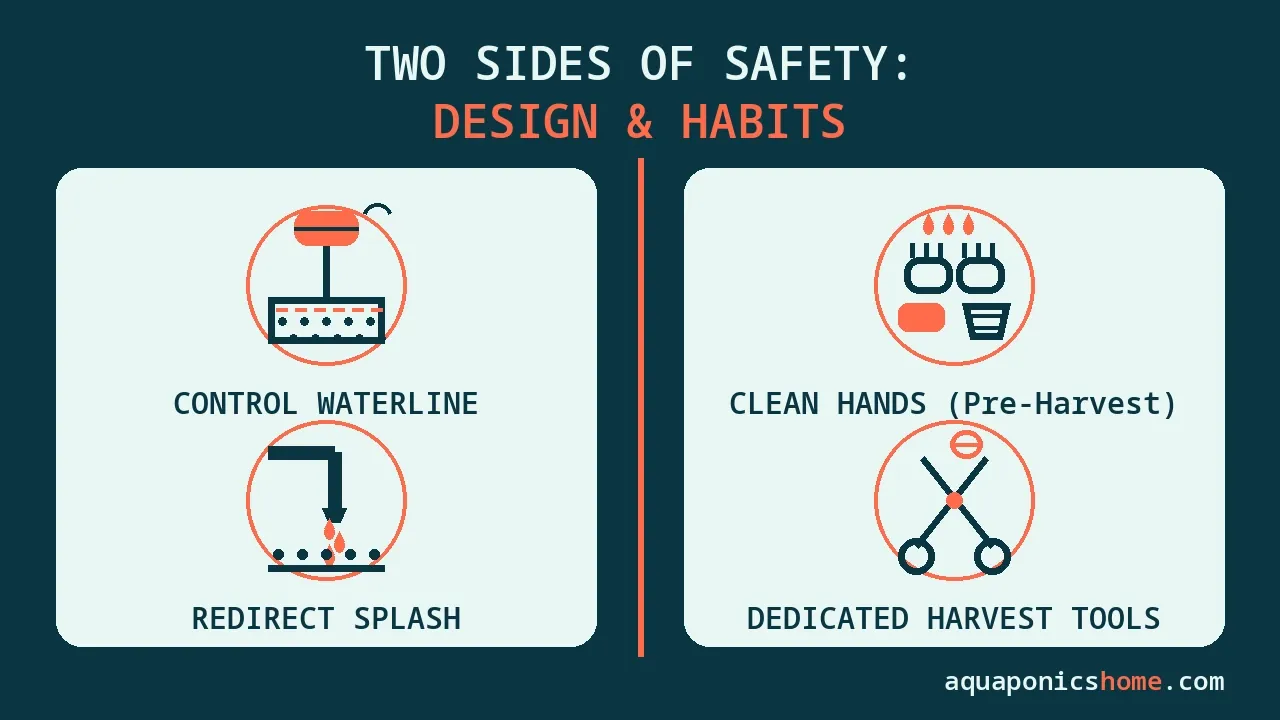
Good design fails if hands and tools carry the water to the leaf anyway. Purdue’s Hye-Ji Kim put it plainly in the 2020 release: the best way to manage the risk is to not touch roots or water throughout production, and if you do, to thoroughly wash your hands before touching the edible parts of the plants.
The CDC’s guidance on hygiene around animals, reviewed January 31, 2025, lists handwashing after handling animal habitats and equipment, including tanks, and before preparing food. Translated into aquaponics routines, that looks like this:
- Handwashing after any contact with system water, fish, nets or pipes, and before touching the crop.
- One pair of scissors kept for harvest only, never used for trimming roots or opening bags of fish feed.
- A separate container for harvested produce that never holds system water.
- Maintenance and harvest done at different times, or harvest done first while hands are still clean.
If anyone in your household is pregnant, has a weakened immune system or is undergoing medical treatment, the question of eating raw produce from this system belongs with their doctor, not with a gardening website.
What We Do Not Know Yet
Honesty matters here more than anywhere else on this site. There is no published safe level of bacteria for home aquaponics water, and we will not invent one.
Home test kits measure ammonia, nitrite, nitrate and pH, not pathogens, so a perfect set of water readings tells you nothing about E. coli. The Purdue finding that bacteria stayed out of edible tissue came from specific systems under study conditions, and it does not promise the same result in every balcony tank.
What the sources agree on is direction, not a number: keep system water away from the edible part, keep hands and tools clean between the system and the crop, and treat any event that put water on the leaves as a reason for caution.
If you want a lab test of your water, your local cooperative extension office is the right first call.
Frequently Asked Questions
Is it a problem if lettuce roots sit in fish water?
Roots in the water are how aquaponics works, and they are not the part you eat. Purdue University researchers found harmful E. coli on root surfaces but not inside the leaves in their 2020 study. That finding does not make the roots harmless: the risk rises when roots are damaged or water reaches the leaves, so crowns belong above the waterline and roots belong away from the harvest container.
Does splashing really matter in a small home system?
Yes. Purdue’s 2020 release names water splashing during harvest as one way pathogens can reach edible parts. Returns pointed at leaves, a hard-bubbling air stone next to young plants, or lifting a raft quickly can all throw water onto the crop.
Can I pour system water over my plants to water them?
That puts fish water directly on the edible surface, which is exactly the contact produce safety guidance treats as the highest-risk case. Let the system deliver water to the roots instead.
Do the FDA rules apply to my home system?
The FSMA Produce Safety Rule is written for farms rather than home gardens. It is still a useful model, because it shows regulators treat water that touches the harvestable part as a stricter category than water that does not.
Can a water test tell me my produce is clean?
Standard aquaponics test kits measure nitrogen compounds and pH, not bacteria. Only a laboratory test can check for E. coli, and even a clean result describes the water on the day it was sampled. Your local extension office can explain testing options.