
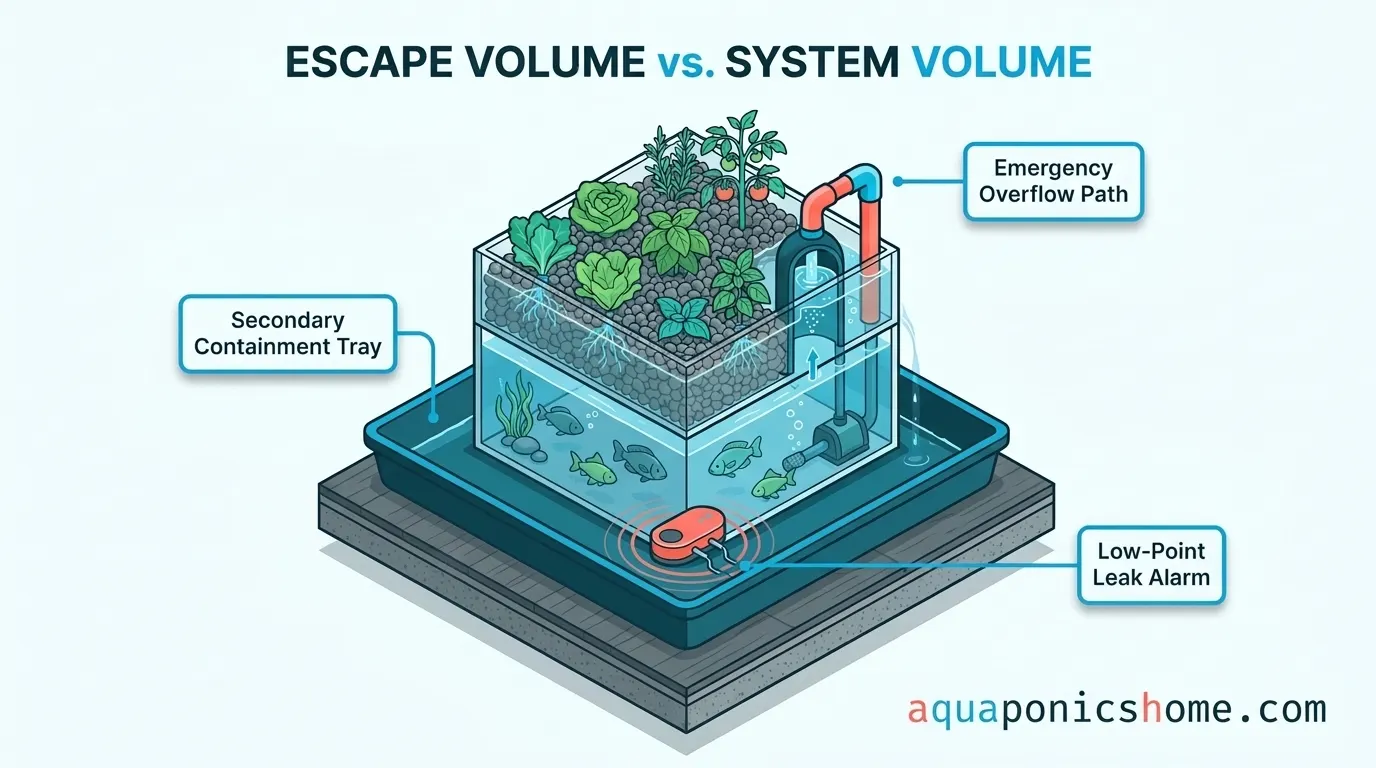
Aquaponics leak and overflow protection starts with a question that is not about plumbing: how much water can leave this system while nobody is watching, and what is underneath it when it does? Answer that first. Then give the water a drain path you chose, put a tray under the system that can hold the amount that can realistically escape, and add something that wakes you up. Fittings fail. Planning for the failure is the protection.
The failure I had
My siphon ran all night once and put water across the floor. I had spent real time on that siphon: watched it fire, timed the cycle, adjusted it, felt clever about it. What I had never once done was ask what the floor was going to do if the siphon stopped breaking and the pump just kept going.
That was my fault, and it is the mistake I see repeated in almost every build log online. People plan the system. They do not plan the room. I write about most of my failures on my about page, and this one still ranks as the most avoidable, because avoiding it did not need better plumbing. It needed ten minutes of thinking about a floor.
Escape volume is not system volume
Here is the framing that would have saved me. Your system has a total volume, and that is the number everyone quotes. It is not the number to plan with. The number that matters is the escape volume: how much water can actually get out through a given failure before something stops it.
Those are very different numbers, and the difference is the whole subject.
A pinhole low in a grow bed releases only the water sitting above the hole, then stops on its own. Annoying, survivable, a mopping job. A pump running into a blocked drain is a different animal: nothing stops it. It keeps lifting water into a bed that cannot empty, and the bed overflows for as long as the pump has power. At 2am that is hours, and the escape volume is effectively most of the water you own.
Water weighs about 8.34 pounds per US gallon (about 1 kilogram per liter), so even a modest escape volume is a large amount of weight arriving somewhere nobody accounted for. The load question is a separate article, how heavy is an aquaponics system, really?, and it is ultimately a question for a qualified structural engineer or your building’s own records, never for a blog.
Where the water actually goes: four failure points
Most small-system leaks come from one of four places. What separates them is not how likely they are. It is how much water each one can release.
| Failure point | What usually fails | What can escape | What caps it |
|---|---|---|---|
| Grow bed drain or bell siphon | Roots, media fines or solids block the standpipe, or the siphon never breaks | Whatever the pump can move, for as long as it has power | An emergency overflow at the bed rim, plus the siphon design itself |
| Tank or sump penetration (bulkhead) | Gasket seated on the wrong side, or over-tightened until the flange cracks | Everything above the level of the hole | Fitting penetrations as high on the vessel as the design allows |
| Tubing joint at the pump outlet | Hose works loose off a barb under pressure or over time | Pump output, continuously, while it runs | A clamp on every pressurized joint, and a tray under the whole run |
| Power cut with gravity drain-back | Beds and pipework empty back into the tank or sump and overtop it | The full drain-back volume of everything above the water line | Enough freeboard in the receiving vessel to swallow all of it |
That last row is the one beginners never see coming, because it happens while the system is doing nothing at all. If your design uses a pump to hold water up somewhere, the moment power stops, that water comes down. Sizing the receiving vessel to absorb it is the fix, and it is one reason to consider the no-pump and passive options if your power is unreliable. Siphon and grow bed mechanics belong in the media bed guide; here I only care about where the water lands.
The layer nobody plans: what is under the floor
Every aquaponics page I found on this answers from inside the system. Almost nobody asks what is under it, which for anyone in an apartment is the actual question.
If you rent, three things sit below your system, and they fail in escalating order of expense: your flooring, the ceiling of the unit below you, and your relationship with the person who owns both. Water reaching a neighbor’s ceiling is not a plumbing event, it is a liability event. The Insurance Information Institute states that the liability portion of a renters policy covers you against claims for property damage you cause, and that renters policies cover certain kinds of water damage while excluding others. So the only useful version of this advice is: read your own policy, and ask your insurer about a water-holding hobby system before you build one, not after.
The lease side is a different conversation, written out separately in do you need to tell your landlord about aquaponics?. The short version: a landlord’s real objection is almost always water, so arriving with a leak plan works better than arriving with enthusiasm.
Containment before cleverness
Containment is boring, cheap, and the only layer that works while you are asleep. Every clever protection depends on something functioning. A tray does not.
- Put a tray under the whole footprint, not just the tank. Size it against your escape volume, not your system volume. A wide, shallow tray also catches drips from joints you were not worried about.
- Prefer hard flooring. Tile or sealed surfaces turn a flood into an inconvenience. Carpet and unsealed wood turn the same volume into a repair.
- Site it near an existing drain. On a balcony, position the system so an overflow runs toward the balcony drain and away from the door threshold. Never place it where it blocks that drain.
- Watch the threshold. The most expensive direction for water to travel on a balcony is inward, over the door sill, into the room.
- Keep the electrics off the floor and out of the splash path. Mains equipment near standing water is its own serious subject, and if you are unsure about the wiring around your setup, ask a licensed electrician.
Containment is also what makes a rented balcony a reasonable place to try this at all, which is why it runs through the whole balcony aquaponics guide.
Overflow protection: give the water a path you chose
The plumbing half is simple, and every reputable source agrees on it. Fit an emergency overflow so the water level in any vessel physically cannot exceed a height you picked. In a grow bed that means a second, higher outlet at the rim. In a fish tank or sump it means an overflow that returns water to the rest of the system rather than to the floor.
Then keep those paths clear. An overflow that has silted up with solids is decoration. Checking that the emergency path is open belongs in your weekly routine, not in your memory.
Detection is the 2am part
A leak alarm turns “I found it in the morning” into “I found it in ten minutes.” Battery water alarms are widely available and cheap, and placement is the part people get wrong: put the sensor at the lowest point of the tray or of the floor nearby, not next to the tank. Water goes to the low spot, and that is where the sensor should be waiting for it. An alarm is not containment. It tells you, it does not hold anything. Use both.
The pre-build checklist
Before you fill anything, be able to answer these out loud:
- What is the largest volume that can escape unattended? Not the system volume. The escape volume, from the worst of the four failure points above.
- What is directly underneath? Flooring type, and whether there is a unit below you.
- Where does the water go if the tray overflows too? Toward a drain, or toward your living room.
- What tells me? The alarm, and where its sensor sits.
- What do I switch off first? Know which socket kills the pump before you need to know it in the dark.
FAQ
What should I put under an aquaponics system indoors?
A waterproof tray covering the full footprint, including the pump and any tubing runs, on hard flooring wherever possible. Size it against how much water can realistically escape from your worst failure point, not against the system’s total volume. A tray that catches drips but overflows in a real failure is doing half a job.
Can a bell siphon overflow the grow bed?
Yes. That is the failure I had. If the siphon does not break, or the standpipe blocks, the pump keeps delivering water into a bed that cannot empty. A separate emergency overflow at the bed rim, at a height you chose, is what makes that failure a puddle instead of a flood.
How do I stop water damage if the power goes out?
Work out how much water sits above the tank or sump while the pump runs, because all of it comes back down when the pump stops. Then make sure the receiving vessel has enough empty space to take it. That is a design decision made before you fill the system, not something you can fix during an outage.
Does renters insurance cover a leak from an aquaponics system?
It depends on your policy. The Insurance Information Institute describes renters liability coverage as protecting you against claims for property damage you cause, and notes that renters policies cover some kinds of water damage and exclude others. Wording varies by insurer and by state, so ask your own insurer about your specific setup rather than relying on a general answer.
I run small systems on a rented balcony and I have had the overnight failure this article is about. Nothing here is a structural, electrical, legal or insurance ruling. For load questions ask a qualified structural engineer or your building management, for wiring ask a licensed electrician, and for coverage ask your own insurer.