
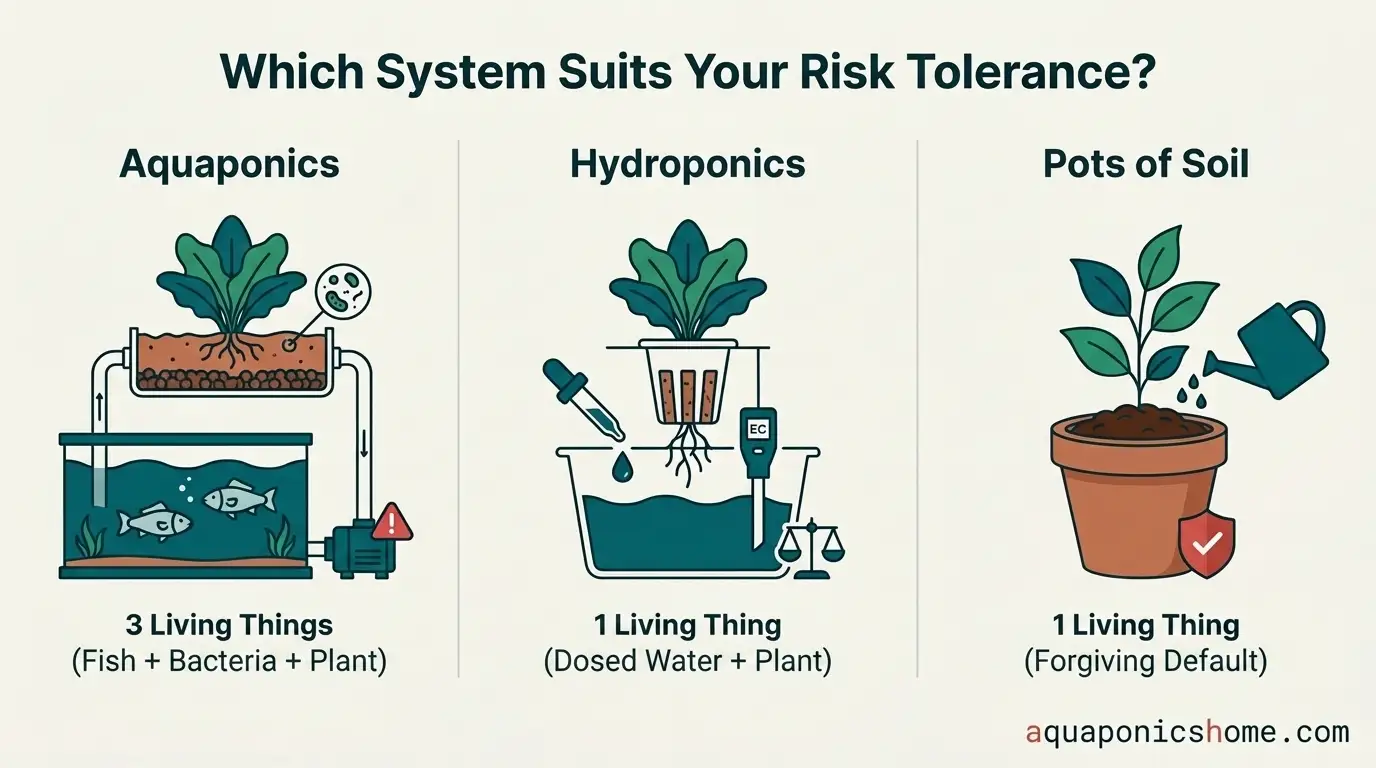
Pick by what you are willing to keep alive. If you mainly want vegetables and want the fewest things that can fail, pots of soil are still the sane default for a first grow. If you want a soil free system and a short learning curve, hydroponics is the easier start. Choose aquaponics only if you actually want fish in your life, because the fish are the whole point of it and also the whole risk.
Before anything else: what I have and have not done
I have run small aquaponics systems on a rented balcony in Dhaka for about three years. Two rebuilds, one overnight flood when a siphon failed, and a first batch of catfish that did not survive the first month because I cleaned the system so thoroughly I starved the bacteria that were supposed to be doing the work.
I have never run a hydroponic system. Not once. So I can speak from experience about exactly one of these three options. For the other two I am either quoting a named source or telling you plainly that I am reasoning from the outside. My background is on my about page.
I say that here rather than burying it, because most comparison pages on this question are published by companies that sell equipment for one method or both. That does not make them wrong. It does mean nobody is going to tell you that their method is the wrong first project for you, and somebody should.
The three methods, side by side
| Aquaponics | Hydroponics | Pots of soil | |
|---|---|---|---|
| What plants grow in | Water from a fish tank, run through gravel, clay pebbles or a raft | Water you have dosed yourself. No soil, no fish | Soil or potting mix in a container |
| What you buy | Tank, pump, aerator, grow bed, media, plumbing, fish, feed, test kit | Reservoir, pump or wick, containers, a nutrient product you re-buy, test equipment | Pots, mix, seeds, a watering can |
| What you keep alive | Fish, bacteria and plants. Three living things, chained together | Plants only. Nothing in the system breathes | Plants only, plus soil life that looks after itself |
| What fails first | The fish. A stopped pump or a heat spike can cost you a tank overnight | The water. No biological buffer, so chemistry drifts | The plant, slowly and visibly. Usually days of warning |
| Effort per week | Feeding, a fish check, water testing. Front loaded onto the first two months | Regular monitoring and reservoir changes. Steady, never front loaded | Watering, occasional feeding, occasional repotting |
| Who it suits | Someone who wants fish as much as vegetables and is home most days | Someone who wants soil free growing without livestock | Someone who wants food with the fewest new skills |
Two things about that table matter. The aquaponics column is the only one I have lived. And the third column is not a consolation prize: for a lot of readers, a row of pots is the right answer, and nobody selling anything is paid to say so.
The real difference is what you keep alive
In hydroponics the grower supplies plant nutrition directly. In aquaponics the fish do it indirectly: their waste produces ammonia, and colonies of nitrifying bacteria convert that ammonia to nitrite and then to nitrate, which is the form of nitrogen plants take up. That mechanism is set out in FAO Fisheries and Aquaculture Technical Paper 589, Small-scale aquaponic food production (Somerville et al., 2014), which is the most useful free document a beginner can read on this.
That is the textbook difference. The practical one is this: hydroponics gives you one living thing to worry about, aquaponics gives you three, and the three depend on each other. If the bacteria are not established, ammonia climbs and the fish suffer. If the fish die, the plants lose their nitrogen. If the pump stops, everything downstream stops with it.
I am not going to explain how hydroponic nutrition is managed or how to read a meter, because I have never done it and this site does not cover it. If you go that way, learn it from somebody who runs one.
What fails first, and how much warning you get
This is the axis I wish somebody had shown me three years ago, because it predicts how a method will feel to own.
Aquaponics fails fast and loud. The failure mode is dead fish, and fish give little warning. My first catfish batch was gone inside a month. Later a siphon failed overnight and I woke to water across the balcony floor. Neither was recoverable by noticing early, because I was asleep. That is why I take the power supply seriously enough to have written about running a system without a pump.
Hydroponics, from what the sources say, fails at the water. With no biological buffer, chemistry drifts and the grower has to catch it. Clemson Cooperative Extension’s factsheet on this exact comparison, written by Lance Beecher and published in 2021, reports that hydroponics requires daily tracking of electroconductivity, pH and nutrient levels, while an established aquaponic system needs mainly weekly pH and ammonia checks. That is their finding, not my measurement.
Soil fails slowest. A potted plant wilts, yellows, sulks, and generally gives you a week to work out what you did. Nothing suffocates at three in the morning. For a first attempt at growing anything, that forgiveness is worth more than any efficiency claim.
Where the effort actually lands
The same Clemson factsheet reports that an aquaponic system needs roughly six to eight weeks for beneficial bacteria to colonize before it is really running, with close water quality monitoring throughout. That matches my experience, and it is the most underestimated part of starting. You are not planting in week one. You are waiting, testing, and resisting the urge to intervene, which I wrote about in cycling a system without killing your fish.
So the profiles differ in shape, not only size. Aquaponics is front loaded: a demanding start, then a system that largely runs itself. Hydroponics, by the Clemson description, is flatter and more constant. Soil is low and occasional.
That factsheet also reports startup expenses for the two soil free methods as broadly comparable. I am putting no money figures on that here. What a small system really costs is its own question, answered in what a small aquaponics system really costs.
The numbers I am not going to quote you
You will see confident percentages on this topic. Aquaponics uses some dramatic share less water. One method grows plants some percentage faster. I have looked, and the figures quoted across the popular pages on this question do not agree with each other, and most trace back to vendors rather than to published research. One page currently ranking for this search is itself an argument that the water efficiency comparison is overstated.
So I am leaving those numbers out, because I cannot source them to a named study and stand behind them, and a number you cannot check is worse than no number. If somebody quotes you a water saving figure, ask which study, which year, and at what scale. Commercial greenhouse results do not describe a tank on a balcony.
Four questions that decide it
- Do you want the fish, or only the vegetables? If fish sound like a chore rather than a reason, that is your answer. Aquaponics is not a more efficient way to grow lettuce. It is a way to grow lettuce and fish together, and the fish are half the work.
- Can you be home most days for the first two months? The cycling period is neither optional nor passive. If you travel constantly, start with pots.
- How reliable is your power? A pump dependent system on unreliable electricity is a real risk, not a theoretical one.
- What happens if it leaks? If the answer involves somebody else’s ceiling, that changes the calculation whichever soil free method you pick. Renters should read the balcony aquaponics guide before spending anything.
If you get through those four and still want fish, the next decision is which design to build, and I compare those in the aquaponics system types guide.
FAQ
Is aquaponics harder than hydroponics?
For a beginner, most likely yes, though the difficulty sits in a different place. Aquaponics has a demanding six to eight week startup while bacteria establish, as reported by Clemson Cooperative Extension in 2021, and a failure mode that kills animals quickly. Hydroponics, by the same source, starts faster but demands daily monitoring indefinitely.
Can I run aquaponics without fish?
Not really. A system without fish is a hydroponic system, because something has to supply plant nutrition and in aquaponics that something is fish waste converted by bacteria. If you like the setup but not the livestock, what you want is hydroponics, and this site is not the place to learn it.
Which one grows food faster?
I cannot answer that honestly. The growth rate comparisons circulating online are mostly unsourced or come from equipment sellers, and the peer reviewed work that exists tends to be crop specific and greenhouse scale rather than balcony scale.
Is soil really still a valid option?
Yes, and I say that as someone who chose water. Pots need the fewest new skills and fail slowly enough that you can learn from your mistakes. Starting there and moving to aquaponics later is a perfectly reasonable order.
Sources named above: FAO Fisheries and Aquaculture Technical Paper 589 (Somerville et al., 2014); Clemson Cooperative Extension HGIC, “Aquaponics vs. Hydroponics: Which is best?” (Lance Beecher, 2021). No water saving percentage, growth rate figure or cost figure is published here, because I could not source one. I have never run a hydroponic system.