
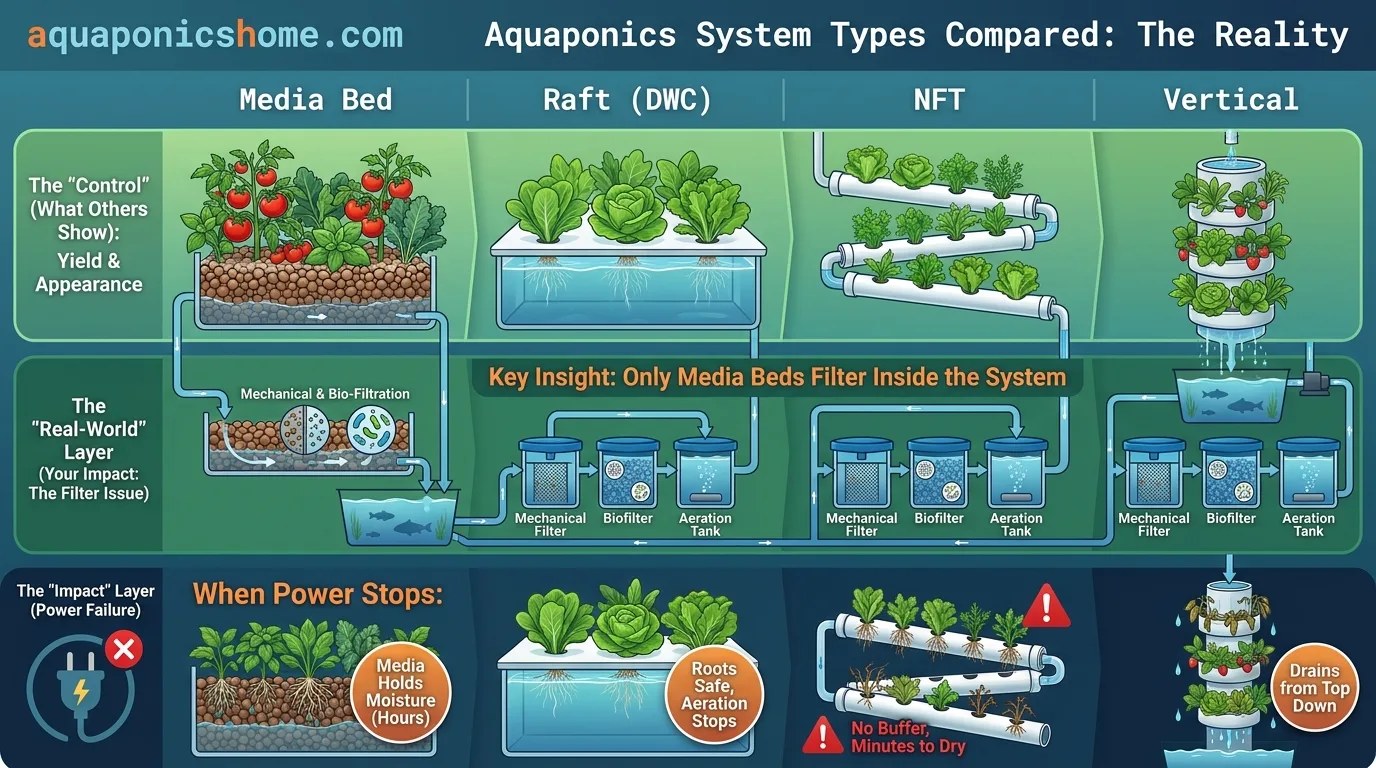
Start with a media bed. For a first small system, a grow bed filled with clay pebbles or gravel is the design that forgives the most mistakes, because the media does three jobs at once: it holds the plants up, it traps the solid fish waste, and it houses the bacteria that turn that waste into plant food. Raft, NFT and vertical designs all make you build, run and clean separate equipment for those last two jobs.
That is the recommendation. The reasoning is below, with the three questions that settle it faster than any chart.
What I can and cannot tell you here
I have run small aquaponics systems on a rented balcony in Dhaka for about three years. Two rebuilds. One overnight flood, when a siphon failed and I woke up to water across the floor. One first batch of catfish that did not survive the first month, because I cleaned the system so thoroughly that I starved the bacteria doing the actual work.
So I have lived with more than one design, which is the only reason I will pick one instead of listing four and wishing you luck. I am not an aquaponics scientist, and where I have never built something I quote a named source instead of guessing.
The four aquaponics system types compared
| Media bed | Raft (DWC) | NFT | Vertical | |
|---|---|---|---|---|
| Holds the plants | Roots sit in gravel or clay pebbles, which support the plant | Net pots in a floating board, roots hanging in the water | Holes in a sloped pipe, roots in a thin film of moving water | Stacked levels fed from the top, using whichever method is stacked |
| Cost to build | Lowest at small scale. The media is the main outlay and it is reusable | Beds and rafts are cheap. The filtration you must add is not | Highest at small scale: the pipes are half the build, the filter train the rest | Varies widely, and adds a pump that must lift water higher |
| Solid fish waste | Trapped in the media and broken down in place. No separate filter | Removed by dedicated filtration before the water reaches the rafts | Same, and it matters more: solids in a thin channel have nowhere to go | Depends on the method stacked, and the filter must fit the footprint |
| How it fails | Slowly and visibly: clogged siphon, waterlogged zones, poor drainage | At the water. Still, warm water with roots in it goes bad without aeration | Fast: clogged channels, uneven flow, plants at the far end starving | At the pump. What it cannot lift, the plants above do not get |
| When power stops | Drains once, then sits damp. Media holds moisture, bacteria stay put. Hours of margin | Roots stay wet but aeration stops. Volume buys time, not safety | Almost none. The film goes and roots sit in an air filled pipe | Drains from the top down. The highest level empties first |
| Grows well | Widest range, including larger plants that need root support | Fast leafy greens and herbs with small root masses | Light leafy crops. Root vegetables and heavy fruiting plants fit badly | Light leafy crops, to keep weight off the upper levels |
| Beginner verdict | Start here. Simplest to build, most forgiving to own | Second choice, fine if you only want salad | Not first. Least margin for error | Not first. Solves a floor space problem you may not have |
The cost row is relative on purpose: component prices vary too much by country to publish. The power row is the one I would read first, which is not how any other comparison orders these.
Question one: where does the solid fish waste go?
Fish produce solid waste and it does not disappear. Every design has to answer where it collects and who removes it. That question, not yield, is the mechanism behind the beginner advice everyone repeats without explaining.
FAO Fisheries and Aquaculture Technical Paper 589, Small-scale aquaponic food production (Somerville, Cohen, Pantanella, Stankus and Lovatelli, 2014), calls media filled beds the most popular design for small-scale aquaponics and gives the reason plainly: the medium supports the roots of the plants and the same medium functions as a filter, both mechanical and biological. That manual states media beds have the most biological filtration of any aquaponic design, because of the huge area of media on which bacteria can grow, and says directly that NFT and DWC both require isolated and more complicated components for filtration.
That is plumbing you either build or you do not. For NFT, FAO 589 describes water passing through a mechanical swirl filter, then a mesh screen, then a separate aerated biofilter. DWC filtration, by the same source, is arranged the same way. A media bed hands you that job already done.
Question two: what happens when the power stops
This is the question I care about most, and no comparison I found includes it.
Media bed. The pump stops, the bed drains one last time, then sits there damp. The media holds moisture around the roots and the bacteria live on the media, not in the moving water. The fish tank is in trouble, because aeration stopped too, but the growing half gives you hours rather than minutes.
Raft. The roots are already in a large body of water, so they will not dry out. FAO 589 is blunt that aeration for DWC units is vital, and specifies air stones releasing about 4 liters of air per minute, arranged every 2 to 4 square meters (roughly 20 to 45 square feet) of canal area. Remove the air and you have still, warm water with roots in it.
NFT. This is the one that worries me. NFT runs a thin film of water down a sloped channel. Stop the pump and the film is gone almost immediately, leaving a bare root mass in an air filled pipe. There is essentially no buffer.
Vertical. Whatever method is stacked, water is lifted to the top and works its way back down. When the pump stops the column drains from the top down, and the highest level empties first.
If your power is reliable this matters less. If it is not, it decides everything, which is why I treat running a system without a pump as a real option. And plan for water going where you did not intend it, because mine did: that story is in planning for leaks and overflows.
Question three: what it costs you to be wrong
You will get this wrong at least once. I did, twice. So the useful question is not which design is best, it is which one is cheapest to be wrong about.
A media bed forgives you. Move it, drain it, re-plumb it, change what you grow in it: the media comes back out and gets reused.
NFT is the opposite. Cut the channels and you have committed to pipe diameter, slope and hole spacing. FAO 589 reports grow pipes of about 4 inches (11 cm) for larger fruiting vegetables against about 3 inches (7.5 cm) for leafy greens with small root masses, so the pipe you cut partly decides what you may plant later. The same manual warns to be mindful of tomatoes and mint, whose roots can clog even large pipes.
Rafts sit in between: the boards are easy to change, the filtration is not. Vertical is hardest to unwind, because the pump was sized for a particular lift and a particular number of levels.
So which one is actually yours
Media bed, for a first system. The only one of the four where filtration lives inside the thing holding your plants. The full case, and the catch, is in why media beds are the right default.
Raft, if you only want salad. Greens and herbs harvested constantly, filtration added honestly rather than hoped away. Whether it scales down to a balcony is the question in raft and deep water culture at home.
NFT, only with a reason. There is one, usually weight, since channels of moving water are lighter than beds of wet gravel. When that holds and when it does not is in NFT channels in a small system.
Vertical, later. It answers a floor area problem. Until you have run a system flat, you do not know how much floor area you need, and going up adds a pump and a drain path to a project with enough to go wrong.
Why every site tells you something different
Scale, incentive, and one real disagreement. FAO 589 describes deep water culture as most common for large commercial aquaponics growing one crop, typically lettuce, salad leaves or basil. True, and irrelevant to a tank on a balcony, but it gets retold on beginner pages with the scale removed. Meanwhile most pages ranking for this question sell equipment for one of these designs, and a company selling channel systems will find channel systems suitable for beginners.
The disagreement is genuine, though. FAO 589 presents DWC as commercial equipment needing NFT’s filtration train, but also notes a low stocking density variant that runs without external filters and is cheaper to begin, useful for initial projects with low capital. So whether raft counts as a beginner design has two defensible answers. I still pick media bed.
If you are working out whether any of this fits a rented flat, start with the balcony aquaponics guide before picking a design.
FAQ
Can I combine two designs in one system?
Yes, and it is common. The usual pairing puts a media bed ahead of a raft bed so the media handles filtration for both, which follows from FAO 589’s point about media beds carrying the most biological filtration. For a first build I would still keep to one design.
Is NFT ever the right choice for a small system?
Sometimes, and weight is usually the reason: channels of moving water weigh less than beds of saturated gravel. That is a genuine argument, but not a beginner one, because you trade your whole margin for error to get it.
Which design grows the most food?
I am not going to give you a number. The yield comparisons circulating for these designs are crop specific, climate specific and mostly greenhouse scale, and the ones quoted on pages ranking for this search trace back to equipment sellers rather than published research.
Do I need a separate filter with a media bed?
By FAO 589’s description, no, and that is the point of the design: the medium is the mechanical and biological filter. What you still have is the bed itself, which is now where the solids live. The work does not vanish, it stops being a separate machine.
Source named here: FAO Fisheries and Aquaculture Technical Paper 589, “Small-scale aquaponic food production” (Somerville, Cohen, Pantanella, Stankus and Lovatelli, 2014). No price, yield, stocking density or bed depth figure appears in this article, because I could not attribute one to a named source at small-system scale.
Pingback: Why NFT Is a Poor First Aquaponics System - AquaponicsHome