
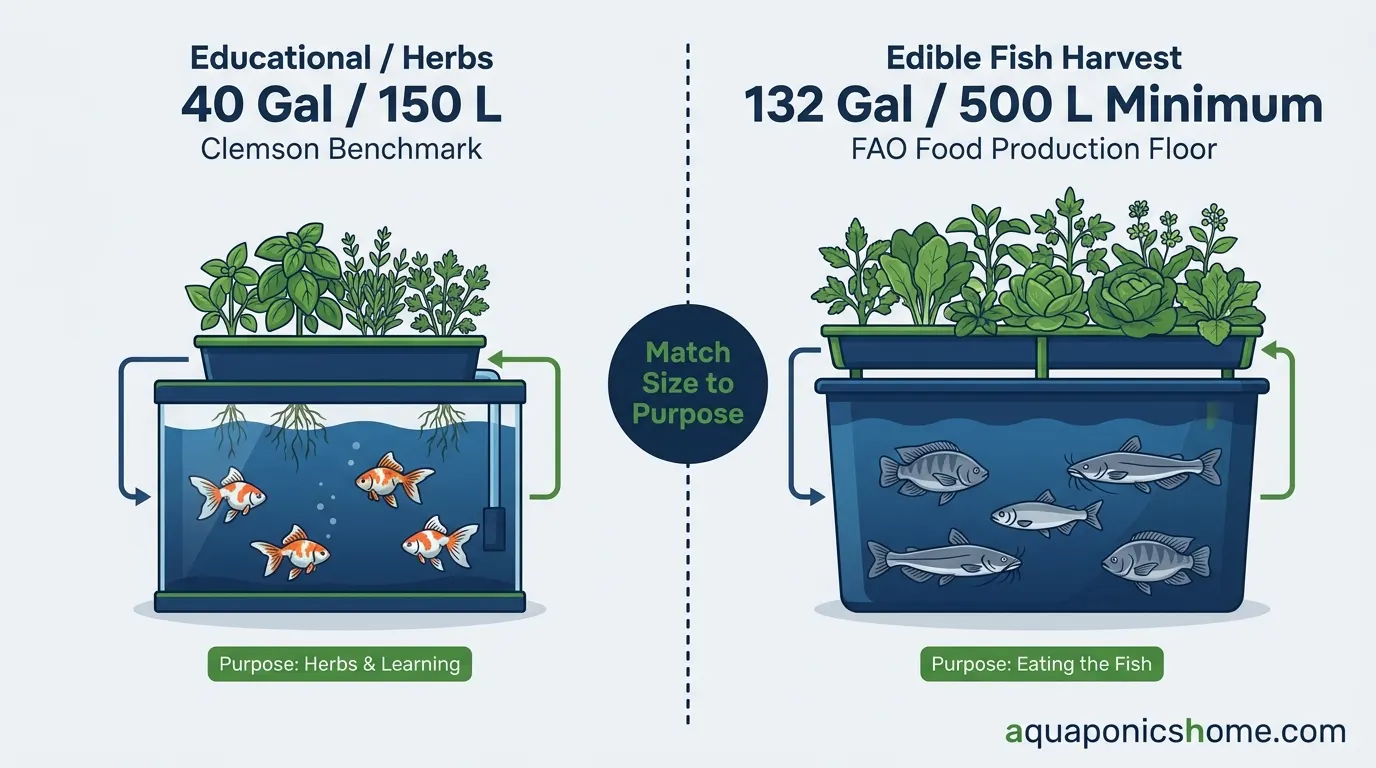
The honest answer splits by purpose. If you plan to eat the fish, the FAO’s 2014 small-scale aquaponics manual reports that growing fish for consumption in a tank smaller than about 132 gallons (500 liters) is not recommended. If the fish are ornamental or the system is for learning, Clemson Cooperative Extension builds its small educational system on a 40 gallon (about 150 liter) tank. Small volumes swing fast, which is why the smallest system is the hardest to run.
I am not an aquaponics scientist. I am a content writer who has run small systems on a rented flat’s balcony in Dhaka for three years, through two rebuilds and one media bed. What I do have is the receipt for that last sentence, and it cost me a batch of fish.
Why the smallest system is the hardest
Every guide tells beginners to start small, and for most hobbies that is good advice. In aquaponics it is backwards, and the reason is dilution.
Water buffers. When a fish produces ammonia, that ammonia spreads through however much water you own. In a large volume the concentration barely moves. In a small volume the same waste lands in a much smaller pool and the reading jumps. Heat behaves the same way: a small tank in afternoon sun warms fast and cools fast. pH does it too. Less water means less of everything that absorbs a shock.
So a small system is not a smaller version of the problem. It is the same problems on a shorter timer, with less room between “slightly off” and “dead fish.”
My first batch of catfish died inside the first month. I cleaned the system too thoroughly because it looked dirty, and I did not know I was scrubbing away the nitrifying bacteria that were the only thing processing waste. In a bigger system that might have been survivable. In mine it was not. If you are at that stage, read cycling a system without killing your fish before you touch anything with a sponge.
What the published guidance actually says
Here is what nobody says out loud: the authorities do not give one number, and they do not even give the same shape of answer.
| Source | What it publishes | Shape of the answer | What it is for |
|---|---|---|---|
| FAO, Small-scale aquaponic food production, Technical Paper 589 (Somerville et al., 2014) | Growing fish for consumption in a tank smaller than 500 liters (about 132 gallons) is not recommended. The household units it describes hold about 1,000 liters (about 264 gallons) with about 3 square meters (about 32 square feet) of growing space | A floor, plus one reference build | Producing food for a household |
| Clemson Cooperative Extension, published plans for its educational aquaponics systems (checked August 2026) | Small system: a 40 gallon (about 150 liter) fish tank with one plant growing area. Large system: a 100 gallon (about 379 liter) tank with two growing trays | Two fixed builds | Teaching and demonstration |
| Rutgers Cooperative Extension, NJAES fact sheet FS1351, Introduction to Aquaponics Systems (Yergeau, Zemeckis and VanVranken, July 2025) | Size the tank so there are 10 gallons of water for every pound of fish at maturity or market size | A ratio, with no volume named at all | Sizing from your own goal |
Three respected institutions, three answers that look nothing alike. That is not a mess, it is the real state of the guidance. Averaging them into one tidy “beginners should buy X gallons” number would be inventing something none of them said.
They are not disagreeing, they are answering different questions
Read the right-hand column again and the confusion dissolves.
Clemson’s 40 gallon build is not competing with the FAO’s floor, because Clemson is describing a system meant to teach the nitrogen cycle to a room of people, not to put dinner on a table. The FAO is describing a unit meant to feed a household, so it sets a floor below which food production stops making sense. Rutgers names no volume at all, because volume is downstream of a decision you have not made yet: how much fish do you want at harvest?
So “what size tank” cannot be answered until you answer “what is this for.” Eating the fish puts you under the FAO’s floor, which sits above the top of almost every beginner range online. Herbs and something interesting to look at is a different system, and small is legitimate there.
Sizing from what you want to eat, not from what fits
The Rutgers ratio is the most useful tool here precisely because it hands you arithmetic instead of a number, and you can run it backward.
As reported by Rutgers Cooperative Extension in FS1351, the rule is 10 gallons of water for every pound of fish at maturity or market size. Decide the harvest first. Ten pounds of fish at maturity points at roughly 100 gallons of water. Twenty pounds points at roughly 200. Two pounds points at roughly 20 gallons, which tells you something honest about what a tiny tank produces.
The FAO arrives near the same place from the other direction. Its published stocking guidance for these small units is a maximum of 20 kilograms of fish per 1,000 liters, roughly 44 pounds per 264 gallons, and it notes that in tanks under 500 liters the density should be halved to 1 kilogram per 100 liters. Both are saying the same structural thing: fish biomass is the input, and water volume is what you buy to support it.
What the FAO floor weighs, and where this article stops
Now the part that catches balcony readers. It caught me.
Water weighs about 8.34 pounds per US gallon, which is the same as saying a liter of fresh water weighs about a kilogram. That is arithmetic, not an opinion. So the FAO’s 500 liter floor for edible fish is roughly 1,100 pounds of water on its own, before the tank, the stand, the grow bed, the media and the plants. The 1,000 liter household unit is double that.
This is where I stop, deliberately. I cannot tell you whether your balcony, deck or floor will carry that, and neither can any blog, forum or product page. That question belongs to a qualified structural engineer, or to your building’s original drawings and management. I have written up the arithmetic and where it runs out in what a loaded aquaponics system actually weighs, and it ends the same way: do the sum, then take the sum to someone qualified.
That constraint is why a lot of apartment systems end up ornamental. It is not a failure of ambition, it is a load question with an honest answer.
If small is all you have
Small is not useless. It just is not a food-fish system, and calling it one is where people get hurt.
A genuinely small tank, in Clemson’s educational range, can run leafy greens and herbs well. That is most of what I grow. The plant side is far more forgiving than the fish side, because plants rarely die overnight from one water reading. If you already own a tank, turning a spare aquarium into a system is the cheapest honest way in.
What you should not do is stock that small tank like a farm, which is what the FAO’s halved density figure is warning about. Keep the fish population modest and make the plants the point. Before you commit, what a small aquaponics setup costs to start covers the rest of the decision.
The mistakes that come free with a small tank
Each one is worse in a small volume, and I have made most of them.
- Over-cleaning. The one that killed my first batch. A small system looks dirty sooner, so you scrub more, and you remove the bacteria doing the work.
- Overfeeding. Uneaten food breaks down in the same small pool. The FAO’s 2014 small-scale aquaponics manual advises removing uneaten food after 30 minutes and adjusting the next day’s portion.
- Topping up too much at once. Evaporation takes a larger share of a small tank, so every refill is a larger change to everything dissolved in it.
- Testing less often, not more. The small system moves faster, so it needs watching more closely. For the whole renter’s picture, start at running aquaponics on a rented balcony.
FAQ
Can I run aquaponics in a 10 gallon tank?
You can run something, but not a food-fish system. The FAO’s 2014 small-scale manual reports that growing fish for consumption is not recommended below 500 liters (about 132 gallons), more than ten times that. At 10 gallons you have a demonstration with a few small fish and some herbs, which is fine to own as long as you call it what it is.
What is the smallest tank I can grow fish to eat in?
The only published floor I will point at is the FAO’s, from its 2014 small-scale aquaponics manual: not smaller than 500 liters, about 132 gallons. Below that, the manual reports it is not recommended for consumption. I have not found a competing figure from an equivalent authority, so I am not going to invent one.
Is a bigger tank really easier to maintain?
Easier to keep stable, yes, and stability is most of the work in this hobby. More water dilutes waste, absorbs temperature swings, and buys you hours to notice a problem instead of minutes. The trade is weight, cost and space, and on a balcony that trade is not small.
How much growing space should go with my tank?
The FAO’s reference household unit pairs about 1,000 liters (about 264 gallons) of fish tank with about 3 square meters (about 32 square feet) of growing space. That is one pairing from one published design, not a universal ratio, so use it as a shape to reason from.
Why does everyone else recommend 20 to 50 gallons for beginners?
Because that is the size that fits an apartment, and because most of those pages never separate an ornamental setup from a food system. In Clemson’s educational framing, a 40 gallon tank is a real published size. As advice for growing fish you intend to eat, it sits well below the FAO’s floor, and that difference is worth saying plainly instead of splitting.