
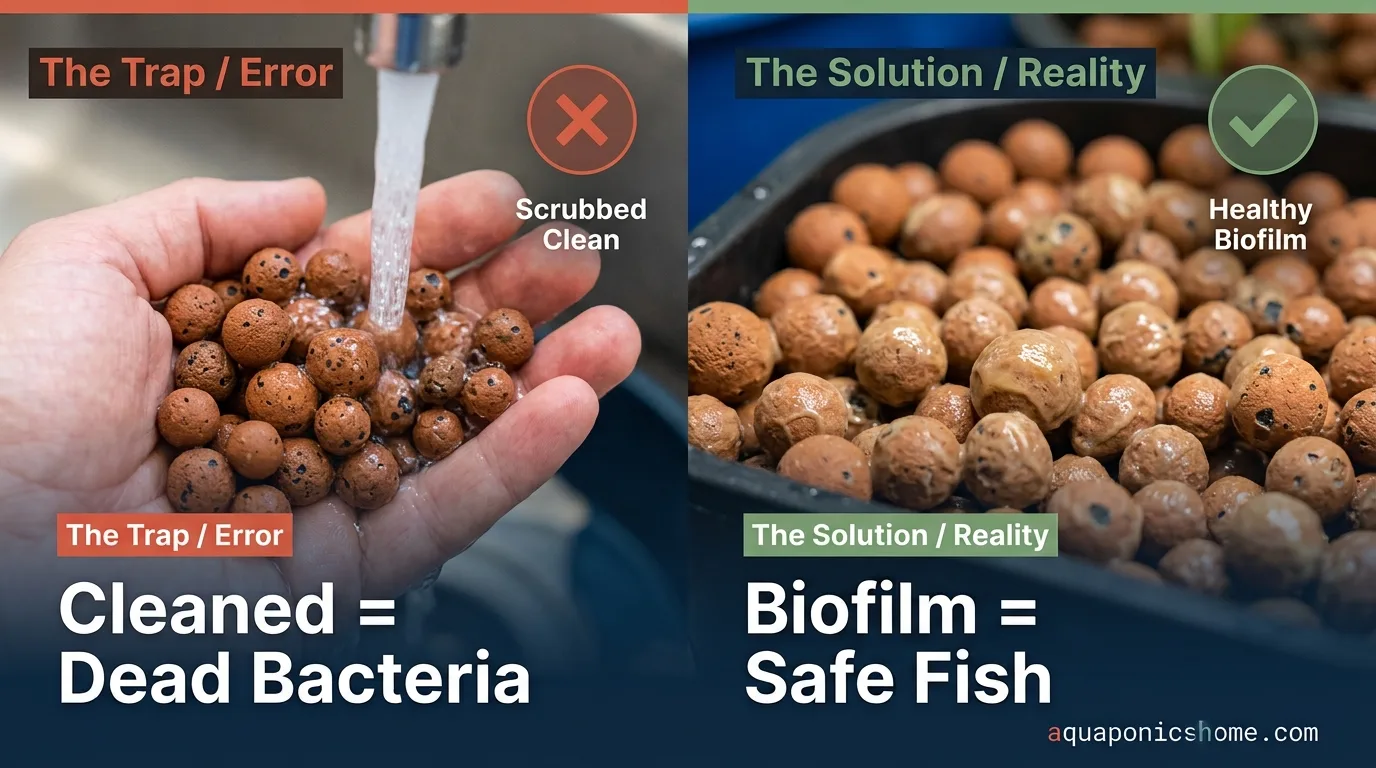
The nitrifying bacteria that keep an aquaponics system safe do not float free in the water. They live in a thin, living layer stuck to your biofilter media, and scrubbing that media clean strips the colony away with it. That is what killed my first batch of catfish. Not neglect, the opposite of it. I cleaned the system too well, and it had nothing left to turn ammonia into something the fish could survive.
I still find this one hard to write about, because it does not fit the story you expect. Nobody warns you that being careful is the risk.
The instinct that killed my first batch
When I started out on my balcony in Dhaka, cleaning felt like the responsible thing to do. A tank that looked dirty seemed like a tank I was neglecting, so I washed the media and the filter material thoroughly, the way I would clean anything else I wanted to take care of. I was not cutting corners. If anything, I was trying too hard.
Within days, the water quality fell apart and the fish did not make it. At the time I assumed I had done something wrong with feeding, or that the fish had come to me sick. It took reading into the nitrogen cycle afterward to understand what had actually happened. I had not neglected the system. I had cleaned the one part of it that was never supposed to be cleaned that thoroughly, and I did not know that part existed until it was gone.
Where the nitrifying bacteria actually live
I am not an aquaponics scientist, so this is the part where I lean on the people who study it. This is the piece of the puzzle nobody hands you at the start. The bacteria that make an aquaponics system work are not swimming around in the water column where you would expect to find them. They grow attached to solid surfaces, forming what is called a biofilm, a slimy, light brown or beige matrix that builds up over weeks on your grow bed media, your filter pads, and any other surface with enough area and enough water flow across it. The FAO’s small-scale aquaponics manual (Somerville et al., 2014, FAO Fisheries and Aquaculture Technical Paper 589) describes this directly: the nitrifying bacteria that convert ammonia to nitrite, and then nitrite to nitrate, colonize the surfaces of the biofilter media rather than living free in the water.
That is also why a media bed doubles as the biofilter in most small home systems. The gravel or clay pebbles are not just holding the plants up. Every rough surface in that bed is real estate the bacteria have been slowly moving into since the day the system started.
Why cleanliness is the trap
Here is the part that still catches new growers, because it runs against every other instinct you have about keeping something alive. A system that looks a little dirty, with media that feels slightly slimy or has a faint biofilm coating, is very often a system that is working exactly as intended. The slime is not a sign of neglect. It is the bacteria.
Tap water makes the problem worse if you use it to rinse media. Most municipal supplies carry chlorine or chloramine specifically to kill bacteria, and it does not distinguish between the bacteria you want gone and the ones quietly running your entire system. Combine chlorinated water with a vigorous scrub, and you are not cleaning the biofilter. You are sterilizing it.
None of this means never clean anything. It means understanding which parts of the system are safe to clean hard and which parts need to be left mostly alone, which is the actual skill here, not an excuse to let things go.
What happens after the colony is stripped
Ammonia is produced constantly in any system with fish in it, from waste and from uneaten food. In a working system, that ammonia gets converted almost as fast as it appears. Strip the biofilm off the media and that conversion step is gone, but the fish keep producing ammonia at the same rate they always did. It has nowhere to go.
I am not going to put a number on how fast that becomes dangerous or how long it takes a stripped biofilter to recover, because that depends on stocking density, feeding rate, water temperature, and how much of the media was actually disturbed, and I would be guessing. What I can tell you is what it looks like in practice: water quality that seems to sour within a day or two of a “thorough clean,” for no reason you can immediately explain. If you are in that position right now, what to do about climbing ammonia covers the next hour. Getting the colony rebuilt afterward is really just re-cycling the system, which the cycling guide walks through properly rather than as an afterthought here.
How to actually clean without starving it
The fix is not to stop cleaning. It is to separate two jobs that feel the same but are not.
Safe to clean, and worth cleaning: anything that only catches solids and does not carry the biological load, like a separate mechanical pre-filter, a settling tank, or filter socks and pads designed to be swapped or rinsed regularly. Rinse these in a bucket of water taken from the system itself, not straight tap water, and rinse gently rather than scrubbing.
Leave alone, or touch minimally: your grow bed media and any dedicated biofilter media. If you must disturb it, at most rinse a portion, never all of it in one session, and always in tank water, never tap water straight from the faucet. Never scrub media until it looks new. New is the opposite of what you want it to look like.
A useful mental test: before you clean anything, ask whether that surface has water flowing across it constantly and whether bacteria have had weeks to establish there. If yes, treat it as biological equipment, not as something that needs to sparkle.
Signs it might be your biofilter, not something else
If ammonia or nitrite readings climb within a day or two of any deep clean, media change, or filter overhaul, biofilter disruption is the first thing to suspect, not disease, not the fish supplier, not bad luck. This is also worth checking after a full filter replacement, after moving media between systems, or after any period the system sat without power and the bacteria went without oxygen. If the timing lines up with something you did to the system rather than something that happened to the fish, work backward from there before you look anywhere else. The full troubleshooting checklist is the place to start if you are not sure yet what you are dealing with.
FAQ
Is slimy or dirty-looking biofilter media actually a bad sign?
Usually not. A light, slimy coating on media is the biofilm, which is the bacteria doing their job. Media that looks completely clean and bare is more often the concerning state, not the reassuring one.
Can I rinse aquaponics media in tap water?
Avoid it where possible. Chlorine and chloramine in most municipal tap water are there to kill bacteria, and they will kill the nitrifying colony along with anything else. If you must rinse media, use water drawn from the system itself.
How often should I clean my aquaponics system?
Mechanical parts that only catch solids, like pre-filters or settling tanks, can be cleaned on a regular routine. Grow bed and biofilter media should be disturbed as little as possible and never scrubbed clean in one pass.
Will a biofilter crash always kill fish?
Not necessarily, but it removes the system’s main defense against ammonia and nitrite buildup while fish are still producing waste. How serious it gets depends on stocking density and how quickly you catch it, which is why testing after any deep clean matters more than guessing.
How do I recover after a biofilter crash?
Treat it as rebuilding the colony, essentially re-cycling the system while keeping a close eye on ammonia and nitrite and doing water changes as needed. The cycling guide covers that process properly. There is no shortcut that skips rebuilding the bacteria.
I still think about that first batch. Not with drama, just as the lesson that changed how I look at a “dirty” tank for good. If your system looks a little slimy on the media, that is usually not the problem. It is the fix already at work.