
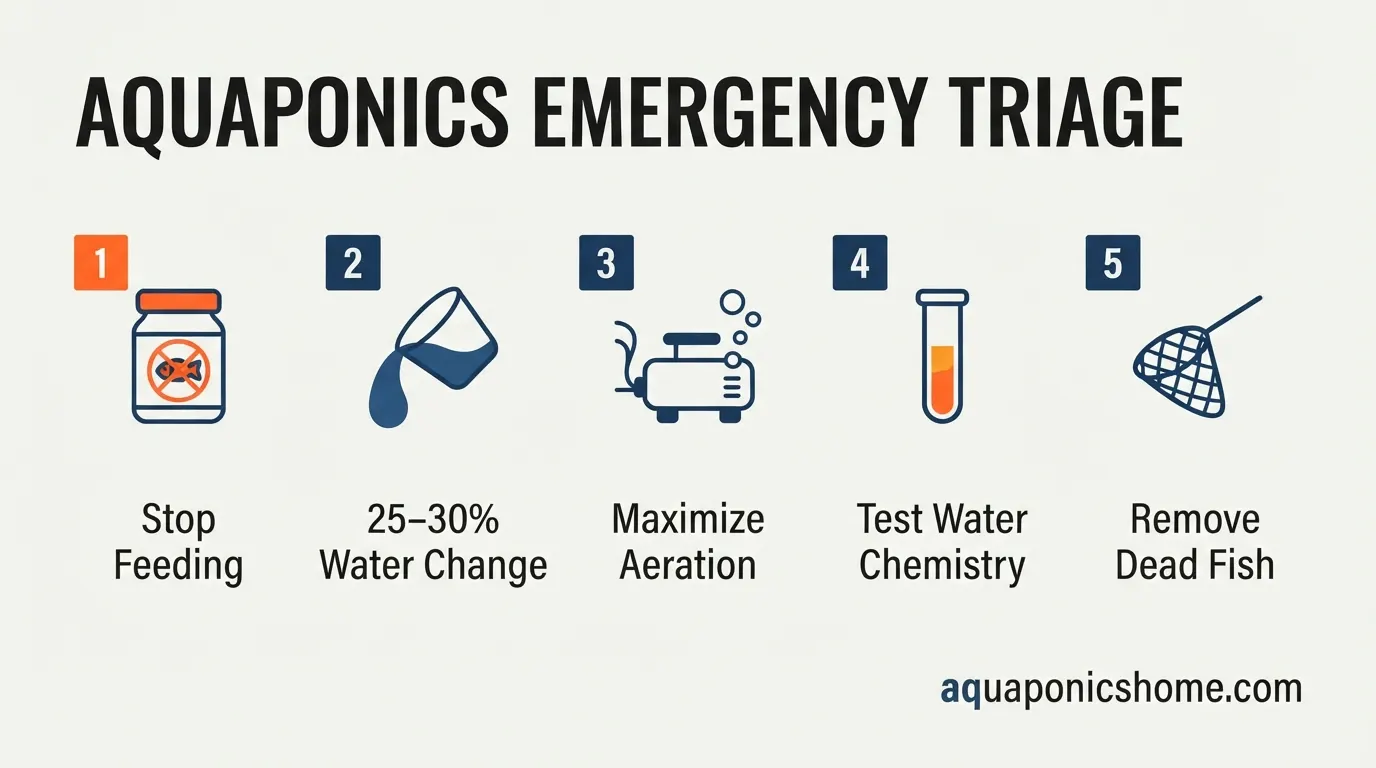
If your aquaponics fish are dying right now, do this before you read anything else: stop feeding, check that your pump and aeration are actually running, test the water for ammonia and nitrite, and do an immediate partial water change, a quarter to a half of the volume, with dechlorinated, temperature-matched water. The most common killer in a home aquaponics system is not disease. It is invisible water toxicity, ammonia or nitrite building up faster than your bacteria can process it. A water change buys your fish hours while you find the cause. Turn up the aeration too. Then work through the triage below, in order, from the fastest and most likely cause to the rarest.
I write this as someone who has stood on a Dhaka balcony holding a dead catfish, feeling awful. So no lectures here. Just the order to check things in.
The 15-minute emergency protocol
Panic makes people do the wrong thing first, usually reaching for a bottle of medication. Do these five things instead, in this order:
- Stop feeding. No food until the water tests clean. Uneaten feed rots into more ammonia, which is the last thing a stressed fish needs.
- Do a partial water change now. Swap out a quarter to a half of the water for dechlorinated, temperature-matched water. The published emergency ranges sit right around there: University of Florida IFAS says 25 to 50 percent, Oklahoma State Extension says a third to a half, and the FAO's aquaponics manual says 20 to 50 percent. This is the single fastest way to dilute a toxin you have not identified yet.
- Maximize aeration. Add an air stone, point a second pump at the surface, or drop the water so it splashes back in. More surface movement means more dissolved oxygen, which every stressed fish needs and which your beneficial bacteria need too.
- Test the water. Ammonia and nitrite first, then pH, then temperature. A liquid test kit is worth its weight here. Do not skip this to save time. You cannot fix what you have not measured.
- Remove any dead fish immediately. A body decomposing in the tank spikes ammonia fast and can carry disease. Net it out.
Only after those five steps do you diagnose. Here is the order that matters.
Triage: what kills fastest, what kills most often
| Check | The tell | How fast it kills | How common |
|---|---|---|---|
| Ammonia / nitrite | Red or inflamed gills, gasping, lethargy, sudden clean-water deaths | Hours to days | Very common, especially in new systems |
| Low oxygen | All fish gasping at the surface at once, worse in heat | Minutes to hours | Common in summer and after pump failure |
| Temperature swing | Erratic swimming after a hot afternoon or a big top-up | Hours | Common on balconies and rooftops |
| pH crash | Sudden drop on the test, fish clamping fins | Hours to days | Occasional |
| Overfeeding / overstocking | Cloudy water, food on the bottom, rising ammonia | Days | Common and self-inflicted |
| Disease / parasites | White spots, frayed fins, ulcers, only some fish affected | Days to weeks | Least common as a first cause |
Notice the pattern. The scary word, disease, is usually the least likely and the slowest. The boring one, water chemistry, is the fastest and the most common. Treat the water before you treat the fish.
Check 1: Ammonia and nitrite, the invisible killer
This is where most home-system fish deaths actually come from, and you cannot see it without a test kit. Fish waste and uneaten food release ammonia. In a healthy, cycled system, one group of bacteria turns ammonia into nitrite, and a second group turns nitrite into nitrate, which your plants then eat. When that bacterial chain is missing or overwhelmed, ammonia and nitrite pile up and burn the fish from the inside, starting with the gills.
Before the numbers, one thing most beginner guides skip, and it changes how you read every figure below.
A total ammonia reading on its own does not tell you how much danger your fish are in. A test kit measures total ammonia nitrogen, but only part of that is the un-ionized form (NH₃) that actually poisons fish, and how large that part is depends on your pH and temperature. As reported by the University of Florida IFAS guide to ammonia in aquatic systems, un-ionized ammonia is roughly 100 times more toxic than the ionized form, its damage starts as low as 0.05 mg/L, and you need pH and temperature to work out the real concentration. The FAO's 2014 aquaponics manual makes the same point and adds that hobby test kits cannot tell the two forms apart, so where pH is high, any detectable ammonia is especially dangerous. Test pH and temperature alongside ammonia, not afterwards.
With that in mind, here is where to act:
- Ammonia. Oklahoma State Extension's media bed aquaponics guide (2021) says to keep total ammonia between 0 and 0.25 ppm to avoid fish stress or death. Above 1 ppm is the emergency line: the FAO manual reports that ammonia and nitrite are both considered toxic above 1 mg/liter, and that tilapia and carp can show poisoning symptoms at that level, with prolonged exposure damaging the central nervous system and gills.
- Nitrite. It should read close to zero in a seasoned system, and the FAO manual treats any detectable level as a sign the system is unbalanced. Do not wait for a big number before you act: UF/IFAS reports nitrite is toxic to fish at levels as low as 0.10 mg/L, and the FAO reports health problems from 0.25 mg/liter. Sensitivity varies a lot by species. As reported in the Southern Regional Aquaculture Center's publication on nitrite in fish ponds (Durborow, Crosby and Brunson, 1997), bass, bluegill and green sunfish are resistant, catfish and tilapia are fairly sensitive, trout and other coolwater fish react to extremely small amounts, and goldfish sit in between.
Why nitrite is the one to fear, and the treatment nobody mentions. Nitrite crosses the gills into the bloodstream and turns hemoglobin into methemoglobin, which cannot carry oxygen. That is brown blood disease, and here is the detail that matters at 2 a.m.: an affected fish suffocates even though the water around it has plenty of oxygen, so an air stone alone will not save it. The standard mitigation is chloride. UF/IFAS reports that adding salt (sodium chloride) or calcium chloride at 10 mg/L of chloride for every 1 mg/L of nitrite reduces nitrite's toxic effect, and the SRAC publication recommends keeping chloride at least ten times nitrite, noting that it takes about 24 hours after salt goes in for the brown blood condition to ease. One caution specific to aquaponics: that guidance comes from fish ponds, and your plants tolerate far less salt than your fish do. Dose against your measured nitrite, never as a blanket precaution.
The fix: repeated partial water changes with dechlorinated, temperature-matched water until the readings drop, no feeding until they do, and make sure your grow bed and biofilter are running. Do not empty the whole tank. The reason is not that you would wash the bacteria out, because they do not live in the water: the FAO manual describes them as a slimy beige matrix growing on the biofilter media. The reasons are that a full volume of replacement water is a full volume of chlorine or chloramine to get wrong, and that an abrupt swing in chemistry is dangerous in itself, with the FAO reporting that a pH change of 0.3 inside 12 to 24 hours can be problematic or even lethal. What genuinely does destroy the colony is washing or cleaning the biofilter media, so leave that alone while you are firefighting.
The single biggest cause: a new, uncycled system
If your system is only a few weeks old, this is the most likely answer, and it deserves its own line because most "reasons your fish are dying" lists bury it. A brand new system has no bacterial colony yet. You added fish, the fish produced ammonia, and there was nothing to process it. Aquarists call it new tank syndrome, and the FAO manual defines it as exactly this: immature biofiltration letting toxic ammonia and nitrite accumulate until fish are stressed and ultimately die.
On the window, the sources do not agree, so do not treat any single number as an all-clear. The FAO manual puts cycling at three to five weeks, while its glossary allows anywhere from one to six weeks depending on temperature and ammonia source, and UF/IFAS says a new biofilter needs six to eight weeks to build up enough bacteria. A system past the four-week mark is not automatically in the clear.
Do not let "most likely" become "certainly" while fish are dying. Gasping at the surface is the shared symptom of ammonia poisoning, of brown blood from nitrite, and of a pump that has simply stopped, and the stopped pump kills fastest of the three. Confirm water is moving and air is going in before you settle on the cycle as your explanation. The FAO's own troubleshooting list names several other causes with these same symptoms: a biofilter that was recently washed or cleaned, overcrowding, overfeeding, too much protein in the feed, reduced water flow, low oxygen, and a temperature drop that has slowed the bacteria down.
The real fix is not a bottle of anything. It is to cycle the system before the fish ever go in. If you are here mid-disaster with a young system, water changes are your daily job now until the bacteria catch up. Read how to cycle your system without killing fish for the slow, safe way to do it next time, and the emergency version for right now.
Check 2: Oxygen and aeration
If every fish is hanging at the surface, mouths working, this is oxygen, and it can kill within the hour. Oxygen drops when a pump or air stone fails, when the water is warm (hot water holds less oxygen, a real issue on a summer balcony), or when the tank is overstocked. A power cut that stops your pump overnight is a classic overnight wipeout.
The fix: get air moving into the water immediately. An air stone, a spray bar, or simply raising the pump outlet so water splashes will all add oxygen fast. If summer heat is the trigger, shade the tank and see the temperature section below. Oxygen is also why aeration is step three in the emergency protocol. It helps the fish and feeds the bacteria at the same time.
Check 3: Temperature swings
Fish handle a steady temperature far better than a swinging one. A sudden change of even a few degrees stresses them, weakens their immune system, and can kill outright. On a balcony or rooftop, the usual culprits are direct afternoon sun heating a small volume of water, or a large top-up of cold tap water dumped in at once.
The fix: shade the tank during the hottest hours, and never add a big slug of water at a very different temperature. Match the temperature of any water you add, and add it slowly. A larger water volume swings less, which is one quiet advantage of a bigger tank in a hot climate.
Check 4: pH crash
pH tends to drift down over time in aquaponics as the system matures, and a sudden crash stresses fish and can stall your bacteria. If your test shows a low or rapidly falling pH alongside sick fish, this may be a contributor. Resist the urge to yank it back up fast. A rapid pH swing in either direction is more dangerous than a stable pH that is slightly off. Adjust gradually over days, not minutes.
Check 5: Overfeeding and overstocking
These two are self-inflicted and easy to fix. Overfeeding leaves food rotting on the bottom, which feeds an ammonia spike. Overstocking means more waste than your biofilter and plants can process, plus more competition for oxygen. As fish grow, a stocking level that was fine at fingerling size becomes a strain.
The fix: feed only what the fish finish in a few minutes, and remove leftovers. If you are consistently overstocked, you need fewer fish, more filtration, or a bigger system. Starting small and adding fish gradually is far safer than stocking a new tank to capacity on day one.
Check 6: Disease and parasites, and when to call a professional
Only reach for this once water quality is confirmed clean, because poor water is what usually opens the door to disease in the first place. Warning signs include white spots (ich), frayed fins, ulcers, cotton-like growths, flashing or rubbing against surfaces, and typically only some fish affected rather than all at once.
Here is the honest limit of what a blog should tell you: diagnosing and treating fish disease is genuinely hard, and the wrong medication can kill your bacteria, your plants, and your fish. If your water tests clean and fish are still sick or dying, this is the point to contact an aquatic veterinarian or your local fisheries authority. This site does not give animal-health treatment advice, and you should be suspicious of any page that hands you a drug dose for a fish you have not had properly diagnosed.
The thing nobody selling you a product will say: test before you treat
The most expensive mistake in this hobby is treating a problem you have not measured. A panicking beginner dumps in an ammonia binder, a pH adjuster, and a fish medication all at once, and now the water is a chemical soup that kills the beneficial bacteria and finishes off the fish the toxins started on. Almost every emergency on this page is diagnosed with a simple liquid test kit and solved with a water change and patience. Buy the test kit. Skip the bottles until a number tells you which one you actually need.
My own post-mortem: what killed my first catfish
When I started, my first batch of catfish died, and for a long time I blamed bad luck. The real cause was the opposite of neglect. I cleaned the system too much. I scrubbed everything spotless and rinsed the media clean, and in doing so I washed away the nitrifying bacteria that were keeping the water safe. Ammonia climbed with nothing left to process it, and the fish paid for my tidiness.
That is the hard lesson of this whole page. The cause of a fish death is usually invisible, and it usually started days before the fish showed it. The fix is rarely dramatic. It is testing, small water changes, and leaving the good bacteria alone.
Prevention: the weekly 10-minute habit
Almost every emergency here is avoidable with one short routine each week:
- Test ammonia, nitrite, and pH, and write the numbers down so you can see trends before they become crises.
- Check that pumps and air stones are actually moving water and air.
- Look at the fish for a minute. Gasping, clamped fins, or off-color gills are early warnings.
- Remove any uneaten food and check you are not overfeeding.
If you are setting up a balcony or small-space system, most fish deaths trace back to two early decisions: skipping the cycling step and stocking too fast. Both are covered in the balcony aquaponics guide, and if you are turning an old aquarium into your grow system, read the fish tank conversion walkthrough so you start with a stable, well-aerated setup instead of chasing emergencies later.
FAQ
One of my fish died but the others look fine. Should I panic?
No, but investigate. A single death can be old age, an injury, or a bully in the tank. Remove the body right away, then test the water. If the numbers are clean and the rest of the fish behave normally, watch and wait. If ammonia or nitrite is up, treat it as an early warning and act before more die.
How fast should I remove a dead fish?
As soon as you notice it. A decomposing fish spikes ammonia quickly and can spread disease. Net it out, then test the water to check for damage already done.
Can I just do a 100 percent water change to be safe?
No, but not for the reason usually given. Your nitrifying bacteria live on the biofilter and grow bed media, not in the water, so draining the tank does not wash them away. The real risks are that a full volume of replacement water is a full volume of chlorine or chloramine to get wrong, and that an abrupt swing in chemistry shocks fish that are already struggling. Stick to partial changes of a quarter to a half, repeated as needed, always with dechlorinated and temperature-matched water.
When can I add fish again after losing a batch?
Not until the water is stable. The FAO manual says it is safe to start stocking once ammonia and nitrite are below 1 mg/liter, and to stock slowly. Do not treat that as the end of it: the FAO notes it is not uncommon to see a second, smaller ammonia and nitrite spike after fish go in, so keep testing daily and be ready to do a water exchange if either climbs back above 1 mg/liter. Restock a few fish at a time so the biofilter can keep up.
Are regular aquarium medications safe in an aquaponics system?
Often not. Many treatments harm the beneficial bacteria and can be taken up by plants you plan to eat. Never medicate blindly. Confirm water quality first, and if disease is genuinely the cause, get a proper diagnosis from an aquatic veterinarian before adding anything.