
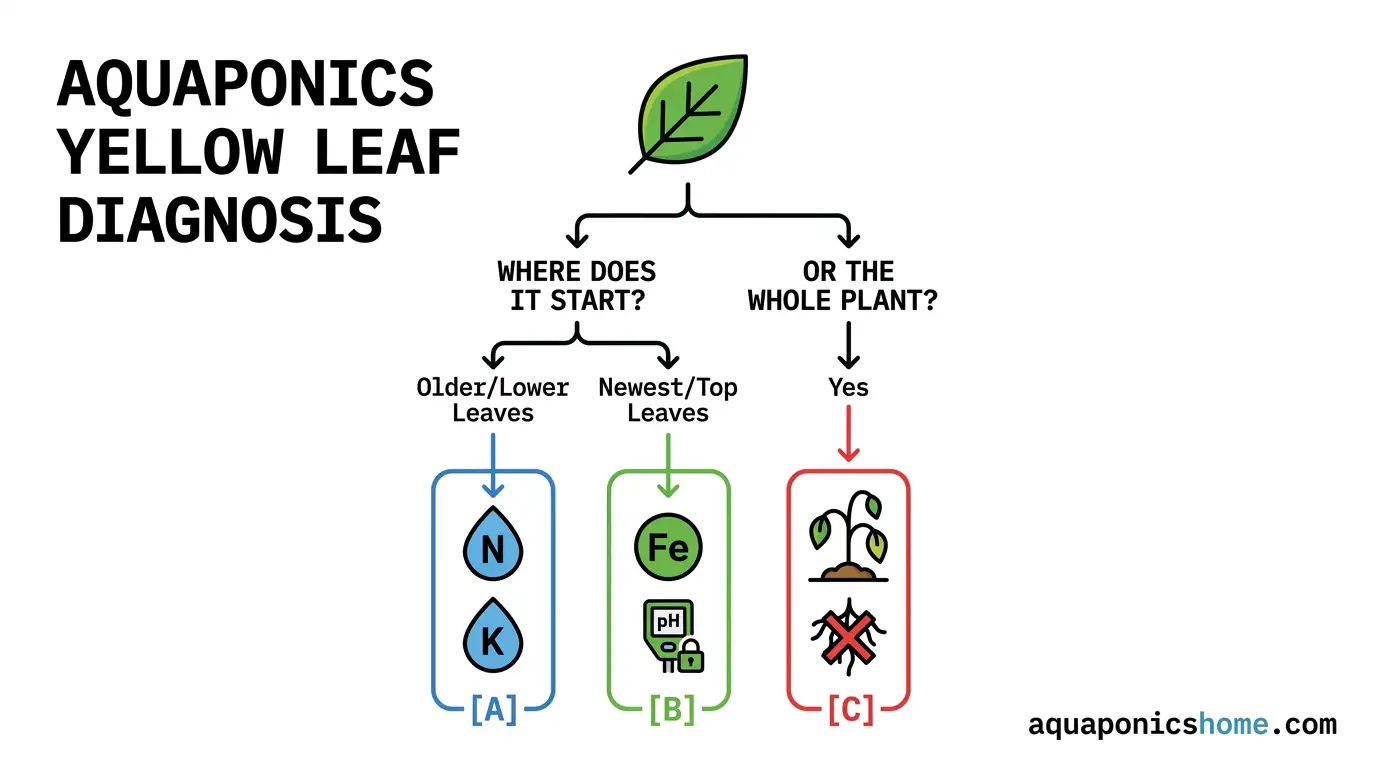
Aquaponics yellow leaves come from one of five causes: too little nitrate in the water, an iron shortage, pH locking nutrients away, a potassium or calcium problem, or trouble at the roots such as low oxygen or poor water flow.
The fastest way to tell them apart is to look at where the yellow starts. Yellow on older, lower leaves points one way; yellow on the newest growth points another. Then test pH and check the roots before you add anything. Many wrong fixes come from skipping those two checks.
Every page seems to give a different reason because each one is describing a different cause. This guide sorts them so you can find yours.
Step One: Where Does the Yellow Start?
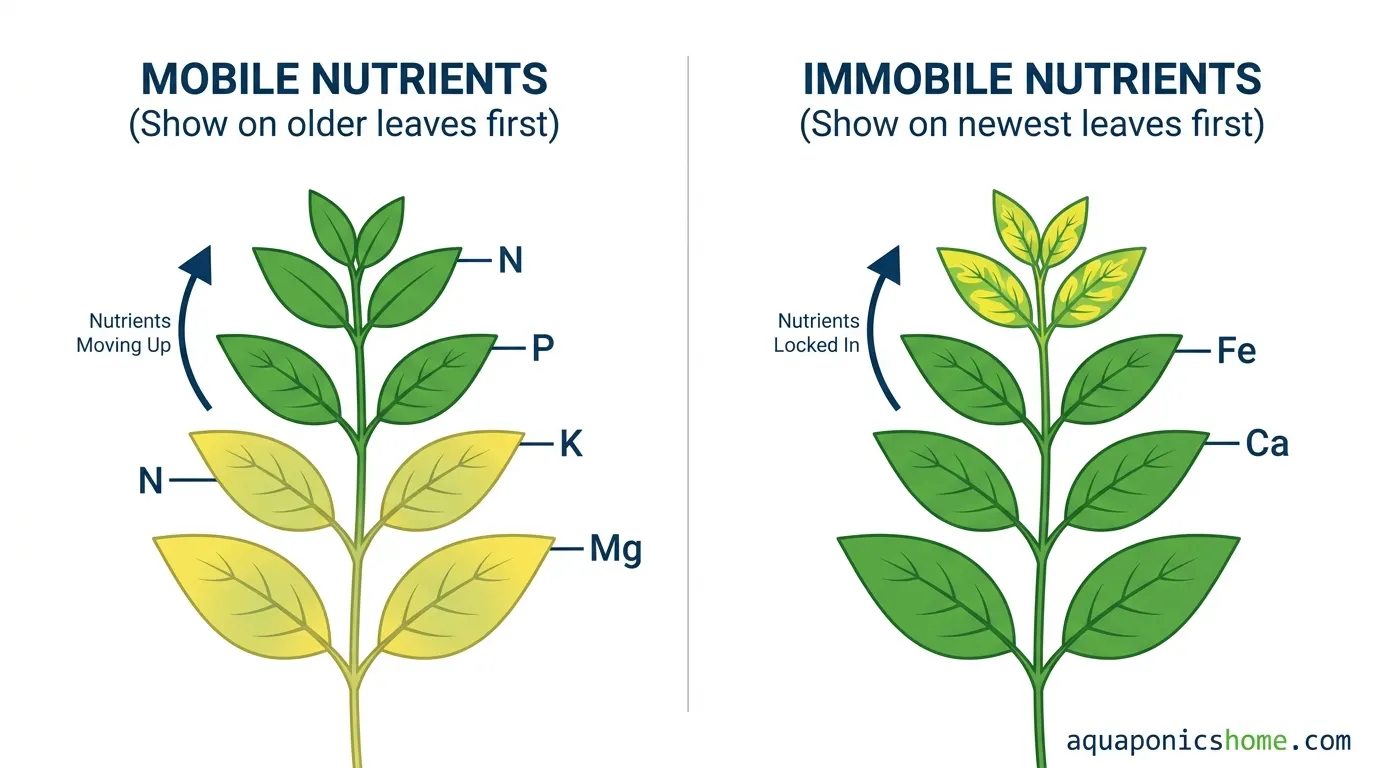
Plants handle nutrients in two ways.
- Some nutrients are mobile: when supply runs short, the plant pulls them out of older leaves to feed new growth, so the old leaves yellow first.
- Others are immobile: once placed in a leaf they stay put, so a shortage shows on the newest growth first.
The University of Connecticut Home and Garden Education Center’s guide Watch Out for These Nutrient Deficiency Symptoms by Haiying Tao (read 2026-09-25) sorts them this way:
- Mobile (older leaves show it first): nitrogen, phosphorus, potassium, magnesium, chlorine, molybdenum.
- Immobile (younger leaves show it first): calcium, sulfur, boron, copper, iron, zinc, manganese, nickel.
So before anything else, look closely:
- Older, lower or outer leaves yellowing first? Think nitrogen (low nitrate), potassium or magnesium.
- Newest, top or center leaves yellowing first? Think iron, pH lockout or calcium.
- Whole plant drooping and yellowing together, possibly with bad-looking roots? Think root-zone problems.
With that sorted, here are the five causes.
Cause 1: Not Enough Nitrate in the Water
Where it shows: older, lower leaves first.
What it looks like: UConn describes nitrogen deficiency as “yellowing of the lower leaves (chlorosis), stunted and slow growth, and death of older leaves in severe cases.”
This one is different from the rest because it is not a problem inside the leaf. It is a problem in the water: there is simply not enough nitrate being made.
In aquaponics that traces back to the fish side of the system: a young system whose bacteria are still establishing, too few fish, too little feed going in, or a plant load bigger than the fish can support.
Because this is a system-level shortage rather than a leaf-level one, it has its own guide. If your older leaves are pale and a nitrate test reads low, go to aquaponics low nitrate and the fix. Adding iron, potassium or calcium will not help this one.
Cause 2: Iron Shortage
Where it shows: newest leaves first.
What it looks like: pale yellow new leaves with veins that stay green, a pattern called interveinal chlorosis.
Illinois Extension horticulture educator James Schuster, in the Illinois Extension guide to chlorosis (read 2026-09-25), notes that iron chlorosis “starts on the younger or terminal leaves and later works inward to the older leaves.”
Iron is a known gap in aquaponics. New Mexico State University’s Circular 680, Important Water Quality Parameters in Aquaponics Systems by Rossana Sallenave (revised June 2026, read 2026-09-25), lists iron among the nutrients that need supplementing, and recommends the chelated form designated DTPA.
A chelated iron product, dosed exactly as its label directs for your water volume, is the usual fix, but only after checking pH (Cause 3).
Cause 3: pH Is Locking Nutrients Away
Where it shows: new growth first, because iron is the nutrient most visibly affected.
What it looks like: the same as an iron shortage, and it may not improve when you add iron.
Nutrients can be present in the water yet unavailable to roots when pH is wrong. Illinois Extension explains that iron “becomes more insoluble as the soil pH climbs above 6.5 to 6.7” and that most plants absorb it as a free ion only “when the pH is between 5.0 and 6.5.” That guidance is written for soil, but the iron and pH relationship is the same idea in a grow bed.
The catch in aquaponics is that the system cannot run at the plants’ preferred pH. NMSU Circular 680 notes that plants “grow best when pH levels are below 6.5,” nitrifying bacteria “perform optimally at pH levels greater than 7.5,” and the compromise for all three “is a pH of 6.8 to 7.0,” with 6.4 to 7.4 tolerable. So aquaponic water already sits near the point where iron gets harder to use, and a small upward drift can tip it over.
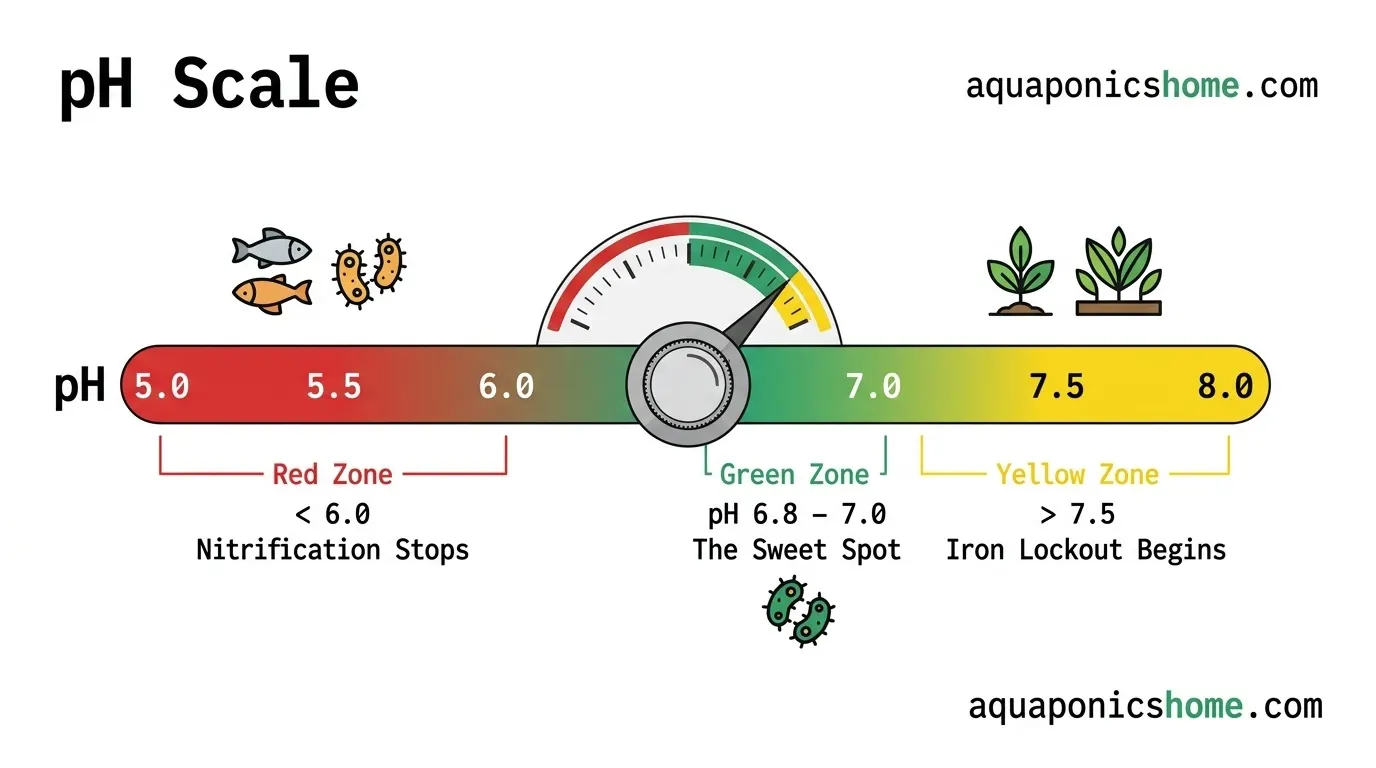
The low side matters too. NMSU notes the bacteria “basically stop working when pH levels fall below 6,” which cuts the nitrate supply and can look like Cause 1.
The rule that follows: test pH before adding any supplement. If it is out of range, correct it slowly. The method is in how to adjust pH in aquaponics without hurting anything.
Cause 4: Potassium or Calcium Problems
These two show up in opposite places, so they are easy to separate.
Potassium: older leaves, starting at the edges. UConn describes potassium deficiency as “yellowing and necrosis of the leaf margins,” with chlorosis that “starts from the tip and progresses along the edge of the leaf.” (Necrosis means dead, brown tissue.) The difference from nitrogen is the pattern: nitrogen yellows the lower leaves broadly; potassium scorches the rims.
Calcium: newest leaves and fruit. UConn describes calcium deficiency as “poor leaf expansion, curling followed by necrotic patches in the young leaves,” and notes it can cause “misshapen fruit and aborted buds.” In tomatoes and peppers, a dark sunken patch at the base of the fruit (blossom end rot) belongs here too.
Calcium problems are often about delivery rather than supply. Calcium moves through the plant with the water the plant draws up, so an erratic pump cycle or roots that dry out can starve new growth even when the water has enough.
NMSU Circular 680 explains that aquaponic systems get potassium and calcium through the bases used to raise pH, potassium hydroxide and calcium hydroxide, and advises alternating the two. Because both raise pH, that route only makes sense when pH needs raising.
Cause 5: Trouble at the Roots
Where it shows: often the whole plant, sometimes with wilting even though the roots sit in water.
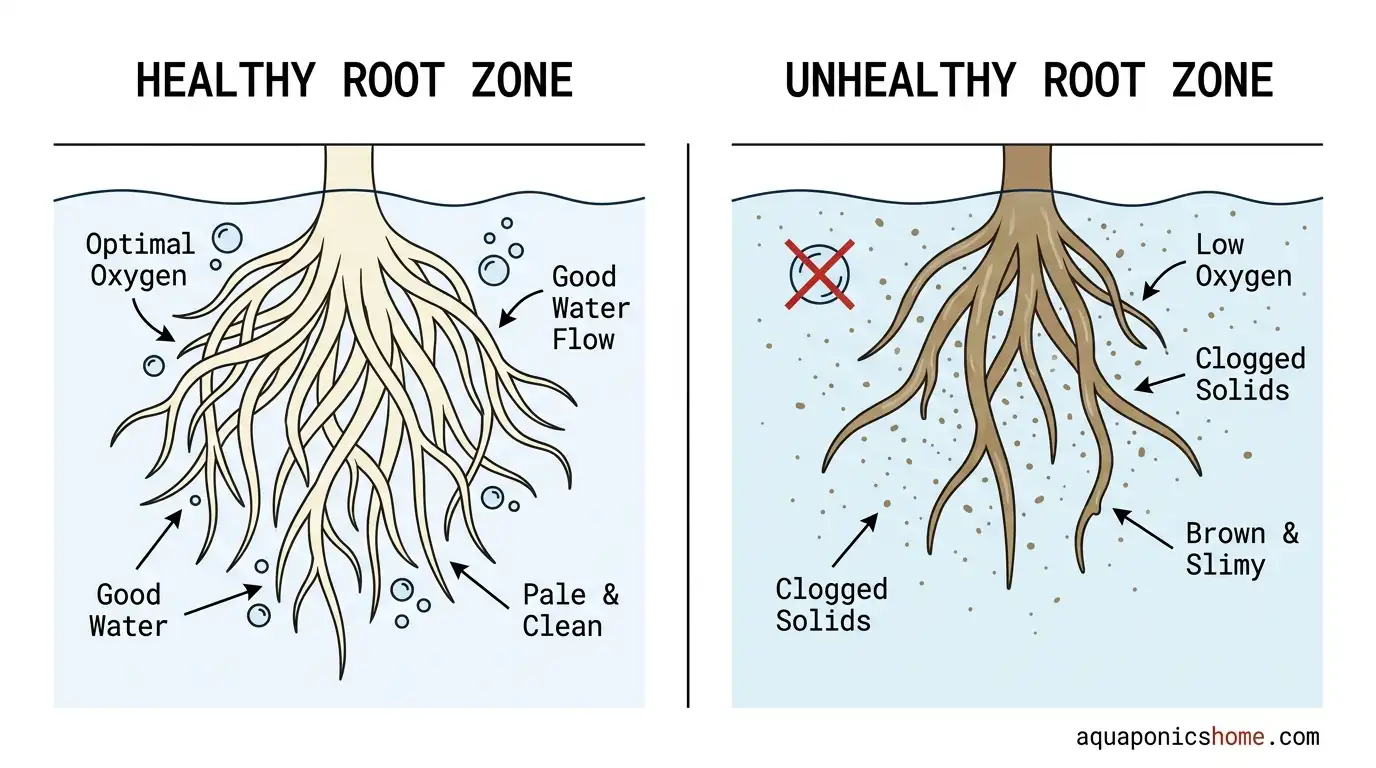
What it looks like: general yellowing, poor growth, and roots that look brown, slimy or smell bad instead of looking pale and clean.
Leaves can only use what the roots can take up. A root zone that is short of oxygen, clogged with solids or not getting regular water flow cannot feed the plant properly, whatever the water test says about nutrients. In that case the leaves may yellow in a pattern that mimics a deficiency.
Things to check:
- Oxygen. Water short of dissolved oxygen is a problem for roots and fish alike. See dissolved oxygen in aquaponics, the number nobody tests.
- Water flow. A pump that has slowed or stopped, a blocked pipe, or a siphon that no longer drains properly leaves roots sitting in stale water or drying out. Start with aquaponics pump not working.
- Root appearance. Brown, slimy or foul-smelling roots point away from nutrients and toward a root-zone problem. Ask a local extension service for advice before deciding what to do with affected plants and media.
The Quick Sorting Table
| Where the yellow starts | What it looks like | Most likely cause | First check |
|---|---|---|---|
| Older, lower leaves | General paling, slow growth | Cause 1: low nitrate | Nitrate test, fish and feed |
| Older leaves | Yellow then brown edges | Cause 4: potassium | pH, then potassium source |
| Newest leaves | Yellow with green veins | Cause 2 or 3: iron or lockout | pH test first |
| Newest leaves and fruit | Curling, dead patches, blossom end rot | Cause 4: calcium | Water flow, then calcium source |
| Whole plant | Yellowing with wilting or bad roots | Cause 5: root zone | Roots, pump, oxygen |
Before You Add Anything
Three habits prevent a lot of wasted fixes:
- Test pH first. It decides whether a supplement can work and which supplements make sense right now.
- Change one thing at a time. If you adjust pH, add iron and change the pump timer on the same day, you will not know what worked.
- Judge by new growth. Leaves that already yellowed often stay that way. Improvement shows in the leaves that open after the fix, over the following weeks.
And a caution: UConn notes that “it is not always easy to identify nutrient deficiencies just by looking at a plant.” Symptoms overlap and more than one nutrient can be short at once. If the pattern does not fit any cause cleanly, a local extension service can help interpret leaves and water tests.
Anything you add reaches fish you care for and food you will eat. Use only products whose makers state they suit aquaponics or systems with fish, follow the label dose, and if fish show distress after any change, stop and test the water. For fish illness, contact an aquatic veterinarian or your local extension aquaculture service.
FAQ
Why are my aquaponics plant leaves turning yellow?
The five common causes are low nitrate, iron shortage, pH locking nutrients away, potassium or calcium problems, and root-zone trouble such as low oxygen or poor flow. Where the yellow starts on the plant is the first clue.
Older leaves are yellow but new ones are green. What is it?
That pattern points to a mobile nutrient, most often nitrogen, meaning too little nitrate in the water. If the yellow runs along the leaf edges and turns brown, potassium is more likely.
New leaves are yellow with green veins. What is it?
That is the classic iron pattern. Test pH before adding iron, because at higher pH iron becomes harder for roots to absorb even when it is present.
Should I add fertilizer to fix yellow leaves in aquaponics?
Not general garden fertilizer, which is not made for water that holds fish. Identify the cause first, test pH, then use a product intended for aquaponics at the label rate.
Can yellow leaves be caused by the pump or roots?
Yes. Roots short of oxygen or water flow cannot take up nutrients well, so leaves can yellow even when the water test looks fine. Check the pump, the flow and the color of the roots.