
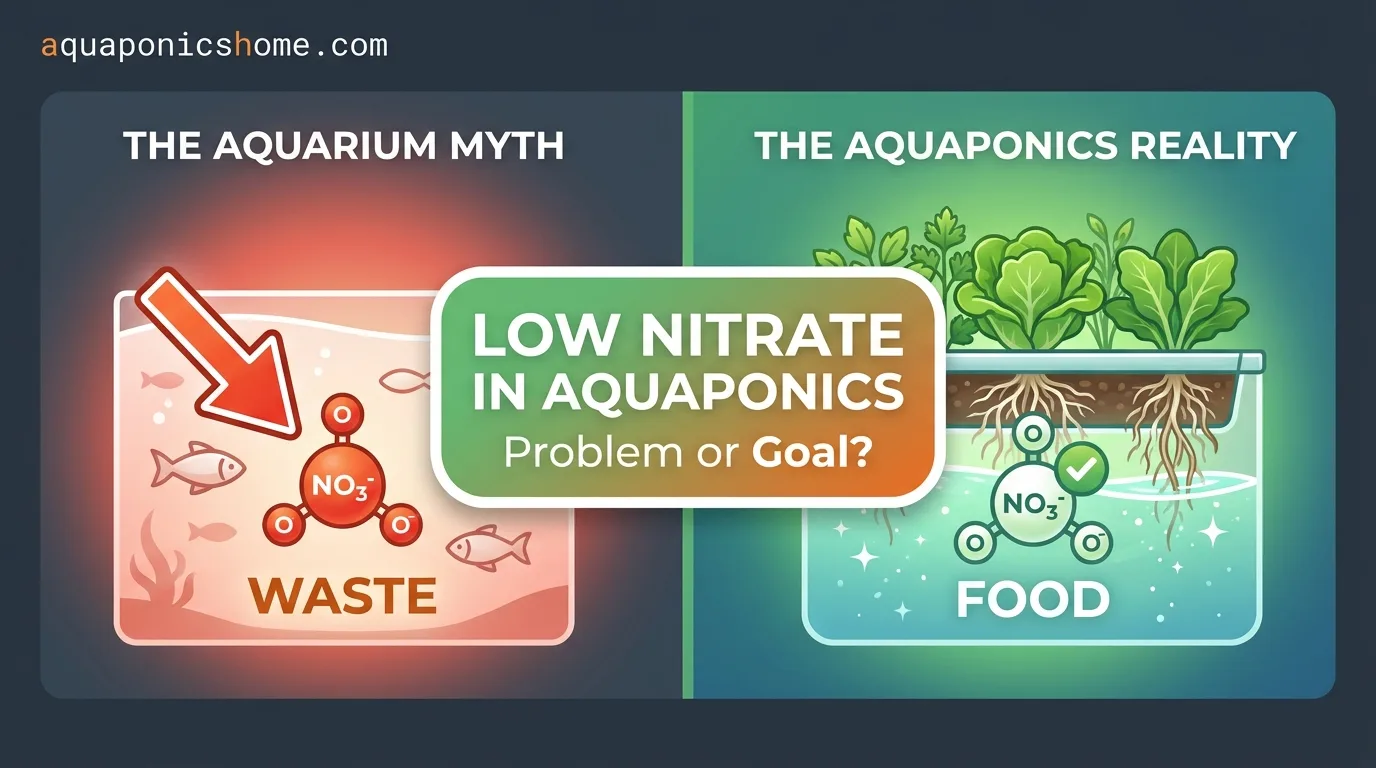
If you have spent any time reading about aquarium water quality, you have been told nitrate is a waste product to keep low. In an aquaponics system growing food, that advice is backward. Nitrate is the main form of nitrogen your plants actually feed on. Near-zero nitrate usually means your system is too young, too lightly stocked with fish, or too small for the crop it is carrying, not that something has gone wrong with your fish.
This is the one place on this site where I have to stop you before you reach for a fix, because the fix most people reach for is the wrong direction entirely.
Why nitrate means something different here
An aquarium exists to keep fish alive in a closed loop with no plants pulling anything out of the water. In that setup, nitrate has nowhere to go, so it climbs steadily and eventually has to be diluted out with a water change or it stresses the fish. That is where the “get your nitrate down” advice comes from, and it is correct, for that setup.
An aquaponics system growing vegetables is a different loop. Fish waste becomes ammonia, ammonia becomes nitrite, nitrite becomes nitrate, and then the plants take that nitrate up through their roots as their primary nitrogen source. A working, mature aquaponics system is supposed to be pulling nitrate down on its own, because the crop is eating it. Rising nitrate readings in a young system are usually a sign the nitrogen cycle is establishing itself the way it should. Nitrate sitting at or near zero, week after week, is the one that should worry you here, because it means the plants are not getting fed.
What chronically low nitrate usually means
I am not going to hand you a target number, because I do not have one I trust enough to put in front of you, and neither, honestly, do most of the pages that will tell you otherwise. When I checked what is currently ranking for this question, three different hobby sites gave three different “ideal” nitrate ranges, and none of them matched each other closely enough to have come from an actual measurement. I would rather tell you what to check than hand you a number that might just be someone else’s guess repeated.
In practice, chronic low nitrate in a home system usually traces back to one of these:
| Likely cause | What to check |
|---|---|
| The system is new and still cycling | How long has it actually been running with fish in it. A young system has not built up the bacteria colony yet, and that takes time before nitrate shows up at all. |
| Light fish stocking | Fewer or smaller fish produce less ammonia to begin with, so there is simply less raw material for nitrate to be made from. |
| A fast-growing or heavy-feeding crop | Leafy greens and herbs in an actively growing phase can pull nitrate out faster than a small system is producing it, especially if the grow bed is fuller than the fish load supports. |
| A biofilter that has not fully established | If the surfaces where nitrifying bacteria live are new, undersized, or were recently disturbed, ammonia is not converting through to nitrate efficiently yet. My biofilter crash story is the extreme version of this. |
More than one of these is often true at once on a small balcony-scale setup, which is part of why it can feel confusing to troubleshoot.
What I have actually seen on my own setup
On my balcony, the times I have seen pale, slow-growing leafy greens have lined up with a system that was either freshly rebuilt or lightly stocked, not with anything mysterious. Early on with a new build, before the bacteria have had time to settle in, the plants sit there looking a bit washed out and I have to remind myself that this is the system catching up, not a crisis. It is a different kind of patience than waiting out an ammonia spike. There is nothing urgent to fix in the next hour. There is a colony of bacteria and a stocking level that both need time to build up to what the plants want.
I am not a scientist and I am not going to pretend I have run controlled trials on my own tank. What I can tell you honestly is that the pattern has repeated more than once here: pale leaves, checked nitrate, found it near zero, and the explanation each time was a young or lightly loaded system rather than anything more dramatic.
What to actually do about it
The FAO’s small-scale aquaponics manual (Somerville et al., 2014, FAO Fisheries and Aquaculture Technical Paper 589) describes the nitrogen cycle in aquaponics exactly this way: fish waste is converted through nitrification into nitrate, and nitrate is the nitrogen form the plants take up and use for growth. That is the whole reframe in one sentence from people who actually study this. Once that clicks, the response to low nitrate stops being “flush it out” and becomes “give the cycle time and check what is limiting it.”
If your system is new, the most honest answer is often to wait. Cycling a system properly takes real time, and nitrate showing up at all is one of the signs the cycle has progressed. If the system has been running a while and nitrate is still flat, look at whether your fish stocking has kept pace with how much you have planted, and whether the biofilter media has had a chance to build up its bacteria undisturbed. Do not reach for an aquarium nitrate remover or a water change aimed at bringing nitrate down. That treats the plants’ food supply as a pollutant, which on this kind of system it is not.
If you are not sure whether low nitrate is your actual problem or something else is going on, the general troubleshooting rundown is a good place to work through the full list of what else it could be before you settle on this one. And if the roots themselves live in a media bed, it helps to understand how that media doubles as your biofilter, because the same bacteria that make nitrate are living in the same bed your plants are rooted in.
FAQ
Every aquarium site tells me to get nitrate down. Why does this site say the opposite?
Because it is a genuinely different question. An aquarium has no plants consuming nitrate, so it only ever climbs and has to be removed. An aquaponics system growing food has a crop pulling nitrate out on purpose. Rising nitrate in a young system is usually the cycle establishing itself. Zero or near-zero nitrate is the sign to pay attention to here, not high nitrate.
My nitrate has been at zero for weeks. Is that dangerous for my fish?
Low nitrate is not typically a fish welfare concern the way high ammonia or nitrite is. The concern here is the plants, not the fish. If you are worried about ammonia or nitrite specifically, that is a separate and more urgent question than nitrate being low.
How long should I wait before I assume something is wrong?
I cannot give you a firm number of days or weeks that applies to every system, because tank size, water temperature, and fish stocking all change how fast a cycle establishes. What I can say is that a new system taking a while to show nitrate is normal, and the more useful question is usually whether your fish stocking matches how much you have planted, not how many days have passed.
Should I just add more fish to raise nitrate faster?
Adding fish increases the ammonia going into the system, which can eventually raise nitrate once the bacteria are converting it, but it also raises the bioload you are responsible for keeping alive and healthy. I would rather you understand why nitrate is low first, through the causes above, than add fish as a quick fix before you know which of them applies to you.
Can I just add a store-bought nitrogen fertilizer instead of waiting?
I am not going to recommend a specific product or dosage here, because that is outside what I have tested honestly on my own setup and outside what this site does. If your plants are showing real deficiency signs and you want a supplement route, that is worth researching against a proper horticultural source, not a quick answer from me.
Low nitrate is not the crisis a lot of the internet trains you to expect. On this kind of system, it usually just means the cycle, the fish load, or the crop size has not caught up with each other yet, and the fix is almost always time and a second look at stocking, not a bottle of anything.