
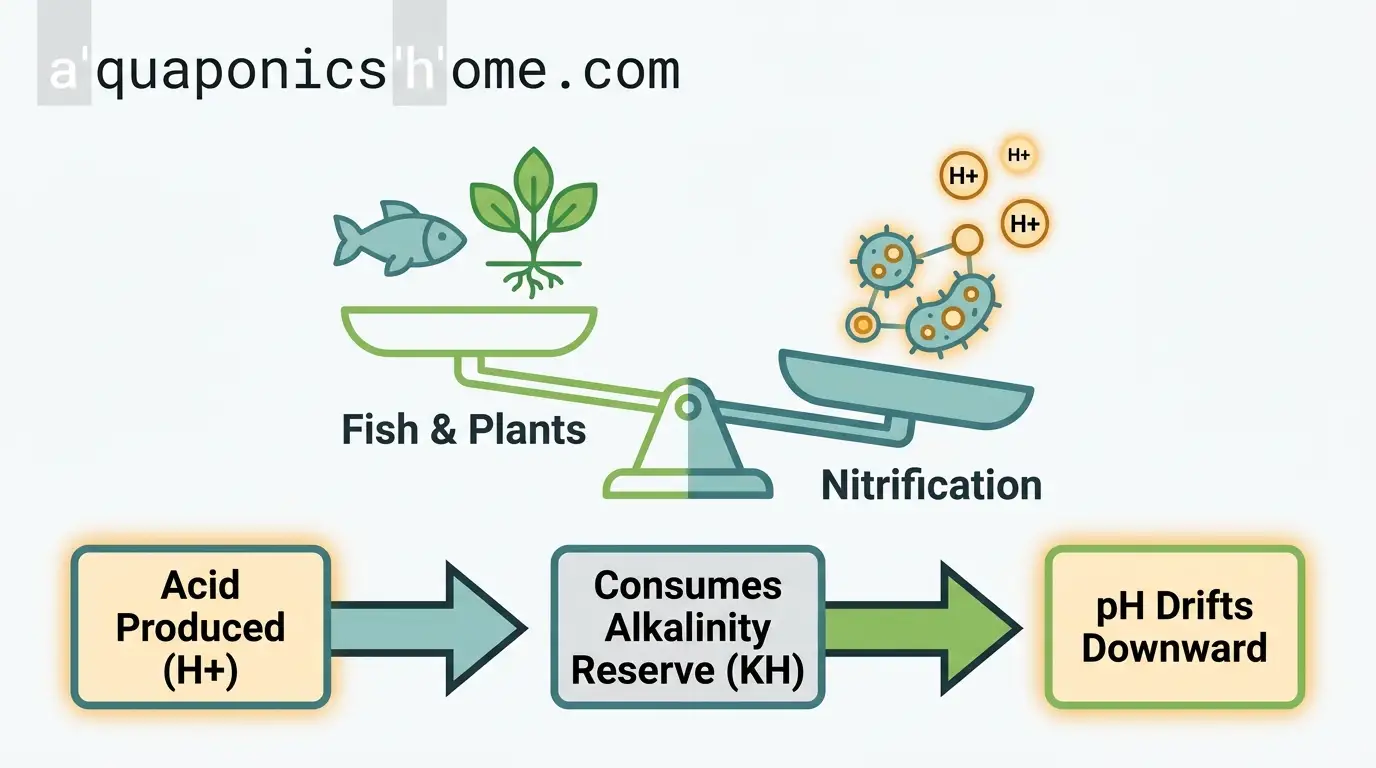
If your aquaponics pH keeps changing every time you test it, that is not something you did wrong. It is the normal byproduct of nitrification, the same bacterial process that keeps your fish alive: the bacteria that turn ammonia into nitrate consume alkalinity and release acid as they work, so pH drifts downward in a healthy, functioning system. Chasing it in circles usually means a correction was made without addressing the water’s underlying buffering capacity, so it gets used up and the number creeps right back.
I have rebuilt my system twice on this balcony, and both times I spent weeks assuming a moving pH number meant I had broken something. I had not. I am not a scientist, and I learned this the slow way, by testing, worrying, and eventually reading past the hobby forums to find out what was actually happening in my own water.
The Real Reason Your pH Keeps Dropping
Nitrification is the process that makes an aquaponics system work at all. It is also, quietly, the process pulling your pH down. New Mexico State University’s Extension Circular 680 (Sallenave) reports that nitrification “requires oxygen, destroys alkalinity, produces acid (H+), and lowers pH,” and notes that pH commonly declines from day to day as a result. Texas A&M AgriLife Extension’s water quality guide for aquaponics (Masabni and Sink, 2020) describes the same mechanism: the bacteria that convert ammonia to nitrite, and the second group that convert nitrite to nitrate, both run acid-producing reactions as part of their normal work.
This is not a malfunction. It is the running cost of keeping a colony of bacteria alive that is, at the same time, the only thing standing between your fish and ammonia poisoning. A system with no pH drift at all is more often a sign that nitrification has stalled than a sign that everything is fine. If your system is still young, this drift can feel sharper and less predictable simply because the bacterial colony itself is younger and less established; the guide to cycling a system without killing your fish covers why that colony takes real time to build.
Why a Correction Never Seems to Hold
This is the part that turns into “chasing it in circles.” Alkalinity is not just a number on your test strip, it is your water’s buffering capacity, its ability to absorb acid without the pH number actually moving. Every day that nitrification runs, it spends a little of that buffering capacity down. For a while, you do not notice, because there is enough alkalinity in reserve to soak up the acid and keep pH roughly steady. Once that reserve runs low, the same acid production starts showing up as a falling pH reading instead of being absorbed quietly in the background.
Here is the part most pages skip: pushing the pH number back up without restoring what was consumed does not fix the underlying reserve. The number moves, nitrification keeps producing acid at the same rate, and there is still nothing left to absorb it. So the reading drifts back down again, often within days, and it looks exactly like the correction failed. It did not fail; it was never addressing the actual shortage.
The Nitrification Chain, Step by Step
| Stage | What the bacteria are doing | Effect on your water |
|---|---|---|
| Ammonia to nitrite | Nitrosomonas bacteria oxidize the ammonia your fish produce | Consumes alkalinity, releases hydrogen ions (acid) |
| Nitrite to nitrate | A second group of bacteria oxidizes that nitrite into nitrate | Also acid-producing, running continuously alongside the first stage |
| Net effect over time | Two acid-producing steps running every day your system is alive | Alkalinity reserve is drawn down; pH drifts downward unless something restores that reserve |
That “something” is a separate topic in its own right, buffering capacity and how it gets replenished, and it deserves a full explanation rather than a paragraph tacked onto this one. This site will cover it properly in its own piece. What matters here is understanding that the drift you are seeing is this table, not a mistake in how you are running your system.
Other Things That Nudge pH Besides Bacteria
Nitrification is the main, steady driver, but it is rarely the only thing moving your number. Your plants take up nutrients unevenly depending on their growth stage, and that uptake shifts pH slightly in one direction or another depending on which form of nitrogen they are pulling from the water. Evaporation concentrates whatever is left in your system, and topping up with fresh water dilutes it again, so a system that gets topped up irregularly will show more noise in its readings than one topped up on a steady schedule. None of these move the needle as consistently as nitrification does, but they explain why two systems with similar fish loads can still drift at different rates.
Why There Is No Single “Right” Number
Part of why chasing pH feels endless is that the target itself is not one number, it is a compromise. FAO Technical Paper 589 (Somerville et al., 2014), the FAO’s small-scale aquaponics manual, describes fish, nitrifying bacteria, and plants as each preferring a different pH range: fish generally do better in the upper range, the bacteria doing the nitrifying work perform best higher still, and plants take up several key nutrients more easily lower down. The manual frames the widely used working range as a deliberate middle ground between those three sets of preferences, not the ideal number for any one of them individually.
That matters for how you read your own results. If you are hunting for a single figure that will make every reading feel “correct,” you are hunting for something that does not fully exist. What you actually want is a number that keeps all three parts of your system reasonably healthy at once, and that number moves slightly system to system depending on what you are stocking and growing. This site will give that compromise its own full treatment separately; here, the point is simply that a moving target is not a sign you are reading it wrong.
What Actually Helps: Test Before You Touch Anything
The honest next step is not a recipe, it is information about your own water. Test your alkalinity, not just your pH, so you know whether you are looking at a healthy reserve or one that is running low. Your test kit’s own documentation will tell you how to read that number and what range it considers workable for your kit specifically, and that documentation is written for your exact product, which a general blog post cannot be. If your alkalinity is consistently low and your pH keeps sliding faster than feels manageable, a local extension aquaculture service can look at your specific setup and water source in a way a one-size guide cannot.
I am deliberately not handing over a dose or a quantity here, even a “natural” one. Every system’s starting water, fish load, and plant load are different enough that a number that works on my balcony could do the wrong thing in your tank. Test first, understand what your own numbers mean using your kit’s documentation, and treat any addition as something to be guided by a named source or a professional, not by a blog post’s best guess.
When to Worry Versus When to Let It Be
A slow, steady downward drift over weeks, matching a system that is otherwise stocked, feeding, and stable, is exactly what the mechanism above predicts. That is not an emergency. What is worth taking seriously is a sudden, sharp swing, especially alongside fish gasping, refusing food, or other signs of distress, because that combination points toward something faster-moving than ordinary buffering exhaustion. If you are already troubleshooting fish behavior alongside a pH swing, the troubleshooting hub will help you work out which emergency you are actually looking at, in the order that matters most.
It is also worth remembering that the same nitrification producing this acid is also producing the nitrate your plants depend on. If your pH is behaving exactly as this page describes but your nitrate readings look unusually low anyway, that is a different, specific problem covered in why aquaponics nitrate runs too low, not a sign that something here is wrong.
Three years into doing this on a rented balcony, the biggest shift for me was not learning a fix. It was learning to stop treating a moving number as proof I had failed. My full story, including the mistakes that came before I understood any of this, is on my about page.
FAQ
Is a slowly dropping pH always a problem?
No. A gradual downward drift over days or weeks is exactly what nitrification does in a working system, according to New Mexico State University’s Extension Circular 680. It becomes worth investigating further when the drop is sudden or sharp, or when it comes alongside fish showing distress.
Why does correcting my pH only last a few days?
Because the correction moved the number without restoring the water’s buffering capacity, the reserve that absorbs the acid nitrification keeps producing. Nitrification does not pause, so once that reserve is spent again, the reading drifts back.
Does topping up with tap water help stabilize pH?
It can play a role, since evaporation concentrates your water and topping up dilutes it again, but it is not addressing the underlying buffering capacity that nitrification is steadily consuming. Treat it as one factor among several, not a fix on its own.
Why do fish, bacteria, and plants all seem to want different pH levels?
Because they genuinely do. FAO Technical Paper 589 (Somerville et al., 2014) describes each group as having its own preferred range, with the commonly used aquaponics range representing a deliberate compromise between all three rather than the ideal number for any single one.
How often should I actually test pH?
Testing regularly, alongside alkalinity rather than pH alone, gives you a much clearer picture of whether you are watching normal daily movement or a reserve that is genuinely running low. Your own test kit’s documentation will tell you how to interpret both numbers together for the product you are using.