
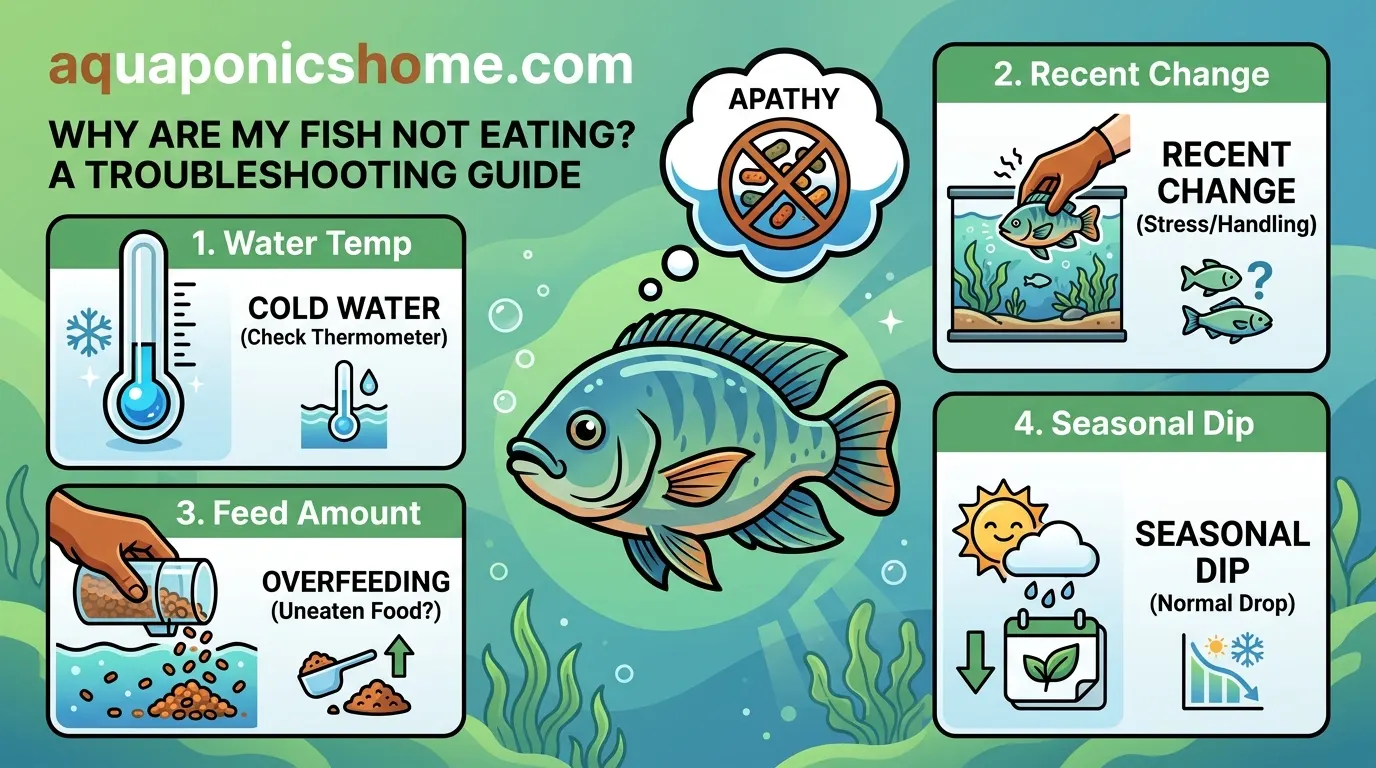
Most of the time, fish that ignore food are dealing with cold water, recent stress, overfeeding that has taught them to wait you out, or a normal seasonal dip in appetite. None of those need medication. But sores, discoloration, or unusual swimming point somewhere this site cannot follow: illness, which only an aquatic veterinarian or a university extension aquaculture service can diagnose.
My first batch of catfish did not survive their first month on my Dhaka balcony, and I still remember how much I wanted a quick answer back then. I am not an aquaponics scientist. When my own fish went off their food during a stretch of power cuts last year, my first instinct was still to panic, not to reach for anything in a bottle, and that instinct turned out to be the right one.
The Ordinary Reasons, Listed Plainly
Before you worry about disease, rule out the boring stuff, because most of the time it really is the boring stuff.
A fish skipping meals is usually reacting to one of four things: a swing in water temperature, stress from something that recently changed around it, a feeding routine that has grown too generous, or a normal dip tied to season or age.
Poor water quality belongs on this list too, but it is its own emergency with its own fixes, covered elsewhere on this site rather than repeated here.
None of these causes call for medicating anything. They call for checking a thermometer, thinking back over the last few days, and being honest about how much food has actually been going in.
Temperature Swings and Cold Water
If your water has swung cold, even for a day, that alone can explain a fish ignoring food. Fish are cold-blooded; their body temperature tracks the water around them, and their appetite tracks right along with it.
FAO Technical Paper 589 (Somerville et al., 2014), the FAO’s small-scale aquaponics manual, reports that tilapia tolerate a wide range, roughly 14 to 36 degrees Celsius (57 to 97 Fahrenheit), but stop feeding once water drops below about 17 to 18 degrees Celsius (63 to 64 Fahrenheit), well short of the 27 to 30 degree range the same manual gives for their best growth.
Species raised further north tell a similar story: Mississippi State University Extension Service (Avery and Yamamoto) reports that farmed catfish eat less consistently once water drops below 70 Fahrenheit and largely stop eating around 50 Fahrenheit and below.
On my own balcony, the power cuts that used to hit Dhaka were never really about heat. They were about the pump, and any heater, dropping out for hours at a stretch, and the water drifting toward the outside air in ways my fish clearly felt before I did.
Stress From a Recent Change
A fish that just arrived, was just moved into a rebuilt system, or is living through a loud, vibrating environment is a stressed fish, and a stressed fish often stops eating for a few days.
SRAC Publication No. 474 (Green and Haukenes, 2015), a Southern Regional Aquaculture Center fact sheet on stress in fish culture, names crowding, handling, and transport among the stressors that trigger hormones capable of changing a fish’s normal behavior.
I did not need a lab to learn that firsthand. Both times I rebuilt my own system, my fish sulked and ignored food for what felt like forever, and both times they were back to normal within about a week once things settled down.
New tankmates, a just-cleaned tank, construction noise through the building, even relocating the tank itself, all sit in this same category. Give it a few calm, undisturbed days before assuming something worse is happening.
Overfeeding and the Feedback Loop
Overfeeding creates its own kind of appetite problem, and it can look confusingly like fish that are simply not hungry. Uneaten food does not disappear; it breaks down in the water and adds to the same ammonia and nitrite load your biofilter already has to manage.
SRAC Publication No. 474 specifically lists avoiding overfeeding as a way to prevent this buildup of organic debris and nitrogenous waste. FAO Technical Paper 589 reports that grow-out feeding rates for most cultured fish run around 1 to 2 percent of body weight per day; if you have been feeding by eye rather than against any real reference point, that gap alone can explain both overfeeding and a fish that seems to be losing interest in food.
If portions have crept up recently and you are seeing leftovers, cut back before assuming anything else is wrong, and read what to do when ammonia is climbing if your test kit backs up that suspicion.
Poor Water Quality Deserves Its Own Page, Not a Rehash Here
Sometimes a fish off its food is the first sign of a water chemistry problem rather than a behavior one, and this page will not re-derive that ground.
If your ammonia or nitrite readings are anything other than clean, or your fish are gasping at the surface rather than simply skipping meals, treat that as the more urgent story.
Start with the ammonia emergency guide, the nitrite spike guide, or the oxygen emergency guide depending on what your symptoms and test kit are telling you, then come back to feeding behavior once the water itself is not the more urgent problem.
Normal Seasonal or Age-Related Dips
Appetite is not a flat line even in a healthy system. Cooler stretches of weather, shorter days, and a fish simply getting older can all mean smaller meals and slower feeding for a while, without anything being wrong.
FAO Technical Paper 589’s guidance to track appetite alongside feed conversion over time, rather than reacting to any single day’s leftovers, reflects that same reality. A day or two of picking at food, especially with a season change, is not automatically a crisis, particularly if your fish otherwise look and swim normally.
When It Is Ordinary, and When It Is Not
| Ordinary behavior cause | This needs a vet or extension service |
|---|---|
| Water temperature dropped recently (cold snap, power cut, heater failure) | Visible sores, ulcers, or unusual patches of color on the skin |
| A new fish, a recent move, or a just-cleaned system | Erratic swimming, listing to one side, or trouble staying upright |
| A recent, honest increase in feed portions | Isolating at the bottom or top of the tank for days, not just skipping a meal |
| A cooler or shorter-day stretch of weather | Rapid loss of more than one fish in a short window |
| Ammonia, nitrite, and oxygen all read clean and normal | Any of the above alongside water readings you cannot bring back to normal |
What This Site Will Not Diagnose
This page stops firmly at behavior. Sores, discoloration, ragged fins, cloudy eyes, erratic swimming, or a fish isolating itself for days rather than missing one meal, that is a disease question, and this site does not diagnose fish disease. Contact an aquatic veterinarian, or a named university extension aquaculture service in your state or region, and describe exactly what you are seeing.
Guessing at a remedy, or reaching for a product because a forum thread suggested it, is how a manageable problem turns into a lost fish. This site will never publish a medication, a feed additive dose, or a treatment schedule.
If you are not sure this is even a feeding problem, the full troubleshooting hub walks through the wider set of aquaponics emergencies in kill-speed order, and my own story has the longer version of what three years of getting this wrong on a rented balcony looks like.
FAQ
How long can a fish go without eating before I should worry?
This site will not hand you a fixed number, because it depends heavily on species, size, and water temperature. Watch the pattern, not the clock: a fish that skips one or two feedings while everything else looks normal is different from one that has refused food for the better part of a week. If unsure, a named extension aquaculture service can advise on your specific species.
Can cold water alone stop a fish from eating, with nothing else wrong?
Yes. FAO Technical Paper 589 (Somerville et al., 2014) reports that tilapia stop feeding once water drops to roughly 17 to 18 degrees Celsius (63 to 64 Fahrenheit), and Mississippi State University Extension Service reports that farmed catfish largely stop eating around 50 Fahrenheit. A thermometer check is one of the fastest ways to rule this in or out.
My fish stopped eating right after I cleaned the tank. What happened?
Cleaning disturbs your fish and can disturb your biofilter at the same time, both of which count as stressors under SRAC Publication No. 474’s list of stress triggers. Give it a calm, undisturbed few days, watch your ammonia and nitrite readings closely rather than guessing, and treat any climbing number as its own emergency.
Is it normal for fish to eat less as the seasons change or as they get older?
Yes. Appetite naturally moves with water temperature, day length, and age, and a slower stretch of feeding without any other symptoms is not automatically something to fix.
Should I try a different food or add something to make my fish eat again?
No. None of the ordinary causes here call for a different feed additive or anything added to the water to force appetite back. Rule out temperature, recent stress, overfeeding, and water quality first. If your fish still will not eat after several days, or you notice any signs beyond appetite, contact an aquatic veterinarian or a named extension aquaculture service rather than experimenting further.