
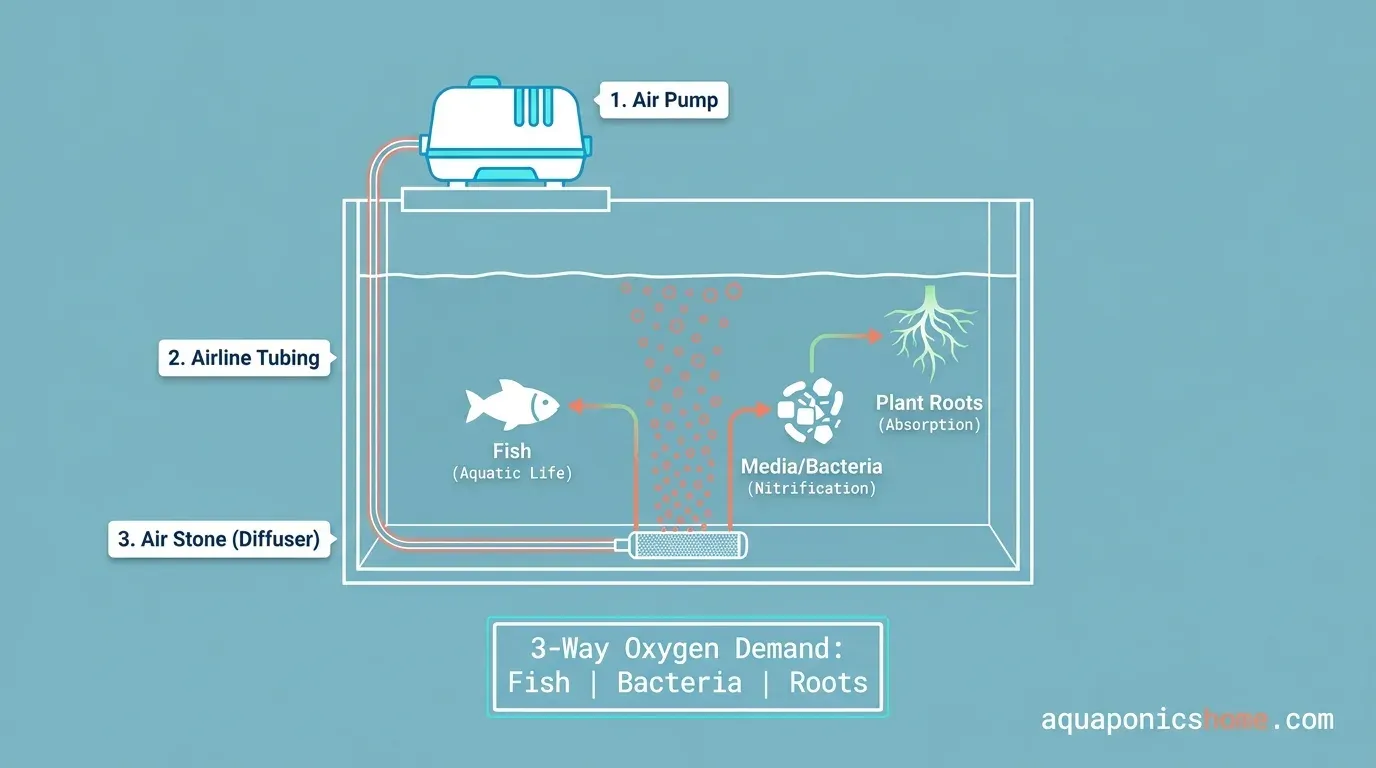
An aquaponics aeration air pump pushes air through tubing to an air stone at the bottom of the fish tank. The stone breaks the air into bubbles, which help oxygen dissolve into the water.
Your water pump moving water is not the same thing. Fish, the bacteria that turn fish waste into plant food, and plant roots all need dissolved oxygen, and the return flow alone may not supply enough.
It also stops completely the moment the water pump fails. That is why extension sources treat aeration as a core part of the system, not an extra.
This guide explains what the air pump does, what the published numbers say, where the air stones go, and how to set it up safely next to water.
What an Aquaponics Aeration Air Pump Does
Clemson University’s Land-Grant Press fact sheet Aquaponics: System Layout and Components (Lance Beecher, October 2021, read September 27, 2026) describes the setup in one sentence: “
An air pump, which produces compressed air, tubing to carry the compressed air to the bottom of the tank, and air stones to bubble air into the system, make up the aeration system.”
So there are three parts:
- The air pump. A small electric pump that sits outside the water and pushes air.
- Airline tubing. Thin flexible tube that carries the air down into the tank.
- The air stone (diffuser). A porous block at the end of the tubing that splits the air into many small bubbles.
Clemson’s sheet is direct about why this matters: aeration “is critical for providing adequate dissolved oxygen for fish survival, beneficial bacteria in the filter unit, and proper levels for plant growth.”
University of Maryland Extension’s build guide for a small system says the same thing in its own words. It calls aeration “Critical for the functioning aquaponics system,” because “Aquatic life and bacteria need dissolved oxygen to survive and multiply.”
“The Water Is Moving. Is That Not Enough Oxygen?”
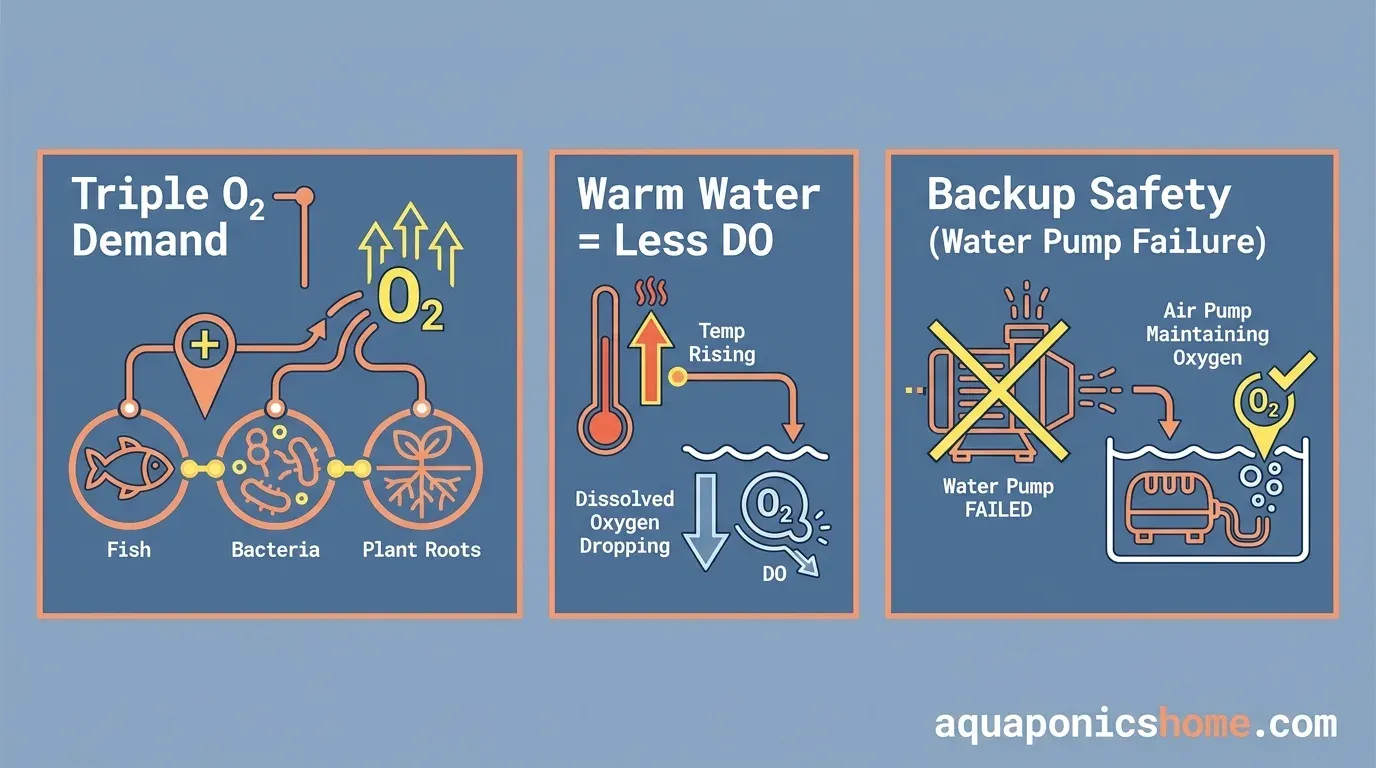
This is the question most people ask, and the answer is: sometimes, but you cannot rely on it.
Water falling back into a tank does add oxygen, because it breaks the surface.
Oklahoma State University Extension’s fact sheet Nitrification and Maintenance in Media Bed Aquaponics (HLA-6729, October 2021, read September 27, 2026) mentions exactly this: a grower may use a recirculating design “with water flowing back into the tank, breaking water surface tension so it also aerates the system.”
But there are three reasons not to depend on the return flow alone.
Oxygen demand comes from three places at once
Fish breathe it. The nitrifying bacteria need it to turn ammonia into nitrate. Plant roots use it too.
Clemson’s sheet warns that if dissolved oxygen falls below 6 mg/L, “there can be disruptions in ammonia transformation and formation of zones within the media bed completely without oxygen (i.e., dead zones).”
Our guide to aquaponics beneficial bacteria explains why those bacteria matter so much.
Warm water holds less oxygen
OSU’s fact sheet notes that “as the temperature and elevation increase, dissolved oxygen will decrease.”
A system that is fine in the cool season can run short in the hot season with nothing else changed. More fish, more feed and more decaying waste all raise demand at the same time.
The water pump is a single point of failure
If the pump stops because of a blockage, a burnt-out motor or a timer switching it off, the return flow stops too.
A separate air pump keeps oxygen going into the fish tank while you fix the problem. It does not help if the whole house loses power, which is a separate planning problem.
What the Published Numbers Say
These figures come from named extension sources. They describe targets and tolerances, not something to aim for by cutting aeration.
| Source | What it says |
|---|---|
| OSU Extension HLA-6729 | “Many warm-water fish and plants prefer 6 to 7 parts per million of dissolved oxygen.” |
| OSU Extension HLA-6729 | “Consider adding air stones if dissolved oxygen drops to less than 6 parts per million.” |
| Clemson Land-Grant Press | Below 6 mg/L, ammonia conversion can be disrupted and dead zones can form in the media bed. |
| SRAC Publication No. 454 | The University of the Virgin Islands commercial system “maintains DO levels near 80 percent saturation (6 to 7 mg/L).” |
(For dissolved oxygen in fresh water, parts per million and mg/L are used interchangeably.)
OSU also lists how low some fish can survive. It gives catfish at 2.5 to 3 parts per million and tilapia as low as 1 part per million.
Surviving is not the same as thriving, and those numbers are no reason to run a system short. OSU names low dissolved oxygen and water leaks as the most common problems in these systems.
How do you know your number? OSU notes that “dissolved oxygen is most easily measured with a dissolved oxygen meter.” Most hobby test kits do not measure it.
Our guide to dissolved oxygen in aquaponics, the number nobody tests goes through the options.
Where the Air Stones Go
- The fish tank, always. This is where oxygen demand is highest and where a pump failure hurts first.
- Any separate biofilter or sump that holds standing water. The bacteria living there need oxygen too.
- Deep water culture (raft) beds. In raft systems the roots sit in water all the time, so they rely on dissolved oxygen in that water. The UVI system described in SRAC 454 aerates its raft tanks with “numerous small air diffusers (one every 4 feet).” If you are thinking about rafts, read our guide to DWC aquaponics at home first.
- Media beds get air differently. A flood and drain bed pulls air into the gravel each time it drains, which is one of the reasons that design is forgiving.
Clemson’s sheet also makes the point that aeration has to be sized, just as water flow is: “it is essential to size the aeration system accurately to provide a sufficient level of dissolved oxygen throughout the aquaponic system.”
We found no extension rule of thumb for air pump size in small home systems, so we do not give one. Check the pump maker’s rating for the tank depth you have, because pushing air to the bottom of a deeper tank takes more pressure.
Setting It Up Safely
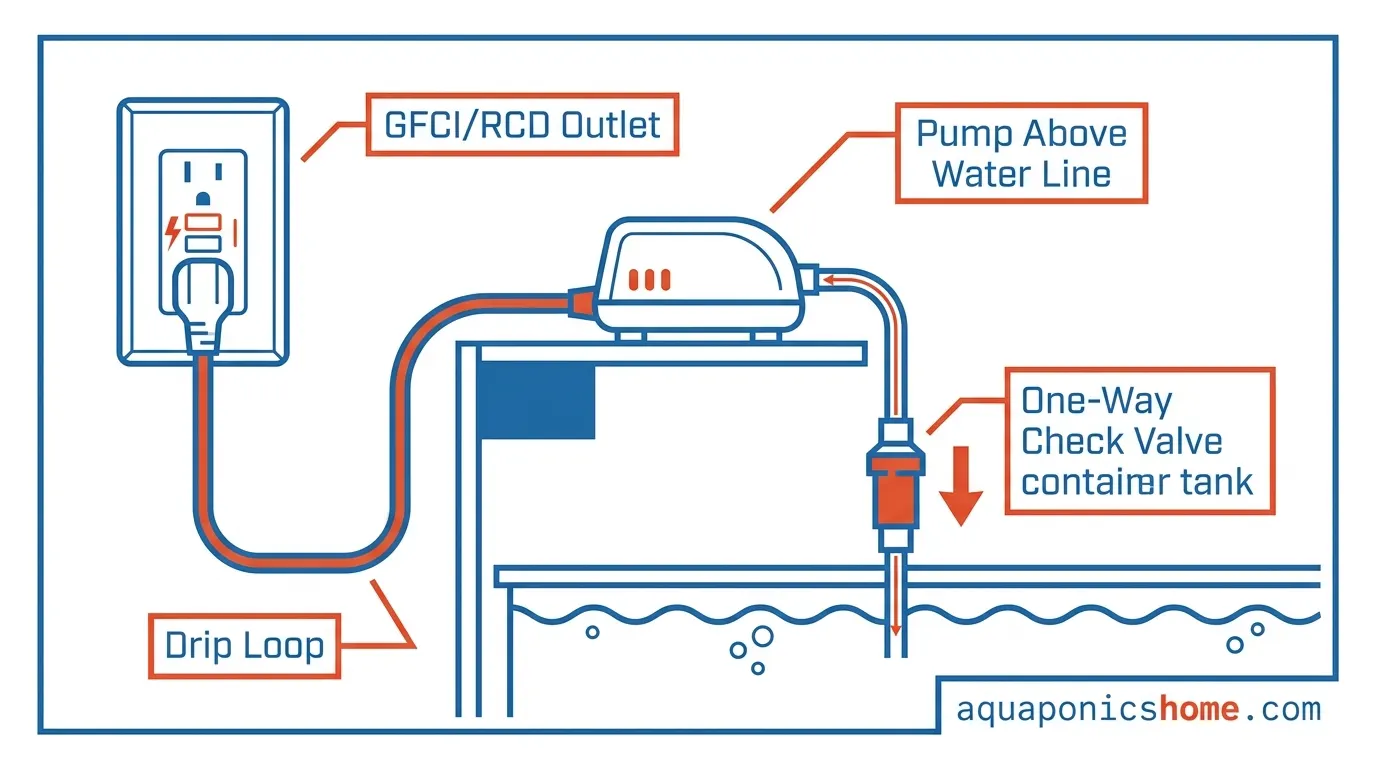
This is mains electrical equipment beside standing water. The steps below cover plug-in equipment only.
Protect the socket
Plug the air pump into a socket with residual current protection. In the US this is a GFCI, and in the UK and many other countries it is an RCD.
The University of Washington’s GFCI focus sheet (April 2025) explains that a GFCI “shuts off power when it detects an imbalance in the electrical current flowing through it,” and that a tested plug-in GFCI adapter can add protection to a socket that does not have it.
That same sheet makes a point that matters for fish: everything on a protected circuit goes off when it trips. If your water pump and air pump share one protected outlet and it trips, both stop. That is the device doing its job.
Do not respond by removing the protection. Instead, check daily that both pumps are running, and think about a battery-backed air pump that keeps working when mains power is cut.
Keep the pump above the water line
Place the air pump on a shelf higher than the tank’s water level. When an air pump below the water line switches off, water can flow back down the airline into the pump.
Fit a check valve
A small one-way valve in the airline stops water running back toward the pump if it switches off. Fit it following the direction arrow on the valve, so air flows toward the tank.
Leave a drip loop
Let the power cord dip below the socket before it rises to it, so any water running along the cord drips off at the low point instead of reaching the plug.
Stop here if your plan involves adding a socket, moving an outlet or any fixed wiring near the tank. That is work for a licensed electrician, and the rules on what a householder may do differ by country.
If water ever reaches a socket or extension lead, do not touch it or the water around it. Switch off at the main switch only if you can do so without standing in water. Otherwise, call an electrician.
Looking After It
- Check the bubbles every day. A stone that bubbles weakly or only on one side is starting to clog.
- Clean or replace clogged stones. Fish waste, algae and mineral deposits block the pores over time. Replace a stone when the flow stays uneven after cleaning.
- Replace hardened tubing. Old airline goes stiff and cracks, which leaks air before it reaches the stone.
- Know the warning signs. Fish crowding at the surface or gulping air can mean low oxygen. Our guide to fish gasping at the surface covers what to do first. If fish show signs of illness rather than oxygen stress, contact an aquatic veterinarian or your local aquaculture extension service.
FAQ
Do I need an air pump in aquaponics if my water pump runs all the time?
It is strongly recommended. Returning water adds some oxygen, but Clemson, Oklahoma State and Maryland extension sources all describe aeration as critical. An air pump also keeps oxygen going into the fish tank if the water pump fails.
What dissolved oxygen level should an aquaponics system have?
Oklahoma State University Extension says many warm-water fish and plants prefer 6 to 7 parts per million, and suggests adding air stones if it falls below 6. Clemson warns that levels below 6 mg/L can disrupt ammonia conversion.
Where should I put the air stone?
At the bottom of the fish tank at minimum, plus any separate biofilter or sump and any deep water culture beds. Media beds that flood and drain draw in air as they drain.
Why does my air pump need a check valve?
A check valve is a one-way valve in the airline. It stops water flowing back toward the pump when the pump switches off. Keeping the pump above the tank’s water line helps as well.
Will an air pump keep my fish alive in a power cut?
A mains-powered air pump stops when the power does. Some air pumps have battery backup for this reason. Plan for power cuts separately, before one happens.