
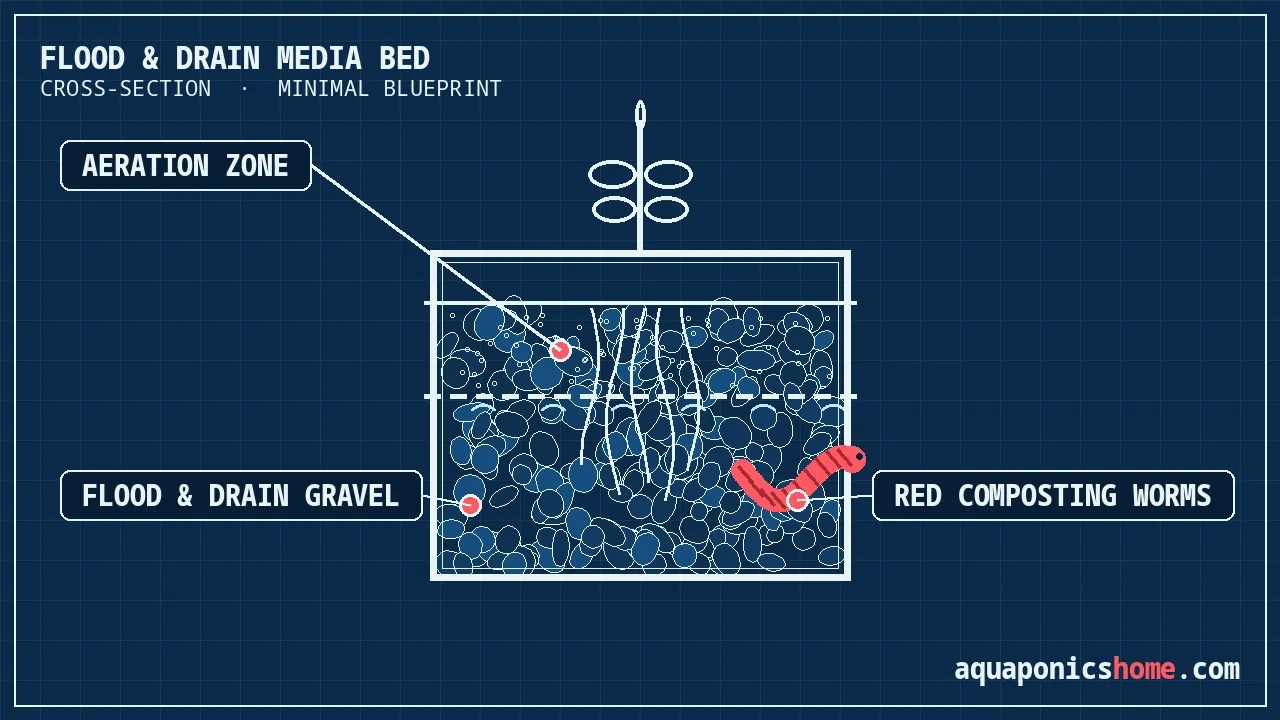
Worms in aquaponics grow bed media can genuinely help, but only in the right kind of bed. The extension literature describes red composting worms (Eisenia fetida) living in flood and drain gravel beds.
There they help break down the fish waste that collects in the media and improve air movement through the bed. They are not a fix for an overloaded system, and they do not belong in raft or channel systems where roots hang in water with no media. Think of them as a helper for a well-balanced media bed, not a substitute for balancing it.
This guide explains where the idea comes from, what worms actually do, which beds suit them, and the limits worth knowing before you add any.
Where the Idea Comes From
Adding worms is not just a forum habit. It appears in one of the most cited aquaponics extension publications.
SRAC Publication No. 454, Recirculating Aquaculture Tank Production Systems: Aquaponics, Integrating Fish and Plant Culture (Rakocy, Masser and Losordo, Southern Regional Aquaculture Center, November 2006 revision, read September 27, 2026), describes a popular gravel-based design.
In it, small beds of pea gravel “are flooded several times daily with system water and then allowed to drain completely.” It then says: “The beds are inoculated with red worms (Eisenia foetida), which improve bed aeration and assimilate organic matter.”
(Eisenia foetida is an older spelling of Eisenia fetida, the same species. It is widely sold as the red wiggler or composting worm.)
The same publication returns to worms when it describes how to size that kind of system. For flood and drain gravel beds built to its recommended fish-to-media ratio, it says “no solids are removed from the system,” and that the beds “should be cultivated (stirred up) between crops and inoculated with red worms to help break down and assimilate the organic matter.”
So the extension source does not describe worms as a clever extra. It describes them as one part of a specific design: flood and drain gravel beds, a balanced fish load, no separate solids filter, and beds stirred between crops.
What the Worms Do
In a media bed, fish waste, uneaten feed, dead roots and fallen leaves collect in the gravel or clay. SRAC notes that solids trapped in sand and gravel “remain in the system to provide nutrients to plants through mineralization.”
Mineralization means breaking organic waste down into plain nutrients that roots can take up. It also warns that “With the high potential of sand and gravel media to clog, bed tillage or periodic media replacement may be required.”
Worms work on both sides of that problem:
- They eat organic matter. SRAC’s word is “assimilate”: the worms take in the waste collecting in the bed.
- They improve bed aeration. Moving through the media, they help keep it from packing into airless pockets.
The aim is for waste to break down in an airy bed, where it feeds the plants, rather than piling up in airless pockets, where it starts to cause trouble for the fish.
Which Beds Suit Worms in an Aquaponics Grow Bed
Flood and drain media beds: the good fit
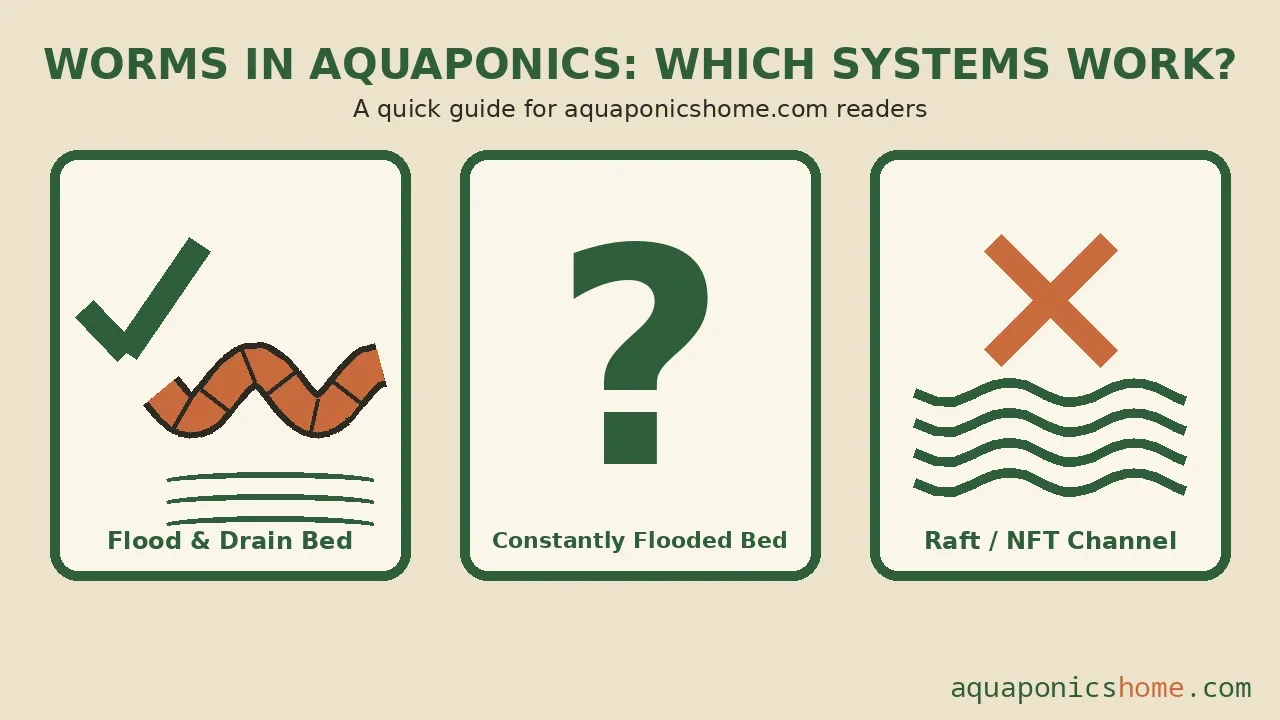
This is the setting SRAC describes. Each time the bed drains, air is pulled down into the media. SRAC notes that during the draining phase “air is brought into the gravel,” and that this speeds up the breakdown of organic matter.
Composting worms need oxygen as well as moisture, and a bed that floods and fully drains gives them both. If you are still choosing a system, our guide to media bed aquaponics explains why this design suits small home setups.
Constantly flooded media: a poorer fit
A bed that never drains, or one whose drain has clogged, stays waterlogged. That is poor habitat for an animal that needs air, and the worms are likely to struggle.
Raft (deep water culture) and NFT channels: not a fit
These systems have no media for worms to live in. Roots hang in water or in a thin film of water. Raft and NFT systems deal with solids by removing them before the water reaches the plants, not by composting them in place.
Which media?
SRAC’s example uses pea gravel. Expanded clay is also common in home media beds. Our comparison of aquaponics grow media, gravel or clay covers the differences. Whatever you use, the bed needs to drain properly for worms to have a chance.
The Honest Limits
Worms do not rescue an overloaded bed
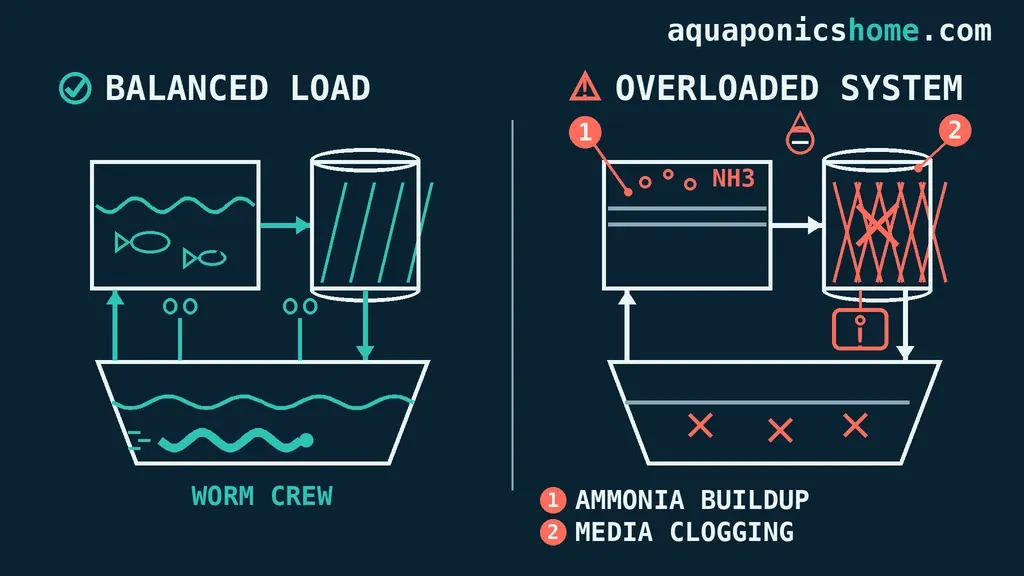
SRAC warns that “If serious clogging occurs from organic matter overloading, gravel and sand filters can actually produce ammonia as organic matter decays, rather than remove it.”
Its fixes are washing the media, adding solids removal before the bed, or stocking fewer fish and feeding less. Adding worms is not on that list.
If too much waste is going into the bed for its size, worms will not bring it back into balance. A bed that has started to smell is often a sign of this. Our guide on why an aquaponics system smells bad walks through the causes.
They are part of a routine, not a replacement for one
Even in the design where SRAC recommends worms, it still says the beds should be stirred between crops. Worms reduce the work. They do not remove it.
We found no extension figure for how many worms to add
Seller and hobby sites give starting amounts per square meter of bed. We found no extension publication that states a number, so we do not give one here.
A common hobby approach is to start small and let the population settle to the amount of food available. Worms that have little to eat tend to stay few, so a small colony is not necessarily a failing one.
Use a composting worm, not whatever is in the garden
SRAC names one species, Eisenia fetida. It is the one to use. Worms dug from a garden are often soil-dwelling species that live differently.
Keeping Soil Out
Part of the point of aquaponics is that no soil is involved. Composting worms are usually sold in bedding such as compost or shredded material. Separate them from as much of that bedding as you reasonably can before they go into the grow bed. That way you add worms, not a scoop of soil and whatever lives in it.
If you grow food to eat, our guide to whether food from a home aquaponics system is safe to eat covers the wider hygiene picture.
Will the Fish Eat Them?
Some worms may be washed down the drain into the fish tank, where the fish may eat them. That is not a problem in itself. It does mean the worm population depends on conditions in the bed, not on worms that end up in the tank.
Should You Add Worms?
Worms are a reasonable addition if:
- You run a flood and drain media bed that fully drains each cycle.
- Your fish load is sensible for the size of the bed.
- You want help keeping organic matter from building up between cleanings.
Skip them, or fix the system first, if:
- You grow in rafts or NFT channels.
- Your bed stays flooded or the drain is clogged.
- The bed already smells, clogs quickly or shows high ammonia. Those are signs of overloading, and worms will not solve them.
FAQ
Are worms good for an aquaponics grow bed?
In a flood and drain media bed, they can help. SRAC Publication No. 454 describes red worms in gravel beds and says they “improve bed aeration and assimilate organic matter.” They are not suitable for raft or NFT systems, which have no media.
What kind of worms should I put in my aquaponics grow bed?
The extension source names red worms, Eisenia fetida, also called red wigglers or composting worms. Avoid worms dug from garden soil.
How many worms should I add to my grow bed?
We found no extension publication that gives a number. Start with a modest amount. The population tends to adjust to the amount of organic matter available.
Can worms replace a solids filter?
Not on their own. In the design SRAC describes, worms work alongside a balanced fish load and regular stirring of the beds. An overloaded bed can still clog and produce ammonia whether worms are present or not.
Will worms survive if my grow bed stays flooded?
They are unlikely to do well. Composting worms need oxygen, and a flood and drain bed supplies it by pulling air into the media each time it drains.