
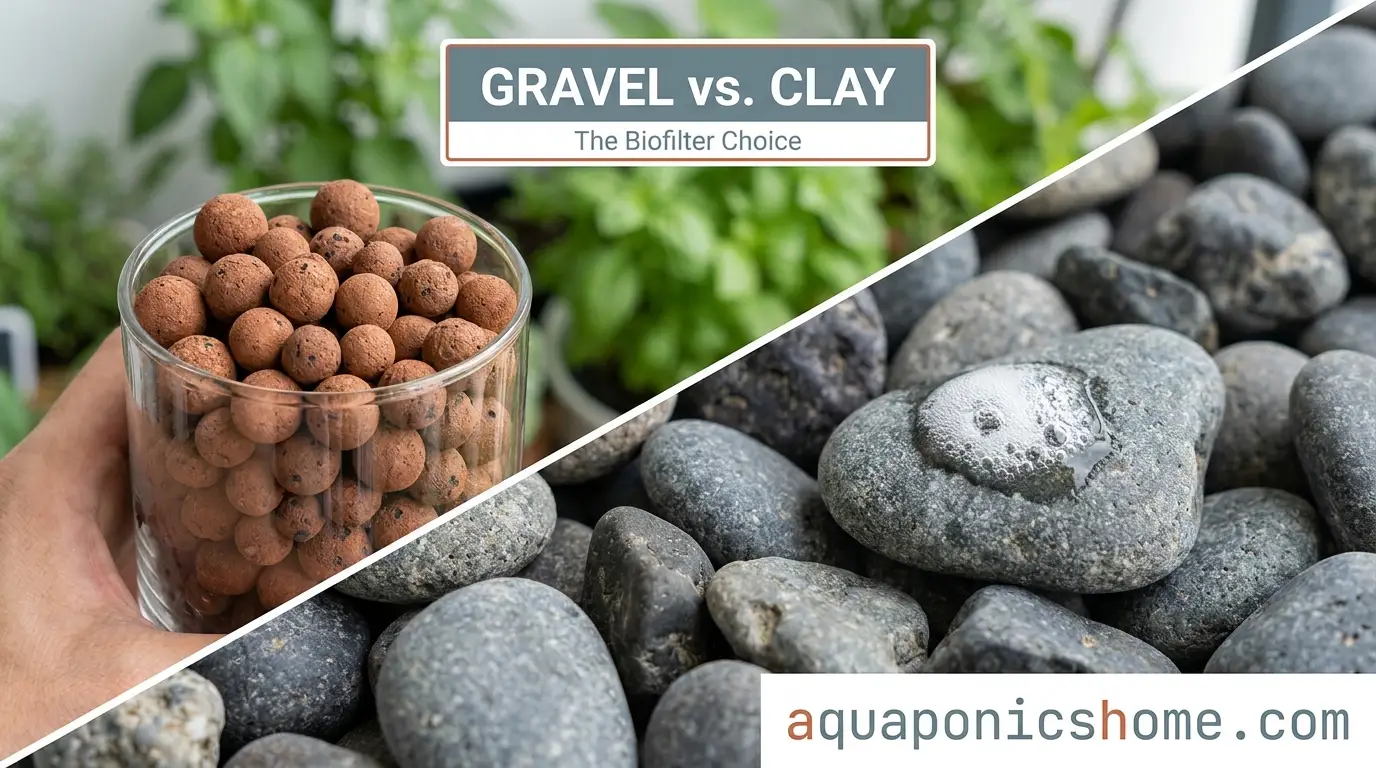
Yes, ordinary gravel works as aquaponics grow media, with one condition attached: it must not be calcareous. Gravel cut from limestone, or gravel that is really crushed shell, is mostly calcium carbonate, and calcium carbonate dissolves slowly into your water and keeps pushing pH upward. Test a handful with acid before you fill anything. If it fizzes, put it back. If it does not fizz, gravel is a legitimate choice, and clay pebbles are a convenience rather than a requirement.
I run a media bed on a rented balcony in Dhaka and I have rebuilt it twice, so I have moved media by hand more often than I meant to. I am not an aquaponics scientist, so wherever this gets chemical I lean on the FAO’s small-scale aquaponics manual (Somerville et al., 2014, FAO Fisheries and Aquaculture Technical Paper 589) rather than on my own guesswork.
One note before the comparison. This site carries no affiliate links, and I am not naming products or quoting prices, because money is the least interesting cost of grow media. What media really costs you is weight, labor, pH trouble, and the fact that you fill a bed once and then live with it.
Your media is the biofilter, which is why this choice sticks
If media only held plants upright, you could change your mind any weekend. It does more than that. The rough, porous surface of every piece is where the nitrifying bacteria live, the ones that turn fish waste into something plants can use. That is the whole argument for why a media bed is the sensible first design: one bed handles plant support, solids filtration and biofiltration at the same time.
So the media is a living component by week six, not inert filler. Swapping it later is not a shopping decision, it is a partial demolition of your biofilter. The ten minutes you spend testing a sample before you buy are the highest-value ten minutes in the whole build.
How the common media compare
FAO 589’s requirement list is short: plenty of surface area for bacteria, a neutral pH, an inert material that will not leach out potentially toxic substances, good drainage, room for air and water to move inside the medium, and, in the manual’s own words, light weight if possible. The surface area figures below are the manual’s, given in square meters of colonizable surface per cubic meter of medium, so a higher number means more room for bacteria in the same bed.
| Medium | Weight | pH behavior | Bacterial surface area (FAO 589) | Durability | Handling | Who it suits |
|---|---|---|---|---|---|---|
| Light expanded clay aggregate (clay pebbles) | Lightest common option, described by FAO 589 as very lightweight compared with other substrates | Inert, pH neutral | 250 to 300 | Does not rot or break down | Smooth, round, dust free, easy to lift | Upper floors and stair carries. FAO 589 notes it is relatively expensive and not widely available around the world |
| Volcanic gravel and lava rock | Heavy | Almost completely chemically inert per FAO 589, apart from small releases of microelements such as iron and magnesium | 300, the highest here | Does not break down | Abrasive, sharp edged, and dusty enough that FAO 589 says wash it thoroughly first | Anyone who can source it locally and carry it |
| Pumice | Lighter than solid rock | Volcanic and inert | 200 to 300 | Long lived | Dusty, needs washing, kinder to hands than lava rock | A middle option where volcanic material is sold nearby |
| Unlabeled river or landscape gravel | Heavy | Unknown until you test it. FAO 589 records that river bed gravel is usually limestone | Variable, depends on the rock | Durable if it is not soluble | Easy to find, easy to shovel | Only after it passes the acid test below |
| Limestone or crushed shell gravel | Heavy | Not inert. FAO 589 states that limestone is composed primarily of calcium carbonate, which dissolves in water and affects water quality, and that it will increase the KH of the water, which will also increase the pH | 150 to 200, the lowest here | Slowly dissolves away | Cheap and everywhere, which is exactly the problem | Nobody, by default. FAO 589 says it is not recommended as a growing medium, though it is commonly used |
The pattern is not subtle. The cheap, heavy, easy-to-find option is also the one most likely to be chemically active, and the expensive option is buying you lightness and certainty rather than better plants.
The limestone and shell trap
This is the part worth slowing down for.
Why calcium carbonate keeps pushing pH up
Limestone, marble, chalk, coral fragments and shell are all mostly calcium carbonate, and in water carbonate does not sit still. It goes into solution, and FAO 589 states the consequence plainly: limestone dissolves in water and affects water quality, increasing the KH of the water, which will also increase the pH. KH is carbonate hardness, and the practical way to picture it is resistance. A high-KH system pushes back against anything trying to move its pH.
That matters more here than in a garden, because a running system generates acid continuously as the bacteria work. In a bed full of calcareous rock, the rock keeps dissolving and keeps replacing the buffer, so pH does not merely start high, it stays high and refuses to move. You are no longer adjusting your water, you are arguing with a mountain, every week, forever.
I am deliberately not publishing a pH target or a correction dose here, because pH adjustment is its own subject and getting it wrong is worse than leaving it alone. The point of this section is narrower: do not build the problem into the bed.
The acid test, and what vinegar can miss
The test is old geology, not aquaponics folklore. The U.S. Geological Survey calls it the acid test: hydrochloric acid on a carbonate sample releases carbon dioxide gas, and the visible bubbling is the identification (USGS, “The Acid Test”, June 2019). No fizz, no carbonate.
The kitchen version uses white vinegar. Take several pieces from different parts of the bag, because a load of gravel is not uniform, break one so you are testing a fresh face rather than a weathered surface, dry it, and put a few drops on. Here is the caveat the one-line versions of this tip leave out: vinegar is a far weaker acid than the hydrochloric acid in the USGS description, so the reaction is slower and fainter. A strong fizz is strong evidence against the rock. A faint fizz, or none at all, is weaker evidence in its favor, so look closely, in good light, and give it a minute rather than three seconds.
The one nuance worth knowing
In fairness, FAO 589 also notes that a small addition of limestone can help counterbalance the acidifying effect of nitrifying bacteria, which can offset the need for regular water buffering in well balanced systems. That is a real observation and I am not going to hide it.
But read the size of it. A small addition inside a balanced system is a deliberate, controlled act by someone who knows their water. A whole bed of limestone gravel is not a small addition, it is the largest single component of your system, and it is not adjustable once it is wet and full of roots.
Weight is the cost nobody puts on the label
Media is heavy dry and heavier saturated, because a flooded bed carries the rock plus water in every gap between the pieces. The water part you can calculate yourself: water weighs about 8.34 pounds per US gallon (1 kilogram per liter). Work out your bed’s flooded volume, multiply, and remember the media’s own weight sits on top of that figure.
What I will not do is tell you what your balcony or floor can carry, because nobody who has not seen your building can. That belongs to a qualified structural engineer or to your building’s original drawings, and I go through how to get a real answer in how heavy a small aquaponics system actually is. Read it before you choose media, because weight is the one property here that can rule an option out entirely. The money side of this decision lives in what a small system actually costs to set up, not in a media comparison.
Particle size, and the washing rule that reverses after day one
FAO 589 reports a recommended size of roughly 0.3 to 0.8 inches (8 to 20 mm) in diameter for both volcanic gravel and expanded clay. The reasoning squeezes from both directions. Too fine and the pieces pack tight, drainage slows, and material washes into your plumbing. Too coarse and you lose bacterial surface area, because surface area per unit of volume falls as the pieces get bigger.
On washing, FAO 589 is clear that the medium should be washed thoroughly before it goes into the beds, particularly volcanic gravel, which carries dust and tiny particles. Do that properly. Then never do it again with tap water once the system is alive, because the surfaces you would be scrubbing are now the bacteria you depend on, and tap water is chlorinated precisely to kill bacteria. That is not theory for me. Early on I decided my system looked dirty, cleaned it thoroughly, and my first batch of catfish did not survive the month. What that colony is and how long it takes to build is in cycling a system without killing your fish.
How I would choose, in order
First, weight. Get the structural question answered before anything else, and if the answer is tight, lightweight media stops being a luxury.
Second, the acid test on whatever is cheap and local. If a heavy, cheap, local gravel passes it, that is a genuinely good choice, and the FAO’s own surface area figures back it up.
Third, handling. You will dig through this material with your hands to plant, harvest and unclog, and sharp volcanic rock makes that a chore you quietly start avoiding. A bed you avoid touching fails slowly.
Last, and only last, price. Not because money does not matter, it does, and I run this hobby on a modest budget in a rented flat. But media that fizzes will cost you at every water test for years afterward, and that is the larger bill. The rest of the small-space picture is in the balcony aquaponics guide.
FAQ
Is gravel really as good as clay pebbles?
For growing purposes, if it is inert, yes. FAO 589’s figures put volcanic gravel’s bacterial surface area at the top of the common options, above expanded clay. What clay pebbles buy you is weight and certainty: lighter to carry, reliably pH neutral, no testing question at all. That is convenience, and convenience is worth paying for when your constraint is a staircase.
How do I test gravel for limestone at home?
Take several pieces from different parts of the bag, crack one open so you are testing a fresh surface, dry it, and drop white vinegar on it. Bubbles mean carbonate. The U.S. Geological Survey describes the same reaction using hydrochloric acid, which releases carbon dioxide from the carbonate, and vinegar is a weaker version of that test, so watch patiently rather than glancing. If in doubt, doubt it.
Can I mix two different media?
Yes, and people do it to get lightness in one layer and surface area in another. Keep the pieces roughly similar in size, because mixing fine with coarse lets the small pieces fill the gaps between the large ones, which is how you lose the drainage and airflow the FAO criteria ask for. Test every component separately, since one calcareous ingredient contaminates the whole bed.
Can I reuse gravel from an old aquarium or a garden?
Only if you know what it is and it passes the acid test. Aquarium substrates are a common trap, because calcareous gravels and crushed shell are sold deliberately for hard-water tanks. Anything that has held fertilizer, paint, solvent or unknown chemicals stays out. If the history is unknown and the rock is untestable, the risk outweighs the saving.