
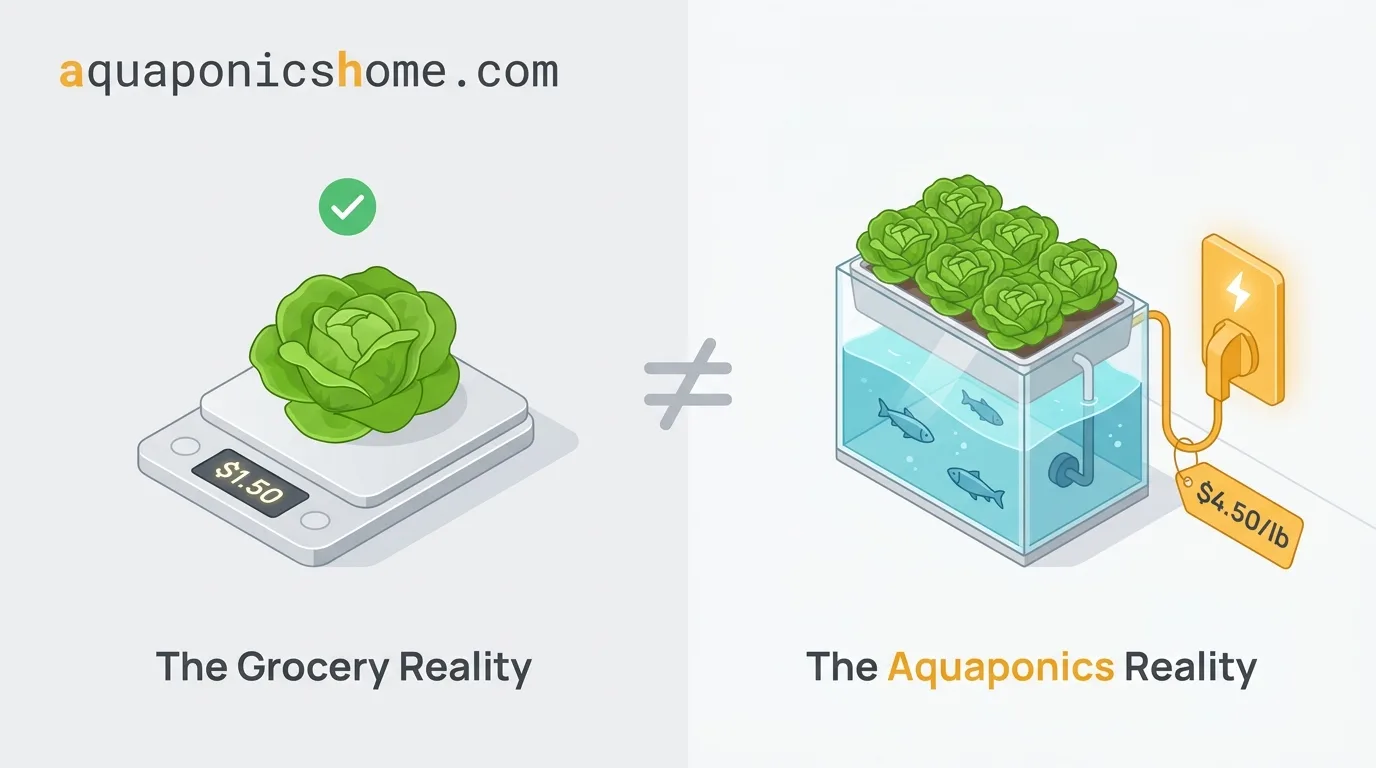
Short answer: for almost everyone running a small home system, no, aquaponics is not cheaper than buying vegetables, and it is not close. A home system has to pay back its build cost, its pump electricity every hour of every day, its fish feed, and its replacement parts, and the crops it grows best are lettuce and herbs, which are among the cheapest things in the produce aisle. Aquaponics is worth it for reasons that are not money: control over what you eat, produce that has not traveled, and the fact that it is genuinely interesting. If your only question is cost per pound of salad, buy the salad.
That is the honest version. What follows is how to check it against your own prices instead of trusting mine, because my grocery bill is in Dhaka and yours probably is not.
Why I will not give you a number
Every “aquaponics cost” article I found does the same thing. It states a setup figure, adds a monthly running figure, divides by a yield figure, and produces a break-even in months. It looks like analysis. It is mostly invention.
Three of those four numbers are not transferable. What a submersible pump costs, what a kilowatt-hour costs, what fingerlings cost and what a head of lettuce costs at your store are all local, and the difference between markets is larger than the difference the whole exercise is measuring. A published break-even calculated on someone else’s utility rate tells you nothing about yours.
I run small systems on a rented balcony and I have receipts for them. Those receipts are in taka, from Dhaka hardware shops, for parts I bought over three years. Publishing them here would not help you and would probably mislead you. So this article gives you the structure of the calculation and the cost lines beginners forget, and you fill in your own prices. That is the only version that is true in your city.
If you want the setup side broken out separately, that is a whole article of its own: what a small aquaponics system actually costs to build. And the parts list you would be pricing lives in the day-one shopping list.
The five cost lines, and the two everyone forgets
Beginners price the build and stop. The build is the easy half, and it is the half that ends.
| Cost line | How it behaves | How to price it |
|---|---|---|
| Build (one time) | Tank, grow bed, pump, plumbing, media, timer or siphon | Add up your own quotes. Media is often the biggest single surprise |
| Electricity (forever) | The pump runs continuously, and an air pump usually does too | Read the wattage off the pump, multiply by hours, divide by 1,000 for kWh, multiply by your utility’s rate |
| Fish feed and fish (recurring) | Feed is bought by the bag, fish are replaced between cycles | Ask your local supplier, not a website in another country |
| Water and consumables (recurring) | Top-up water, dechlorinator, test kit refills, seeds or seedlings | Test reagents run out. Budget for the refill, not just the first kit |
| Replacement and failure (unpredictable) | Pumps die, fittings weep, a heat wave or an outage costs you a batch | Assume the pump is a consumable, not a fixture |
The two people forget are electricity and replacement.
Electricity is forgotten because it is invisible. A pump is a small object making a small noise, so it feels like a small cost, but it is the only appliance in your home that never switches off. The arithmetic is easy and you should do it before you buy: watts, times hours per day, times days per month, divided by 1,000, times your rate. Do it for the water pump and the air pump together. Whatever that number is, it is the floor under your system’s running cost, and it recurs whether or not anything grew that month.
Replacement is forgotten because the first year is the good year. Pumps have a service life. Impellers wear, seals go, and the failure usually arrives at an inconvenient moment. Building the assumption “I will replace this pump” into the budget is more honest than being annoyed when it happens, and it is why a spare pump is worth owning before you need one.
The part the cost articles get wrong: cheap crops break the math
Here is the piece I have not seen anyone state plainly, and it is the whole reason the numbers rarely work.
A small aquaponics system is best at exactly the crops that are cheapest to buy.
Leafy greens, lettuce, herbs and other fast, shallow-rooted plants thrive in a media bed or raft because they are light feeders with short cycles. That is why every beginner guide points you at them. But those are also the crops with the lowest grocery price per pound. You have built an appliance whose specialty is substituting for the cheapest item on your list.
The crops that would move the math, fruiting plants like tomatoes and peppers, are the ones a small system handles worst. They want more nutrient than a lightly stocked balcony tank produces, they want more root volume and support, and they take months rather than weeks. So the substitution you would want is the one your system is least suited to, and the substitution your system is best at is the one that saves you the least.
That single mismatch, not electricity and not the build cost, is why home aquaponics rarely pays back. Any article that promises otherwise is quietly assuming you will grow high-value produce at commercial density on a balcony.
Oklahoma State University’s Cooperative Extension Service publishes a fact sheet titled “Economics of Aquaponics” for readers who want the business-scale analysis. Note what that tells you: the economics of aquaponics is treated as a commercial farming question, studied at commercial scale, with commercial assumptions about labor, volume and market access. None of those assumptions describe a system on a balcony.
Price your own break-even in ten minutes
Do this before you spend anything. It is five lines on paper.
- Total your build quote. Real prices from shops you can actually reach, including delivery, including media, including the fittings you will discover you need.
- Calculate monthly electricity using the pump wattage and your own utility rate, as above. Add the air pump.
- Estimate monthly feed and consumables from local supplier prices.
- Estimate what you will actually harvest per month, in pounds, and be pessimistic. Not what a full grow bed could yield in a photograph. What you, a beginner, will get in month three while you are still learning.
- Price that harvest at your store. Same items, same weight, what you would have paid.
Now compare line 5 against lines 2 and 3. If your monthly harvest value does not clear your monthly running cost, the build cost never pays back at all, and the break-even is not “long,” it is infinite. That is the case for many small systems, and knowing it in advance is not discouraging. It just means you are buying a hobby with a food benefit rather than a food source with a hobby benefit, which is a completely reasonable thing to buy as long as you know which one you bought.
When aquaponics does start to make sense
There are conditions under which the answer flips, and they are worth naming because they are specific rather than motivational.
- Your produce is expensive or bad. If fresh herbs where you live are costly, sold in wasteful quantities, or wilted by the time they reach you, the substitution value rises sharply. Herbs are the one crop where home growing routinely beats buying, because you use small amounts often and the store makes you buy a bunch and throw most of it away.
- You already keep fish. If a tank is already running and already costing you electricity, adding a grow bed adds plants to a cost you were paying anyway. That changes the comparison completely. The aquarium conversion route is the cheapest honest way into aquaponics.
- You value the control. If you want to know exactly what has and has not been applied to what you eat, that is a real benefit and it is not measured in dollars.
- The system runs for years. A build cost divided over five years is a different number from the same cost divided over one. Most abandoned systems are abandoned in year one, which is the worst possible point at which to stop.
And a condition under which it clearly does not: if you are hoping to cut a grocery bill this year, on a balcony, growing lettuce. That specific plan does not work, and it is the plan most beginners have.
What you are actually buying
I keep doing this after three years and two rebuilds, and my systems have never paid for themselves. I am not confused about that. What I get is a balcony that produces greens I pick ten minutes before eating them, a closed loop that makes sense to me, and a hobby that has taught me a genuine amount about water chemistry, most of it by killing things I did not mean to kill.
If that description sounds like value to you, aquaponics is worth it. If it sounds like an expensive way to get spinach, listen to that instinct. It is not wrong. And if you have not decided between methods yet, the cost profile is one of the main things separating them: see aquaponics versus hydroponics versus just using pots, where pots win on cost more often than anyone in this hobby likes to admit.
FAQ
Is aquaponics cheaper than buying vegetables?
For a small home system, usually not. The build cost, the continuous pump electricity, the fish feed and the replacement parts have to be covered by produce that is mostly leafy greens and herbs, which are cheap to buy. The comparison improves if your local produce is expensive, if you grow herbs you would otherwise buy and waste, or if the system runs for several years rather than one season.
What is the biggest hidden cost in home aquaponics?
Electricity, because the pump never stops. It is easy to price and almost nobody does: take the wattage printed on the pump, multiply by hours run, divide by 1,000 to get kilowatt-hours, and multiply by your own utility rate. Do the same for the air pump. That figure recurs every month regardless of yield.
How long does a home aquaponics system take to pay for itself?
There is no honest general answer, because the inputs are all local. Work it out yourself: if your realistic monthly harvest value does not exceed your monthly running cost, the build cost never pays back at any timeline. If it does exceed it, divide the build cost by the monthly surplus. Be pessimistic about the harvest figure.
Can a balcony aquaponics system feed a family?
No. A small system supplements meals rather than supplying them, typically with salad greens and herbs. Treat it as an addition to the grocery run, not a replacement for it. What a small setup can realistically produce is covered in the balcony aquaponics guide.
Is a bigger system more cost effective?
Per pound of produce, generally yes, because the pump and the plumbing are largely fixed costs whether the tank is small or large. But bigger also means more weight, more water, more risk and more to lose when something fails, which is why the smallest systems are the hardest to run and the largest ones are the hardest to justify in a rented flat. Size is a constraint decision before it is an economic one.
I run small aquaponics systems on a rented balcony in Dhaka and I write about what they cost me, not about what they should cost you. All prices in this article are deliberately left blank for you to fill in from your own market. At the time of writing, Oklahoma State University Cooperative Extension Service publishes a fact sheet titled “Economics of Aquaponics” for readers who want the commercial-scale analysis. Nothing here is financial advice.