
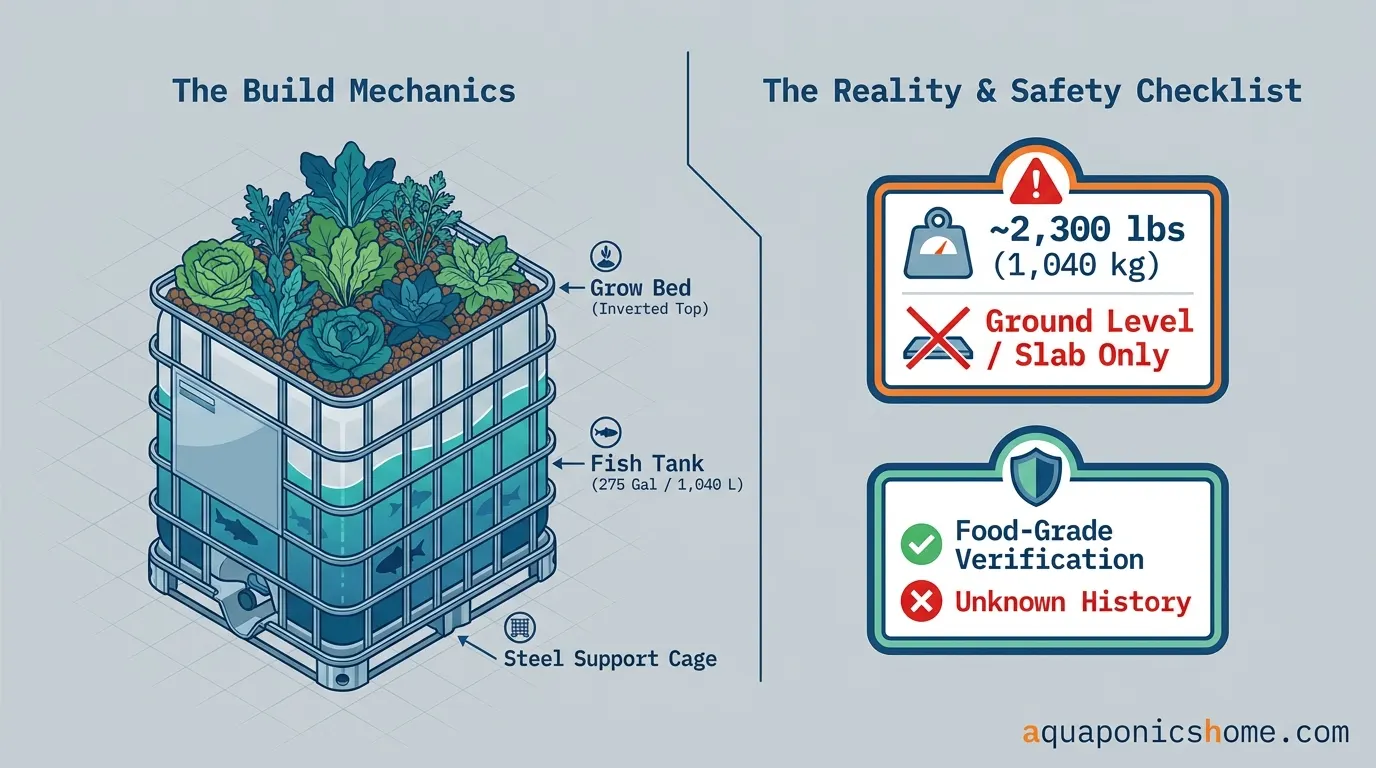
If you garden on a balcony in a rented flat, you probably do not need an IBC tote, and may not be able to use one safely. A tote holds a large volume of water concentrated on one small footprint, and most secondhand totes carry a chemical history the seller cannot document. On the ground, with space and a container whose past you can verify, it is an excellent tank. Above someone else’s ceiling, it is the wrong first system.
I have not built one. I want that in the first hundred words, because most writing about IBC totes comes from people who have, or from companies that sell them. I run a media bed on a rented balcony in Dhaka and I have rebuilt it twice. The tote is the build I keep looking at and keep not doing.
What an IBC tote actually is
An intermediate bulk container is industrial packaging. A plastic bottle sits inside a steel cage on a pallet base so a forklift can move bulk liquid around a warehouse. It was never garden equipment. The US Department of Transportation writes performance standards for these containers as packaging intended to transport hazardous materials (49 CFR Part 178, Subpart N). That is the world they come from before somebody puts fish in one.
The one you see in every build video is the big one. The University of Maryland Extension guide How to Build a Low-Cost, Small-Scale Aquaponic System (EM-2023-0698, by Franchini, Izursa and Little, updated October 2024) lists one repurposed 275-gallon food-grade IBC (roughly 1,040 liters) in its materials list. Treat that as the nominal capacity of a common size, not a universal spec.
Why IBC tote aquaponics became the default build
The standard build is the chop and flip. You cut the top section off the tote, turn that section upside down, and rest it on what is left. The lower part becomes the fish tank, the inverted top becomes the grow bed above it, and the cage carries everything.
Three real reasons it took over. Secondhand totes are inexpensive compared with a purpose-built tank of similar volume. The cage is a frame you do not have to design, weld or buy. And the finished system is large enough to behave itself, which is genuinely true. There is a fourth reason nobody says out loud: a white cube with lettuce on top films better than four buckets, and the videos that shaped this hobby were made by people with a yard.
The honest case for the tote: volume is forgiving
Small water volumes swing. Temperature, ammonia and pH move faster in less water, so a beginner’s mistake arrives as a spike rather than a drift. More water buys you time to notice.
This is not a preference, it is the recommendation. FAO Fisheries and Aquaculture Technical Paper 589 (Somerville et al., 2014) reports that growing fish for consumption is not recommended in a tank under 500 liters (about 130 US gallons). A nominal 275-gallon tote clears that floor comfortably. The other end of the scale is covered in why the smallest system is the hardest to run.
My first batch of catfish died inside a month. More water would not have saved me, because I caused it by over-cleaning and starving the bacteria. It would have slowed everything down while I worked out what I had done.
What a full tote weighs, as arithmetic
Do this on paper before you fall in love with a build video.
Water weighs about 8.34 pounds per US gallon, or about 1 kilogram per liter. Take the nominal 275 gallons from the Maryland Extension build:
- 275 gallons multiplied by 8.34 pounds is about 2,290 pounds
- That is about 1,040 kilograms, or more than a US ton
- Of water only
Nothing else is in that number. Not the container, the cage, the grow media, the water trapped in that media, the plants, or the plumbing. And unlike a row of pots, it does not spread out. It is one mass on one footprint, and once it is full it never moves again.
I am not going to tell you what your balcony can carry. Nobody who has not seen your building can, and any page that hands you a number for a generic balcony is guessing with your safety and your neighbors’. That question belongs to a qualified structural engineer and to your building’s own drawings or management records. How heavy a small aquaponics system really is walks through how to get a real answer from a real source. If you rent, have that conversation before the purchase, not after.
The question that decides it: what was in this tote before?
Build videos handle this in about four words. It deserves more, because it is the part that can quietly poison you.
The Southern Regional Aquaculture Center’s fact sheet Principles of Small-Scale Aquaponics (SRAC 5007, 2017) states that tanks can be made from intermediate bulk containers or barrels, and that only used bulk containers that held food-grade material and have been thoroughly washed should be used. Kentucky State University’s Aquaponics Production Manual (2021) is blunter: food-grade materials are necessary because many repurposed tanks may have held chemicals or hazardous materials, making them unsuitable for fish intended for consumption.
In plain words: you are going to eat what comes out of this. Water sits in that plastic for months, warm, circulating through fish and plant roots the whole time. So the rule is simple and it does not bend. Never use a tote whose previous contents are unknown for a system that grows food.
| What you can establish about the tote | What that means for a food system |
|---|---|
| New, bought as food grade | Fine. The most expensive route and the only one with no homework. |
| Used, and the seller can document the prior contents as food or drinking water | Workable. Ask for the record, not a verbal “I think it was juice,” then wash it thoroughly as SRAC 5007 requires. |
| Used, carries a food-grade marking, but no record of what went into it | Not good enough. A marking describes the container as manufactured. It says nothing about what the last three owners filled it with. |
| Used, prior contents unknown, seller does not know or will not say | No. Walk away. |
| Used, prior contents industrial: solvents, pesticides, cleaning chemicals, fuel additives | No. Not after any amount of cleaning. |
Two arguments people use to get around this, and neither holds. “I will scrub it out” addresses the surface, not what may have soaked into the plastic wall, and you cannot test that at home. “It was only detergent” is still not food. If you cannot establish provenance, the answer is no. The wider version of this question is in whether food from a home aquaponics system is safe to eat.
Who an IBC tote is genuinely right for
Not a rhetorical list. If you can say yes to these, go and build one.
- You are at ground level, or on a slab you own, with nobody living underneath
- You can document the container’s history, or you have budgeted for a new food-grade tote
- You want fish at edible scale, not herbs and two ornamentals
- You can reach all four sides, and you accept that it is permanent once filled
- If you rent, you have raised the weight and the water with whoever owns the building
None of this is sneering at the tote. It is the best inexpensive large tank in home aquaponics, extension services build with it, and the design works. It simply is not a balcony object.
What to build instead if you are on a balcony
Smaller vessels, more of them, spread across separate footprints instead of stacked on one. The two I would point a balcony reader at first are the barrel and bucket build and turning a spare aquarium into a system if you already have a tank in a cupboard.
Name the trade honestly, though. Less water means less structural risk and a worse buffer against your own mistakes. You pay for the lighter system with attention. On a rented balcony that is usually the right trade, because being tired is recoverable and a structural failure is not. The rest of the renter’s version of this hobby is in running aquaponics on a rented balcony.
FAQ
Can I use a secondhand IBC tote if I clean it thoroughly?
Only if you can establish what was in it. SRAC 5007 says to use only bulk containers that held food-grade material and have been thoroughly washed. Cleaning is the second condition, not a substitute for the first. If the history is unknown, no amount of scrubbing makes it a food container.
How much does a full IBC tote weigh?
Run the arithmetic on the container’s rating. Water is about 8.34 pounds per US gallon, or about 1 kilogram per liter, so a nominal 275-gallon tote holds roughly 2,290 pounds (about 1,040 kilograms) of water alone, before the tank, cage, media and plants. Whether your floor can take that is a structural question for a qualified engineer, not for a website.
Is 275 gallons too big for a first system?
The volume is not the problem. FAO Technical Paper 589 reports that fish for consumption should not be grown in under 500 liters, so a tote sits on the right side of that line. The constraint is what is underneath it, and whether you can verify the container.
Do I have to cut the tote at all?
No. The chop and flip is one design, not the only one. You can run the tote whole as a fish tank and build grow beds beside it. Cutting is irreversible, so settle the container’s history and the weight question first.