
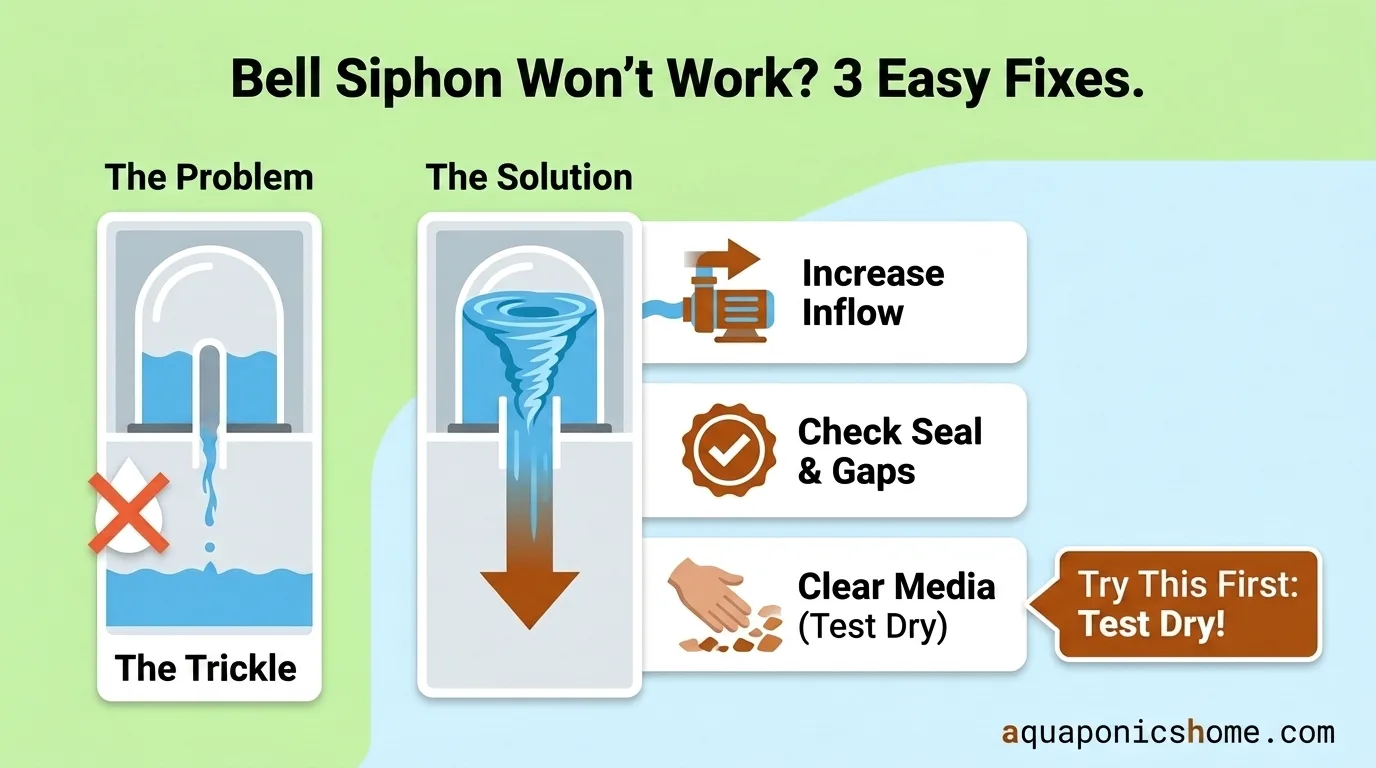
A bell siphon that only trickles and never fires almost always comes down to one of three things: the inflow rate is outside the range the siphon needs to build a pressure differential, an air gap or leak is stopping a proper seal from forming, or media is physically blocking the bell before the mechanism has ever been tested. The fastest first check, if you have not already done it, is to test the siphon dry, with no media in the bed at all.
That last part matters more than it sounds like it should. Between two rebuilds of my own system, resetting a bell siphon that would not fire is the piece of plumbing I have taken apart the most, and almost every time the problem traced back to one of those three things, never anything exotic.
The three reasons a bell siphon never fires
A bell siphon is a passive mechanism. There is no timer, no float switch, nothing electronic deciding when it drains. It works because water rising inside the bell eventually creates enough of a pressure difference between the inside of the bell and the standpipe to pull air out and start a siphoning action that empties the bed on its own. When that never happens, the cause sits in one of three places.
Inflow rate. The water has to arrive fast enough, relative to how the bell and standpipe are built, for the pressure to build before it can drain back out through small gaps. Too slow, and the bed never fills enough to trigger anything, it just trickles through as fast as it arrives.
Seal and air gap. The bell has to seat well enough that air cannot sneak in and equalize the pressure before a vacuum can form. A gap you cannot even see can be enough.
Media interference. Gravel, clay pebbles, or root mass sitting against or inside the bell can physically stop the seal from forming, or block the standpipe outright.
Test it dry before anything else goes into the bed
If you have already filled the bed with media and the siphon has never once fired, the single most useful thing you can do is take the media back out around the bell and test the mechanism with nothing in the way. This sounds like a step backward. It is actually the fastest way forward, because it removes one of the three variables completely and tells you whether the remaining problem is flow or seal.
I test every siphon dry now, before a single piece of media goes anywhere near it, and I only start filling the bed once I have watched it cycle a few times on its own. It is a habit that came from doing this the other way around and not being able to tell which of three possible faults I was actually looking at.
When the flow rate is the problem
If the water trickles through steadily and the bed never fills at all, the water is probably arriving slower than the siphon needs to ever build enough of a pressure differential to trigger. You will not get a gurgle, a rise, or a moment where anything seems close to firing. It just runs through.
The fix is to change the relationship between how fast water enters the bed and how fast it can leave through the gaps around the bell before the seal forms. That can mean increasing what the pump delivers, or it can mean adjusting the fittings on the drain side so water is not escaping as easily before the differential builds. Either direction works on the same principle: the bed needs to fill faster than it can quietly drain away, at least until the siphon takes over.
The seal that will not form: air gaps and leaks
If the bed fills, and you get a gurgle or a slow drain instead of a clean trigger, look at the seal rather than the flow. Anywhere air can get into the space the siphon depends on, whether that is where the bell meets the base, a loose fitting, or a bell that has warped slightly and no longer sits flush, is a place the pressure differential leaks away before it can do its job.
Check that the bell sits evenly and is not rocking or tilted. Check every joint between the standpipe and the bell for a snug fit. None of this requires new parts most of the time. It requires taking the assembly apart, looking at it properly, and putting it back together straighter than it was.
When media is the real problem
This is the cause the rest of the internet talks about least, and in my experience it is one of the most common. If media went into the bed before the siphon was tested, gravel or clay pebbles can lodge against the base of the bell or work their way into the standpipe itself, physically preventing the seal from ever closing.
The tell is a siphon that worked, or seemed close to working, before the bed was planted, and has done nothing but trickle since. Pull the media away from the bell, retest dry, and if it fires cleanly with the media cleared, you have your answer.
The fix from there is either a wider gap between the bell and the base, or a barrier that keeps media away from the mechanism without stopping the water. For the reasoning behind why a media bed is built this way at all, see the media bed aquaponics guide.
Diagnostic checklist
| Symptom | Likely cause | Fix |
|---|---|---|
| Water trickles out continuously, bed never fills, no gurgle at all | Inflow too slow relative to the siphon’s design | Increase what the pump delivers, or adjust the drain-side fittings so the bed fills faster than it drains |
| Bed fills, gurgles, then drains slowly instead of triggering | Air leaking into the seal | Check the bell sits flush and level, tighten every joint, look for warping |
| Fires cleanly with no media, stalls once the bed is planted | Media packed against or inside the bell | Clear media away from the base of the bell, retest dry, then rebuild the barrier around it |
| Worked once, then stopped, no clear pattern | Combination of a marginal seal and inconsistent inflow | Isolate one variable at a time: test dry first, adjust flow, then reintroduce media gradually |
This is not the flood problem
If your siphon fires and will not stop, running all night and emptying the tank into the bed until the floor is wet, that is the opposite failure and a different article’s territory.
I have been through that one myself, and it is covered separately in why the siphon stopped working and flooded the floor. This article is about a siphon that has never once triggered. That one is about a siphon that triggered and then refused to reset. Different mechanism, different fix, worth reading the right one for what you are actually looking at.
When to stop tinkering and start over
There is a point, after enough small adjustments, where the honest move is to rebuild the assembly rather than keep nudging it.
If you have tested dry, corrected the seal, cleared the media, and it still will not fire consistently, the bell and standpipe combination itself may be the wrong fit for each other rather than for anything you are doing wrong. Start again with a bell and standpipe you know fit properly before you troubleshoot further.
For the wider list of what tends to go wrong in a small system and roughly how urgent each one is, the troubleshooting guide is the place to start next time something is not behaving.
FAQ
Why does my bell siphon just trickle and never cycle?
Almost always one of three things: the water is arriving too slowly to build the pressure needed to trigger the siphon, air is leaking into the seal before a vacuum can form, or media is physically blocking the bell. Testing the siphon dry, with no media in the bed, is the fastest way to tell which one you are dealing with.
Do I need to buy new parts to fix a bell siphon that will not start?
Usually not. Most first-fire failures are a flow adjustment, a seal that needs to seat more evenly, or media that needs clearing away from the bell, not a design that needs replacing. Rebuilding with a different bell and standpipe fit is a last resort, after you have ruled out the other three causes.
Should I test my bell siphon before or after adding media?
Before. Test it dry first and confirm it cycles cleanly on its own. Adding media before you know the siphon works removes your ability to tell whether a later problem is flow, seal, or media, since all three are now tangled together.
Is a bell siphon that only works sometimes the same problem as one that never fires at all?
Related, not identical. A siphon that fires inconsistently usually has a marginal seal or a flow rate sitting right at the edge of what it needs, so it depends on small variables. A siphon that has never once fired points more toward one dominant cause, most often inflow rate or media blocking the bell, that needs to be found and fixed before the mechanism will ever work reliably.
Could my grow bed design be the actual problem, not the siphon?
It is worth considering once you have ruled out flow, seal, and media. How a grow bed is built and how water is meant to move through it affects what a siphon has to work with in the first place. That context lives in the media bed aquaponics guide, and my own build mistakes are on my about page if you want the fuller, less flattering version of how I learned this.