
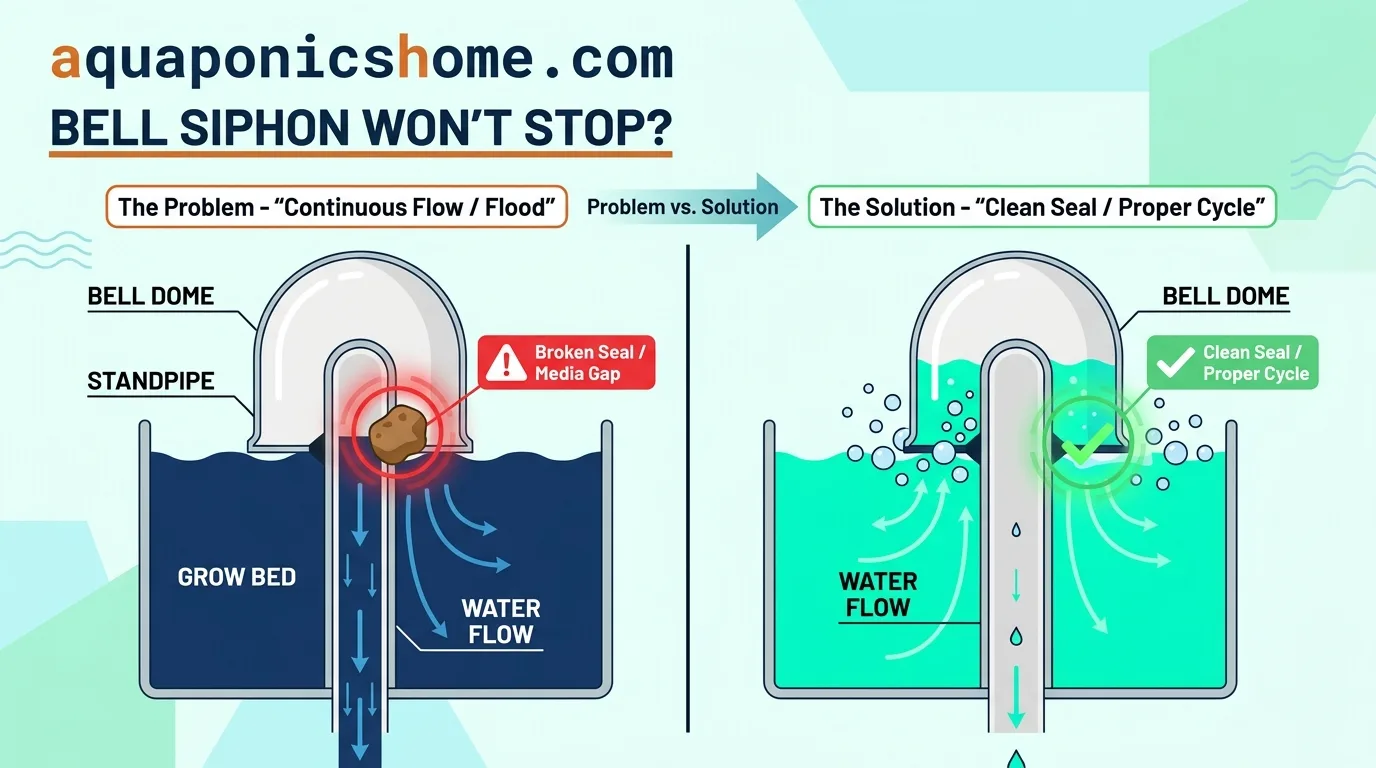
The most common reason a bell siphon stops working and runs continuously instead of shutting off is a broken seal: either an air leak where the bell meets its base, or grow media wedged under the bell so it never seats flat. The fastest check is to lift the bell out, wipe the seat clean, and set it back down flat before you touch anything else.
The night it happened here
My bell siphon ran all night once instead of shutting off, and water ended up across the floor. My downstairs neighbor was affected by it too, which is not a detail I enjoy writing down, but it is the honest reason I take this failure seriously now, and one of the failures I write about openly on my about page.
I do not know the exact hour it started and I am not going to invent a number I never actually measured. What I know is that the pump kept running while the siphon did not do its job, and by morning there was water where water should never be.
I already wrote about planning for that kind of night: the tray under the system, the drain path, the alarm that wakes you before the neighbor does, in aquaponics leak and overflow protection. This article is the other half of that night. Not how to contain the water once it is loose, but why the siphon itself stopped doing its job in the first place.
Why a bell siphon stops on its own when it is working
A bell siphon is not a valve someone opens and closes. It is a mechanical trick that uses air and water pressure against each other, and it only works if a seal forms and then breaks at the right moment.
While the grow bed floods, water rises around a standpipe hidden inside a bell (a cap or wide pipe sitting over the standpipe with a gap underneath). Once the water level reaches the top of the standpipe, water starts falling down the inside of it. That falling water drags air out of the space under the bell with it, and as long as the space under the bell stays sealed against outside air, a vacuum forms that pulls water up and over the top of the standpipe faster than the pump can put water back in. That is the siphon action, and it is what drains the bed quickly instead of slowly.
The siphon keeps pulling until the water level drops low enough to break the seal, usually by exposing a gap at the bell’s base that lets outside air rush in. Once air gets in, the vacuum collapses, the siphon stops, and the bed sits nearly empty until the pump refloods it and the cycle repeats. Every failure that makes a siphon “not work” is a failure of that seal, either sealing when it should not, or refusing to break when it should.
What “not working” actually looks like
Not every bell siphon failure looks the same, and the fix depends on which one you have.
A siphon that will not start at all means the bed floods and stays flooded, with no draining happening. A siphon that drains but never finishes leaves standing water in the bed after every cycle. A siphon that runs continuously is the one that caused my flood: it starts draining normally, then never breaks the seal, and keeps pulling water out of the tank for as long as the pump keeps feeding it, which at night is for hours.
That last failure is the dangerous one, because nothing about it looks urgent while it is happening. The bed is draining, which looks correct, right up until the tank runs low or the floor gets wet. If your problem is a different symptom, aquaponics troubleshooting sorts failures by how fast they can hurt something. This article stays with the runaway siphon specifically, because that is the one that overflows a floor.
Diagnostic checklist: four things to check, in order
Work through these in order. Each one is a seal problem or a flow problem, and the fix for each is different.
| What to check | What it looks like when it is the cause |
|---|---|
| Air leak in the seal | Water seeping around a joint that should be dry, especially where a bell built from separate pipe and cap pieces is glued or fitted together. The siphon may never build a full vacuum, or it loses the vacuum early and never fully drains. |
| Bell not seated properly | The bell sits tilted, off center, or slightly lifted off its base rather than flat and level. A siphon needs an even seal all the way around the bottom edge, and a tilted bell leaves a gap on one side that lets air in too early or too late. |
| Debris or media breaking the seal | Grow media, a stray root, or a buildup of biofilm caught under the rim of the bell, physically holding it up or wedging a gap open. This is the most common cause in a media bed that has been running a while without being checked. |
| Flow rate mismatched to the siphon’s break point | Water entering the bed faster than the siphon was set up to handle, so the vacuum never gets the chance to release. This is also the failure that turns a working siphon into a runaway one if you increase your pump flow later without rechecking the siphon. |
I am not going to attach exact pipe sizes or flow numbers to this table. Every siphon build I have seen written up with confident inch measurements or flow rates was describing one specific build, on one specific bed, and treating those numbers as universal is exactly what sends people down the wrong repair.
The mechanism above is what actually holds across builds. The dimensions of your own bell and standpipe are something you check against your own working siphon, or against a build guide written for the parts you actually have, not against a number from someone else’s tank.
After the fix: trusting it overnight again
Once you think you have found the cause, do not walk away and trust it immediately. Run the system and watch several full flood and drain cycles in a row, in daylight, with nobody needing to be anywhere else. A siphon that breaks cleanly five times in a row and then fails on the sixth is telling you the underlying cause, debris settling back in, a seal that is degrading, is still there.
Only after a fix has held through several clean cycles would I trust it through a night unwatched again, and even then I keep the containment layer from aquaponics leak and overflow protection in place regardless.
A tray, a clear drain path, and an alarm are not admissions that the siphon fix failed. They are what catches the next failure you have not met yet, from a cause you have not seen before. The siphon’s role in draining a media bed, and why that bed depends on the draining as much as the flooding, is covered in media bed aquaponics if you want the fuller picture of what the siphon is actually doing for the system.
FAQ
Why does my bell siphon run continuously instead of stopping?
Almost always because the seal at the base of the bell never breaks. Something is keeping outside air from reaching the gap it needs to reach: a bell sitting slightly off its seat, debris wedging a gap open in the wrong place, or a flow rate high enough that the vacuum never has a moment to release. Check the seal and the bell’s seating first.
Why did my bell siphon stop working overnight when it worked fine before?
Siphons drift out of adjustment as media settles, roots grow into the gap under the bell, or biofilm builds up on the sealing surfaces over weeks, not on a fixed schedule. A siphon that worked for a month can fail on any given night once enough of that buildup accumulates, which is why a periodic check matters even when nothing looks wrong yet.
Can I fix a bell siphon without buying new parts?
Often, yes. Lifting the bell out, clearing debris from the base and the standpipe, rinsing the seal surfaces, and reseating the bell flat resolves a large share of failures with no new hardware. Replacement becomes worth considering only after cleaning and reseating have been tried and the same failure keeps coming back.
How do I know if debris is causing my bell siphon to fail?
Lift the bell straight up and look at the base it was sitting on. Grow media, a root, or a slimy buildup sitting in the seal path is visible once the bell is out of the way. If the base looks clean and the bell sits flat when you set it back down, look at the seal at the joints instead.
Is a bell siphon failure actually dangerous?
It is a water damage risk, not a personal safety risk from the siphon itself, but a siphon that runs continuously overnight can move a meaningful amount of water onto a floor, and in a rented unit that can affect the space below you as it did in mine. The containment side of that risk, the tray, the drain path, the alarm, is covered separately in aquaponics leak and overflow protection, and worth reading alongside this one rather than instead of it.
I run small aquaponics systems on a rented balcony and I have had the overnight bell siphon failure this article describes. I am not an aquaponics engineer, and nothing here should be read as a guaranteed fix for every build. If a repair does not hold after several clean cycles, treat it as still unresolved rather than trusting it through another unwatched night.