
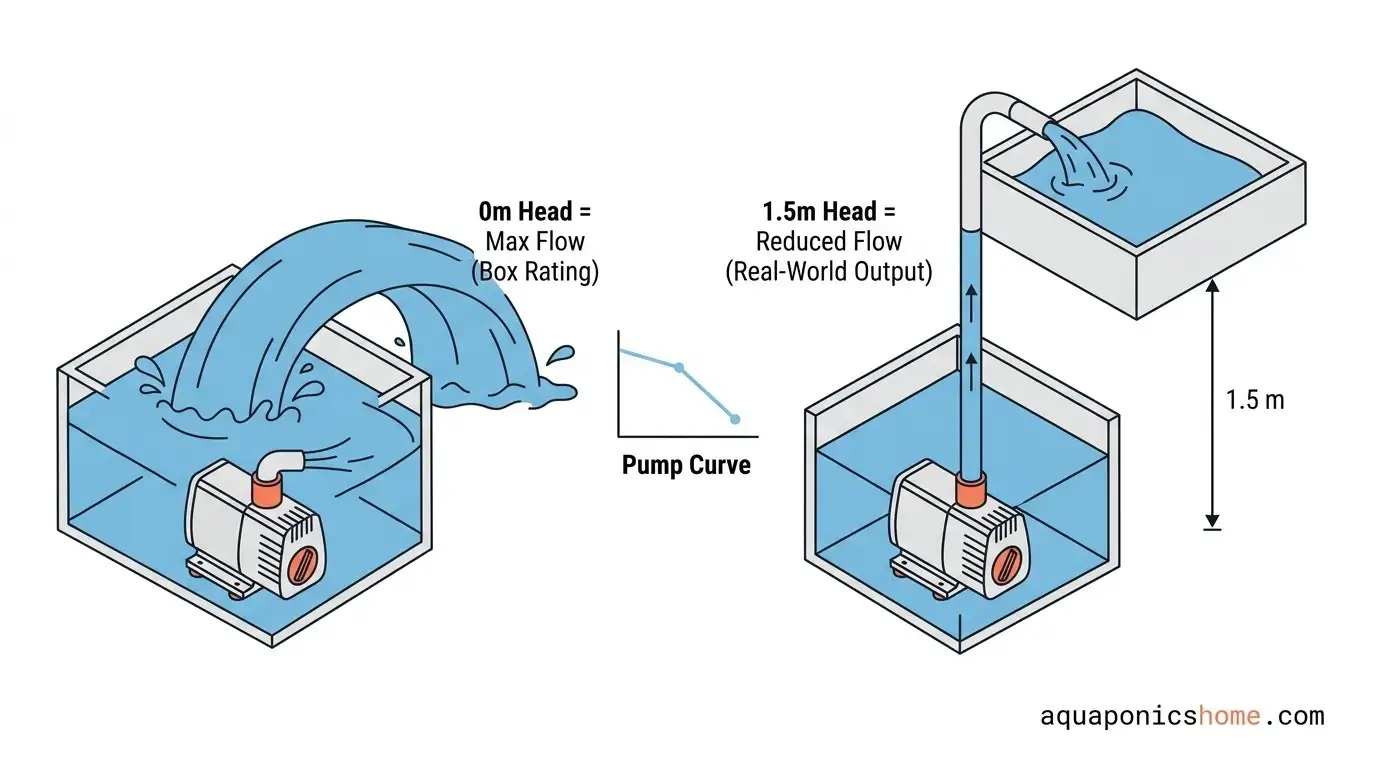
Aquaponics pump size depends on two numbers: how much water you need to move each hour, and how high the pump has to lift it. The flow printed on the box is measured with almost no lift, so it overstates what you will get.
To size a pump, work out your target flow, measure your head height, then check the maker’s pump curve to see what the pump delivers at that height. Aim for a pump that meets your target at your height with a modest margin, not the biggest one on the shelf.
The rest of this guide walks through each step, in liters and meters, with a simple way to check the result once the pump is running.
The Two Numbers That Decide Pump Size
Every pump box shows a flow rate, in liters per hour (L/h) or gallons per hour (GPH), and often a “max head” or “max height.” These two numbers describe the ends of a curve, not what you will get in your system.
- Flow rate is how much water the pump moves in an hour.
- Head height is how high it has to push the water.
They trade against each other. North Dakota State University Extension’s publication Irrigation Water Pumps by extension agricultural engineer Thomas F. Scherer (AE1057, reviewed February 2022, read 2026-09-27) explains that a pump curve shows flow against total head, and that the higher the head, the less water the pump moves. It is written for irrigation pumps, but the physics is the same for the small pump in your fish tank.
So the headline flow on the box is close to what the pump moves with almost no lift. The “max head” figure is roughly the height at which the flow drops to nothing. Your system sits somewhere in between.
Step 1: Work Out the Flow You Need
Flow is expressed as turnover: how many times per hour the full volume of water in the system passes through the pump.
Suppliers publish rules of thumb for this. ZipGrow, a commercial vertical farming equipment maker, recommends “turning over your entire system volume at least twice per hour” in its pump sizing guide.
Other aquaponics publishers use similar turnover rules, and the right figure also depends on how heavily you stock fish: a crowded tank produces more waste and needs more filtering and oxygen than a lightly stocked one.
To turn a turnover rule into a target:
- Add up the water in the whole system: fish tank, sump if you have one, and the water held in the grow bed.
- Multiply by the number of turnovers per hour from the rule you are following.
Illustration only: a system holding 300 liters in total, turned over twice an hour, needs about 600 L/h delivered at the grow bed. That is the flow you need after the pump has lifted the water, not the number on the box.
If your system has a bell siphon, there is a second constraint on flow, which we come to below.
Step 2: Measure Your Head Height
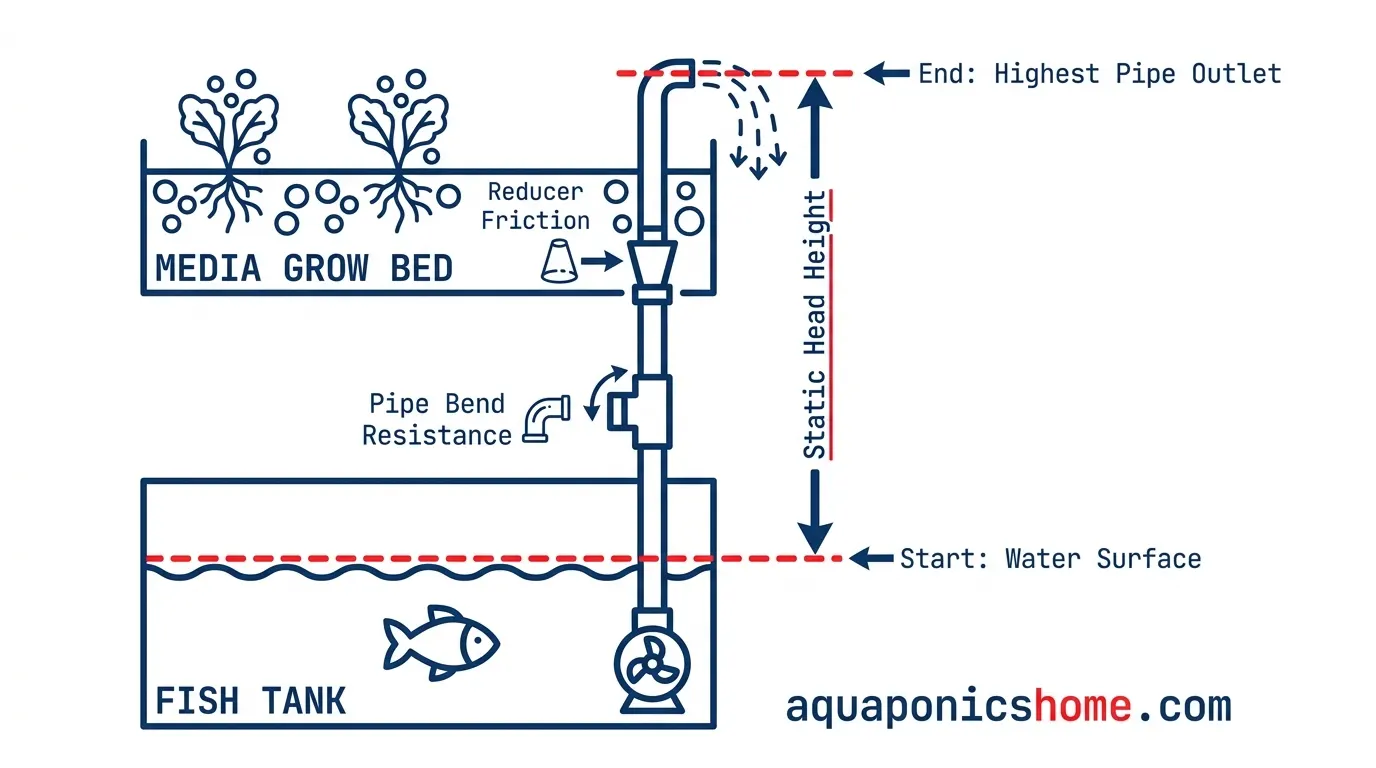
NDSU’s publication defines static head as “the vertical distance the pump must lift the water.” For a home system, measure:
- From: the surface of the water where the pump sits (the fish tank or sump).
- To: the highest point the water reaches before it falls, the outlet above the grow bed.
A tape measure is enough. Measure from the water surface, not from the pump itself, because a submersible pump is already under water.
A few common layouts:
- Tank on the floor, grow bed on a stand above it: head is roughly the height from the tank’s water surface to the outlet over the bed.
- Grow bed beside the tank, level with it: head is small, just the rise from the water surface to the outlet.
- Vertical towers or stacked beds: head is the height to the top outlet, which can be much larger. Our guide to vertical aquaponics and where the water goes covers why tall systems need more pump.
Step 3: Add the Losses Nobody Mentions
Height is not the only thing working against the pump. NDSU explains that friction head is “the energy loss or pressure decrease due to friction when water flows through pipe networks,” and that pressure drops “when water flows through straight pipe sections, fittings or valves; around corners; and where pipes increase or decrease in size.”
In a small system that means:
- Long runs of narrow pipe or tubing cost more flow than short, wide ones.
- Every elbow, tee and valve adds a little resistance.
- Reducers, where the pipe narrows to fit a pump outlet, cost flow.
- A clogged pre-filter or intake can cut flow badly.
ZipGrow’s guide suggests allowing for “a 15% to 30% loss of efficiency” from hose length and plumbing. Treat that as a supplier’s rough allowance, not a precise figure. The practical lesson: keep pipe runs short, use as few bends as you can, and keep the pipe diameter generous.
Step 4: Read the Pump Curve
Most pump makers publish a chart, called a pump curve or head curve, on the box, in the manual or on their website. It shows flow on one axis and head on the other.
To use it:
- Find your head height on the head axis.
- Follow across to the curve.
- Read down to the flow axis. That is roughly what the pump delivers at your height, before friction losses.
If that number, minus an allowance for friction, still meets your target flow, the pump is a reasonable fit.
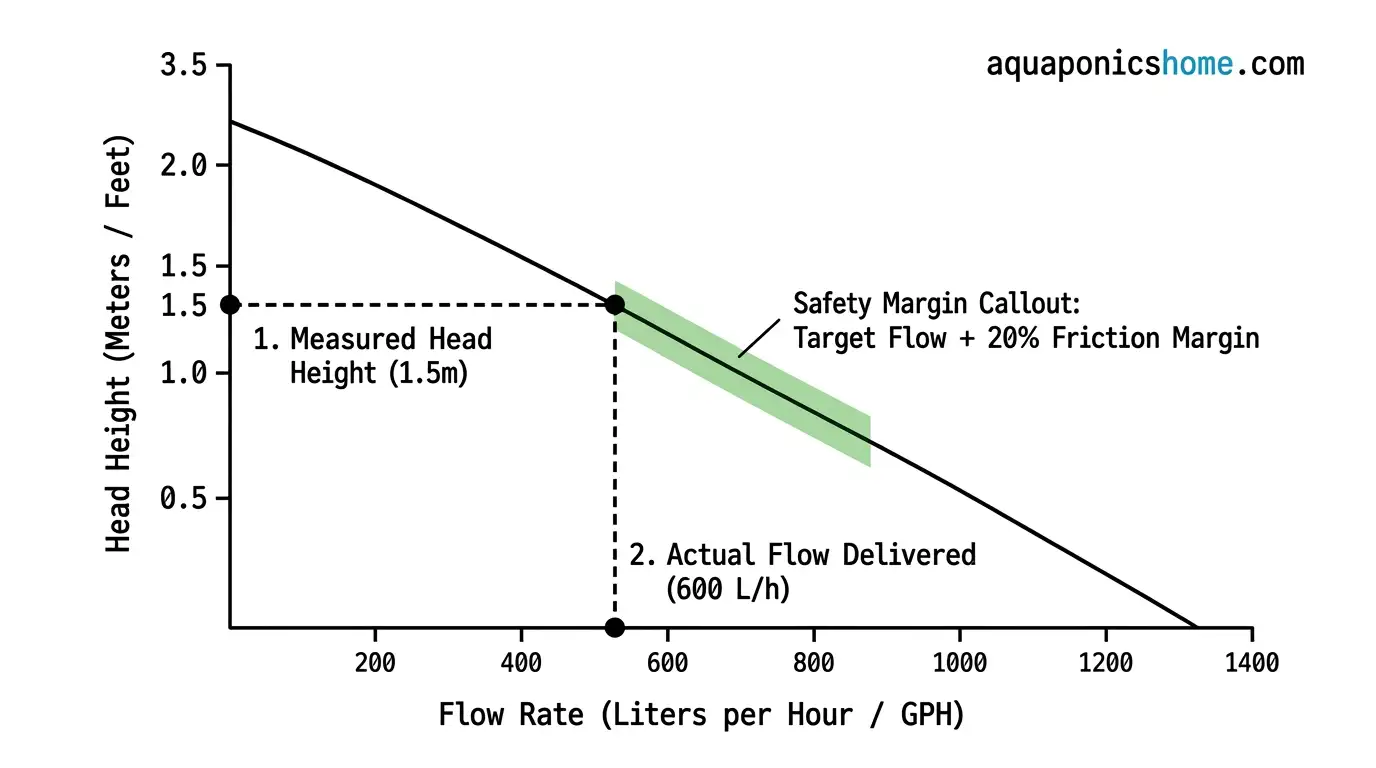
ZipGrow’s guide makes the key point: “pump efficiency at different head heights is almost never a linear relationship.” In other words, you cannot take the box flow and subtract a bit per meter of lift.
Use the chart for the exact pump you are considering. If a maker publishes no curve at all, that is a reason to look at a different pump, because you cannot size it properly.
Why Bigger Is Wrong
The common advice is to buy a bigger pump “to be safe” and turn it down. In aquaponics, an oversized pump causes problems.
It can stop a bell siphon from working
A bell siphon only works within a range of incoming flow. It needs enough flow to start the siphon, but it also needs the incoming water to be slower than the rate the siphon drains, so the bed can empty and the siphon can break.
Too much flow and the siphon runs forever or never fully drains the bed. If your siphon keeps trickling or never breaks, the flow into the bed is one of the first things to check, as explained in bell siphon not working: the causes.
It overwhelms the grow bed
Too much water arriving too fast can flood a media bed faster than it drains, stir up settled solids, and push fine particles back into the fish tank.
It stresses the fish
A strong current in a small tank makes fish work harder. Fish need calm water to rest in.
It wastes electricity and adds heat
NDSU notes that a pump “will operate at peak efficiency only in a narrow range of flow rate and TDH,” meaning total dynamic head.
A pump chosen far outside that range for your system does not use its power well. A submersible pump also releases some of its heat into the water, which matters in a hot climate where the water is already warm.
Throttling is a patch, not a plan
A valve can reduce flow from a large pump, and a small amount of adjustment is useful. But a pump running against a heavily closed valve is still a pump that does not match the system. A pump that meets your target near its natural operating point is the better choice.
The right-size pump meets your target flow at your head height, with a modest margin for friction and for the pump slowing as it ages. A little headroom that you trim with a valve is fine. Double or triple what you need is not.
Check It Once It Is Running: The Bucket Test
After installing a pump, measure the actual flow. It takes a minute and uses a bucket and a phone timer.
- Put a bucket of known volume under the outlet where water enters the grow bed. A 10-liter bucket works well.
- Time how many seconds it takes to fill.
- Work out liters per hour: volume ÷ seconds × 3,600.
Illustration only: if a 10-liter bucket fills in 60 seconds, the flow is 10 ÷ 60 × 3,600 = 600 L/h.
Compare that to your target. Write it down, too. Repeat the test every few months. A falling number is an early warning of a clogged intake or a wearing pump, and our guide on what to do when an aquaponics pump is not working covers the checks when flow drops.
Other Things Worth Checking Before You Buy
- Submersible or inline. Most small home systems use a submersible pump that sits in the fish tank or sump. Inline pumps sit outside the water and are more common in larger systems.
- Intake protection. A pre-filter or sponge on the intake keeps fish, roots and debris out of the impeller. Check it is easy to reach and clean.
- Electrical safety. A mains pump sits in water that you put your hands in. Plug it into a socket protected by a residual current device (called a GFCI in the US and an RCD in the UK and many other countries), and loop the cable below the socket so drips cannot run into it. Anything involving fixed wiring or adding sockets is work for a licensed electrician.
- Where it goes on your list. The pump is one line on the aquaponics equipment list for beginners, and matching it to the rest of the system matters more than its brand.
FAQ
What size pump do I need for aquaponics?
One that delivers your target flow at your head height. Work out your total water volume, multiply by the turnover rate you are following, measure the height from the water surface to the outlet, then check the maker’s pump curve. The flow on the box is not what you will get once the pump has to lift water.
What is head height in aquaponics?
The vertical distance the pump has to lift the water, measured from the water surface where the pump sits to the highest outlet, above the grow bed. Pipe bends, fittings and long runs add further resistance on top of that height.
How many times per hour should aquaponics water circulate?
Suppliers publish rules of thumb. ZipGrow, for example, recommends turning over the entire system volume at least twice per hour. The right rate also depends on how heavily the system is stocked with fish.
Can an aquaponics pump be too big?
Yes. Too much flow can stop a bell siphon from draining, flood the grow bed, stir up solids, stress fish and waste electricity. A small margin trimmed with a valve is fine; a pump several times larger than you need is not.
How do I measure my pump’s actual flow?
Time how long the pump takes to fill a bucket of known volume at the outlet, then calculate liters per hour as volume divided by seconds, multiplied by 3,600. Repeat every few months to spot a failing pump or clogged intake early.