
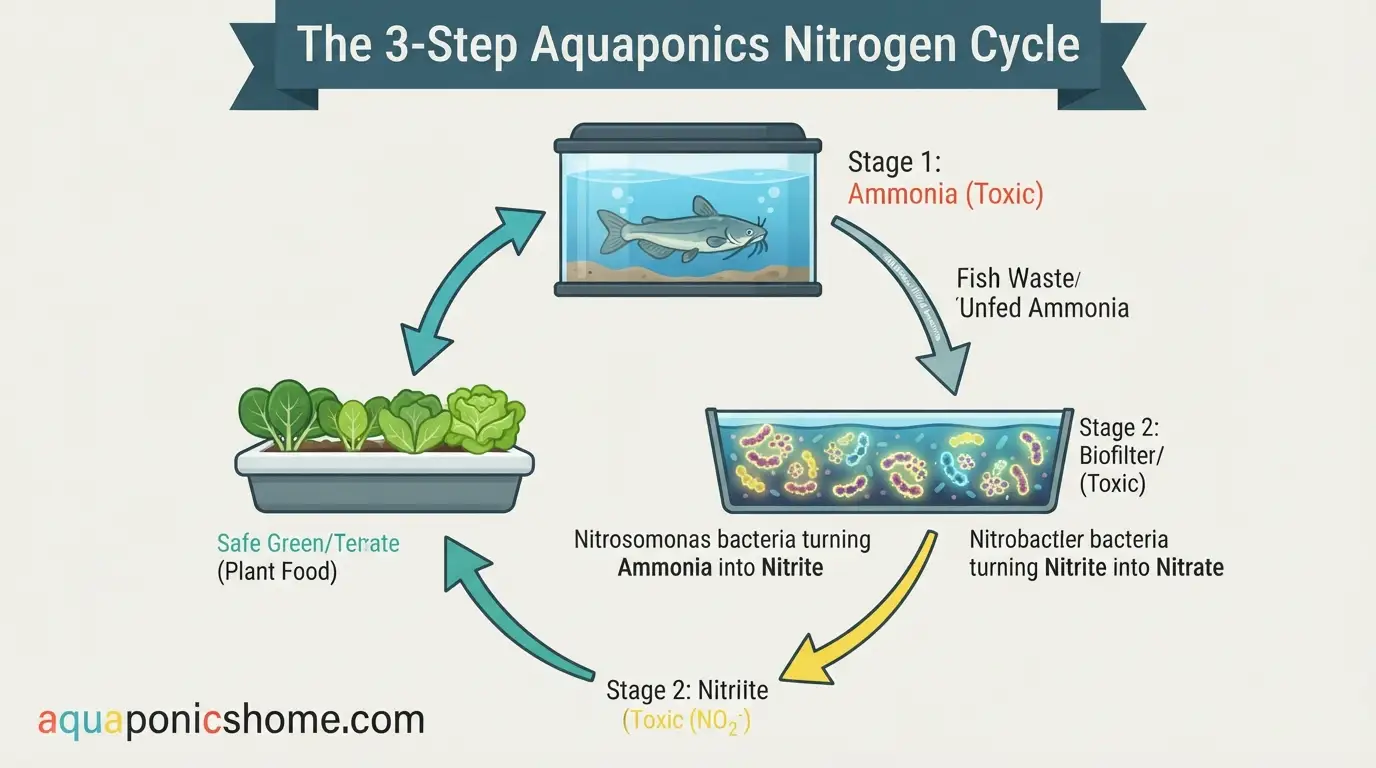
Short answer: Cycle the system before you add a single fish. Put an ammonia source into the water, let a colony of nitrifying bacteria grow on it, and wait until your test kit shows ammonia and nitrite both reading zero with nitrate present. That is a “cycled” system, and the published estimates run from about three weeks to eight, with the FAO reporting 25 to 40 days in good conditions and longer in cool water. Add fish before this happens and they swim in their own waste, because there are no bacteria yet to convert that waste into something harmless. This is called fishless cycling, and it is the single easiest way to keep new fish alive.
If you already added fish and they are struggling, skip ahead to the fish-in section below, then read our fish dying triage guide.
Why new aquaponics systems kill fish
A fresh system looks perfect. Clean water, running pump, happy plants waiting. It is also, biologically, a desert.
Fish constantly excrete ammonia through their gills and waste. Ammonia is toxic to fish even at low levels. In a working system, two groups of bacteria handle it: ammonia-oxidizing bacteria turn ammonia into nitrite, and nitrite-oxidizing bacteria turn nitrite into nitrate. Nitrate is far less toxic, and it is exactly what your plants want to eat. This chain is the nitrogen cycle, and the University of Hawaii’s aquaponics materials and the Oklahoma State University Extension fact sheet on media bed nitrification both describe it the same way.
Here is the catch. Those bacteria are not in your new system yet. They have to arrive and multiply, and they multiply slowly. In a brand new tank there is nothing to convert ammonia to nitrite, and nothing to convert nitrite to nitrate. Both are toxic. So when a beginner drops fish into an uncycled system, the ammonia climbs with nowhere to go, and the fish are poisoned by their own waste within days.
That is the honest reason most first fish die. Not disease. Not bad luck. Ammonia poisoning in a system that was never cycled.
How I killed my first catfish by cleaning
I learned this the hard way on my balcony in Dhaka. My first setup was a plastic tank, a small pump, and a batch of catfish, and I was proud of how clean I kept it. I scrubbed the tank walls, rinsed the media, changed water when it looked cloudy. I thought clean water was healthy water.
I was starving the exact bacteria that keep fish alive. Those colonies live on surfaces: the media, the tank walls, the biofilter. Every time I scrubbed everything spotless, I wiped out the workforce that was supposed to process the ammonia. The catfish died, and for a while I could not understand why, because the water looked beautiful.
Beautiful water and safe water are not the same thing. You cannot see ammonia. You have to test for it.
Fishless vs fish-in cycling: pick by your risk
There are two ways to cycle. One is far safer for the fish.
| Fishless cycling (recommended) | Fish-in cycling | |
|---|---|---|
| Ammonia source | You add it (pure ammonia or fish food) | The fish produce it |
| Risk to fish | None; no fish present yet | High; fish live in toxic water while bacteria grow |
| Your workload | Test, top up ammonia, wait | Frequent water changes, constant testing |
| Best for | Almost everyone | Only if you already have fish and cannot rehome them |
Fishless cycling is the method I use now and the one welfare-focused sources recommend, because no animal has to suffer through the toxic weeks while the bacteria establish. Fish-in cycling is a rescue plan, not a first choice. If you are converting an old aquarium, our fish tank to aquaponics conversion guide covers how to keep any existing bacteria alive so you shorten this step.
Fishless cycling, step by step
- Fill and run the system. Dechlorinate the water first. Tap water in most cities contains chlorine or chloramine, which kills the very bacteria you are trying to grow. Let the pump run so water moves through the grow bed.
- Add an ammonia source. Use a bottle of pure household ammonia with no fragrances, surfactants, or additives, or simply drop in a small amount of fish food and let it rot. On the dose, the FAO’s 2014 aquaponics manual reports adding ammonia to reach 1 to 2 mg/liter, and doing a water exchange if the level ever goes above 3 mg/liter. Oklahoma State Extension sets its ceiling at 4 ppm. Aim low and top up rather than dosing heavily once, because you can always add more and you cannot easily take it back out.
- Keep feeding the bacteria. As the bacteria consume ammonia, top it back up to keep a food supply. Do not let it crash to zero in the early weeks or the young colony starves.
- Test every two to three days and write it down. You are watching for a pattern, not a single number.
- Wait for the handoff. Ammonia will spike, then start to fall as nitrite appears. Nitrite will spike, then fall as nitrate climbs. When you can add a normal ammonia dose and it converts fully to nitrate within about 24 hours with no nitrite showing, the system is cycled.
That “add ammonia, watch it disappear to nitrate overnight” test is the clearest proof the colony is strong enough for fish.
Testing: the two numbers that matter
You need one liquid test kit that reads ammonia, nitrite, and nitrate. Liquid kits are more reliable than paper strips for this job. That is the only piece of equipment cycling actually requires.
Two numbers decide everything:
- Ammonia must reach and hold near zero. Ammonia is the first and most dangerous toxin.
- Nitrite must reach and hold near zero. Nitrite is also toxic to fish, less so than ammonia but still harmful, and it lingers because the second bacteria group is the slower one to establish.
Nitrate is the good news number. Seeing nitrate climb while ammonia and nitrite fall to zero means both bacteria groups are working. That combination, ammonia zero, nitrite zero, nitrate present, is the definition of a cycled aquaponics system.
One caution about that ammonia reading. Your test kit measures total ammonia, but only the un-ionized part (NH₃) is what actually poisons fish, and how much of your reading is that toxic form depends on pH and temperature.
As reported by University of Florida IFAS, un-ionized ammonia is roughly 100 times more toxic than the ionized form and its damage begins as low as 0.05 mg/L. The FAO manual adds that hobby test kits cannot tell the two apart, and that where pH is high, any detectable ammonia is especially dangerous.
So a warm balcony system in a hot climate is genuinely less forgiving than a cool indoor tank at the same number on the vial. Test pH and temperature alongside ammonia rather than reading the ammonia figure on its own.
The aquaponics cycling timeline, week by week
Every system is different, but the pattern is consistent:
- Week 1 to 2: Ammonia climbs. Nitrite and nitrate still near zero. The first bacteria are just arriving.
- Week 2 to 4: Ammonia peaks and begins to drop. Nitrite appears and climbs. This is the halfway point.
- Week 4 to 6: Nitrite falls toward zero. Nitrate rises. Ammonia clears quickly when dosed. The system is finishing.
The published figures do not all agree, which is worth knowing before you decide your system is broken. The FAO’s manual reports about 25 to 40 days in good conditions, roughly three to five weeks, and warns that cool water can stretch it to two months.
University of Florida IFAS puts a new biofilter at six to eight weeks. Oklahoma State Extension says at least four weeks are needed before growing anything. Treat three to eight weeks as the honest band, and treat anything faster than three weeks as a reason to re-check your readings rather than to celebrate.
“It has been six weeks and nothing is happening”
Stalls almost always trace to one of these:
- Chlorinated top-ups. Every time you add untreated tap water you kill bacteria. Dechlorinate every refill.
- Wrong pH. Nitrifying bacteria slow down badly in very acidic water. Keep pH in a moderate range.
- Cold water. Bacteria multiply slower when it is cold. Warmth speeds cycling.
- No ammonia left. If you let ammonia crash to zero and never topped it up, you starved the colony. Add a small dose and resume.
Fix the cause, keep testing, and the numbers will move.
The safer way to do fish-in cycling
Sometimes you already have fish and cannot rehome them. You can still cycle with fish in the system, but your job is to keep them from being poisoned while the bacteria catch up.
- Test daily, not every few days. With fish present, ammonia can climb fast.
- Change water aggressively. Whenever ammonia or nitrite rises above near-zero, do a partial water change with dechlorinated water to dilute it back down. This is the whole game in fish-in cycling: keep both toxins as close to zero as you can, every day, for weeks.
- Feed lightly. Less food means less ammonia. Underfeed during cycling.
- Choose hardy fish. Species known for tolerance, such as tilapia, handle the stress better than delicate fish. This does not make it safe, only survivable.
Fish-in cycling works, but it asks the animal to endure conditions fishless cycling avoids entirely. Treat it as a last resort.
When it is safe to stock fully, and stock slowly
Once ammonia and nitrite hold at zero with nitrate present, you can add fish. Do it gradually. A young colony can handle a few fish, not a full tank on day one. Add a small group, keep testing for a few days to confirm ammonia and nitrite stay at zero, then add more. If a reading spikes, the colony is not yet big enough for that many fish. Slow down.
For stocking density and species suited to a small balcony setup, see our balcony aquaponics guide.
The part most cycling guides leave out
Three honest things nobody selling you a kit tends to say.
Patience is the whole skill. Cycling cannot be rushed into a weekend. The bacteria grow at their own pace, and those weeks are not padding, they are biology. The single biggest cause of dead beginner fish is impatience: adding fish before the system is ready.
Most first fish deaths are avoidable ammonia poisoning, not bad luck. If you cycle first and test, you remove the number-one killer entirely. That is within your control.
Plants alone do not replace the cycle. Healthy plants are wonderful, and they do use up nitrate, but plants do not convert ammonia to nitrite to nitrate. Bacteria do that. A grow bed full of thriving spinach can still have ammonia spiking to lethal levels if the bacterial colony is not established. Green leaves are not proof of a safe cycle. Only your test kit is.
Cycling is not the exciting part of aquaponics. It is the part that decides whether your fish live. Do it first, test the two numbers, and wait for zero.
FAQ
Can I speed up aquaponics cycling?
Somewhat. Keeping the water warm, keeping pH in a moderate range, and adding bottled nitrifying bacteria or media from an established system can shorten it. You still cannot safely skip it. Warm and stable helps; rushing fish in does not.
Can I use media or filter gunk from an old tank to cycle faster?
Yes, and it is one of the best shortcuts. A handful of media, gravel, or filter material from a healthy, established tank carries live bacteria and can significantly speed up a new cycle. Keep it wet and add it early.
Do I need bottled bacteria “in a bottle” to cycle?
No. A system will cycle on its own from bacteria in the air and water. Bottled nitrifying bacteria can give the process a head start, but they are optional, not required.
How do I know for certain the system is cycled?
Go by the published finish lines rather than a single overnight test, because the popular “dose it and see if it clears in 24 hours” check does not come from any extension service or the FAO, only from hobby forums and bacteria sellers. The FAO manual defines the end of cycling as the point where nitrate is steadily increasing, nitrite reads 0 mg/liter, and ammonia is below 1 mg/liter. New Mexico State University Extension says the system is fully cycled once nitrates are detectable and both ammonia and nitrite have dropped to 0.5 ppm or lower. Oklahoma State Extension is stricter, looking for nitrate at 40 to 50 ppm with ammonia and nitrite at 0 to 0.25 ppm. Hit any of those and keep testing as you stock.
My fish are already dying in a new system. What do I do right now?
Do an immediate partial water change with dechlorinated water to dilute the ammonia and nitrite, stop feeding, and test. Then see our fish dying triage guide. For animal-health questions beyond water quality, consult a qualified aquatic vet.
Sources: Somerville, Cohen, Pantanella, Stankus and Lovatelli, “Small-scale aquaponic food production: integrated fish and plant farming”, FAO Fisheries and Aquaculture Technical Paper No. 589, 2014; Deer, Hu, Dunn and Dusci, “Nitrification and Maintenance in Media Bed Aquaponics”, Oklahoma Cooperative Extension Service HLA-6729, 2021; Sallenave, “Important Water Quality Parameters in Aquaponics Systems”, New Mexico State University Extension Circular 680; Francis-Floyd, Watson, Petty and Pouder, “Ammonia in Aquatic Systems”, University of Florida IFAS Extension FA16. Cycling advice is not a substitute for veterinary care for sick fish.