
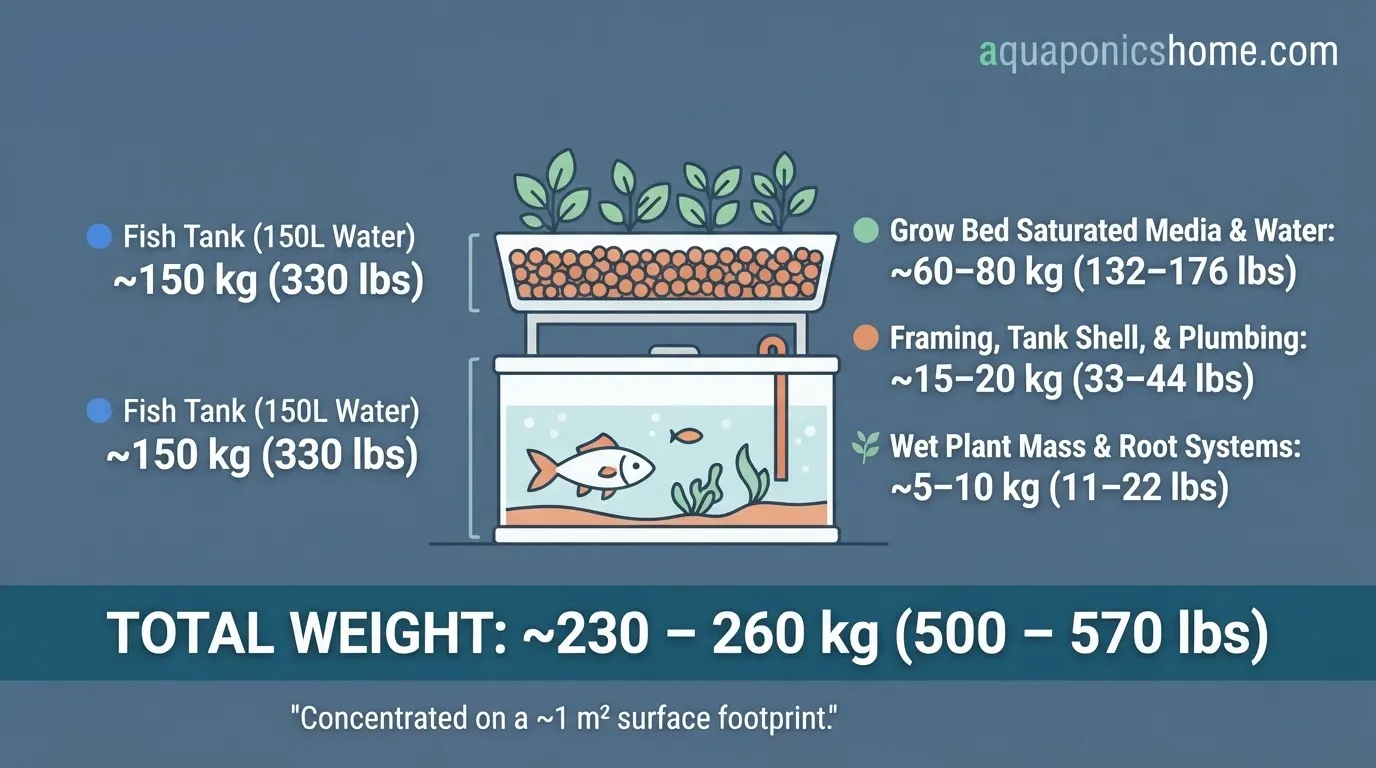
A modest balcony-sized aquaponics system, once you add the tank, the grow bed, the media and the plants, can easily weigh 200 to 300 kilograms (roughly 450 to 650 pounds), concentrated on one small patch of floor. That number comes from simple arithmetic on water weight, not from a safety rating.
Whether your specific balcony can carry that weight is a structural question this article cannot answer for you, and it should not try to. Below is the arithmetic you can run yourself, and then a straight explanation of why the next question belongs to a qualified engineer, not a blog post.
The arithmetic: water is 1 kilogram per liter
This part is not in dispute anywhere, because it is not an opinion. As the U.S. Geological Survey’s Water Science School states, one liter of fresh water weighs almost exactly 1 kilogram. One US gallon is about 3.8 liters, which weighs about 3.8 kg, or roughly 8.3 pounds. That conversion is the whole foundation of this article, and you can check it against any physics reference.
Run it against a real system. Take the 75 to 150 liter range I recommend as a beginner tank size in balcony aquaponics: a beginner’s small-space guide:
- A 75 liter tank holds about 75 kg of water alone.
- A 150 liter tank holds about 150 kg of water alone.
- A grow bed sized to match typically adds another 20 to 50 liters of water held in the media, which is itself another 20 to 50 kg before you count the media’s own weight.
Already, before a single fish or plant goes in, a modest setup is carrying somewhere between 100 and 200 kg of water. That is the number nobody selling a starter kit puts on the box.
What adds to the water weight
Water is the majority of the load, but it is not the whole load. Four things stack on top of it:
- The tank and grow bed themselves. Plastic barrels and IBC totes are light empty, but a welded steel frame or a glass tank is not.
- The growing media. Expanded clay pebbles or gravel fill a grow bed and hold water inside their pores when saturated. A saturated grow bed’s media can weigh close to as much as the water it displaces.
- Wet plants and root mass. Individually small, but a fully planted grow bed adds real weight over its footprint.
- Anything you bolt to the frame: shelving, a second tank, a pump housing.
Put together, a genuinely modest system (75 to 150 liters of fish tank plus a matched grow bed) can land anywhere from about 150 kg at the small end to 300 kg or more once media, frame and plants are accounted for. I go through what that same setup costs to build in small aquaponics system cost: an honest breakdown, because the money and the weight rise together.
What this site will not tell you: your balcony’s safe load
Here is the point where a lot of aquaponics guides get more confident than they have any right to be. Some publish a single “balconies can hold X kilograms per square meter” figure as if every balcony everywhere were built the same way. They are not.
A balcony’s actual rated load depends on its construction, its age, the building code it was built under, whether it is cantilevered or supported by posts, and decisions made by an engineer decades ago that nobody handed down to you.
This site does not publish a safe-load figure, and it will not invent one. A wrong number here does not just embarrass a blog. It can mean a floor giving way. That is not a risk worth taking to make an article sound more complete.
How to find out
The honest path is slower than a number in an article, but it is the only one that means anything:
- Ask your building management or landlord whether the balcony has a documented load rating. Many buildings do, even if nobody has asked in years.
- Check the original architectural or structural drawings, if you or the building can access them. This is the actual source of any real number.
- Bring in a qualified structural engineer for anything beyond a very small tank, especially on an older building, a cantilevered balcony, or an upper floor. This is a genuinely small cost against the alternative.
None of this is optional for a fully loaded system. It is optional only in the sense that a small guppy tank on a ground-floor patio carries a different risk profile than a 150-liter tank on a fifth-floor cantilevered balcony, and you are the one who has to tell those two situations apart, with real information, not a guess from a website.
Reducing risk regardless of the number
Whatever your balcony’s actual rated capacity turns out to be, these general precautions apply and cost nothing extra:
- Position the system near the load-bearing wall, not out at the balcony’s outer edge, since the edge of a cantilevered slab typically carries less than the section closest to the building.
- Spread the load over a wider footprint rather than concentrating it under four small feet. A wider stand distributes weight over more of the floor.
- Do not add water weight gradually and forget it is still there. Topping up a system regularly can quietly push it toward its heaviest state without you noticing.
- Reconsider before combining a large system with other heavy items already on the same balcony: furniture, a second planter run, stored materials.
None of this replaces an engineer’s answer. It just means you are not adding unnecessary risk on top of whatever your real capacity turns out to be.
FAQ
How much does a small aquaponics system actually weigh?
Water alone accounts for most of it: 1 liter weighs about 1 kg, so a 75 to 150 liter tank holds 75 to 150 kg of water before you add the grow bed, media, frame or plants. A modest complete setup commonly lands between 150 and 300+ kg. There is no single “the” weight: it depends entirely on your tank and grow bed size.
Can I just look up my balcony’s weight limit online?
No reliable way exists to look this up generically, because it depends on your specific building’s construction and age. The only real sources are your building management, the original structural drawings, or a qualified structural engineer.
Is a smaller tank always safer for a balcony?
It carries less water weight, which helps, but a very small tank brings its own problem: small volumes of water swing in temperature and water chemistry faster, which is harder on fish. Weight and biological stability pull in different directions, which is why balcony aquaponics: a beginner’s small-space guide recommends a middle range rather than the smallest possible tank.
Does it matter where on the balcony I put the tank?
Position affects risk even at a given weight. A load near the wall, on a supported section, is generally treated as less risky than the same load out at a cantilevered edge, but this is a general principle, not a substitute for confirming your balcony’s actual capacity.
Should I mention the weight when I talk to my landlord?
Yes. It is one of the two things landlords actually care about with aquaponics: the other is water damage from a leak. I cover that conversation directly in do you need to tell your landlord about aquaponics?
The water-weight conversions in this article are basic physical arithmetic (1 liter of fresh water ≈ 1 kg; 1 US gallon ≈ 3.8 liters ≈ 8.3 lb), confirmed against the U.S. Geological Survey’s Water Science School figures cited above. No balcony load-capacity figure is published in this article; that question is deliberately left to a qualified structural engineer or your building’s own records.