
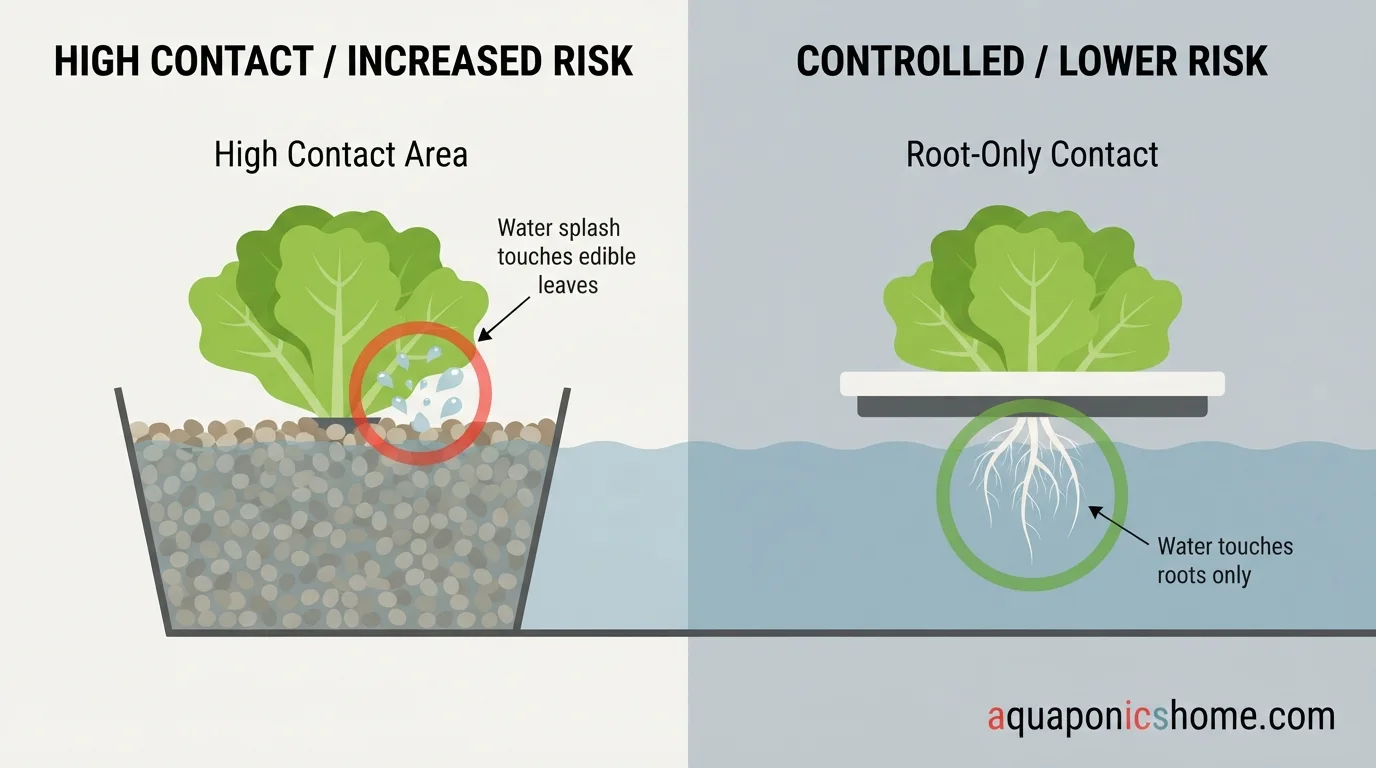
Yes, food grown in a home aquaponics system can be safe to eat, provided you understand where the actual risk sits and design around it, and the single biggest factor is whether the fish-waste water ever touches the part of the plant you eat. This is not a reassurance. It is the same test the FDA's produce-safety rules use for irrigation water generally: water that is likely to contact the harvestable part of a crop is treated differently than water that never does. The rest of this page is the honest version of that answer, including the parts a system like this cannot promise.
I want to be direct about something before going further: I am not a food scientist and this page is not medical or regulatory advice. It is a plain-language walk through what named authorities actually say, with the sources named so you can go read them yourself.
Where contamination risk actually comes from
The risk in an aquaponics system does not come from the fish existing in the water. It comes from a small number of specific routes, and naming them matters more than being generally worried:
- Fingerlings or fish brought in from an outside source, which can carry organisms into the system.
- Uneaten feed and fish waste, the same waste stream that feeds your plants, sitting in the same water.
- Recirculated water itself, if anything enters the loop and is never removed.
- Pests and animals with access to the system: birds, rodents, insects.
- Handling at harvest: hands, tools, and surfaces that touch the produce after it leaves the system.
No single one of these is treated as more likely than the others without a specific reason in your own setup. What matters is that the risk is a small, nameable list, not a vague cloud of "fish waste is dirty," and each one has an obvious, practical response: source fish carefully, do not overfeed, keep the system covered from pests, and handle harvested produce the way you would handle any raw vegetable.
The one design decision that matters most: does water touch what you eat
This is the design question that decides more of your actual risk than anything else on this page, and it maps directly onto how food-safety regulators think about irrigation water. Under the FDA's produce-safety framework, agricultural water is treated differently depending on whether it is likely to contact the harvestable portion of a covered crop or a food-contact surface. Water intended for, or likely to reach, the part you eat is held to the relevant water-quality provisions; water that is not likely to reach the edible part is not treated the same way.
University of Hawai'i CTAHR's aquaponics food-safety fact sheet (FST-38, 2009) puts the practical version of this plainly: water should not contact the edible part of the plant. In a home system, this has direct design consequences:
- Leafy greens sitting directly in flood-and-drain media that is periodically submerged are a higher-contact scenario than a raft or NFT design where the leaf canopy sits above the waterline and only the roots are wet.
- Splash and spray matter. A pump return that splashes onto lower leaves is a different exposure than water that stays below the root zone.
- Harvest timing and technique matter too: cutting a leaf that has just been splashed is not the same as cutting one that has been dry for a day.
None of this means a media-bed system is unsafe. It means the water-contact question is the first thing to actually think through in your own system's layout, rather than assuming the whole subject is either "fine" or "risky" as a blanket judgment.
What washing does, and does not do
Nearly every ranking page on the practical side of this query tells you to wash your harvest and stops there. Washing genuinely helps, and it is not the whole answer. CTAHR's FST-38 states it directly: washing produce under running water removes some but not all microorganisms. That is the honest ceiling on what a rinse achieves. It is worth doing every time, and it is not a guarantee.
This site does not publish a homemade sanitizing protocol: no bleach dilution, no peroxide ratio, no UV specification presented as sufficient for a home system. Sanitizer efficacy for small-scale, home-grown produce is not a settled, simple recipe, and a wrong one is worse than none at all. If you want to go further than a running-water rinse, that is a question for the same named authorities cited on this page, not an improvised ratio from a gardening forum.
What the research has and has not settled
Being honest here matters more on this page than on almost any other article this site publishes. Peer-reviewed research (published in journals including ScienceDirect) has specifically examined E. coli and coliform organisms in aquaponic water used for crop irrigation, because this is recognized as an open, active area of study rather than a closed question. Extension and public-health material from sources including the Minnesota Department of Health and Certified Naturally Grown's own aquaponics standards likewise treats aquaponics as a food-safety category that needs its own attention, distinct from ordinary soil gardening.
This site will not manufacture certainty the research does not have. There is no universally agreed bacterial threshold, no single number that separates a "safe" home system from an "unsafe" one, and this page will not invent one. Where the honest answer is "this is still being studied," that is the answer given, not a rounded-off reassurance.
When the honest answer is "do not eat it"
Some situations have a clear answer, and softening it would be the opposite of the point of this page:
- A fish has died and you have not found and removed it promptly. A decomposing fish in the water is a contamination event in a system whose water may reach your crop, not only a fish-welfare event. If a source says do not eat the recent harvest in that situation, this site says the same thing rather than reassuring you it is probably fine.
- The system has had a clear failure: a crash, contamination from an external source, standing water that has gone visibly wrong. Treat the produce the way the underlying problem warrants, not the way you would like it to be.
There is no page on this site written to talk you out of caution here.
Who this page is not written for
If you are growing food for children, someone who is pregnant, or someone who is immunocompromised, the acceptable margin for uncertainty is smaller than the rest of this page assumes, and that decision belongs with a qualified health professional who knows the specific person involved, not with a gardening website. This page gives you information to bring to that conversation. It does not substitute for it.
FAQ
Is it actually safe to eat vegetables grown in aquaponics water?
Yes, with real precautions, and the single biggest factor is whether the fish-waste water ever contacts the part of the plant you eat. This is the same test the FDA's produce-safety framework applies to agricultural water generally. Design and harvest technique that minimize water contact with the edible portion address most of the practical risk.
Does washing my harvest make it safe?
Washing under running water helps and should always be done, but University of Hawai'i CTAHR's food-safety guidance is explicit that washing removes some, not all, microorganisms. It is a real reduction in risk, not a guarantee.
Can I use bleach or another sanitizer to be extra safe?
This site does not publish a homemade sanitizing recipe or dilution ratio. Sanitizer effectiveness for home-scale produce is not a simple, settled formula, and an improvised one is a genuine risk rather than an extra safety margin. If you want guidance beyond a running-water rinse, look to the named food-safety authorities cited on this page, not a forum recipe.
A fish died in my system. Can I still eat what I harvest?
Remove a dead fish immediately: it is a contamination event, not only a welfare one. If you are unsure how long it was there or whether the water was affected, the cautious and honest answer is to treat that harvest as compromised rather than assume it is fine.
Is aquaponics produce safe for children or someone who is pregnant?
This is exactly the situation where this page steps back. The right answer depends on the specific person and system, and it belongs with a qualified health professional, not a general article. Bring what you have read here to that conversation rather than treating it as a substitute for one.
Sources named in this article: the FDA's Food Safety Modernization Act produce-safety framework for agricultural water (fda.gov), and University of Hawai'i CTAHR's "On-Farm Food Safety: Aquaponics" fact sheet (FST-38, 2009), both checked directly against the source 2026-07-29. Peer-reviewed research on E. coli and coliforms in aquaponic water is referenced by its existence, not by any specific figure, because this page does not state a bacterial threshold or count from any study. No holding-period, dilution ratio, or "safe" contamination figure appears anywhere in this article by design.