
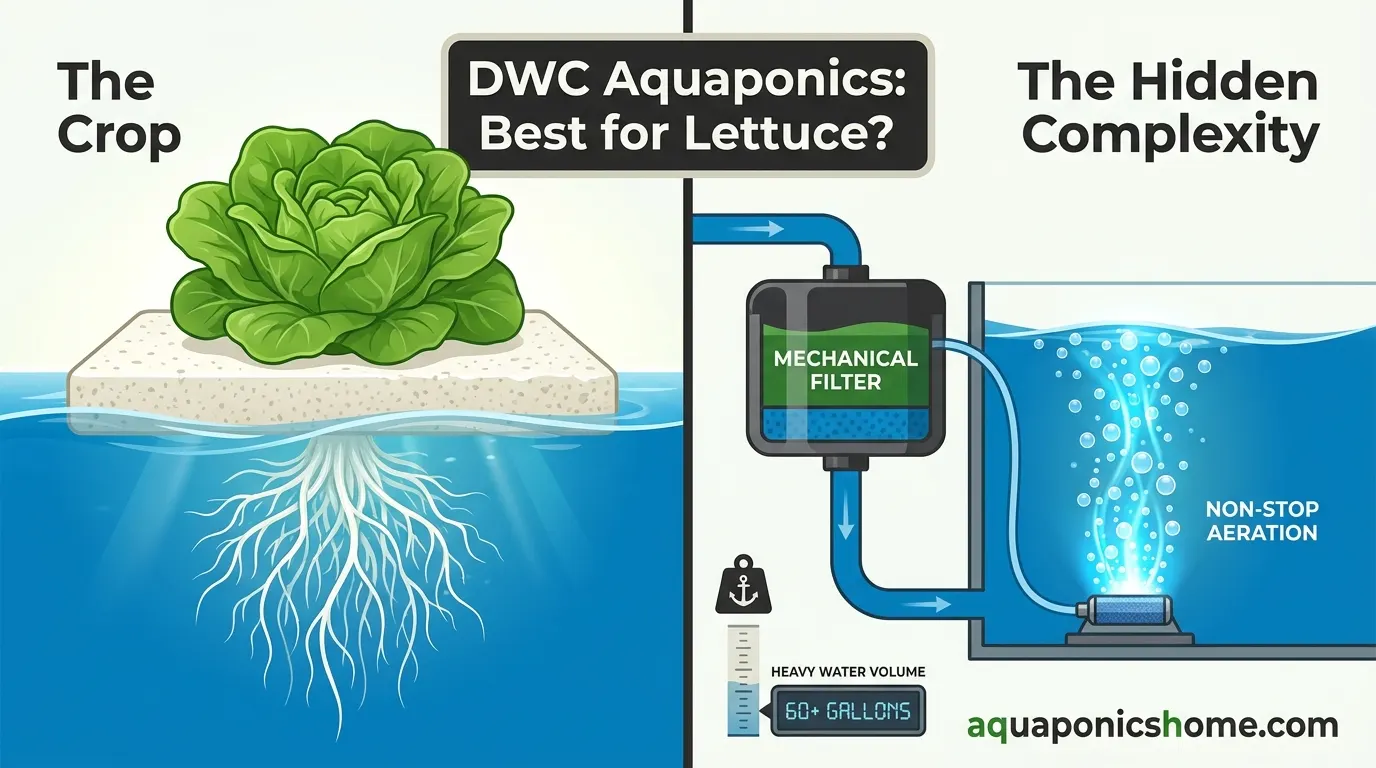
Yes for the lettuce, no for most balconies. A raft is one of the best ways to grow leafy greens, and that part of the method scales down fine. What does not scale down is what sits behind the raft: solids filtered out before the water reaches the roots, enough water volume to stay stable, and aeration that never stops. Give a raft those three and it works small. Skip them and it fails faster than a media bed does.
I run a media bed, not a raft, and I will not pretend otherwise. But I grow spinach, leafy greens and herbs, which is exactly the crop list a raft is built for, so I have no reason to be sniffy about it.
What deep water culture actually is
Deep water culture, DWC and “raft system” all mean the same thing. A sheet of foam board floats on water, plants sit in holes in that board in small mesh cups, and their roots hang down permanently into the water below. No gravel, no clay pebbles, no flood and drain cycle.
The published dimensions are modest, which is part of why the method looks approachable. FAO’s deep water culture unit description, from Technical Paper 589 (Somerville et al., 2014), circulates water through canals about 8 inches (20 cm) deep, with polystyrene rafts at least about 1.2 inches (3 cm) thick so they carry the weight of the plants, and planting holes of roughly 16 to 30 mm depending on whether you use cups or sow straight into the board.
If you have not picked a design yet, start at the comparison of the four aquaponics system types. This article assumes you came here for the raft specifically.
Why lettuce and rafts genuinely belong together
Credit where it is due. For leafy greens a raft is not a compromise, it is arguably the best method there is. Lettuce, salad leaves and basil are shallow-rooted, fast and want constant moisture, and a raft gives them that with no watering cycle to get wrong. FAO’s DWC unit is described as being run with one crop at a time, typically lettuce, salad leaves or basil, and that uniformity is a feature: everything on a board is at the same stage, so you plant a board and harvest a board. To inspect the roots you lift the board, where in a media bed you dig the plant out of gravel and mostly ruin it.
What a raft needs in order to work
None of these is optional in a working raft. The right-hand column is where a small balcony setup usually stands.
| What the design assumes | Why it matters | What a home setup has |
|---|---|---|
| Solids removed before water reaches the roots | Roots sitting in settling waste suffocate | No dedicated filter: the media bed did that job invisibly |
| Water deep enough to float rafts | Shallow water swings in temperature and chemistry | The smallest tank that fits, chosen for weight |
| Aeration running continuously | Submerged roots and bacteria both pull oxygen from still water | One air pump, sometimes none |
| A flat, usable board area | The board is your entire growing area | A narrow rail or a two-foot shelf |
| One crop at one growth stage per board | Mixed maturity means you cannot harvest a board cleanly | An ambitious mix of six herbs and a tomato |
Two or three of those you can solve on a balcony. All five at once is a bigger project than most people think they are starting.
The part that breaks first: solids
In a media bed, the gravel does two jobs at once. It traps fish waste physically, and it houses the nitrifying bacteria that turn that waste into plant food. Filtration in one box, and you never think about it. A raft has no media, so those jobs do not disappear, they become your problem.
FAO’s DWC design handles them with a separate chain: a mechanical swirl filter to trap particulate waste, then a mesh screen for whatever slipped past, then a biofilter holding the bacteria, and only then the water reaches the rafts. Three components a media bed owner never had to buy, house or clean.
I learned the biology half the expensive way. My first batch of catfish died within a month because I cleaned the system too thoroughly and starved bacteria I did not know I had. That story is in cycling a system without killing your fish. With filtration in separate containers you can accidentally scrub out, the same mistake is easier to make.
Aeration, and why a raft fails faster
Raft roots are underwater permanently. They cannot take oxygen from the air between floods the way a media bed’s roots do every time the bed drains. All the oxygen they use has to be put into the water and kept there, alongside what the fish and the bacteria need.
FAO’s guidance for DWC canals is air stones releasing about 4 liters of air per minute, distributed across the canal area, plus venturi fittings on the inflow pipes to pull air in as water enters.
I am deliberately not publishing a dissolved oxygen target. Sources vary, and a wrong number on a blog is worse than none. The shape of the risk is what matters: when a media bed loses power the bed drains and the roots meet air, and when a raft loses power the roots stay submerged while everything living in that water keeps consuming oxygen.
Water volume, and the weight it brings
FAO describes DWC canals of roughly 300 liters (about 80 US gallons) each, and that sits on top of the fish tank, not instead of it. Water weighs about 8.3 pounds per US gallon, so one canal is several hundred pounds on a small footprint. I run the arithmetic, and explain why this site will not hand you a balcony safe-load number, in how heavy a small aquaponics system really is. In a rented flat this is often where the raft idea quietly ends.
The version that does scale down
Now the fair part, because there is one. FAO’s own material describes a DWC variant built without external filtration containers, mechanical or biological, where water flows by gravity from the fish tank into the canals through a simple mesh screen. The condition is low stocking density, given as about 15 kg of fish per cubic meter of tank (roughly 33 pounds per 265 gallons). The price is built in: fewer fish means less waste, fewer nutrients and gentler growth than the commercial photos suggest. For a home grower that is a reasonable trade.
The other route is to stop treating the raft as the whole system. If you already run a media bed, that bed is doing your filtration, and a small raft trough downstream of it inherits filtered water. That is the version I would consider on my own balcony, and the only reason I have not is floor space. The case for the media bed as a first system explains why that bed is worth having first anyway.
So, is it worth it?
Worth it if you have floor area rather than rail space, can run air continuously, are growing leafy greens and only leafy greens, and either accept low stocking density or already have a filtered system to hang the raft off.
Not worth it if this is your first system, your space is narrow, your power is unreliable, or you were drawn to the raft because it looked simplest. It is not the simplest option. It is the one with the least forgiving failure mode.
For most people on a balcony the honest order is media bed first, raft second once you have filtration you trust, and NFT a distant third for the reasons in why NFT channels rarely suit small systems. If you are still deciding whether any of this fits a rented flat, start with the balcony aquaponics guide.
FAQ
Can I run a raft in a single container with the fish underneath the board?
People do, and it is the smallest possible version of the idea. The catch is that fish waste settles in the same water your roots hang in, with nothing removing it. FAO’s low-density variant is the closest published version, and it works by keeping the fish load low enough that the waste stays manageable.
Do I need an air pump, or will the water pump do?
A water pump moves water, it does not reliably oxygenate it. Raft roots are permanently submerged and cannot reach air, so aeration is its own requirement in the published DWC designs, with air stones and optionally venturi fittings on the inflow. I would not plan a raft around the water pump alone.
What can I grow on a raft besides lettuce?
The published designs center on lettuce, salad leaves and basil. Leafy greens and soft herbs fit because they are light, shallow-rooted and want constant moisture. Fruiting plants are heavier and hungrier, which is a much harder ask in a small system.
Why do commercial farms use rafts if they are this demanding at home?
Because at scale the demands stop being demands. Raft designs in the extension literature are specified per unit of plant growing area: SRAC Publication No. 454 (Rakocy, Masser and Losordo, 2006) gives feeding rates of 60 to 100 grams of fish feed per square meter of plant growing area per day for raft culture in the University of the Virgin Islands system. A method described that way was built to be scaled up, not shrunk down.
Sources: FAO Fisheries and Aquaculture Technical Paper No. 589 (Somerville et al., 2014) and FAO’s deep water culture unit description; SRAC Publication No. 454 (Rakocy, Masser and Losordo, 2006). No dissolved oxygen target, plant density or yield figure is published here, because I could not source one I trust for a home-scale raft.