
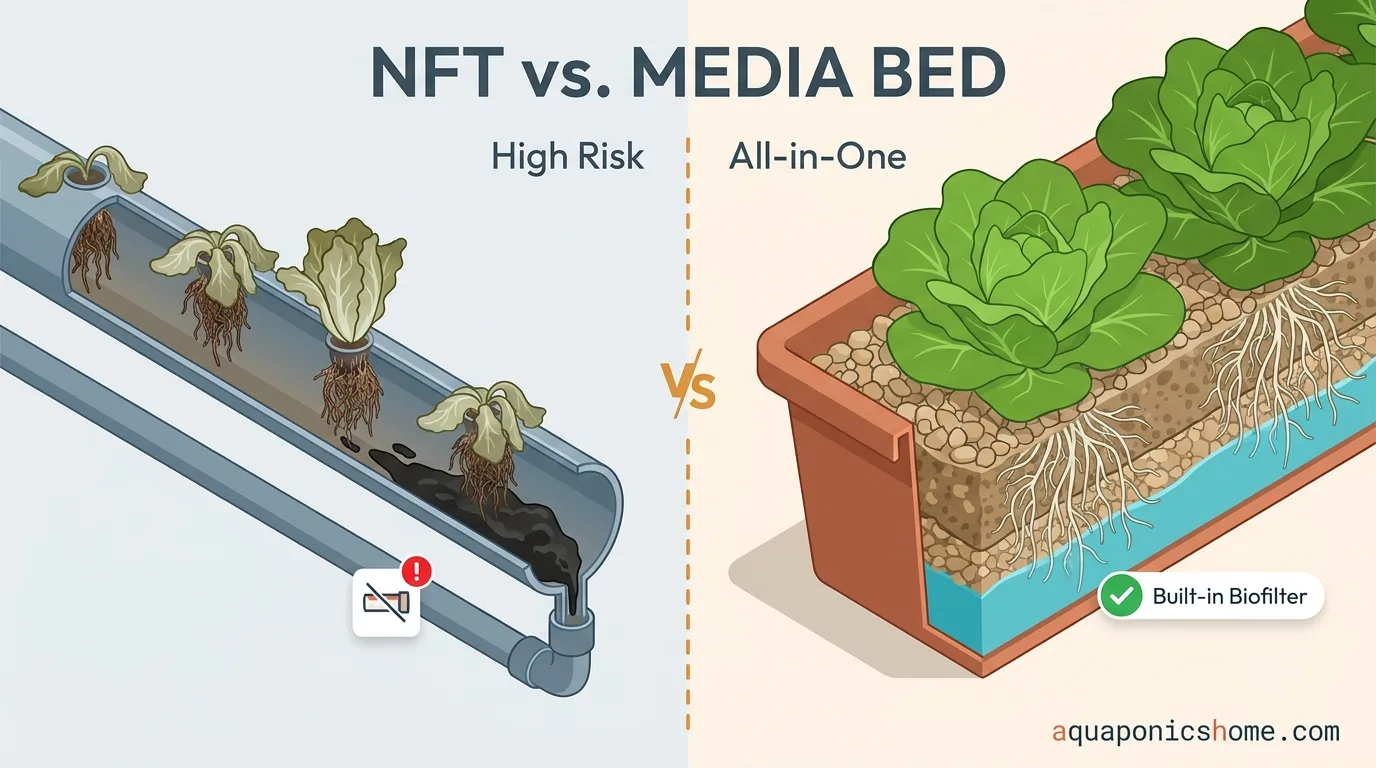
NFT is a poor choice for a first aquaponics system, for three specific reasons. The channels hold a thin film of water and no growing medium, so they provide almost no biofiltration. Solid fish waste has nowhere to settle, so it blocks the channels. And when the pump stops, there is no water left around the roots within minutes. A media bed solves all three for free. NFT makes you buy the solutions separately.
If you came from the comparison of the four main aquaponics designs, you already have the verdict. This page is the argument underneath it, and the part where I try to be fair.
Why I did not build an NFT aquaponics system
I have run small aquaponics on a rented balcony in Dhaka for about three years, through two rebuilds, one overnight flood when a siphon failed, and one first batch of catfish that did not survive the first month. What I run is a media bed. I have never run an NFT system at home.
So this is not the story of somebody who tried channels and got burned. It is somebody who looked hard at them, wanted them, and chose otherwise. Where the answer needs experience I do not have, I quote a named source instead of my own opinion. I am not an aquaponics scientist.
The real reason: no media means almost no biofilter
Bacteria have to convert the ammonia your fish produce into nitrate, which is what plants can actually use. Those bacteria live on wet, rough, oxygenated surfaces. Every design has to give them somewhere to live, and that is where these two part company.
What a media bed gives you at no extra cost
FAO Fisheries and Aquaculture Technical Paper 589, Small-scale aquaponic food production (Somerville, Cohen, Pantanella, Stankus and Lovatelli, 2014), states that the medium supports the roots of the plants and the same medium functions as a filter, both mechanical and biological, and that this double function is the main reason media bed units are the simplest design. You bought the gravel to hold plants up. The filtration is a side effect you did not pay extra for, and what it buys you day to day is in why media beds are the right default.
What an NFT system makes you build instead
An NFT channel has no medium, and the water in it is a moving film. FAO 589 says dedicated filtration is of critical importance in NFT units, and describes the train: water leaves the fish tank, passes through a mechanical swirl filter that traps particulate waste and is vented periodically, then a mesh screen for whatever got past it, then a separate biofilter aerated with air stones and packed with something for the bacteria to live on, and only then reaches a plant.
Read that as objects, not as a diagram. Two more vessels on your balcony, each needing somewhere to sit and a cleaning schedule that is now yours, both of which have to be running and colonized before your fish are safe. What that colonization period asks of you is in cycling a system without killing your fish.
The second reason: solids have nowhere to go
Fish produce solid waste and it does not dissolve away. In a media bed it is caught in the gaps between the gravel and breaks down in place. In a shallow film there is no gap to fall into, so it travels until something stops it, and that something is usually a plant hole, a root mass or the drain.
FAO 589 is direct about the consequence: with insufficient filtration, NFT units would clog, become anoxic and exhibit poor growing conditions for plants and fish alike. It warns to be especially mindful of plants like tomatoes and mint, whose root systems can easily clog even large pipes.
A blocked channel does not announce itself, either. Water backs up or diverts, and the plants below the blockage quietly stop being fed while everything above them looks fine.
The third reason: no buffer when the pump stops
This is the failure a renter cannot supervise, so I would weigh it first.
When a flood and drain media bed loses its pump, the bed drains once and then sits damp. The media holds moisture around the roots and the bacteria stay put on the media. The fish tank is in trouble because aeration stopped, but the growing half has hours of margin.
An NFT channel has essentially none. The film is the entire water supply, so when flow stops the channel empties and the roots hang in air. Oregon State University Extension’s guide to nutrient film technique (EM 9457, Nelson, Langellotto and Nackley, May 2025) makes the same point for hydroponic NFT: because the method depends on a continuous thin film, backups for power and pumps matter, and a loss of flow can wilt plants quickly. That publication covers hydroponics rather than aquaponics, but the channel behaves the same either side of that line.
The fish half of the same outage is the more urgent emergency, and what to check in what order is in what to do when your fish are dying.
The numbers everyone copies, and where they come from
Search this topic and the same specifications appear page after page, usually with no source attached. They are worth having, and worth attributing, because the authority behind them is not the site you read them on.
As reported in FAO 589: a slope of about 1 cm per meter of pipe length is needed so the water flows through the whole pipe with ease, roughly an eighth of an inch per foot. Flow for each grow pipe should be no greater than 1 to 2 liters per minute, about a quarter to half a US gallon. And there should be a minimum of 21 cm, about 8 inches, between the center of each plant hole.
Those tolerances are narrow, and slope and hole spacing are cut into the pipe on the day you build it. Precision is doing the work that gravel does for free in a media bed. I have not given you a film depth figure, because I could not attribute one to a named authority.
When NFT is not a bad idea
The title takes a position, so it owes you the other side. These cases are real, not consolation prizes.
When weight is the binding constraint. Channels of moving water are far lighter than beds of saturated gravel. If your building, your landlord or an engineer has given you a limit that a media bed cannot live inside, NFT may be the design that makes a system possible at all. That is the reason I would accept fastest.
When you already run a filtered system. The strongest case, and the least discussed. If a media bed is already working on your balcony, the expensive and annoying part of an NFT build exists. FAO 589’s own point is that media beds carry the most biological filtration of any design, so a short channel run fed downstream of an established bed is a different proposition from NFT built alone. That is an expansion, not a first system.
When you want one leafy crop in volume and you are home daily. NFT suits fast, light, small-rooted greens, and harvesting at waist height without picking gravel out of roots is a real advantage. If that is the goal, weigh it against raft and deep water culture at home, which needs the same filter train but gives you water volume as a margin.
When you have run channels before, without fish. If you already know how to keep a film moving evenly down a pipe, the new part is solids and livestock rather than plumbing. A much smaller step.
Two things cancel all of the above. If your power is unreliable, this is disqualifying rather than inconvenient. And if you are away for days at a time, a design whose entire water reserve is a moving film is not the one to leave alone.
If you still want channels
Then do not make it your only system. Build the media bed first, run it until you know what your own water does in your own weather, and add a channel run off it later, when the filtration you would otherwise be buying is already built and colonized.
One practical note, since NFT is often sold racked up in tiers. Stacking changes the water problem first: the pump has to lift to the top level, and every drop has to find its way back to the tank. The frame is somebody else’s subject. The drainage path is yours, and it belongs on paper before anything is cut. If you are still working out whether any of this fits a rented flat, start with the balcony aquaponics guide.
FAQ
Does an NFT aquaponics system need a separate biofilter?
Yes. FAO 589 describes NFT units as requiring a mechanical filter for solids and a separate aerated biofilter holding media for the nitrifying bacteria, because the channels provide neither. That is the biggest single difference from a media bed, where one bed does both jobs.
Can I run NFT pipes without any filtration?
Not safely. FAO 589 states that with insufficient filtration, NFT units clog, become anoxic and produce poor growing conditions for plants and fish alike. Skipping the filter train does not simplify the design, it moves the failure later.
What can I grow in NFT channels?
Fast, light, small-rooted plants. FAO 589 pairs fast growing leafy greens with pipes of about 3 inches (7.5 cm) and larger fruiting vegetables with about 4 inches (11 cm), and warns that root systems like those of tomatoes and mint can easily clog even large pipes. Root vegetables are a poor fit at any diameter.
What happens to NFT plants in a power cut?
The channel empties and the roots are left in air, with no medium holding moisture. Oregon State University Extension’s nutrient film technique guide (EM 9457, 2025) notes that because the method depends on a continuous film, power and pump backups matter, and a loss of flow can wilt plants quickly. The fish side of that outage is the more urgent half.
Sources named here: FAO Technical Paper 589, “Small-scale aquaponic food production” (Somerville, Cohen, Pantanella, Stankus and Lovatelli, 2014), and Oregon State University Extension EM 9457, “Hydro hints: Nutrient film technique” (Nelson, Langellotto and Nackley, May 2025), which covers hydroponic NFT. No price, film depth or yield figure appears here, because I could not attribute one. The balcony experience described is my own, and it is a media bed, not a channel system.