
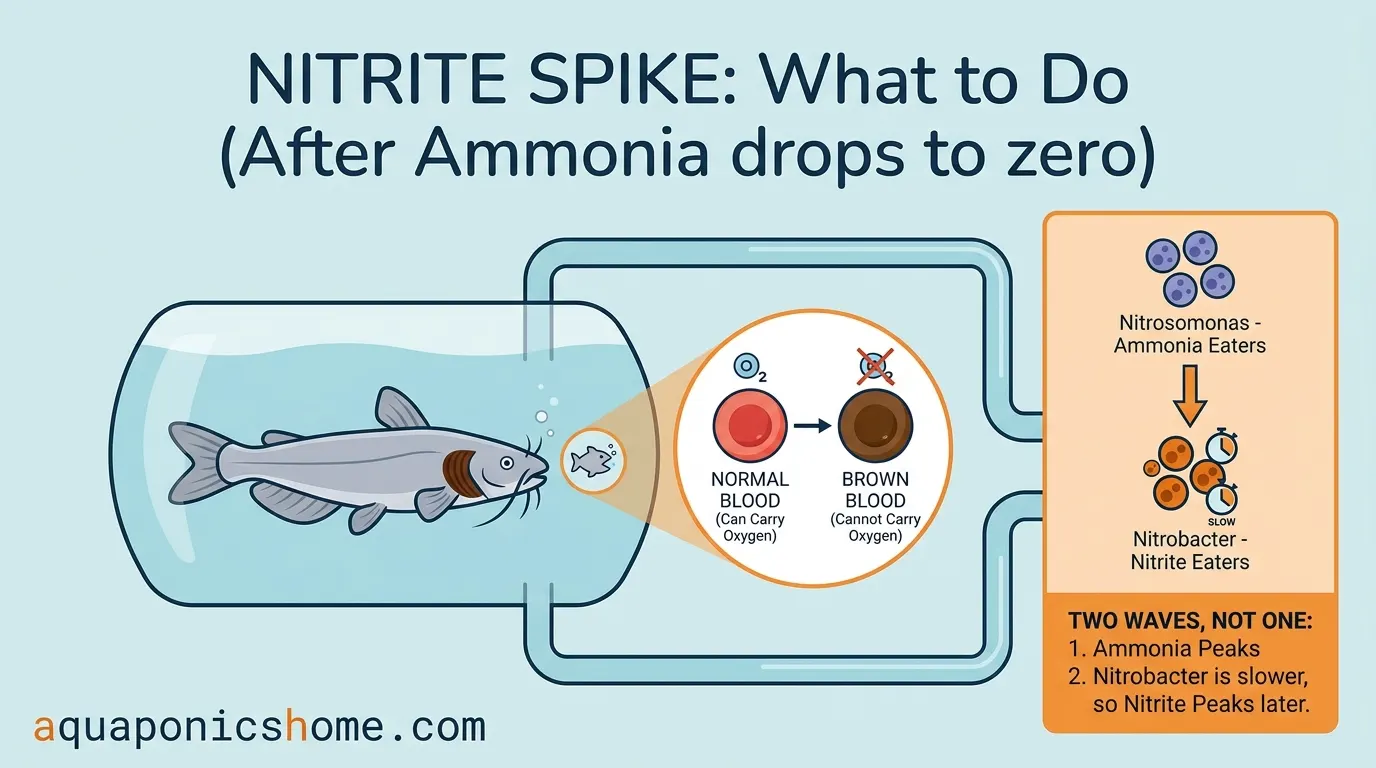
If your ammonia test finally reads clean and your fish are still dying, test for nitrite before you do anything else. Nitrite is produced from the very ammonia your bacteria just processed, so it often peaks days after the ammonia crisis looks solved. It attacks fish differently than ammonia does, and more aeration alone will not save them. Test, then act.
My first batch of catfish did not survive their first month on my Dhaka balcony, and the cause was invisible water chemistry, not anything I could see happening. I am not a scientist. I just do not want you finding this out at 11 p.m. the way I nearly did.
Why an Aquaponics Nitrite Spike Is the Second Wave, Not the Same One
Ammonia and nitrite are two different problems produced one after the other by two different groups of bacteria, and they rarely peak at the same time. One group of bacteria, Nitrosomonas, turns ammonia into nitrite. A second, slower group, Nitrobacter, turns that nitrite into nitrate, which your plants can actually use. When a system is new, recently disturbed, or was just scrubbed too hard, the ammonia eaters tend to establish themselves faster than the nitrite eaters. That gap is exactly why a reader can watch her ammonia number fall to zero, relax, and then a few days later find nitrite has climbed instead. It is not a new emergency arriving out of nowhere. It is the same nitrogen working its way through a bottleneck one stage further down the line.
If your system is only a few weeks old, this lag is the most common explanation, and the fix is patience plus water changes while the second bacterial group catches up. If you have not read it yet, the guide to cycling a system without killing fish walks through why this stage takes real bacteria real time and cannot be rushed with a product.
What the Numbers Actually Say
Skip any page that gives you a single round number for “safe nitrite” without naming who said so. Here is what the named sources actually report.
In a seasoned, balanced system, nitrite should read close to zero. FAO Technical Paper 589 (Somerville et al., 2014), the FAO’s small-scale aquaponics manual, treats any detectable nitrite as a sign the system is out of balance, not something to wait out.
Do not wait for a big number before you act. The University of Florida IFAS guide to nitrite in aquatic systems (Francis-Floyd et al., publication FA16) reports that nitrite is toxic to fish at levels as low as 0.10 mg/L. The FAO manual separately reports health problems beginning around 0.25 mg/liter. Both are far below the kind of thresholds some pages toss around without a source attached.
Sensitivity also varies sharply by species, and this matters if you have mixed stock. The Southern Regional Aquaculture Center’s publication on nitrite in fish ponds (Durborow, Crosby and Brunson, 1997) reports that bass, bluegill, and green sunfish are relatively resistant, that catfish and tilapia are fairly sensitive, and that trout and other coolwater species react to extremely small amounts. If you keep a species not on that list, treat “close to zero” as your target rather than guessing where your fish fall.
The Mechanism: Why Your Fish Can Suffocate in Oxygen-Rich Water
This is the single most important thing to understand on this page, and it is exactly why a nitrite spike catches people off guard after they have already fixed the oxygen or the ammonia problem.
Nitrite crosses the gills and gets into the bloodstream, where it turns hemoglobin into a form called methemoglobin. Methemoglobin cannot carry oxygen. The SRAC publication on nitrite in fish ponds (Durborow, Crosby and Brunson, 1997) describes this condition as methemoglobinemia, commonly called brown blood disease, because affected blood actually turns a chocolate brown color instead of red.
Here is the detail that trips people up: a fish with brown blood disease can suffocate even in water that is well aerated and reading high on a dissolved oxygen meter, because the problem is not the oxygen in the water, it is the blood’s inability to carry that oxygen to the fish’s own tissues. That is why “the second wave that kills after you relax” is such an accurate description. A reader fixes her aeration, watches the gasping stop, assumes the crisis has passed, and loses fish anyway because oxygen was never the actual bottleneck this time.
The Chloride Mitigation, Carefully
There is one legitimate water chemistry intervention here, and it is chloride, not a medication. The University of Florida IFAS guide reports that adding salt (sodium chloride) or calcium chloride at a ratio of about 10 mg/L of chloride for every 1 mg/L of measured nitrite reduces nitrite’s toxic effect on fish. The SRAC publication gives the same guidance, recommending at least a 10 to 1 chloride to nitrite ratio, and notes that brown blood symptoms typically start easing about 24 hours after the chloride goes in.
Both of those sources are writing about outdoor fish ponds, not aquaponics, and that gap matters. Your plants are in the same water as your fish, and they tolerate far less salt than your fish do. Do not add chloride as a blanket precaution “just in case.” Dose it against a nitrite number you have actually measured with a test kit, lean toward the lower end of the reported ratio rather than the higher end, and treat it as a bridge that buys time while your biofilter catches up, not a fix on its own. If you are unsure how your specific crops will handle it, a local extension aquaculture service can advise on your exact setup better than a blog post can.
What to Do Tonight
- Test nitrite specifically, not just ammonia. A clean ammonia reading does not rule out nitrite. Test both.
- Do a partial water change, roughly a quarter to a half of the volume, with dechlorinated, temperature matched water. This dilutes nitrite directly.
- Stop feeding until the numbers come down. Uneaten food only adds more nitrogen to the same bottleneck.
- Keep aeration running, not because it fixes nitrite on its own, but because your fish and your bacteria both still need the oxygen for everything else going on.
- Retest daily until nitrite reads consistently near zero, not just once.
If your fish show white spots, frayed fins, ulcers, or other signs that look like disease rather than water chemistry, that is outside what a blog should diagnose. Contact an aquatic veterinarian or a named extension aquaculture service rather than guessing. For the fuller first-hour sequence when fish are actively dying and you are not sure why yet, start with the fish dying triage checklist, and if this whole spike started because your ammonia never really came down, read what to do when ammonia is too high first.
The Pattern Behind Both Waves
Ammonia and nitrite are really one story told in two acts, and most of the emergencies on this site trace back to the same root cause: a biofilter that has not caught up with the fish yet, whether that is because the system is new, was recently over-cleaned, or was scrubbed the way I scrubbed mine when I lost that first batch. The aquaponics troubleshooting hub collects the rest of these emergencies in one place if you want the fuller picture, and my own story has the longer version of what three years of getting this wrong on a rented balcony actually looks like.
FAQ
Will more aeration fix a nitrite spike?
No, not on its own. Aeration raises dissolved oxygen in the water, but nitrite poisoning stops your fish’s blood from carrying that oxygen to their tissues in the first place. Keep aeration running for general fish and bacteria health, but treat water changes and retesting as the actual fix.
How long does a nitrite spike typically last?
It depends on how fast your nitrite eating bacteria catch up, which is not something this site will put a fixed number on. Keep testing daily, keep doing partial water changes, and stop feeding heavily until the readings settle back down near zero.
Should I add salt to my system just to be safe?
No. Chloride dosing reported by UF/IFAS and SRAC is meant to be measured against an actual nitrite reading, not added as a precaution. Your plants tolerate far less salt than your fish, so test first, dose conservatively against that number, and ask a local extension service if you are unsure about your specific crops.
My ammonia and nitrite are both high. What do I do first?
Treat it as one water quality emergency, not two separate ones. Stop feeding, do a partial water change with dechlorinated, temperature matched water, keep aeration running, and retest both numbers daily. The fish dying triage checklist walks through the full first-hour order if you have not already worked through it.
Is a nitrite spike a sign my system will never cycle properly?
Not usually. A second, smaller spike after ammonia settles is a well documented part of a system still finding its balance, especially a young one. It becomes a bigger concern only if it keeps recurring for many weeks with no sign of settling, which is worth a closer look at your biofilter and feeding habits rather than a one time water change.