
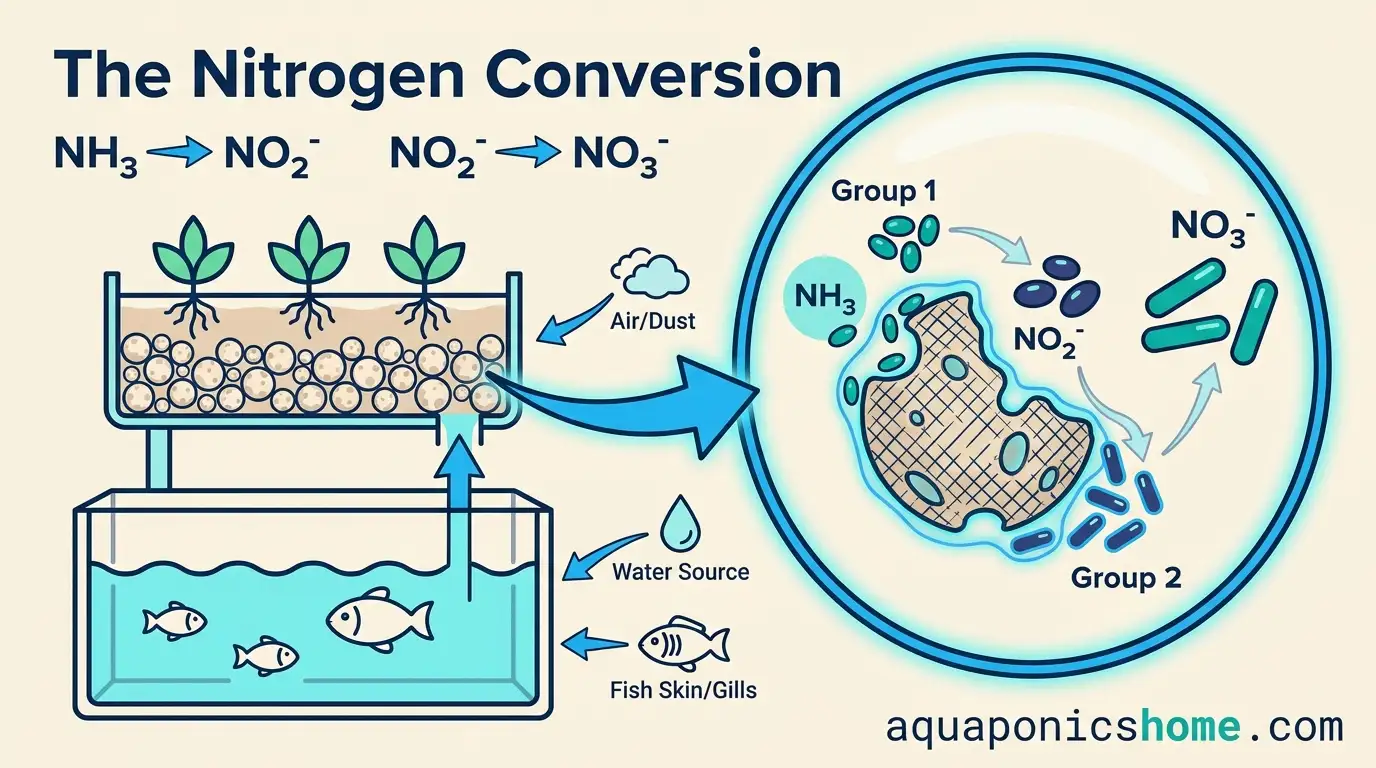
Aquaponics beneficial bacteria are not a product you dose once and forget. They are two groups of naturally occurring microbes, ammonia oxidizers and nitrite oxidizers, that colonize every wet surface in your system on their own once ammonia and oxygen are present.
You cannot see them and you did not add most of them on purpose; they arrived on your grow media, in your tap water, on your fish, and in the dust that settled on the tank before you ever filled it.
What speeds them up is not a magic bottle, it is surface area, steady ammonia, warm water, stable pH, and dissolved oxygen, in that order of importance.
What “beneficial bacteria” actually means
The phrase covers two separate jobs, done by two separate groups of bacteria, and mixing them up is why a lot of beginner troubleshooting goes nowhere.
The first group are ammonia oxidizers, historically labeled Nitrosomonas in hobbyist writing though the Oklahoma State University Extension fact sheet on media bed aquaponics (read 2026-09-18) lists several genera capable of the same job, including Nitrosospira and Nitrosococcus. They eat ammonia and excrete nitrite.
The second group are nitrite oxidizers, commonly grouped under Nitrobacter and Nitrospira, and they eat that nitrite and excrete nitrate, the form your plants can use.
This two-step conversion is the whole reason the aquaponics nitrogen cycle works: fish waste becomes plant food only because both groups are doing their job in sequence, not because either one alone finishes the process.
Neither group photosynthesizes and neither group swims. They are chemoautotrophs: they get their energy from oxidizing nitrogen compounds, not from light or organic food, and they live attached to a solid surface in a thin biofilm rather than floating free in the water column. That single fact explains almost everything else in this article.
Where they come from
They do not arrive because you bought a bottle labeled “aquaponics beneficial bacteria,” although a bottled starter culture can shortcut the wait.
In practice, nitrifying bacteria colonize a new system from several ordinary sources at once: municipal tap water carries a small population, the air carries spores and cells that settle on wet surfaces, fish gills and skin carry some, and any media, gravel, or filter sponge that has touched an already-cycled tank carries a great deal.
This is why the fastest way to start a new system is almost always to borrow: a handful of gravel, a piece of sponge, or a bucket of water from a friend’s established tank seeds a colony that would otherwise take weeks to grow from ambient exposure alone.
If you have no established system to borrow from, fishless cycling is the honest way to build the colony from scratch: you feed the tank ammonia (from a pure ammonia source, not fish) on a schedule and let the bacteria that are already drifting in from the sources above find that food and multiply.
Nothing about the bacteria changes between fishless cycling and cycling with fish already stocked; what changes is whether ammonia spikes are safe to let happen, which is exactly why fishless cycling exists as the welfare-first option.
What Speeds Up Aquaponics Beneficial Bacteria
Four factors control how fast a colony of aquaponics beneficial bacteria establishes and grows. Surface area matters more than any of the others, because nitrifying bacteria live in a biofilm on solid material, not suspended in the water.
The Oklahoma State University Extension fact sheet cited above puts the useful biological surface area for grow media in the range of roughly 300 to 600 square meters per cubic meter of media, and recommends inert, porous, lightweight media such as expanded clay or expanded shale specifically because they pack far more surface area into the same footprint than plain gravel.
A media bed that looks identical from the outside can hold a colony many times larger or smaller depending on what the media actually is.
Temperature is the second lever, and it works differently on the two bacterial groups. A nitrification study published in Water Research (Grunditz and Dalhammar, cited via ScienceDirect, read 2026-09-18) found ammonia-oxidizing activity peaking around 35°C in laboratory cultures, with nitrite oxidizers peaking a few degrees higher; most home systems run well below that lab optimum, which is normal and not a sign of failure, but it does mean a system sitting in the mid-60s Fahrenheit will cycle noticeably slower than one in the high 70s. Cold water does not kill the colony, it just idles it.
pH is the third lever and the one most beginners get backwards, because they assume “more alkaline is always better.” The Oklahoma State fact sheet gives a working pH range of 6.5 to 8.0 for healthy nitrifying bacteria activity, and outside that band the colony’s efficiency drops sharply even if no individual bacterium dies outright.
If your pH has drifted and you are not sure which direction is safe to correct it, read how to adjust pH in aquaponics without hurting anything before making a change, because overcorrecting pH in one move is one of the more common ways a beginner stalls a colony that was otherwise fine.
Dissolved oxygen is the fourth lever. Nitrifying bacteria are aerobic; they need free oxygen in the water to do the ammonia-to-nitrate conversion at all, and a system that is well aerated at the biofilter (air stones, a waterfall return, or simple splash aeration) will out-cycle an identical system with stagnant, low-oxygen media.
This is also a fish welfare issue independent of the bacteria: any stocking density you run needs enough dissolved oxygen and space for the fish themselves, not just enough oxygen for the biofilter, and a system that is borderline on oxygen for its bacteria is usually borderline for its fish too.
What slows or kills the colony
A few things reliably set a colony back, and it is worth naming them plainly because “the bacteria died” is one of the most common wrong diagnoses in this hobby.
Chlorine and chloramine in untreated tap water will kill nitrifying bacteria on contact; always dechlorinate top-off water before it reaches the biofilter, not just at initial fill.
A sudden, large pH swing, rather than pH sitting outside the ideal range, stresses the colony more than a stable but suboptimal pH does, which is the direct link to why gradual correction matters more than hitting an exact number.
A gap in ammonia supply, such as removing all the fish for a week or overfeeding then underfeeding erratically, causes the colony to shrink to match whatever food level is actually available, which is why restarting a dormant system after a long pause needs a slow re-ramp rather than dumping fish straight back in at full stocking.
And any household disinfectant, medication, or unrinsed cleaning product reaching the media is a straightforward bacterial kill event, not a slow decline.
If ammonia or nitrite spikes suddenly and will not come back down with water changes and reduced feeding, that is not a bacteria-tuning problem to guess your way through.
Confirm the reading with a proper water testing routine first, and if a genuine crash is underway with fish showing distress, a state aquaculture extension program or cooperative extension office is the right next call, not a forum thread. Persistent mass mortality is an emergency, not a bacteria question.
A practical way to think about timing
Most home systems take somewhere in the range of two to six weeks to establish a working colony from scratch, and that range is wide because it depends on all four levers above landing in your favor or against you at the same time.
If your system genuinely will not start converting ammonia to nitrate after several weeks, the bacteria themselves are rarely the actual cause; the five real causes of a system that will not cycle covers the more likely culprits, most of which trace back to surface area, ammonia supply, or a chemical kill event rather than the bacteria being somehow defective.
Ammonia oxidizers also colonize measurably faster than nitrite oxidizers do, so a system stuck with nitrite present but nitrate still absent is often just waiting on the second group, not broken.
FAQ
Do I need to buy a bottled bacteria starter for aquaponics?
No, it is optional. Nitrifying bacteria colonize from tap water, air, fish, and media on their own; a bottled starter or borrowed media from an established tank simply speeds up the timeline rather than being the only source of the colony.
How long does it take beneficial bacteria to establish in a new aquaponics system?
Typically a few weeks, commonly cited in the two-to-six-week range, depending on temperature, pH, available surface area, and how steadily ammonia is supplied during that period.
Can beneficial bacteria die from cold water?
Cold water slows nitrifying bacteria activity rather than killing the colony outright; expect a noticeably longer cycle in cool water and faster conversion as the system warms.
Will adding more fish speed up bacteria growth?
No, and it can backfire. The colony grows to match the ammonia supply already available; adding fish faster than the existing colony can process their waste creates an ammonia spike, not faster bacterial growth.
What kills aquaponics beneficial bacteria the fastest?
Chlorinated or chloraminated water added without dechlorinating, and household disinfectants or medications reaching the biofilter media, are the two most common ways an established colony is wiped out quickly.