
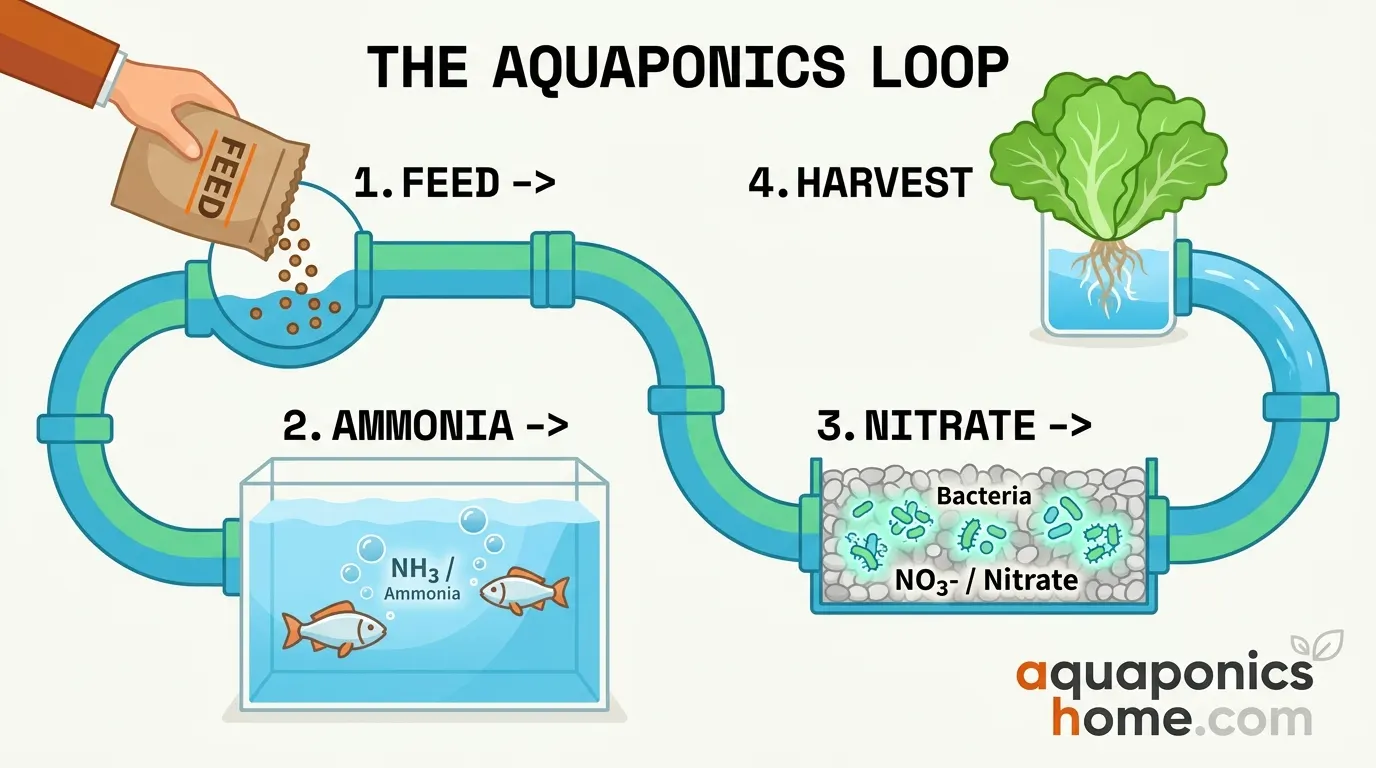
Short answer: the aquaponics nitrogen cycle is how nitrogen moves from a bag of fish food to a leaf you eat. Fish eat the feed and excrete most of its nitrogen as ammonia, which is toxic. One group of bacteria converts that ammonia to nitrite, which is also toxic. A second group converts nitrite to nitrate, which is not, and which is the exact form of nitrogen plants absorb. The plants take it up and grow. That last step is the one an ornamental fish tank does not have, and it is why aquaponics works at all: the waste that an aquarium keeper exports through water changes is, in your system, the fertilizer.
Everything else about water chemistry in aquaponics follows from that chain. You need it once, in plain words. Here it is.
Start at the feed bag, not the fish
Every explanation of this subject starts with the fish. That is the wrong end, and it hides the most useful fact in the whole system.
Almost all of the nitrogen in your system walked in as fish food. Fish do not create nitrogen. They eat protein, use some of it to build their own bodies, and excrete the rest, mostly as ammonia across the gills and partly in solid waste. Uneaten food that decomposes in the tank goes the same way, without the fish being involved at all. A dead fish, dying roots and decaying leaves all add to the same pool.
So the fish are a conversion step, not a source. That reframing pays off immediately in three places:
- Feeding is your input dial. How much you feed determines how much nitrogen enters the system, which determines how much ammonia the bacteria have to process and how much nitrate your plants eventually get. Feed heavily and you load the biofilter. Feed lightly and the plants go hungry.
- When something goes wrong, look at feed first. An ammonia spike after you started feeding more is not a mystery. Neither is pale, nitrogen-starved lettuce in a lightly stocked, lightly fed tank.
- Stop feeding and the cycle stops. Which is exactly why “stop feeding” is the first instruction in almost every emergency on this site. It closes the tap at the source.
The three bacterial steps
Now the middle of the chain, in the order it happens.
Step one: ammonia appears. From fish excretion, from uneaten feed, from any decaying organic matter. Ammonia is toxic to fish, and it is more toxic in warm water and at higher pH, because those conditions push more of the total toward the un-ionized form that does the damage. A hobby test kit reads the total, not the split, so the same number means something different on a hot balcony than in a cool room.
Step two: ammonia becomes nitrite. Ammonia-oxidizing bacteria, the group usually named Nitrosomonas in beginner explanations, do this. They are slow-growing, they live on surfaces rather than floating in the water, and they need oxygen. Nitrite is also toxic to fish, and it is the step beginners forget to test for.
Step three: nitrite becomes nitrate. Nitrite-oxidizing bacteria, usually named Nitrobacter, do this. They are the slower of the two groups to establish, which is why nitrite is the second wave that arrives after ammonia has started falling and everyone has relaxed. Nitrate is far less toxic to fish than either of the compounds before it.
Two things about these bacteria are worth understanding properly, because most beginner errors come from not knowing them.
They live on surfaces, not in the water. The colony grows as a film on the grow media, the tank walls, the pipework and anything else wet and stationary. This is why grow media matters, why media beds are the sensible default for a first system, and why scrubbing everything clean is a catastrophic idea rather than a tidy one. I killed my first batch of catfish exactly this way, and the mechanism is written out in the starved biofilter.
They need oxygen. Nitrification is an aerobic process. Anything that removes oxygen from where the colony lives, including a stopped pump, a permanently flooded bed with no air exchange, or a heavy solids load consuming oxygen, slows or damages the colony. Water movement is not only for the fish.
Both steps are described the same way by the sources worth reading. Oklahoma State University’s Cooperative Extension Service publishes a fact sheet on nitrification and maintenance in media bed aquaponics, and the FAO’s technical paper on small-scale aquaponic food production covers the same chain, as does the University of Hawaii’s material on nitrogen transformations in aquaponic systems. There is no controversy about the sequence itself. The disagreements in this field are about numbers, not about the chain.
The fourth step: where aquaponics stops being an aquarium
Here is the part that most “nitrogen cycle” explanations, written for fish tanks and lightly edited for aquaponics, get structurally wrong.
In an ornamental tank, the cycle effectively ends at nitrate. Nitrate accumulates, and the keeper removes it by changing water. Nitrate is the end product and it is waste.
In aquaponics there is a fourth step. Plants absorb nitrate through their roots and build it into leaves. The nitrogen leaves the water not through a bucket but through the salad. That single addition changes what “a healthy system” means:
| Ornamental fish tank | Aquaponics | |
|---|---|---|
| What nitrate is | Accumulating waste | The product, and the plants’ main nitrogen source |
| How nitrate leaves | Water changes | Plant uptake, and harvest |
| A rising nitrate reading means | Time for a water change | Your fish are producing more than your plants are using |
| A nitrate reading of zero means | Excellent | Your plants are being starved, and often that your system is under-fed or under-stocked |
That third and fourth row are where beginners who have read aquarium advice go wrong. Panicking about nitrate in an aquaponics system, or celebrating a zero, is reading the right number against the wrong scoreboard. If your nitrate is at zero and your greens are pale, that is a real problem with its own article: nitrate is too low and the plants are starving.
The loop closes: feed goes in, fish convert it to ammonia, bacteria convert that to nitrate, plants convert that to leaves, and the water goes back to the fish cleaner than it left. Nothing is destroyed at any step. Nitrogen just changes form four times.
The part of the loop that is not in the diagram
One honest complication, because the tidy four-step version leaves it out and it explains a lot of real-world behavior.
Not all the nitrogen in fish waste is dissolved. A meaningful share is in solid waste and uneaten feed, which sits in the tank and settles in the grow bed. That nitrogen is not immediately available to anything: it has to be broken down first, by a different set of organisms doing a different job, before it enters the nitrification chain at all.
That is why solids management is a real subject rather than housekeeping, and why systems behave differently depending on where the solids end up. Solids left to accumulate consume oxygen as they break down, which competes with the nitrifying bacteria you want. Solids removed entirely take their nitrogen with them, which is fine if you are feeding enough but not if your plants are already short. A media bed occupies the middle ground: it traps solids and breaks them down slowly, inside the bed, which is another reason it is the forgiving choice for a first system.
You do not need to manage this precisely as a beginner. You do need to know it exists, so that when your nitrate does not behave the way the four-arrow diagram predicts, you know there is a slower process underneath it rather than assuming your test kit is broken.
What to do with this understanding
Three practical consequences, and then the numbers can wait.
Cycling is just growing the bacteria before the fish arrive. Once you see the chain, cycling stops being a mysterious ritual. You are supplying ammonia so that the two bacterial groups can establish in order, first one, then the other, before an animal depends on them. That is the whole idea, and the procedure is in the cycling guide.
Testing in order tells you where you are. Ammonia, nitrite, nitrate, in that sequence, is a position report. Ammonia present and nothing else means step two has not established. Nitrite present means step two is working and step three is not there yet. Nitrate present with the other two at zero means the chain is complete. What that sequence looks like over time is the cycling timeline.
Never clean the colony out of your own system. The bacteria are the machinery, and they are the part that is invisible, unlabeled and easy to destroy by being conscientious. Rinse mechanical filters in system water, never under a chlorinated tap, and leave the biological surfaces alone.
FAQ
What is the nitrogen cycle in aquaponics?
It is the chain that converts fish waste into plant food. Fish excrete ammonia, one group of bacteria converts ammonia to nitrite, a second group converts nitrite to nitrate, and the plants absorb the nitrate and grow. Ammonia and nitrite are toxic to fish and nitrate is not, so the bacteria are what makes it possible to keep fish and plants in the same water.
How is the aquaponics nitrogen cycle different from an aquarium’s?
An aquarium’s cycle ends at nitrate, which the keeper removes with water changes. Aquaponics adds a fourth step, plant uptake, so nitrate is the product rather than the waste. That reverses how you read a nitrate test: in an ornamental tank a rising figure is a prompt to change water, while in aquaponics a reading of zero usually means your plants are being starved.
Where does the ammonia in aquaponics come from?
Mostly from the fish, which excrete it across their gills after digesting protein in their feed, and partly from uneaten food and other decaying organic matter. Ultimately almost all of it entered the system in the feed bag, which is why how much you feed is the main dial controlling the whole cycle.
Where do the nitrifying bacteria live?
On surfaces, as a biofilm: the grow media, the tank walls, the plumbing and any wet stationary surface. They are not floating in the water, which is why water changes do not remove them and why scrubbing surfaces clean does. They also need oxygen, so anything that starves the system of dissolved oxygen weakens the colony.
How long does the nitrogen cycle take to establish?
It varies with temperature, whether you seeded the system with media or material from an established one, and system size, so no single figure is honest. What is consistent is the order: ammonia rises first, then nitrite appears as ammonia begins to fall, then nitrate appears as nitrite falls. Judge your position by that sequence in your own test results rather than by a calendar.
I run small aquaponics systems on a rented balcony and I learned this chain the expensive way, by destroying the bacterial colony in my first system while trying to keep it clean. At the time of writing, the nitrification sequence described here is set out in Oklahoma State University Cooperative Extension Service’s fact sheet on nitrification and maintenance in media bed aquaponics, in FAO Fisheries and Aquaculture Technical Paper No. 589 on small-scale aquaponic food production, and in the University of Hawaii’s material on nitrogen transformations in aquaponic systems. No water quality thresholds are published here; use your own test kit’s documentation and a named extension service for target figures.