
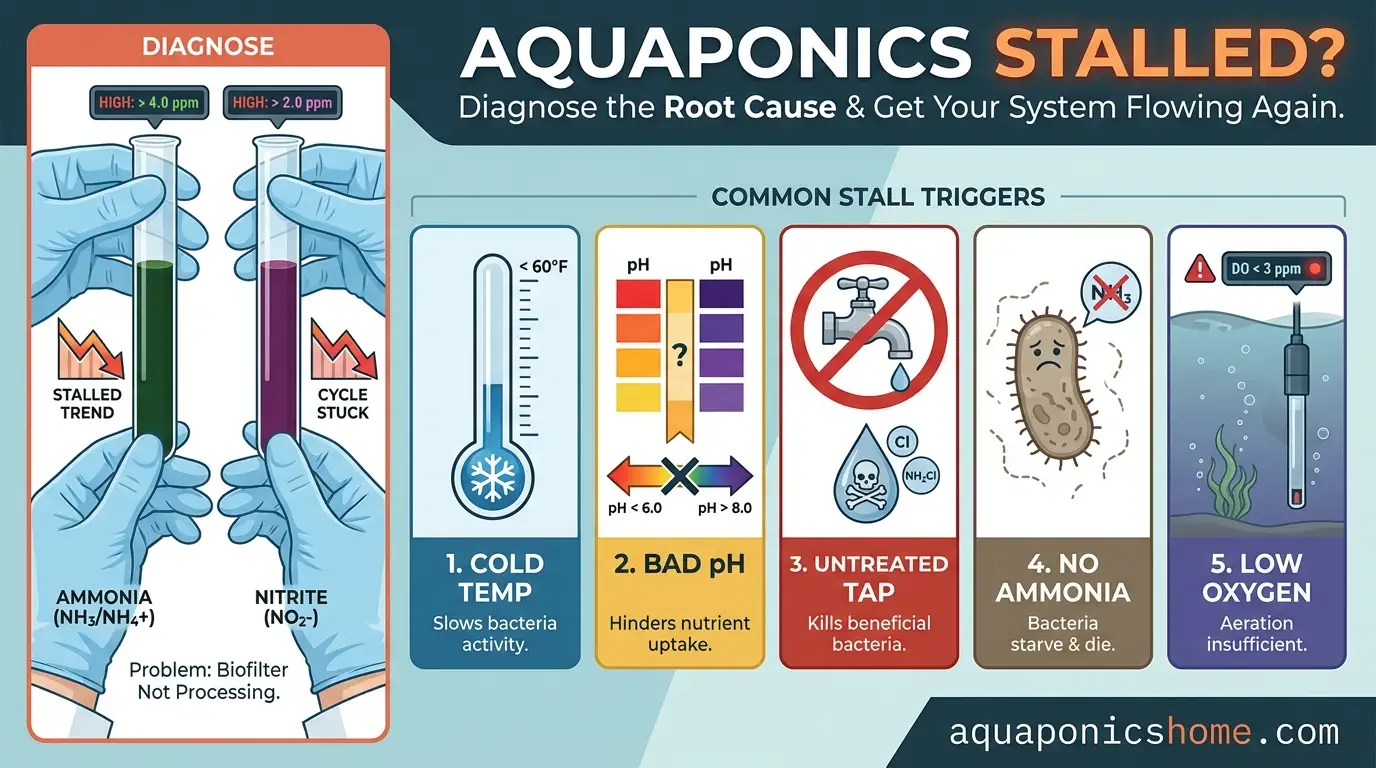
Short answer: a system that refuses to cycle is almost never mysterious. Five things stop nitrifying bacteria from establishing, and four of them are things you did: untreated tap water, a pH that has drifted outside the range the bacteria work in, a colony that ran out of ammonia to eat, water that is too cold, and a lack of oxygen or flow where the bacteria live.
Before you treat any of them, check that you are actually stalled, because a long quiet stretch with ammonia present and no nitrite yet is what a normal cycle looks like from the inside.
I am not going to tell you how many weeks cycling takes. Nobody honestly can, and the number you were given by the last page you read is an average of somebody else’s water temperature. What this article gives you instead is a way to read your own test results and work out which of the five causes is yours.
The cycling procedure itself, start to finish, is in the guide to cycling without killing your fish. This page assumes you already started and it stopped going anywhere.
First, are you stalled or just early?
This matters more than anything else here, because the commonest response to a slow cycle is to tear it down and start again, which throws away weeks of genuine progress.
The FAO’s technical paper on small-scale aquaponic food production (Somerville and colleagues, Technical Paper 589, 2014) puts it plainly: nitrifying bacteria are relatively slow to reproduce and establish colonies, requiring days and sometimes weeks.
The first group to establish converts ammonia to nitrite. Until that group is large enough to produce a measurable amount of nitrite, your test kit shows ammonia and nothing else. There is no reading that displays “bacteria are multiplying.” The stage is invisible by design.
So use this test instead of a calendar.
You are probably just early if ammonia is present and holding or rising, nitrite is still at zero, and you have been running less than a few weeks in cool conditions. Nothing is wrong. Keep the ammonia supply going and keep testing.
You may genuinely be stalled if any of these is true: ammonia went to zero and stayed there with nitrite never appearing at all, nitrite appeared and has not moved in either direction over many consecutive tests, or ammonia keeps climbing with no nitrite showing after a long stretch in warm water. Those are patterns, not dates, and a pattern is something you can act on.
The five causes, and the reading each one leaves behind
This is the part the ranking pages skip. They list causes; they do not tell you how to work out which one is yours. Your test kit already contains the evidence, because each cause leaves a different signature across the three numbers.
| What your readings show | The likely cause | What to check next |
|---|---|---|
| Ammonia at zero, nitrite never appeared, readings flat for a long time | The colony starved. Ammonia ran out before the bacteria established | Your dosing log. Did ammonia sit at zero for days at a time? |
| Ammonia climbing steadily, nitrite still zero, everything else normal | Bacteria are being killed faster than they establish. Usually the top-up water | Whether your utility uses chlorine or chloramine, and whether you treat every top-up |
| Ammonia climbing, pH low and falling | Nitrification has slowed or stopped because of pH | A pH test before anything else. This one masquerades as every other cause |
| Ammonia climbing, water cold to the touch | Temperature. Not a fault, but a real brake | Water temperature, not air temperature |
| Ammonia climbing, pump off or bed permanently flooded, water smells | Oxygen or flow at the biofilter | Whether water is actually moving through the media, and whether it drains |
None of these needs a new product. Four need a change to what you are doing.
Chlorine and chloramine in the top-up water
This is the one that catches the most careful beginners, because they did everything else right. Municipal water is disinfected specifically to kill microorganisms, and your nitrifying bacteria are microorganisms.
The US Environmental Protection Agency’s guidance on chloramine in drinking water describes it as a disinfectant chosen partly because its residual is more stable and longer lasting than free chlorine, which is exactly the property that makes it a problem here: chloramine does not dissipate by letting the water stand overnight or by boiling it, the way free chlorine largely does.
That is why “I left a bucket out for a day” is not a reliable answer for everyone. Whether it works at all depends on what your own supplier puts in the water, and that varies by utility, not by country.
Look up your water supplier’s annual water quality report, or call and ask which disinfectant they use. If it is chloramine, standing water is not a treatment.
Every untreated top-up sets the colony back, so a system topped up weekly from an untreated tap can stay stalled indefinitely while the owner does everything else correctly.
pH outside the range nitrification works in
pH is the cause that pretends to be the other causes, because when nitrification slows for pH reasons the reading pattern looks like starvation or cold.
FAO Technical Paper 589 states that nitrifying bacteria function adequately through a pH range of 6 to 8.5, with optimal ranges of 7.2 to 7.8 for the ammonia oxidizers and 7.2 to 8.2 for the nitrite oxidizers.
New Mexico State University Extension’s aquaponics water quality circular (Sallenave, Circular 680) is blunter about the bottom end: nitrifying bacteria perform optimally above pH 7.5 and basically stop working when pH falls below 6.
Read that carefully, because it is a trap for beginners. Plants prefer acidic water, so a reader who has been chasing plant performance can push pH straight into the range where the biofilter quits.
If your pH has crashed, fix that first and reassess, rather than concluding the cycle failed. Why it crashed, and why it will not stay where you put it, is its own recurring problem.
The colony starved
Bacteria eat ammonia. Take the ammonia away and they stop multiplying and start dying back.
This is my own failure and the reason this site exists. My first batch of catfish died because I cleaned the system properly, the way you would clean a fish tank, and washed the surfaces the bacteria were living on.
The water looked better than it had ever looked, and the biofilter was gone. That specific mistake, and how to recognize it after the fact, is the biofilter crash.
During a fishless cycle the same thing happens in slow motion when you let the ammonia dose run out and do not replace it for days. The fix is not a bigger dose later. It is a steady supply.
Cold water
Temperature is the cause nobody can argue with and everybody underestimates. FAO 589 gives the optimal temperature range for nitrifying bacteria as 17 to 34 degrees Celsius, about 63 to 93 Fahrenheit, and notes that below that range productivity tends to decrease.
If your water sits under that range, the cycle is not broken. It is running at the speed cold water allows, and patience is the only intervention that works.
This is worth knowing before you start a system outdoors in the fall in a temperate climate, because you may be signing up for a much longer wait than a summer builder had.
No oxygen, or no flow, where the bacteria live
Nitrification is aerobic. FAO 589 gives optimal dissolved oxygen for the process as 4 to 8 mg per liter and states that nitrification does not occur if dissolved oxygen drops below 2 mg per liter.
In a small home system that usually means one of three physical faults: the pump has stopped or is barely moving water, the grow bed is permanently flooded with no drain and no air exchange, or the water is warm and still. Put your hand in the flow. If nothing is moving through the media, nothing is happening in the media either.
The cause almost nobody names: light on the biofilter
Here is the one I have never seen on a troubleshooting listicle, and it matters for balcony systems specifically.
FAO 589 states that nitrifying bacteria are photosensitive until they fully establish a colony, and that sunlight can cause considerable harm to the biofilter.
A balcony system is, by definition, in the sun. If your media bed surface, sump or exposed biofilter media sits in direct sunlight through the establishment period, you are working against the colony while you wait for it.
Shading the biofilter, not the plants, costs nothing and is worth doing during cycling. It also reduces the algae that otherwise turns the water green and competes for the same nutrients.
What not to do while you are waiting
- Do not start over. A stalled cycle keeps whatever colony it has. A teardown does not.
- Do not add fish to prove it works. A system that cannot process ammonia will not learn to process it faster because there is now a fish producing more.
- Do not treat a chemistry problem as a bacteria shortage. If the cause is chloramine, cold or pH, adding more bacteria into the same conditions changes nothing.
- Do not clean anything. Ask me how I know.
- Do change one thing at a time and keep testing. If you fix the top-up water and the pH and the flow on the same afternoon, you will never know which one it was, and you will make the same mistake on your next system.
If you are cycling as part of a first build and want the whole sequence in order rather than this one failure, it sits inside the first thirty days of a new system.
If there are fish in the system right now
A stalled cycle with fish already in the water is a different situation from a stalled fishless cycle, because ammonia has somewhere to accumulate and something to poison.
Right now, in this order, and none of it is chemistry:
- Stop feeding. Uneaten food and fish waste are the ammonia source. Feeding into a system that cannot process ammonia makes the reading worse within hours.
- Increase aeration. More surface movement, an air stone, a second air pump if you have one.
- Do a partial water change with dechlorinated, temperature-matched water. Match the temperature to the tank, and treat the replacement water before it goes in, not after.
- Test again after the change and write both readings down.
Do not reach for a bottle of anything until you know what you are treating. If fish are gasping at the surface, lying on the bottom or unresponsive, work through the first-hour triage for dying fish, and take anything that looks like disease rather than water chemistry to a qualified aquatic veterinarian or your state extension aquaculture service.
FAQ
How long should cycling take before I decide it has stalled?
Judge by the pattern in your readings rather than by a number of weeks, because temperature, seeding, system size and how consistently you supplied ammonia all change the duration enormously and published estimates contradict each other for that reason. A genuine stall looks like ammonia at zero with nitrite that never appeared, or readings that have not moved in either direction across many consecutive tests.
My ammonia is zero but nitrite never showed up. Is that cycled?
Almost certainly not. A finished cycle shows zero ammonia and zero nitrite with nitrate present. Zero ammonia with no nitrite and no nitrate is the signature of a colony that ran out of food before it established, and the fix is a steady ammonia supply rather than a restart.
Can tap water really stop a cycle?
Yes, if it is untreated. Drinking water is disinfected to kill microorganisms, and chloramine in particular does not dissipate by standing or boiling the way free chlorine largely does, according to EPA guidance on chloramine in drinking water. Find out from your own water supplier’s quality report which disinfectant they use, and treat every top-up accordingly.
Will bottled nitrifying bacteria fix a stalled system?
Only if the reason the system stalled was a shortage of bacteria. If the cause is chloramine in the top-up water, a pH below the range nitrification works in, cold water or no oxygen at the biofilter, a fresh culture meets the same conditions that killed the last one. Diagnose first.
Should I do a water change while cycling?
Only for a specific reason, such as diluting an ammonia level that is stressing fish or correcting water you have identified as the problem. Routine water changes during a fishless cycle mostly remove the ammonia the colony needs. If fish are in the system and distressed, a partial change with dechlorinated, temperature-matched water is a physical intervention that buys time.
Sources
- Somerville, C., Cohen, M., Pantanella, E., Stankus, A. and Lovatelli, A. (2014). Small-scale aquaponic food production: integrated fish and plant farming. FAO Fisheries and Aquaculture Technical Paper No. 589.
- Sallenave, R. Important Water Quality Parameters in Aquaponics Systems. New Mexico State University Cooperative Extension Service, Circular 680.
- US Environmental Protection Agency, information for consumers on chloramine in drinking water.
I run small aquaponics systems on a rented balcony and I have stalled a cycle by cleaning it, which is where the biofilter section comes from. No cycling duration, ammonia threshold or nitrite threshold is published here on purpose: those figures vary with water temperature, species and system, and a confident wrong number in a beginner’s hands is worse than no number at all. Use your own test kit’s documentation and a named university extension aquaculture service for target values, and consult a qualified aquatic veterinarian for anything concerning live fish. This site is not a laboratory, a fisheries agency or a veterinary practice.