
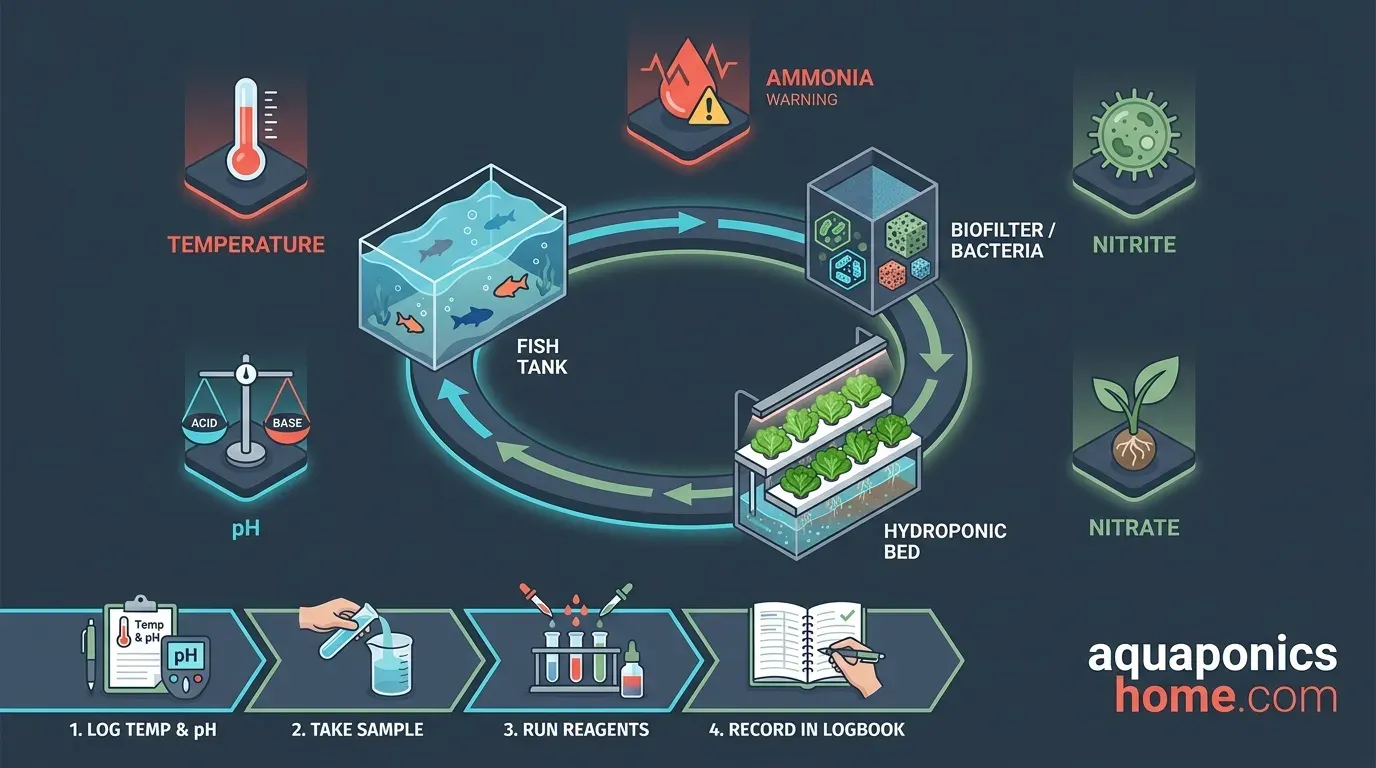
Short answer: aquaponics water testing means being able to read five things: ammonia, nitrite, nitrate, pH and water temperature. Ammonia and nitrite tell you whether the biofilter is keeping up, nitrate tells you whether the plants are being fed, and pH and temperature are the conditions that make the other three readable at all. New Mexico State University Extension’s aquaponics circular puts the frequency plainly: test daily while a system is starting up, and once the nutrient cycles are balanced, weekly testing is usually sufficient. Ten minutes, same order, written down.
This page does not rank test kits and does not name a product to buy. It covers what you have to be able to measure, what the classes of test hardware actually differ on, and the routine that turns readings into something you can act on. If you want the wider list of what a small system needs, that lives in the equipment list.
The five things you have to be able to measure
Aquaponics is three living systems sharing one body of water, and each of the five readings is about a different one of them.
| Reading | What it is telling you | Why you cannot skip it |
|---|---|---|
| Ammonia | Whether waste is being produced faster than the first bacterial group can convert it | It is the reading that moves first when something breaks |
| Nitrite | Whether the second bacterial group is keeping up with the first | It rises after ammonia looks fixed, which is why people miss it |
| Nitrate | Whether the plants are getting fed | It is the only one of the three you are trying to produce |
| pH | The condition that decides whether nitrification happens at all | FAO reports nitrifying bacteria function adequately between pH 6 and 8.5; NMSU reports they basically stop below pH 6 |
| Temperature | The condition that sets the speed of everything biological | FAO gives 17 to 34 degrees Celsius, roughly 63 to 93 Fahrenheit, as the optimal range for nitrifying bacteria |
Two of those, pH and temperature, are not optional extras. A total ammonia reading on its own cannot be interpreted, because only part of the ammonia in your water is in the form that harms fish, and how much depends on pH and temperature. Recording ammonia without recording the pH and temperature it was measured at gives you a number you cannot use later.
Sources here are the FAO’s Small-scale aquaponic food production (Somerville and colleagues, Technical Paper 589, 2014) and New Mexico State University Cooperative Extension’s Circular 680 on water quality parameters in aquaponics systems (Sallenave). Both are free, both are aquaponics-specific, and both are better references for target values than any blog, including this one.
The classes of test kit, and what actually separates them
Ignore brands for a moment. There are four classes of thing you can test water with, and they differ on precision, running cost and how likely you are to actually use them.
Liquid reagent kits. You add counted drops of a reagent to a measured sample, wait a stated time, and compare the color against a printed card. Slower and fiddlier than the alternatives, cheaper per test than they look, and the class most home systems settle on. The weak points are human: not shaking a reagent bottle that needs shaking, reading the color under a yellow kitchen light, and guessing between two shades on the card.
Test strips. Dip, wait, compare. Fast, convenient, and the class most likely to actually get used on a busy week, which is a real advantage rather than a consolation. The trade-off is precision, and strips lose accuracy as the container is exposed to air, so a tube opened months ago is not the same test it was when new.
Digital meters and probes. Usually pH, sometimes temperature and conductivity together. The appeal is a number instead of a color judgment. The catch is calibration: an uncalibrated meter gives a precise, confident, wrong answer, and it needs calibration solutions and a maintained probe to stay honest.
Send-out testing. Your state or provincial extension service, a university aquaculture program or a commercial water lab. Slow and occasional, but it is the only class that tells you what your source water actually contains, which is worth doing once when you set up rather than never.
Here is the part that gets left out of every comparison: no home kit is a laboratory, in any class. A peer-reviewed assessment of water test kits for pond aquaculture (Naigaga and colleagues, Journal of the World Aquaculture Society, 2017) found that on replicate analyzes of pond water, kits gave results that often differed from, and were usually less precise than, standard laboratory methods, while remaining sufficiently reliable for many practical uses.
That is not a reason to skip testing. It is the reason to care about the trend rather than the individual number. Your kit is consistent with itself, so a reading that has doubled since last week is real information even if the absolute figure is a little off. A single reading compared against a threshold you read on the internet is the weakest possible use of it.
The ten-minute weekly routine
Same order, same time of day, same spot in the tank. Consistency is what makes the numbers comparable week to week.
- Write the date, the time and the water temperature first. Water temperature, taken in the tank, not air temperature from your phone.
- Take one sample in a clean container, from the same place each week. Mid-water, away from the return flow, before you feed.
- Test pH. Do it first, because it is the condition the other results have to be read against.
- Test ammonia, then nitrite, then nitrate. In that order, following your kit’s timings exactly. If the instructions say shake for thirty seconds and wait five minutes, that instruction is the test.
- Write all five numbers down, in a notebook, immediately. Not in your head, not on your phone’s notes app if you will not find it again.
- Write one line about anything that changed: topped up the water, weather turned, added fish, harvested, cleaned something, fed more than usual.
- Look at last week’s line before you put the book down. This is the whole point of the exercise and it takes fifteen seconds.
The most useful piece of equipment I own is a notebook with a pen tied to it. My second system was diagnosed almost entirely from that notebook: readings that made no sense on their own made complete sense next to the note that said “topped up from tap, no treatment.”
How often, honestly
NMSU Circular 680’s answer is the one to follow: start-up systems should be tested daily, and once the nutrient cycles are balanced, weekly testing is usually sufficient. It also notes that pH should be watched more often than the rest, because it tends to decline over time in a running system.
So in practice:
- While cycling: every day or two, following the cycling procedure. This is the period where the readings actually change day to day, and it is the only period where daily testing earns its cost in reagent.
- A mature, stable system: weekly for the full set, with pH checked more often if yours is a system that drifts. Many are, and pH that will not stay put is its own problem with its own causes.
- After any change: new fish, a big harvest, a pump failure, a heat wave, a top-up with new water, a dead fish removed. Test the next day rather than waiting for the schedule.
When to break the schedule and test now
The weekly routine is for a system that is behaving. Test immediately, whatever day it is, if you see any of these:
- Fish at the surface gulping, or crowded around the water return
- Fish refusing food they normally take
- A fish dead for no visible reason
- The pump stopped, however briefly
- Water that has gone cloudy, or that suddenly smells
- Plants that yellowed noticeably since last week
Those are symptoms with several possible causes, and the readings are how you narrow them down rather than guess. The routes from a symptom to a cause are collected in the troubleshooting guide, and if fish are already in visible distress, the first hour matters more than the diagnosis, so go straight to the triage sequence for dying fish.
What testing will not tell you
Worth saying, because a full set of green readings can be falsely reassuring.
- Dissolved oxygen is not in a standard home kit, and it is one of the fastest killers in a warm small system. FAO 589 gives 4 to 8 mg per liter as the optimal range for nitrification and states that nitrification does not occur below 2 mg per liter. Most home operators infer oxygen from fish behavior and aeration equipment rather than measure it, which is a real gap in the toolkit, not a solved problem.
- No standard kit measures the toxic fraction of ammonia directly. It measures total ammonia. Converting that to the fraction that actually harms fish needs your pH and temperature and a conversion table, which is why step 1 of the routine is what it is.
- A nitrate reading does not tell you which nutrient your plants are short of. Nitrogen is one of several, and pale or stunted growth with a healthy nitrate reading is a different problem from nitrate that will not rise at all.
- A reading is not a diagnosis of a sick fish. Water chemistry explains a great deal in aquaponics and it does not explain everything. Anything that looks like disease belongs with a qualified aquatic veterinarian or an extension aquaculture specialist.
Small habits that make the numbers trustworthy
- Rinse the test vial in system water, not tap water, before filling it.
- Check reagent expiry dates. Old reagent reads low and gives a comforting, wrong answer.
- Read colors in daylight, against white, not under a warm kitchen bulb.
- Store strips sealed and dry, and accept they are less accurate months after opening.
- Keep one kit. Two brands of kit will disagree slightly, and switching mid-season destroys the comparability of your log, which is the only thing you actually own.
- Do not test straight after feeding, or you are measuring the feed rather than the system.
FAQ
What water parameters should I test in aquaponics?
Ammonia, nitrite, nitrate, pH and water temperature, as a minimum. Ammonia and nitrite show whether the biofilter is keeping up, nitrate shows whether the plants are being fed, and pH and temperature are the conditions the other three have to be interpreted against. Dissolved oxygen matters as much as any of them but is rarely included in a home kit.
How often should I test my aquaponics system?
New Mexico State University Extension’s Circular 680 advises testing daily while a system is starting up and weekly once the nutrient cycles are balanced, with pH watched more frequently because it tends to decline over time. Test off-schedule after any change and immediately if fish behavior changes.
Are test strips accurate enough for aquaponics?
They are less precise than liquid reagent kits and lose accuracy after the container has been open a while, but a strip used every week beats a liquid kit used twice a year. A peer-reviewed assessment of water test kits for pond aquaculture (Naigaga and colleagues, 2017) found home kits generally less precise than laboratory methods across the board while still being useful for practical monitoring, so track the trend rather than treating any single number as exact.
Do I need a digital pH meter?
Not to run a small system. A meter gives a number instead of a color judgment, which is genuinely easier to record, but it has to be calibrated with calibration solutions to stay accurate, and an uncalibrated meter is more misleading than a color card because it looks authoritative.
When can I stop testing?
You reduce the frequency; you do not stop. A balanced system settles into a weekly check, but stocking changes, weather, harvests and equipment failures all move the numbers, and a system that has been ignored for a month gives you no trend to read on the day something goes wrong.
Sources
- Somerville, C., Cohen, M., Pantanella, E., Stankus, A. and Lovatelli, A. (2014). Small-scale aquaponic food production: integrated fish and plant farming. FAO Fisheries and Aquaculture Technical Paper No. 589.
- Sallenave, R. Important Water Quality Parameters in Aquaponics Systems. New Mexico State University Cooperative Extension Service, Circular 680.
- Naigaga, S., Boyd, C. E., Gaillard, P., Abdelrahman, H. A. and Molnar, J. J. (2017). Assessing the reliability of water-test kits for use in pond aquaculture. Journal of the World Aquaculture Society, 48(4).
I test a small balcony system with an inexpensive kit and a notebook, and that is the whole toolkit this article assumes. No product is recommended, ranked or linked here, and this site carries no affiliate links. Target values are deliberately left to the named extension and FAO publications above and to your own kit’s documentation, because the right figure depends on your species, your temperature and your pH. Anything concerning a sick fish belongs with a qualified aquatic veterinarian.