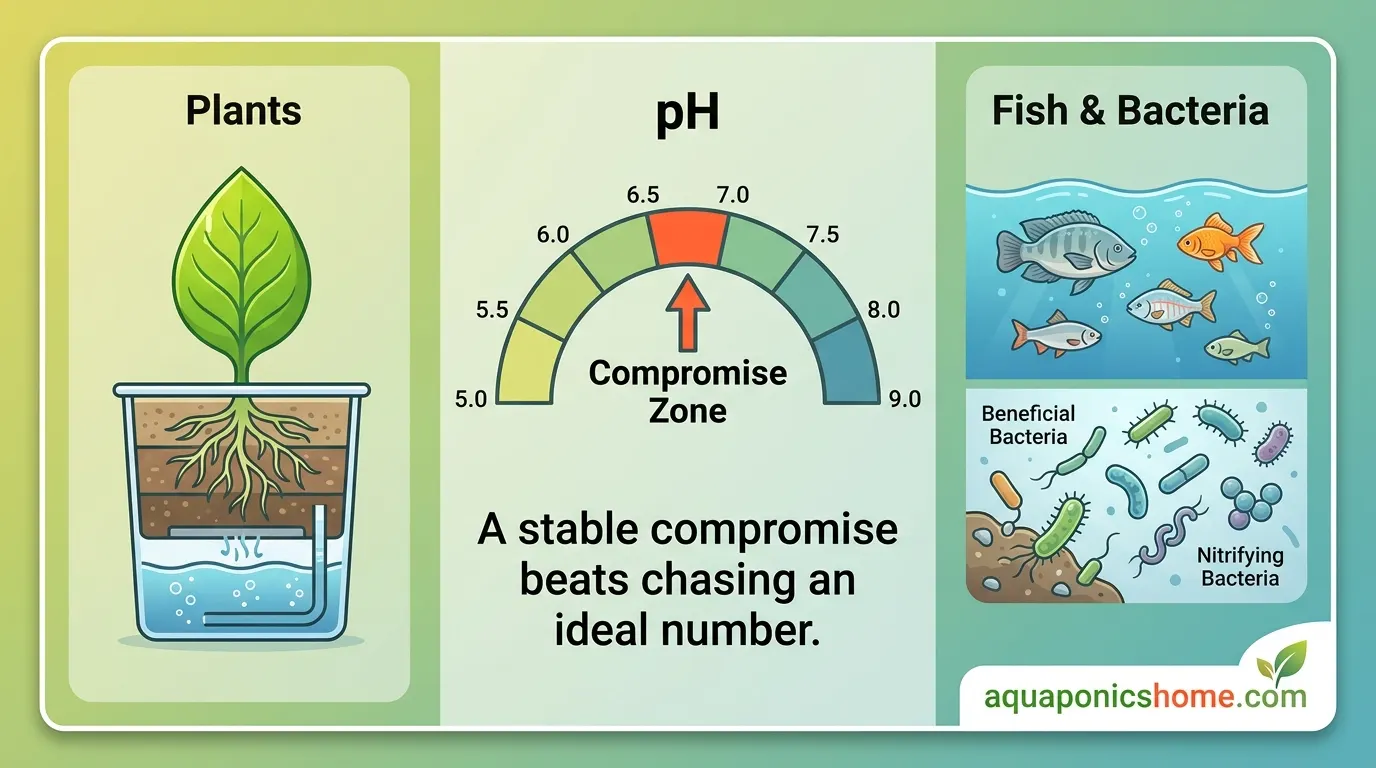
Short answer: you are running three living systems in one body of water and they do not agree. New Mexico State University Cooperative Extension’s aquaponics circular sets out the conflict directly: nitrifying bacteria perform optimally above pH 7.5 and basically stop working below pH 6, plants take up nutrients best below about 6.5, and fish such as tilapia tolerate a wide band. The circular’s answer is a compromise rather than an optimum: a pH of 6.8 to 7.0, described as the value optimal to all three components at once. Nobody in your system gets exactly what they want, and that is the correct outcome.
This is the explainer. If your pH will not stay where you put it, that is a different and very common problem with its own causes, and it lives in why your aquaponics pH keeps changing.
Three tenants, one apartment
It helps to stop thinking about a target and start thinking about a negotiation.
| Who | What they want | What happens outside it |
|---|---|---|
| Nitrifying bacteria | NMSU: optimal performance above pH 7.5. FAO 589: adequate function through a range of 6 to 8.5, with optimal ranges of 7.2 to 7.8 for the ammonia oxidizers and 7.2 to 8.2 for the nitrite oxidizers | NMSU: they basically stop working below pH 6. A stopped biofilter means ammonia accumulating |
| Plants | Slightly acidic. Nutrient availability is generally best below about 6.5 | Nutrients present in the water become progressively harder for roots to take up as pH climbs |
| Fish | Species dependent, and the widest tolerance of the three. NMSU gives tilapia a range of 5.0 to 10.0 | Extremes stress fish, and rapid change stresses them more than a steady value at the edge of the range |
The two sources above are FAO’s Small-scale aquaponic food production (Somerville and colleagues, Technical Paper 589, 2014) and NMSU Cooperative Extension’s Circular 680 (Sallenave). Read together they explain why every article you have found gives a different number: each one is quoting the preference of a different tenant. A hydroponics page optimizes for the plant. An aquaculture page optimizes for the fish. A wastewater or biofilter reference optimizes for the bacteria. None of them is wrong; none of them is describing your system.
The compromise costs you something real, and pages that present a single ideal figure hide that. At the published compromise your plants are above their preferred nutrient-availability range and your bacteria are below their optimum. Both are working at less than their best, on purpose, so that neither fails. Commercial operators sometimes solve this by decoupling, running the fish loop and the plant loop at separate pH values and connecting them selectively. That is not a home-scale option on a balcony, which is why the compromise is our answer.
The trap that kills small systems
This is the part I want a beginner to leave with, because it is the mistake that looks like good gardening.
Plants prefer acid. Yellowing leaves push a grower toward lowering pH. Lower pH improves nutrient availability, the plants respond, and the grower keeps going. Then, somewhere under pH 6, the biofilter quietly stops. NMSU Circular 680 states it plainly: nitrifying bacteria basically stop working when pH levels fall below 6.
What follows is not obvious, because nothing visible happens immediately. Ammonia begins accumulating because the conversion has stopped, and the first symptom most people notice is fish behaving oddly, days later, in a system whose plants had never looked better.
If your plants are yellowing, pH is one candidate among several, and the others include the nutrients an aquaponic solution is genuinely weak in. Rule those out before you chase pH downward, starting with what a low nitrate reading means.
What pH does to your other readings
pH is not just its own parameter. It changes the meaning of the most important number on your test sheet.
Ammonia exists in water in two forms: un-ionized ammonia, which is the form that poisons fish, and ammonium, which is far less harmful. Home test kits measure both together as total ammonia nitrogen. The split between them depends on pH and temperature. NMSU Circular 680 states that at pH 7.0 or below, more than 95 percent of the ammonia present is in the non-toxic ammonium form, and publishes a table of the toxic percentage across a pH range of 7.0 to 10.0 and temperatures from 50 to 89.6 degrees Fahrenheit.
Two consequences follow, and they matter:
- The same ammonia reading is more dangerous at higher pH. A number that is unremarkable in slightly acidic water can be a genuine problem in alkaline water at summer temperatures.
- Raising pH during an ammonia problem increases the toxic fraction. This is why “just fix the pH” is bad advice during an ammonia event, and why the physical actions, stop feeding, aerate, partial water change with dechlorinated and temperature-matched water, come before any chemistry.
Record pH and water temperature on the same line as every ammonia reading. Without them, an old ammonia number in your notebook cannot be interpreted at all.
Why pH will not stay where you put it
Two things are worth knowing here, and the details belong to the drift article rather than this one.
Nitrification is an acidifying process. A running, working system tends to trend downward over time, which is why NMSU Circular 680 advises measuring pH more often than the other parameters and notes it typically declines. A system whose pH never moves is unusual; a system whose pH falls slowly is normal.
What resists that fall is carbonate hardness, the buffering capacity of your water, and it is consumed as it does its job. This is the real reason a pH correction “snaps back” within days: the correction changed the number without changing the buffer, so the same drift resumes immediately. Two systems on the same street can behave completely differently here depending on their source water.
Some of your buffering can come from the system itself. Media containing limestone, shell or other carbonate material raises and holds pH continuously, which is helpful if you needed it and a permanent problem if you did not. That is a choice made at build time and it is one of the things to check before you buy, in choosing grow media.
Measuring pH so the number means something
- Use the correct test range. Many liquid kits ship both a standard and a high-range pH test. Reading a system that is actually above the standard test’s ceiling gives you a maximum-color result that is not your pH.
- Test at the same time of day. pH moves on a daily rhythm in a system with plants, algae and respiration in it. Comparing a morning reading with an evening one produces a swing that is not really there.
- Read in daylight against white. Kitchen bulbs shift color cards.
- Calibrate a digital meter, or do not trust it. An uncalibrated meter gives you a confident wrong number, which is worse than a color card you know you are estimating from.
- Record it with the temperature. Always, for the reason in the previous section.
Stability beats hitting the number
If you take one habit from this page rather than one figure, take this one.
A system sitting steadily slightly outside the published compromise is generally in better shape than a system being pushed back to the ideal figure twice a week. Every correction is a change, changes stress fish, and repeated overcorrection produces a sawtooth that nothing in the system enjoys. Aquatic organisms live with a steady value far better than they live with a moving one.
Practically, that means: measure before you decide anything, change one thing at a time, and give a change several days to show its effect before adding another. A slow drift you are watching is not an emergency. A pH you have moved three times this week is a problem you created.
What this page will not give you
No dose, and no product quantity. Not for a buffer, not for an acid, not for a carbonate, not for the household ingredients some sites treat as automatically safe because they are ordinary. The right amount depends on the concentration of the specific product in your hand, on your true system volume, and on how strongly your water is buffered, and none of those are things a web page can know. That figure is on the label, and the “how to adjust it” question deserves its own careful treatment rather than a paragraph here.
No single ideal number presented as universal. The compromise range above is attributed to a named extension publication, applies to the components as that publication describes them, and reasonable sources place the emphasis differently.
If something has gone wrong right now
A sharp pH change, in either direction, is a physical emergency for fish before it is a chemistry problem.
- Stop feeding.
- Aerate hard.
- Do not chase the number back with another correction. Two corrections in one day is how a swing becomes a crash.
- If you must move the water quality, dilute: a partial water change with dechlorinated, temperature-matched water, added slowly.
- Test and record pH, temperature, ammonia and nitrite together so you can tell whether the pH change is the cause or the symptom.
If fish are gasping, lying on the bottom or dying, go straight to the first-hour triage for dying fish and work the physical steps before the chemistry. If you are trying to work backward from a symptom rather than a reading, start at the troubleshooting guide. Anything that looks like disease rather than water chemistry is a question for a qualified aquatic veterinarian or your state extension aquaculture service.
FAQ
What is the ideal pH for aquaponics?
New Mexico State University Cooperative Extension’s Circular 680 describes a pH of 6.8 to 7.0 as the compromise optimal to all three components of an aquaponic system at once, with an acceptable band around it. It is explicitly a compromise: at that value the plants are above their preferred nutrient-availability range and the nitrifying bacteria are below their optimum, and both are working at less than their best on purpose.
Why do different sites give different pH targets?
Because each is optimizing for a different organism. FAO 589 reports nitrifying bacteria functioning adequately between pH 6 and 8.5 with optima in the 7.2 to 8.2 region; plant references favor slightly acidic water for nutrient availability; fish references quote broad species tolerances. A page that gives you one number without saying which of the three it serves has left out the reason for the number.
What happens if aquaponics pH gets too low?
NMSU Circular 680 states that nitrifying bacteria basically stop working below pH 6. Nitrification stalling means ammonia accumulating, so a low-pH system can develop an ammonia problem with no change in feeding or stocking. The plants may look excellent throughout, which is what makes it dangerous.
Does high pH hurt my fish directly?
The more immediate effect is indirect and often overlooked: at higher pH a greater share of your total ammonia reading is in the un-ionized form that actually harms fish. NMSU reports that at pH 7.0 or below, more than 95 percent of ammonia is in the less harmful ammonium form, and publishes a table showing how that changes as pH and temperature rise. So a high pH makes an existing ammonia reading more serious.
How often should I test pH?
More often than the other parameters. NMSU Circular 680 advises daily testing while a system is starting up and weekly once the cycles are balanced, and notes that pH should be watched more frequently because it typically declines over time in a running system. Testing at the same time each day is what makes the readings comparable.
Sources
- Sallenave, R. Important Water Quality Parameters in Aquaponics Systems. New Mexico State University Cooperative Extension Service, Circular 680.
- Somerville, C., Cohen, M., Pantanella, E., Stankus, A. and Lovatelli, A. (2014). Small-scale aquaponic food production: integrated fish and plant farming. FAO Fisheries and Aquaculture Technical Paper No. 589.
I run small aquaponics systems on a rented balcony and I have chased pH in both directions, which is where the warning about overcorrection comes from. No dose of any buffer, acid or additive is published here on purpose: the amount depends on that product’s concentration, your true system volume and how strongly your water is buffered, and it belongs on the label rather than in a blog post. Target values here are attributed to named extension and FAO publications, and reasonable sources place the emphasis differently. Anything concerning a sick fish belongs with a qualified aquatic veterinarian.