
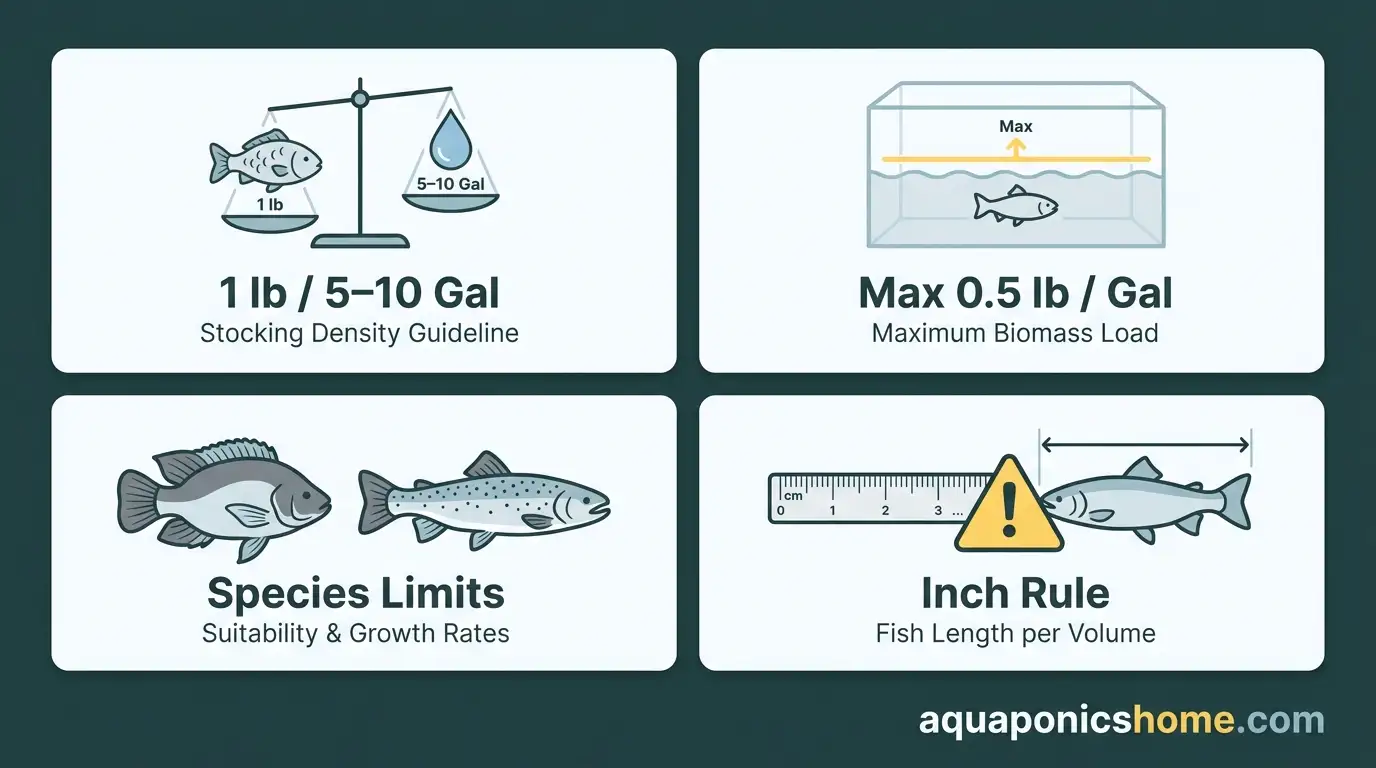
Aquaponics stocking density is usually given as one of four different rules of thumb: a weight-per-gallon ratio, a “critical standing crop” ceiling, a species-specific biomass figure, or the old aquarium inch-per-gallon shortcut.
They disagree because they measure different things (weight versus length) and assume different levels of filtration and aeration. For a small home system, the safest starting point is the lower end of the weight-based rules, then adjusting once ammonia and nitrate readings are stable.
None of these numbers is a law. They are starting points from aquaculture research, and every one of them assumes a working biofilter (the tank of bacteria-coated media that turns fish waste into a form plants can absorb), working aeration and a grower who checks water quality rather than trusting a formula.
Below are the four rules as named sources state them, what each one is actually measuring, and why a beginner should not average them together.
What Aquaponics Stocking Density Means
Two different questions get answered by the phrase “stocking density,” and mixing them up is where most confusion starts.
The first question is how many fish, or how many pounds of fish, fit into a given volume of water right now. The second is how many pounds of fish that tank can carry once every fish reaches full harvest size.
Aquaculture researchers call that second ceiling the critical standing crop, or CSC: the maximum fish biomass a system can support without the fish’s own waste slowing their growth. A tank can be lightly stocked today and still be heading toward an overstocked harvest six months from now if the stocking plan only looked at today’s fish size.
Every rule of thumb below is really an attempt to answer one of those two questions, which is the first reason they read differently on different websites.
Rule 1: Pounds of Fish Per Gallon of Water
The most commonly repeated aquaponics stocking density guideline is a straight weight-to-water ratio. Texas A&M AgriLife Extension’s fisheries and wildlife management program (read 2026-09-18) gives the figure as roughly 1 pound of fish for every 5 to 10 gallons of water in a small tank-based system, using the fish’s expected weight at harvest, not its size at stocking.
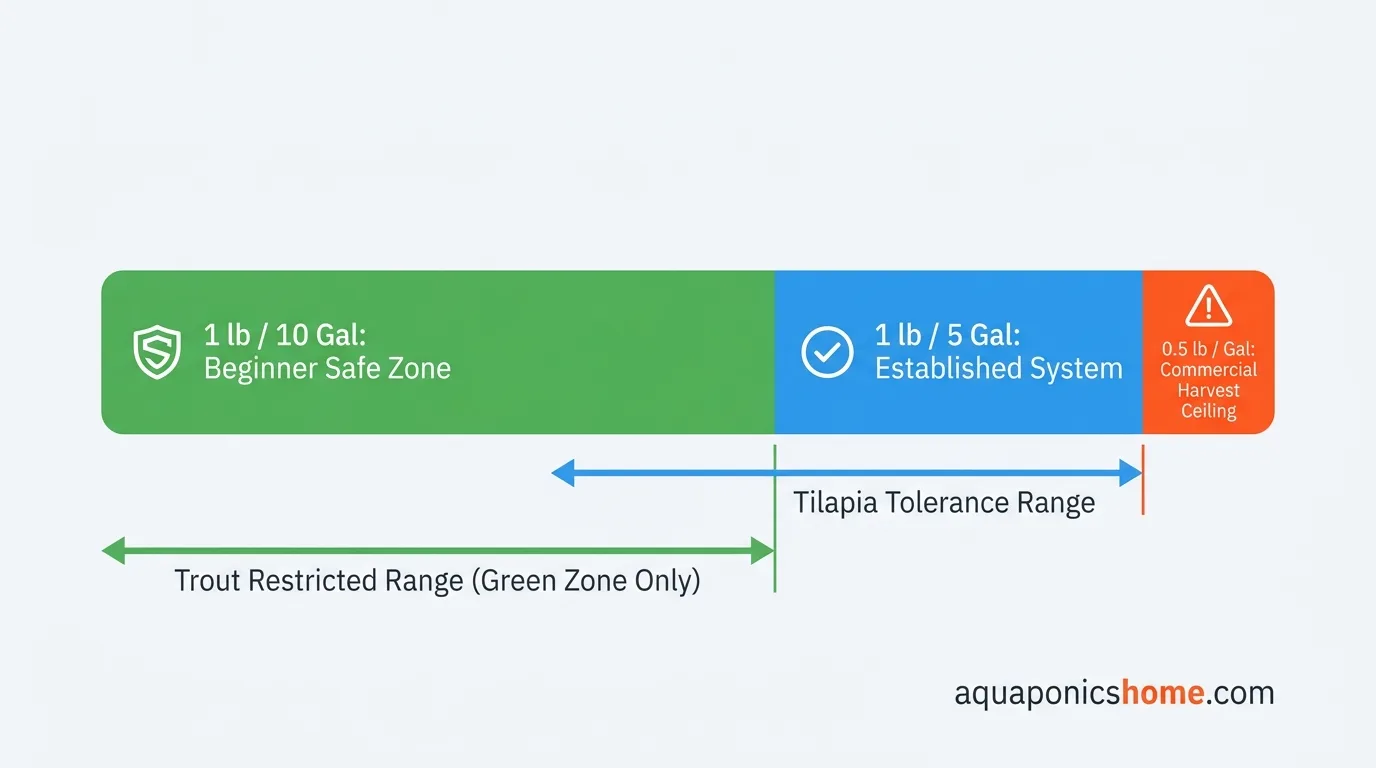
That range matters more than the single number. A beginner running a basic media bed with an air stone and no backup aeration should plan toward the 10-gallons-per-pound end.
A system with a dedicated blower, a solids filter and a grower who tests water weekly can safely lean toward the 5-gallons-per-pound end. The rule is not wrong at either end; it is a range because filtration and aeration, not the fish themselves, set the actual ceiling.
Rule 2: Critical Standing Crop
Oklahoma State University Extension’s fact sheet on recirculating aquaponic tank systems (read 2026-09-18) states that the critical standing crop in an aquaponic system should not exceed about 0.5 pounds of fish per gallon of water at final harvest weight, and specifically that CSC is not the same figure as a stocking rate.
The same fact sheet describes the University of the Virgin Islands commercial model, where Nile tilapia are stocked at roughly 0.29 fish per gallon and red tilapia at roughly 0.58 fish per gallon, densities that only work with continuous aeration and heavy biofiltration built for exactly that load.
This is a ceiling for a mature, well-aerated commercial system, not a beginner’s target. A home grower reading “0.5 pounds per gallon” and stocking a new tank to that level on day one is looking at the wrong end of the timeline: that number describes the tank at harvest, after weeks of growth, feeding and an established nitrogen cycle doing the work of converting fish waste into a form plants can use.
Rule 3: Species-Specific Biomass Limits
Fish species change the math on their own. The same Oklahoma State fact sheet’s tilapia figures above only hold for tilapia, a fish tolerant of lower dissolved oxygen and higher ammonia than most cool-water species.
A trout system, by contrast, needs colder, more oxygen-saturated water and cannot carry anywhere near the same biomass per gallon without dedicated chilling and pure-oxygen injection, equipment a beginner’s equipment list rarely includes. Catfish and bluegill sit somewhere between the two.
This is the rule that most often gets flattened into a single number online. A stocking density that is conservative for tilapia can already be pushing the limit for a cold-water species in the same size tank, because the ceiling was never really about gallons. It was about how much dissolved oxygen and ammonia tolerance that particular species has.
Rule 4: The Aquarium Inch Rule
The oldest and least reliable of the four is the traditional aquarium hobbyist shorthand: roughly one inch of fish per gallon of water.
It is not an aquaponics-specific figure and it was never built around a nitrogen cycle carrying a grow bed on top of it, but it still circulates because it is easy to picture.
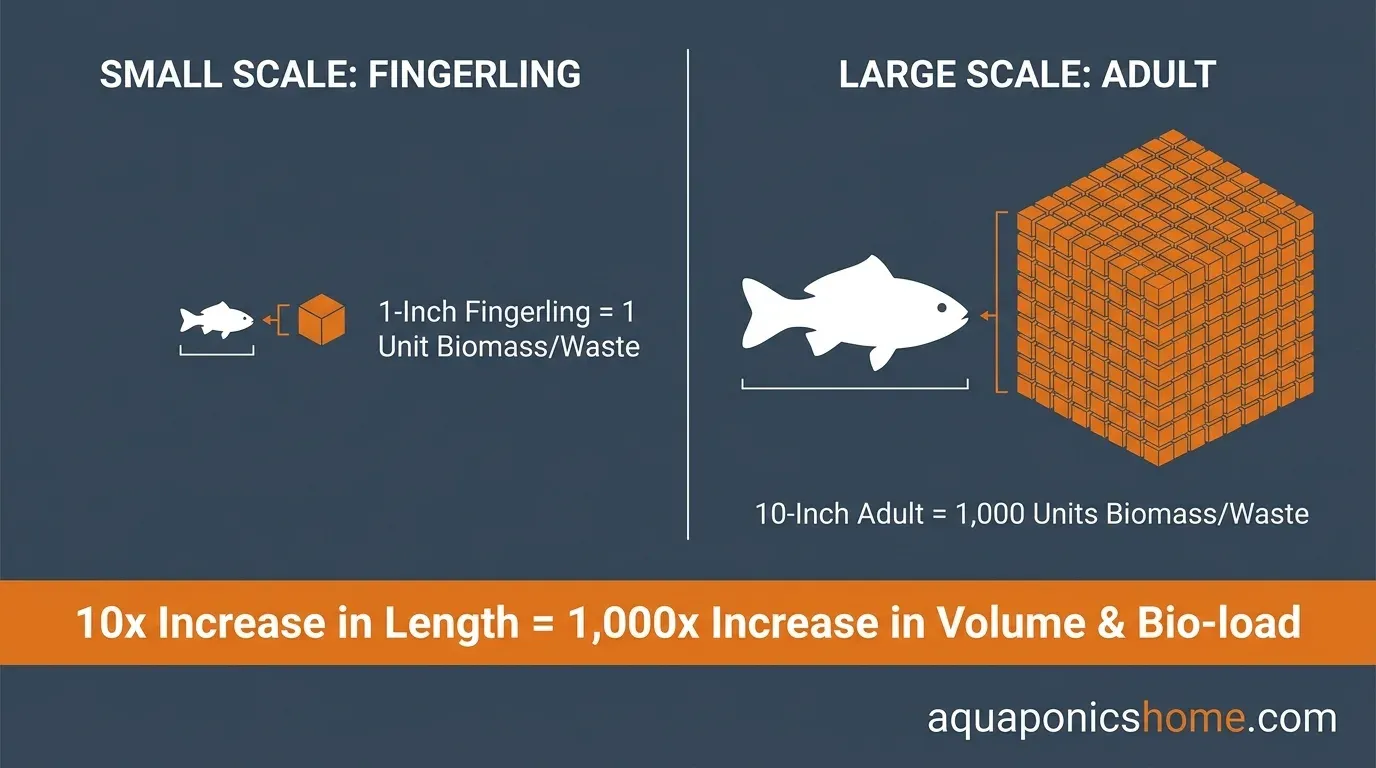
The problem is that fish do not grow in a straight line. A one-inch fingerling and a ten-inch adult of the same species are not ten times the mass; body volume and waste output scale closer to the cube of length, so a small increase in length can mean a much larger increase in bioload.
A tank stocked correctly by the inch rule at fingerling size can be badly overstocked by the time those same fish reach harvest length, which is exactly the mismatch the weight-based rules and the critical standing crop figure exist to avoid.
Why the Four Rules Disagree
Put side by side, the disagreement is not really about aquaponics being an inexact science. Each rule answers a slightly different question:
- The weight-per-gallon rule (Rule 1) is a general planning ratio for a home-scale tank with typical filtration.
- Critical standing crop (Rule 2) is a ceiling for a mature, well-aerated system at full harvest weight, not a stocking instruction for young fish.
- Species-specific limits (Rule 3) adjust either of the above up or down based on a fish’s oxygen and ammonia tolerance.
- The inch rule (Rule 4) measures length, not weight or waste output, and was built for a static aquarium, not a system that has to keep a biofilter and a grow bed running as well.
None of the four is “the” correct aquaponics stocking density. They are compatible once you know which question each one is answering, and the practical move for a small home system is to use Rule 1 as the starting stocking rate, treat Rule 2’s figure as the ceiling you are growing toward, and use Rule 3 to shift the whole range up or down for the specific fish species in the tank.
A Practical Starting Point for a Small System
For a first system, sized using the guidance in a small aquaponics tank size plan, starting near the conservative end of the weight-per-gallon rule is the safer move than reaching for the critical standing crop figure on day one.
A new tank does not yet have an established biofilter, so it cannot process the ammonia load a mature system carries. Stocking light in the first weeks, then adding fish gradually as ammonia and nitrite readings stay at zero, follows the same logic as the nitrogen cycle itself: the bacteria colony that processes fish waste grows in proportion to the waste it is regularly fed, not all at once.
Media volume also matters alongside water volume. A media bed aquaponics setup with a shallow or undersized bed cannot support the same fish load as a deep, well-established bed, because the media itself hosts a large share of the nitrifying bacteria that the fish load depends on.
Signs the Tank Is Overstocked
Watch for these regardless of which rule was used to plan the stocking:
- Ammonia or nitrite readings that will not settle at zero after the system should be cycled.
- Fish gasping at the surface, a sign of low dissolved oxygen rather than hunger.
- Slower growth and reduced appetite across the whole tank, not one individual fish.
- Cloudy or foamy water that was not present at lower stocking levels.
Any of these is a reason to reduce feeding, add aeration, or rehome some fish, not to wait and see whether the numbers settle on their own.
FAQ
What is a safe aquaponics stocking density for a first-time system?
Starting near the conservative end of the weight-based rule, about 1 pound of fish per 10 gallons of water at expected harvest weight, gives a new system’s biofilter time to establish before the fish load grows, per Texas A&M AgriLife Extension’s guidance (read 2026-09-18).
Why do aquaponics stocking density rules give different numbers?
Because they measure different things: a stocking ratio for young fish, a critical standing crop ceiling for mature fish in a fully aerated system, a species adjustment for oxygen and ammonia tolerance, and an old aquarium rule based on length rather than weight.
Can I use the “one inch per gallon” rule for aquaponics?
It is not built for aquaponics and does not account for how fast weight and waste output increase as a fish grows past fingerling size, so it is the least reliable of the four rules for planning a system.
Does fish species change how many fish I can stock?
Yes. Species with higher tolerance for lower dissolved oxygen and higher ammonia, such as tilapia, can be stocked more densely than cold-water species, which need more oxygen and stricter water quality at the same biomass.
What happens if an aquaponics system is overstocked?
Ammonia and nitrite will not stay at zero, fish will gasp at the surface or stop feeding, and growth slows across the tank; the fix is reduced feeding, added aeration, or removing fish, not waiting for the numbers to settle.