
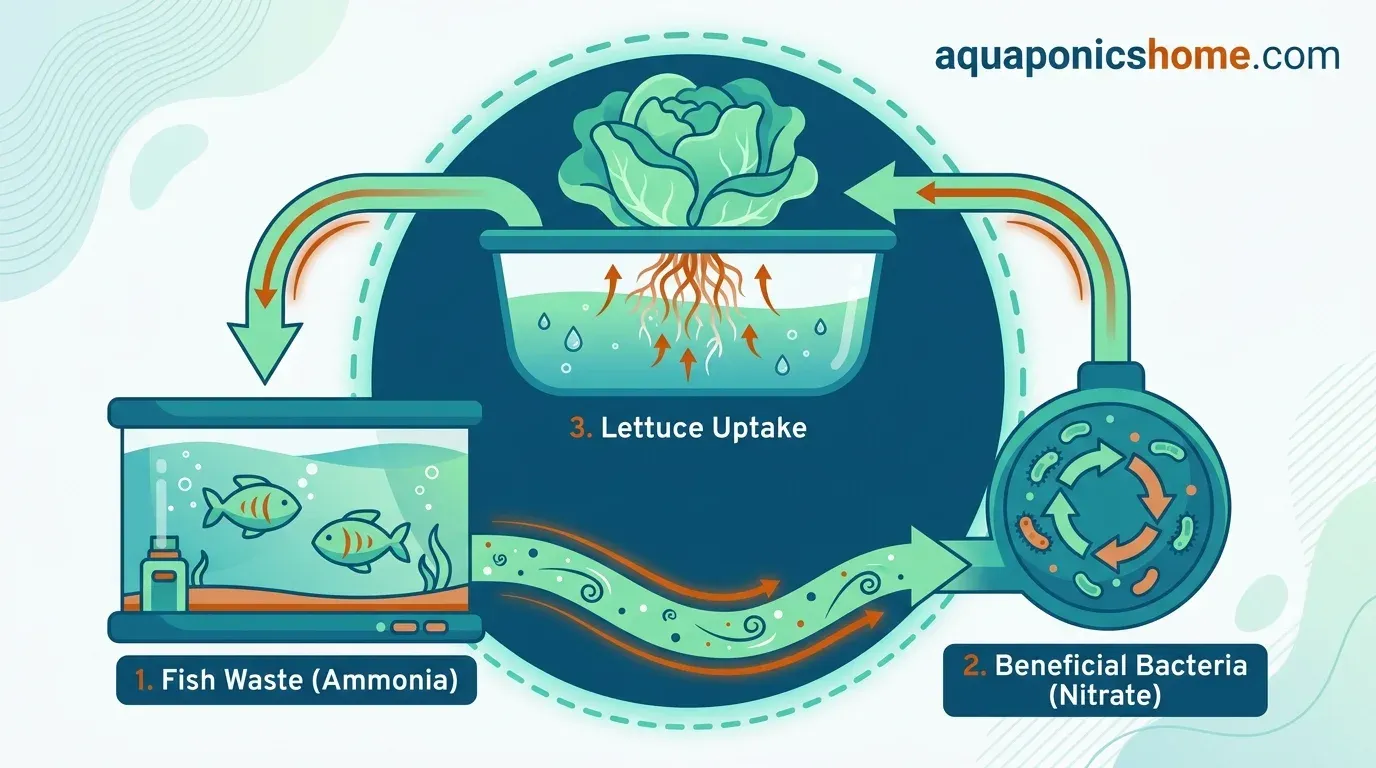
Aquaponics lettuce is lettuce grown in a fish-fed system instead of soil, and it is the crop most small systems get right first.
It asks for less nitrogen than fruiting plants, tolerates the pH swings a new tank goes through, and reaches harvest size in roughly five to seven weeks in a media bed, raft, or NFT channel. That combination is why almost every beginner’s plan, including this site’s own, puts lettuce in the very first grow bed.
Why Lettuce Is Usually the First Crop in a New System
A brand-new aquaponics system is an unstable place. The bacteria colony that turns fish waste into a form plants can use has not built up yet, ammonia and nitrite can spike, and nutrient levels wobble for weeks before they settle.
Lettuce is one of the few crops light enough on nitrogen to grow through that wobble without stalling, which is a large part of why it survives beginner mistakes that would stunt a tomato plant.
It also turns over fast. Cut-and-come-again varieties, loose-leaf especially, can be harvested a few outer leaves at a time and keep producing, so a small grow bed does not sit empty between crops.
If you have not started your system’s first cycle yet, running through your aquaponics system’s first 30 days before stocking a grow bed with lettuce will save a batch of seedlings from a tank that is not ready for them.
The Water Chemistry Lettuce Tolerates
Every aquaponics system is a compromise between three living things that want different water. Plants generally do best in slightly acidic water, fish tolerate a wide range, and the nitrifying bacteria that carry out the nitrogen cycle prefer more alkaline conditions.
New Mexico State University Extension puts the practical compromise for a combined system at pH 6.8 to 7.0, and notes that anywhere from 6.4 to 7.4 is tolerable to all three, even if it is not ideal for any one of them (New Mexico State University Extension, read September 18, 2026).
Lettuce is forgiving inside that band. It will not sulk at 6.5 the way a more demanding crop might, which is another reason it is the crop growers lean on while they are still learning to hold their system’s pH steady rather than chasing a number.
Media Bed, Raft or NFT: Which Setup Suits Lettuce
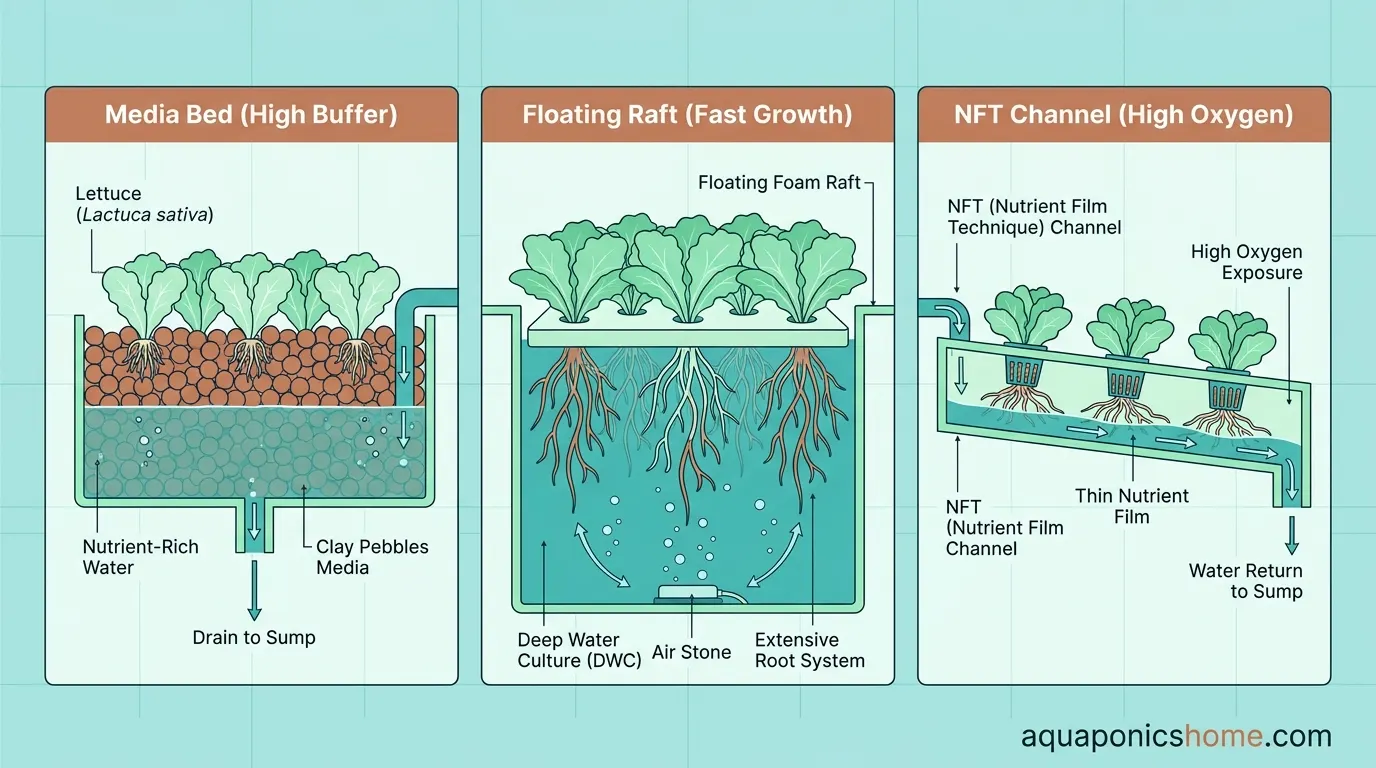
All three of the common aquaponics layouts grow lettuce well, but they suit it differently. A media bed setup, filled with clay pellets or gravel, gives roots something to anchor into and buffers pH gently as the media weathers, which is a large part of why it is the default recommendation for a first system.
A floating raft, where lettuce sits in net pots with roots dangling directly into the water, and an NFT channel, where a thin film of nutrient water runs past the roots, both grow lettuce a little faster because the roots sit in more oxygen, but they give a beginner less room for error if a pump fails.
Whichever layout you pick, choose it before you build the grow bed, since switching later means rebuilding it.
Best Aquaponics Lettuce Varieties for Beginners
Growers who run lettuce in aquaponics systems generally settle on the same handful of types. Loose-leaf varieties do not form a tight head, tolerate water temperature swings better than most lettuce, and grow quickly enough to harvest leaf by leaf.
Butterhead and Bibb types are compact, which suits a small grow bed, and romaine holds up well and does not turn bitter as fast as some other types once it matures.
Iceberg is the one to avoid starting out: it is slower and more nutrient-hungry than the others, which is exactly the wrong combination for a system still finding its balance.
Planting for a Weekly Harvest, Not One Big One
The mistake most beginners make with aquaponics lettuce is planting an entire grow bed on the same day.
University of New Hampshire Extension describes lettuce in a soilless system as roughly a seven-week crop from seed to harvest, and recommends sowing on a schedule, for example one new planting each week into a system sized for a handful of plants at a time, so that a harvest is ready every week instead of a single large batch followed by an empty bed (University of New Hampshire Extension, read September 18, 2026).
Staggering plantings this way also means a failed batch, from a pH swing or a pest, does not cost you the whole crop at once. Before you plant anything, confirm you have enough net pots or media space to run a true rotation rather than one big planting.
When Lettuce Goes Wrong: Yellowing, Tipburn and Slow Growth
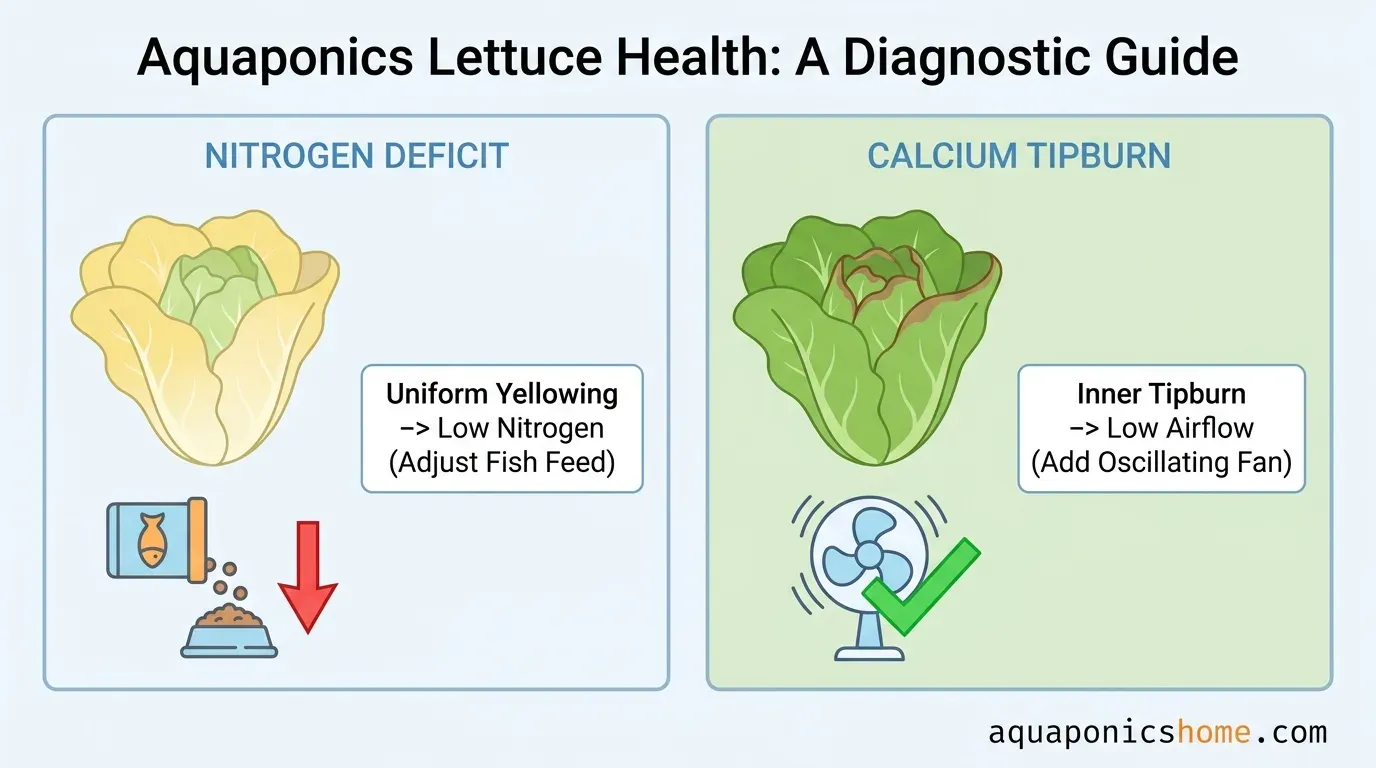
Two problems account for most aquaponics lettuce complaints, and both trace back to the nitrogen cycle rather than the lettuce itself.
Uniform yellowing of the older, lower leaves alongside slow growth points to a nitrogen shortfall. Nitrogen in an aquaponics system comes entirely from fish waste, converted by bacteria, so a tank that is understocked or underfed relative to the size of the grow bed simply cannot supply what a full bed of lettuce needs.
That is a stocking and feeding decision for the tank, not something to fix by feeding the lettuce directly, and it is worth reading up on how the nitrogen cycle actually works in a single tank before assuming more fish is the answer, since overstocking or overfeeding carries its own water quality risks that should be judged against what a named aquaculture authority, not a blog post, recommends for your fish species and tank size.
Browning or dead tissue at the edges of the newest inner leaves is tipburn, and it is a calcium problem, not a nitrogen one. UNH Extension explains that this happens even when calcium is present in the system, because calcium only moves into the plant as it transpires water, and low airflow around the plants limits that uptake.
Their suggested fix is mechanical, not chemical: increasing airflow gently with a fan until the leaves visibly flutter, so the plant pulls in more water and, with it, more calcium (University of New Hampshire Extension, read September 18, 2026).
Where Lettuce Fits in the Cost Picture
Because it needs so little from the system and turns over so fast, lettuce is usually the crop that makes an aquaponics setup look worthwhile fastest, and it is the one most worth running the numbers on before you decide whether the whole hobby pays for itself.
If you have not worked through whether aquaponics is worth it against simply buying vegetables, lettuce is the fairest crop to use for that comparison, since it is the one every system grows well regardless of skill level.
What a Healthy Lettuce Bed Doesn’t Prove
Because lettuce tolerates instability that would already be stressing fish or damaging a more demanding crop, a lettuce bed that looks fine is not proof that the rest of the system is fine.
New growers sometimes read strong lettuce growth as confirmation that their cycle is complete and their water is safe, when lettuce is precisely the crop least likely to show early warning signs of a problem building underneath it.
Treat a healthy lettuce bed as encouraging, not as a substitute for checking pH, ammonia and nitrite directly.
FAQ
How long does aquaponics lettuce take to grow?
Most sources describe aquaponics lettuce as roughly a five- to seven-week crop from seed to harvest, depending on variety and how much light or warmth the system gets, which is why staggered sowing keeps a steady harvest coming.
What is the best pH for aquaponics lettuce?
New Mexico State University Extension recommends a system-wide pH of 6.8 to 7.0 as the working compromise between fish, plants and nitrifying bacteria, with 6.4 to 7.4 tolerable if you cannot hold the tighter range.
Why is my aquaponics lettuce turning yellow?
Uniform yellowing of the lower, older leaves usually points to a nitrogen shortfall, meaning the fish tank is not yet producing enough waste for the amount of lettuce it is supporting. This is a stocking and feeding question for the fish, and any change to feeding should follow the label and guidance from a named aquaculture source rather than a guess.
Why do the edges of my lettuce leaves look brown and dead?
That pattern, especially on the newest inner leaves, is tipburn, a calcium uptake problem rather than a lack of calcium in the water. Extension guidance points to low airflow limiting the plant’s ability to draw calcium in as it transpires, and suggests improving air movement around the plants first.
Can lettuce grow in a brand-new, uncycled aquaponics system?
It is the crop most likely to survive a new system’s unstable first weeks because its nitrogen demand is low, but it still needs the nitrogen cycle to be functioning, at least partially, before transplanting. Running through the first 30 days properly before stocking a grow bed avoids losing an early planting to an ammonia spike.