
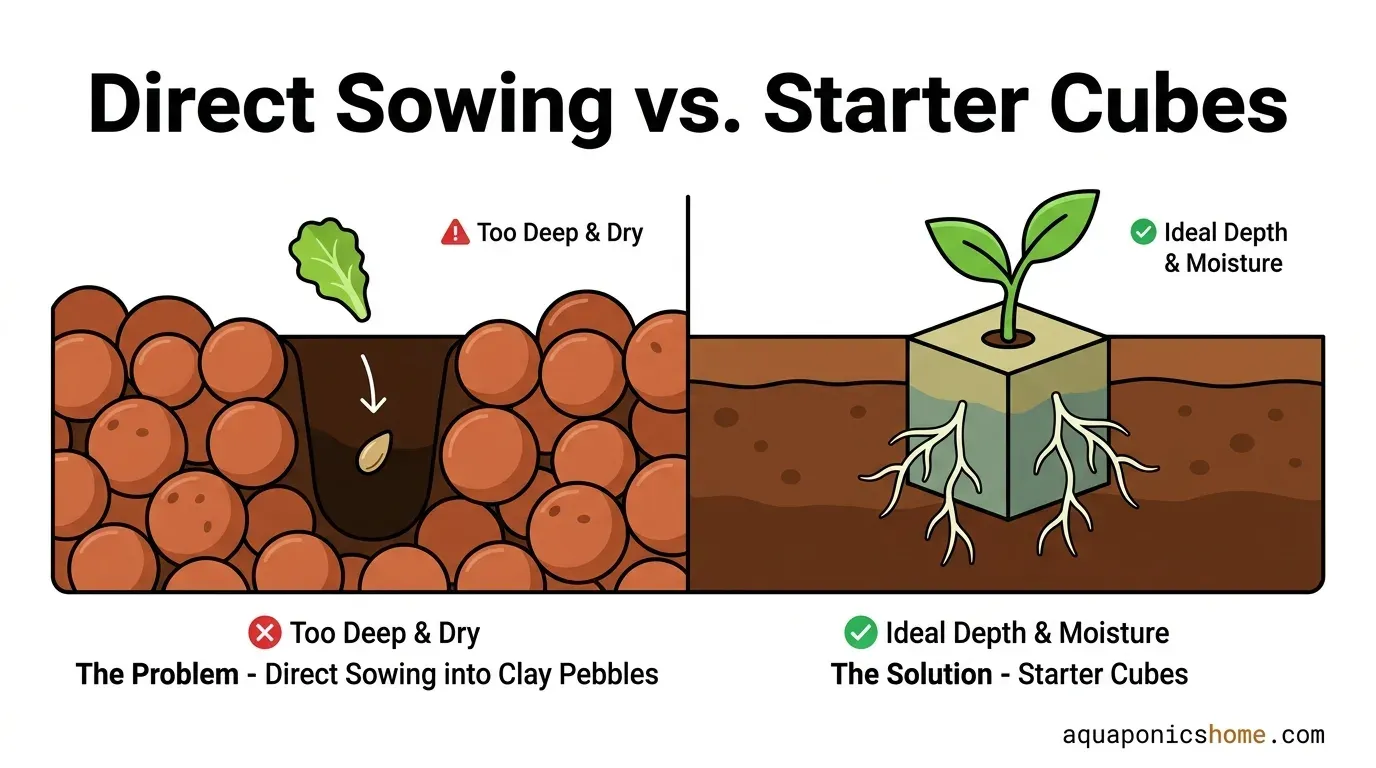
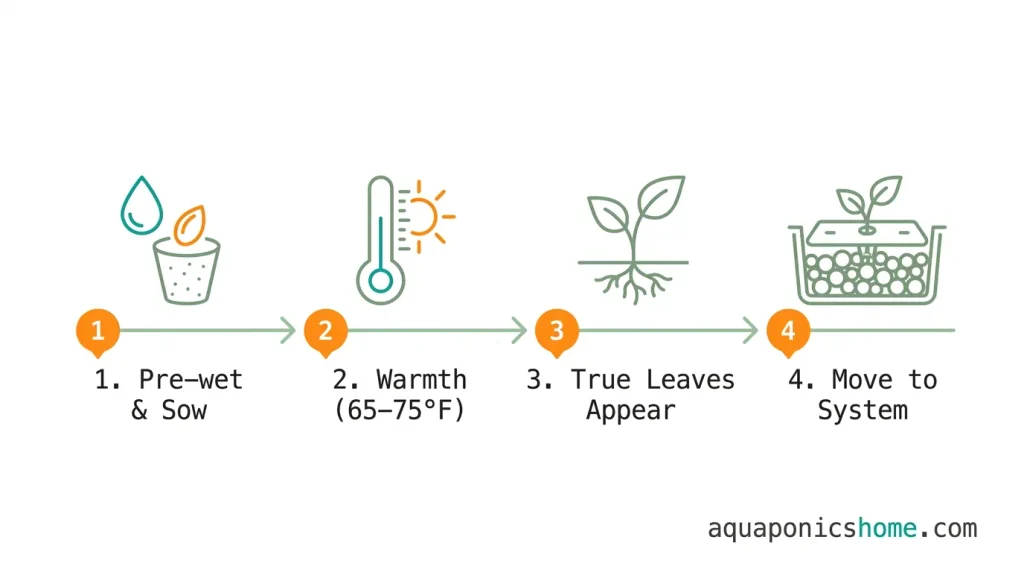
Aquaponics seed starting works best away from the grow bed. Sow into small starter cubes or plugs, keep them moist but not wet, and move each seedling into the system once its first true leaves appear.
Sowing straight into clay pebbles or gravel mostly fails for small seeds, because University of Maryland Extension’s rule of thumb puts a seed about twice its own diameter deep.
A tiny lettuce seed dropped onto pebbles either sits dry on top or falls far deeper into the gaps. Large seeds are the exception worth testing, and there is a section on them below.
Why Sowing Straight Into the Pebbles Fails
The instinct to sow directly into the grow bed makes sense. The water, the nutrients and the plant’s final home are all there. For most seeds, three things work against it.
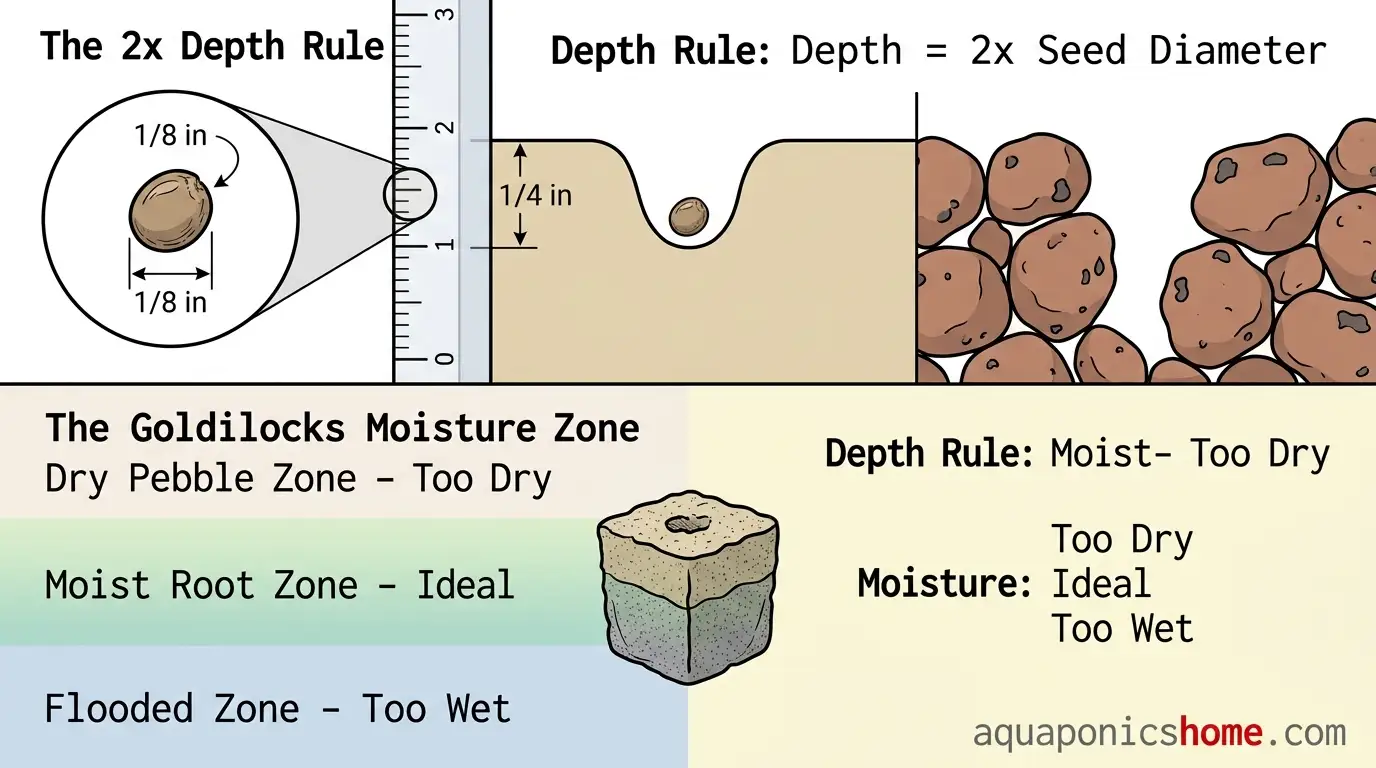
Depth. University of Maryland Extension’s seed-starting guide (read September 25, 2026) gives the usual rule: “A suitable planting depth is about twice the seed’s diameter. For example, a seed ⅛ inch wide can be planted ¼ inch deep.”
Clay pebbles and gravel are many times larger than a lettuce or basil seed, so there is no reliable way to place a small seed at a shallow, even depth. It lands on a pebble top or rolls down into a gap.
Moisture. The same guide says to keep the growing medium “moist, but not wet,” with the goal of supplying the roots with both water and oxygen.
A media bed does not offer that steady middle ground. In many beds the top layer is kept dry on purpose, while the layers below swing between flooded and drained on every cycle. A seed gets either too little water or too much.
Light, for some seeds. University of Maryland Extension notes that lettuce seeds “can be left on the surface, uncovered or very lightly covered.” A seed that has slipped into the dark gaps between pebbles has lost that option.
The pebbles themselves are not the problem. They are excellent for roots, as covered in aquaponics grow media: gravel or clay. They are simply the wrong size and the wrong moisture pattern for a seed.
What Aquaponics Seed Starting Needs From the Medium
A seed asks for very little, but it asks for it steadily. University of Maryland Extension puts it plainly: “Seeds need a warm, moist growing medium to germinate. A potting mix temperature of 65° to 75°F is good for germinating most vegetable seeds.”
Two practical points follow for an aquaponics grower.
- Warmth comes from where the tray sits, not from the system. If your system lives in a cool garage or basement, its water will be cool too, and seeds started beside it may be slow. Start them somewhere that stays in the 65 to 75°F range. How temperature affects the rest of the system is covered in what aquaponics water temperature controls.
- Too wet is the real danger. University of Maryland Extension warns that water molds such as Pythium, Phytophthora and Rhizoctonia “cause root rot and damping-off disease that can quickly kill a container of seedlings if the growing media is kept too wet.” A tray standing in water is the classic way to get there.
Choosing a Starter That Suits a Fish System
Commercial soilless growers settled this question long ago. Alabama Cooperative Extension System’s greenhouse lettuce guide (Jeremy Pickens, Daniel Wells and Caroline Blanchard, August 5, 2022, read September 25, 2026) says “most commercial operations now use cubed media made from foam or stone-based mineral fiber insulation such as Rockwool,” while “some smaller production systems use net pots with a well-drained potting media.”
For an aquaponics system, add one more question to the usual ones: what happens to the starter once it is sitting in the grow bed or raft for months, with fish water running past it?
| Starter | How it works | Aquaponics consideration |
|---|---|---|
| Mineral fiber cubes (such as rockwool) | Pre-formed cubes, often with a sowing hole | Widely used commercially; stays intact in the bed. Wear gloves and follow the maker’s handling advice |
| Foam cubes | Pre-formed cubes in sheets that pop apart | Also widely used commercially; stays intact |
| Net pot with loose starting mix | Small mesh pot filled with a fine, well-drained mix | Works, but loose particles can wash into the bed or raft water |
| Paper towel pre-sprouting | Seeds sprout on a damp towel in a closed container, then move to a cube or net pot | Useful for checking old seed; sprouted seeds are fragile to handle |
| Direct sowing into the bed | Seed goes straight into the media | Unreliable for small seeds; see the section on large seeds below |
Whichever starter you choose, pick one that holds together. A plug that crumbles will shed material into the system over the life of the plant.
Step by Step: Starting Seeds for an Aquaponics System
- Choose untreated seed. Some seed is coated with a fungicide or other treatment, and the packet will say so. That has no place in water shared with fish you intend to eat.
- Wet the cubes or plugs first, then let excess water drain away so they are damp, not dripping.
- Sow at the right depth. Use the twice-the-diameter rule for most seeds, and leave lettuce on the surface or barely covered.
- Keep the tray warm and evenly moist. Aim for the 65 to 75°F range University of Maryland Extension gives, and check moisture daily. A clear cover helps hold humidity until the seeds sprout; take it off once they do so air can move.
- Give seedlings good light as soon as they emerge. Seedlings started in dim light tend to grow tall and weak.
- Water gently. Alabama Cooperative Extension System notes that “hand watering once or twice a day is also an effective way to water seedlings,” and that a soft-flow water breaker reduces the impact of water on young plants.
Alabama Cooperative Extension System also notes that seedlings “can be grown in a lower nutrient concentration than that in the grow-out system; however, many small growers use the same concentration for seedlings and grow-out.”
For an aquaponics grower, that means plain water or system water are both reasonable choices for the tray.
When Seedlings Are Ready to Move
University of Maryland Extension says the ideal time to transplant is “shortly after the first ‘true leaves’ appear,” when seedlings are small and recover quickly from the move.
The first pair of leaves a seedling opens are seed leaves; the true leaves come next and look like small versions of the adult plant’s leaves.
For lettuce, Alabama Cooperative Extension System says seedlings grown in 1-inch cube media “are ready to transplant when they have 2 to 3 true leaves and are approximately 2 weeks old.” Slower crops take longer, so go by the leaves rather than the calendar.
One aquaponics-specific check: look at the bottom of the cube or plug. If roots are showing, the seedling can reach the water on its own.
Moving seedlings into a media bed
Pull the pebbles aside, set the cube in so its top sits above the highest level the flood reaches, and push the media back around it. The roots will grow down into the wet zone; the stem should not sit in it. The flood-and-drain cycle behind this is explained in why media bed aquaponics is the default.
Moving seedlings onto a raft
Seat the cube in a net pot so the roots hang into the water and the top of the cube stays above it. The raft setup itself is covered in DWC aquaponics at home.
When Direct Sowing Does Make Sense
The depth rule is also the reason direct sowing can work for large seeds. A seed that is itself fairly big, such as a bean, pea, squash or cucumber seed, needs to go correspondingly deeper, and it can be tucked into the media by hand at roughly the right depth.
The moisture rule still applies. Place large seeds where the media stays damp but the flood does not submerge them, a little above the high-water line. If they rot instead of sprouting, the spot was too wet; move the next attempt higher, or start them in a cube like everything else.
What to Keep Out of the Fish Water
Seed starting is one of the few parts of aquaponics that happens away from the fish, and that separation is useful. Keep it that way for anything you would not want in the tank.
- Treated seed has no place in a system that holds fish.
- Damping-off remedies and fungicide drenches sometimes suggested for seed trays should never go into, or drain into, the system. If damping-off keeps recurring, the fix University of Maryland Extension points to is the one that costs nothing: a medium kept moist, not wet.
- Old tray water should be tipped out, not poured into the sump.
Moving a seedling that was started in soil is a different job, with its own risks, and it is not covered here.
FAQ
Can I plant seeds directly in clay pebbles?
Large seeds sometimes work if placed at the right depth above the flood line. Small seeds such as lettuce rarely do, because University of Maryland Extension’s rule puts seeds about twice their diameter deep, and pebbles are far too coarse to hold a small seed at that depth.
What is the best medium for starting seeds in aquaponics?
Something that holds together in the bed. Alabama Cooperative Extension System says most commercial operations use foam or mineral fiber cubes such as rockwool, while smaller systems often use net pots with a well-drained mix.
When should I move seedlings into my aquaponics system?
Shortly after the first true leaves appear, per University of Maryland Extension. For lettuce in 1-inch cubes, Alabama Cooperative Extension System says 2 to 3 true leaves at about 2 weeks old.
Why do my aquaponics seedlings keep dying at the base?
Damping-off is one possibility. University of Maryland Extension says water molds can quickly kill a container of seedlings if the growing medium is kept too wet. Let the medium stay moist but not wet, and improve airflow once seeds sprout.