
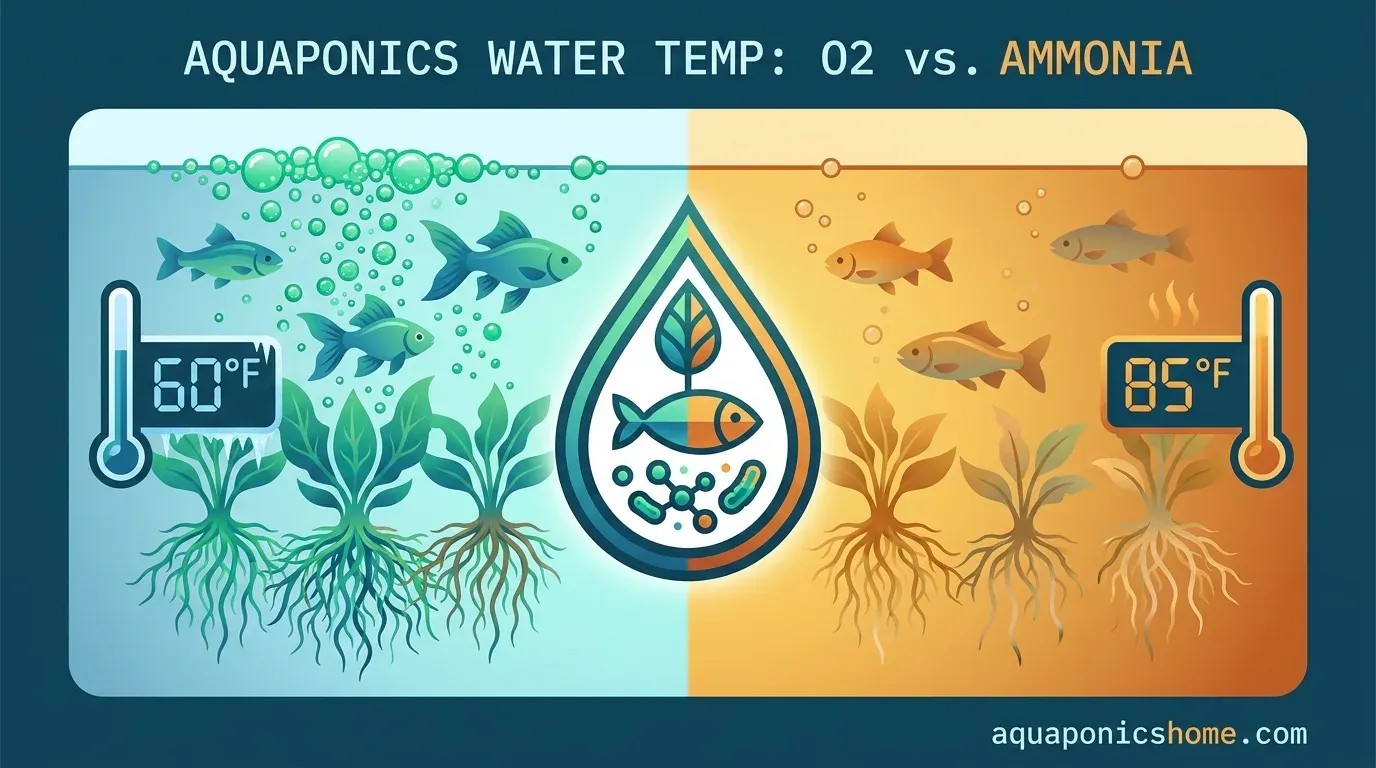
Short answer: there is no single correct aquaponics water temperature, because the fish, the plants and the bacteria each prefer their own range, and temperature quietly changes your other readings. Warmer water holds less oxygen and makes the same ammonia reading more toxic. New Mexico State University’s aquaponics circular gives 65 to 85°F for warmwater fish, 55 to 65°F for coldwater fish such as trout, 70 to 75°F for vegetables, and 77 to 86°F for nitrifying bacteria. In practice you choose your fish first, because the fish has the least room to compromise, and then manage the water to stay inside its range.
The three ranges, side by side
Every figure in this table is attributed. NMSU is Circular 680 (Sallenave, revised June 2026, read September 11, 2026). SRAC is Publication No. 454 (Rakocy, Masser and Losordo of the University of the Virgin Islands, Texas A&M and NC State, 2006 revision, read September 11, 2026).
| Who | Preferred range | What happens outside it | Source |
|---|---|---|---|
| Warmwater fish (goldfish, bass, catfish, tilapia) | 65 to 85°F | For tilapia below 70°F, growth slows dramatically, reproduction stops and disease incidence increases; tilapia die below 50°F | NMSU |
| Coldwater fish (trout) | 55 to 65°F | Needs more dissolved oxygen than warmwater species | NMSU |
| Vegetables | 70 to 75°F; about 75°F best for most hydroponic crops | Most common garden crops tolerate the mid-60s, and winter crops such as cabbage and broccoli slightly lower | NMSU, SRAC |
| Nitrifying bacteria | 77 to 86°F | Work below their best in cooler water | NMSU, SRAC |
Notice what the table does not do: it does not produce one number that suits everyone. The bacteria want warmer water than the plants. Coldwater fish and warmwater fish do not overlap at all. SRAC even notes that “water temperature is far more important than air temperature” for plant production, which means a warm greenhouse over a cold tank is still a cold system.
Species choice also comes with rules. Which fish you may keep, transport and raise for food differs by state, so check with your state fish and wildlife agency before choosing any species.
Aquaponics water temperature and oxygen
This is the relationship that matters most on a hot afternoon.
The U.S. Geological Survey’s Water Science School page on dissolved oxygen (read September 11, 2026) states it simply: “Cold water can hold more dissolved oxygen than warm water,” and describes the relationship as inverse. NMSU says the same thing for aquaponics: “the warmer the water, the less oxygen it can hold.” NMSU recommends keeping dissolved oxygen at 5 ppm or higher, and notes that coldwater fish such as trout need more, about 6.5 ppm.
The squeeze comes from two directions at once. Warm water holds less oxygen, and warm water also speeds up everything that consumes oxygen. SRAC 454 points out that organic matter left to accumulate in a system “will depress dissolved oxygen levels as it decays,” and that plant roots draw large amounts of oxygen from the water too. On the hottest days you have the least oxygen available and the most demand for it.
If your fish are hanging at the surface in warm weather, treat it as an oxygen problem first and work through the fix for fish gasping at the surface. A stopped pump in warm water is the fastest way to lose fish.
Temperature changes what your ammonia test means
Here is the part most temperature guides leave out. Your ammonia test kit measures total ammonia, but only one form of it, un-ionized ammonia, is highly toxic. How much of your reading is in that form depends on pH and temperature together.
NMSU Circular 680 states that “water temperature will also affect the ratio of NH3 to NH4+, with more toxic NH3 present at any given pH in warmer water than in cooler water.” In other words, the same ammonia number is more dangerous in July than in January.
Two habits follow:
- Write the water temperature on the same line as every ammonia and pH reading. Without it, an old ammonia number in your notebook cannot be interpreted.
- Take any positive ammonia reading more seriously when the water is warm. If you have one, go to the steps for ammonia that is too high rather than waiting to see.
Cold water: the North American winter problem
For most readers in the U.S. and Canada, the season that tests a system is winter.
Fish slow down, and some stop coping. NMSU’s tilapia figures are the clearest example: below 70°F, growth slows dramatically, reproduction stops and disease incidence increases, and tilapia die when the water drops below 50°F. That last figure is a lethal limit, not a comfortable margin. If you keep a warmwater species in a system that sits outdoors, in a garage or on a porch, you need a plan for the cold months before they arrive.
The biofilter slows too. Both NMSU and SRAC put the bacteria’s best range at 77 to 86°F. In cooler water they still work, but more slowly, which is one reason a system started in cold weather can seem to take forever. If a new system has stalled and the water is cold, temperature belongs on the list of reasons in why a system refuses to cycle.
Heating is normal in temperate climates. SRAC notes that maintaining the best water temperature “requires heating during the winter in temperate greenhouses.” Where you put the system matters as much as the heater. A system against an interior wall behaves very differently from one on an exposed balcony, which is covered in where to put an aquaponics system at home.
Hot water: the summer problem
Warm water brings its own trouble, beyond oxygen.
SRAC 454 records that at the University of the Virgin Islands, fungal root pathogens (Pythium) “are encountered in summer” and reduce production, and that they “dissipate in winter in response to lower water temperature.” Warm water that looks great for fish growth can be quietly working against your plant roots.
The same publication describes the cooling measures that work at scale, and they translate to a home system:
- Shade the fish tank and filter. SRAC notes that in tropical outdoor systems, complete shading of the fish-rearing and filtration components lowers system water temperature.
- Cover open water. In raft systems, SRAC says the floating sheets shield water from direct sunlight and keep it several degrees cooler than open water.
- Chillers exist, at a cost. SRAC mentions chillers alongside evaporative cooling in tropical greenhouses. For most home growers, shade and placement come first.
Heaters, chillers and electricity around water
A heater is an electrical appliance sitting in water that your hands will be in. Take that seriously.
The U.S. Consumer Product Safety Commission’s GFCI fact sheet (Pub. 099, read September 11, 2026) explains that a ground fault circuit interrupter shuts off power when current leaks to ground, and recommends ground fault protection “especially for circuit outlets in particularly vulnerable areas such as where electrical equipment is near water.” Where the outlet is not protected, the fact sheet notes that portable GFCIs are available. It advises testing every GFCI at least once a month and after a power failure, and says that if you are in doubt about installing one, a qualified electrician should do it.
Beyond the GFCI:
- Use only a heater designed to be submerged, and follow its manual on placement and water level.
- Unplug heaters and pumps before putting your hands in the water.
- Leave a drip loop in every cord so water running down the cable falls away before the outlet.
- Keep outlets and power strips above and away from anywhere a leak or overflow could reach.
Stability beats hitting the number
A steady temperature inside your fish’s range is worth more than a perfect figure that swings. Sudden changes are the ones to avoid, and the most common cause is a large volume of new water at a different temperature. NMSU’s guidance for water exchanges is to make sure “the temperature and pH of the replacement water are the same as the water remaining in the tank.” Match temperature before any top-up or partial change, and add the water slowly.
Measure the same way each time: one thermometer, in the fish tank, read at the same time of day. If you can, a thermometer that records the day’s high and low shows you the swings you would otherwise sleep through.
If fish look unwell rather than simply sluggish, anything that looks like disease belongs with a qualified aquatic veterinarian.
FAQ
What is the best water temperature for aquaponics?
It depends on the fish. NMSU Circular 680 gives 65 to 85°F for warmwater species, 55 to 65°F for coldwater species such as trout, 70 to 75°F for vegetables, and 77 to 86°F for nitrifying bacteria. Choose the fish first and keep the water inside its range, because the fish has the least room to compromise.
Does warm water really hold less oxygen?
Yes. The USGS states that cold water can hold more dissolved oxygen than warm water, and NMSU says the warmer the water, the less oxygen it can hold. Warm water also speeds up oxygen demand from decaying waste and plant roots, so hot days squeeze oxygen from both sides.
Do I need a heater for aquaponics?
It depends on your fish and your climate. NMSU notes that tilapia growth slows dramatically below 70°F and that tilapia die below 50°F, and SRAC says temperate systems require heating in winter. If you use a heater, plug it into a GFCI-protected outlet, as the CPSC recommends for electrical equipment near water.
Can the water be too warm for the plants?
Yes. SRAC Publication No. 454 gives about 75°F as the best water temperature for most hydroponic crops and records root pathogens appearing in summer at UVI and fading as the water cooled in winter.
Sources
- Sallenave, R. Important Water Quality Parameters in Aquaponics Systems. New Mexico State University Cooperative Extension Service, Circular 680, revised June 2026. https://pubs.nmsu.edu/_circulars/CR680/ (read September 11, 2026)
- Rakocy, J.E., Masser, M.P. and Losordo, T.M. Recirculating Aquaculture Tank Production Systems: Aquaponics, Integrating Fish and Plant Culture. SRAC Publication No. 454, November 2006 revision. (read September 11, 2026)
- U.S. Geological Survey Water Science School. Dissolved Oxygen and Water. https://www.usgs.gov/special-topics/water-science-school/science/dissolved-oxygen-and-water (read September 11, 2026)
- U.S. Consumer Product Safety Commission. What Is a GFCI? Fact Sheet Pub. 099. (read September 11, 2026)