
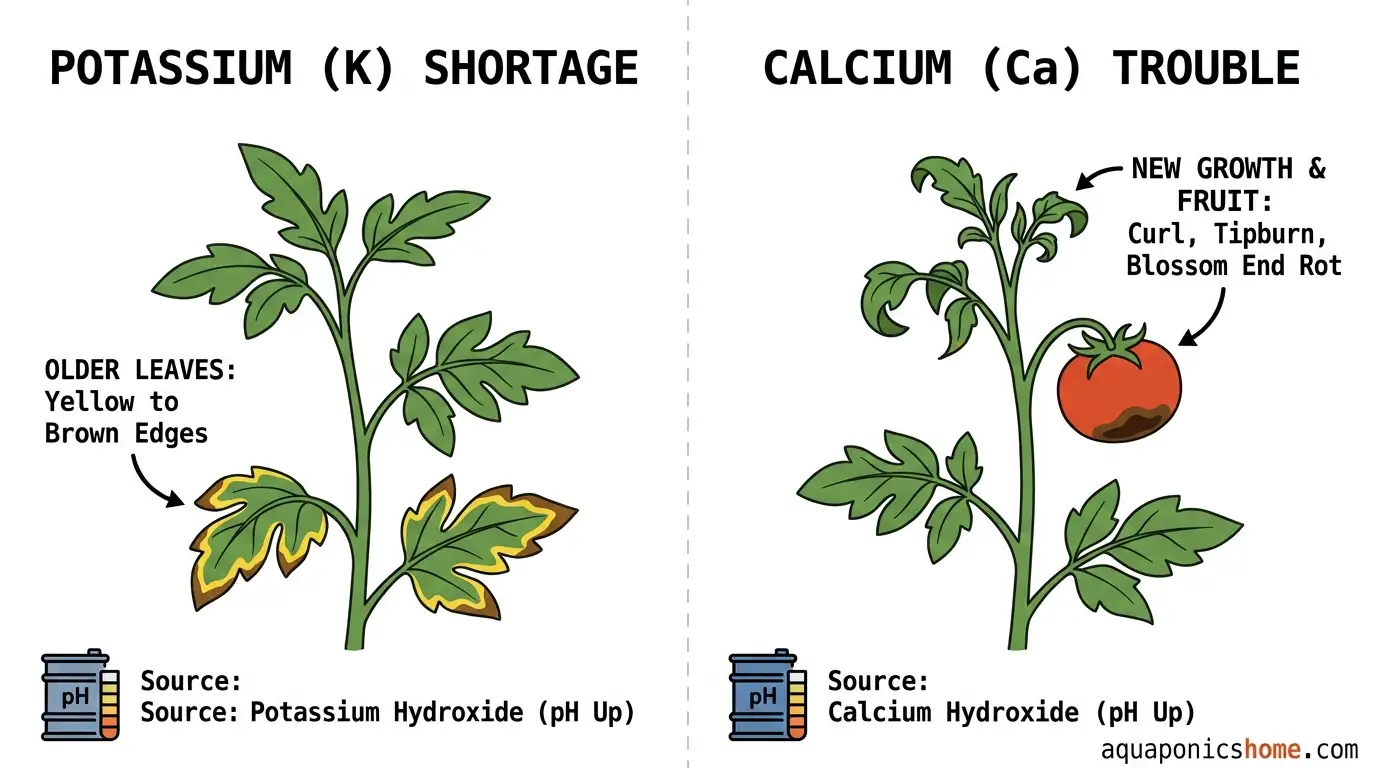
An aquaponics potassium calcium deficiency shows up in two different places on the plant. Potassium shortage hits the older leaves first, with yellowing that turns brown along the leaf edges. Calcium trouble hits the newest growth: young leaves that curl and develop dead patches, and fruit such as tomatoes with a dark, sunken base (blossom end rot).
Fish waste does not reliably cover either nutrient, so aquaponic growers usually supply them through the same products they use to raise pH. That link to pH is the key to fixing both safely.
This guide explains how to tell the two apart, why an aquaponic system runs short of them, why blossom end rot is often a delivery problem rather than a supply problem, and how supplementing works without putting the fish at risk.
Why Fish Food Leaves a Gap
Almost every plant nutrient in an aquaponic system arrives through the fish. They eat feed, and bacteria turn their waste into forms plants can absorb. That chain handles nitrogen well, which is why leafy greens grow in a fairly young system. It does not guarantee that everything a plant needs arrives in the right amount, and potassium and calcium are two of the nutrients where aquaponic growers routinely have to top up.
New Mexico State University’s circular Important Water Quality Parameters in Aquaponics Systems by Rossana Sallenave (NMSU Circular 680, revised June 2026, read 2026-09-25) explains how that top-up usually happens: “Calcium and potassium will be supplemented when calcium hydroxide and potassium hydroxide are added to increase pH. It is therefore advisable to alternate additions of these bases to ensure that the system receives adequate amounts of these two macronutrients.”
In other words, in a standard aquaponic system, potassium and calcium are not added as separate fertilizers on their own schedule. They ride in on pH adjustment. That has consequences we will come back to, because it means your pH decides when you can add them.
Mobile vs Immobile: Why the Two Show Up in Different Places
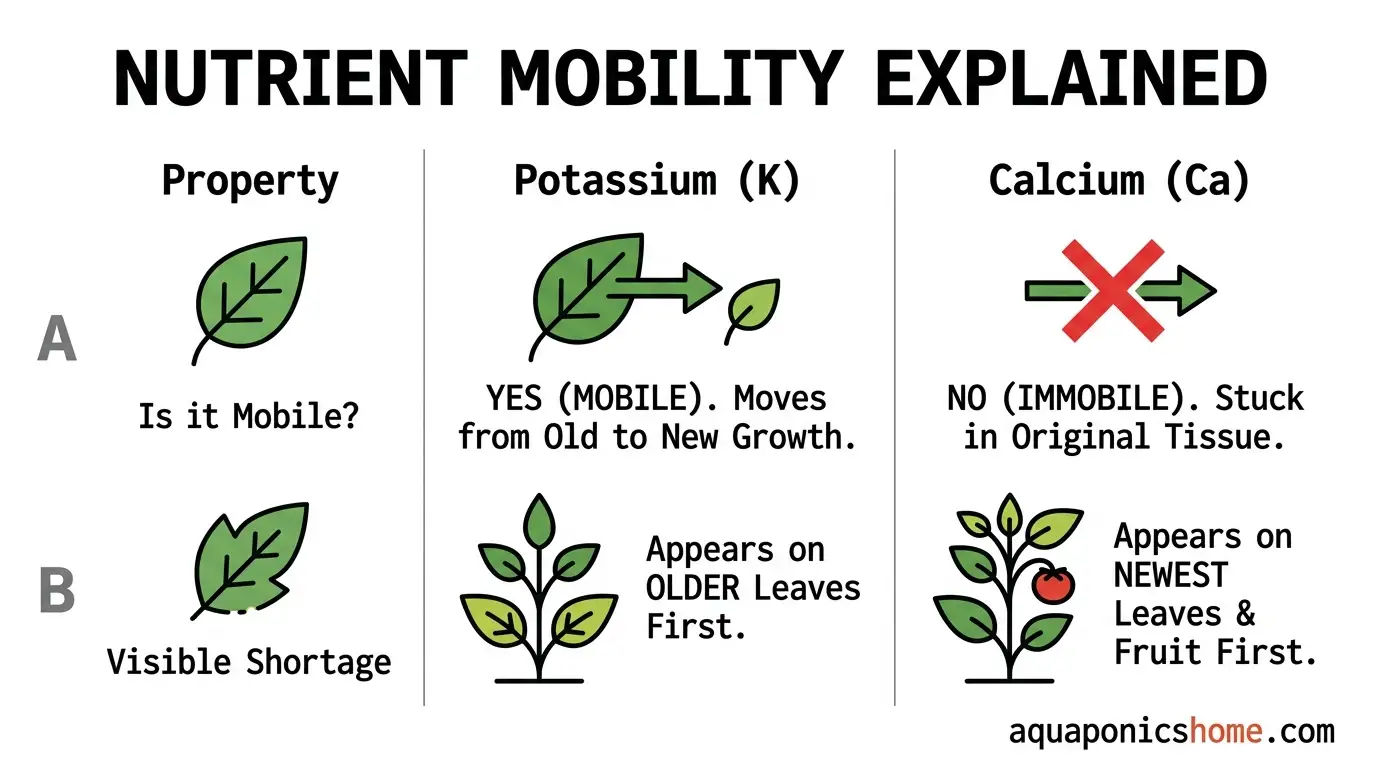
Plant nutrients fall into two groups based on whether the plant can move them after they have been used.
- Mobile nutrients can be pulled out of old leaves and sent to new growth when supply runs short. So the old leaves show the shortage first.
- Immobile nutrients stay where they were first deposited. When supply runs short, the new growth cannot borrow from old leaves, so the newest tissue shows the shortage first.
The University of Connecticut Home and Garden Education Center’s guide Watch Out for These Nutrient Deficiency Symptoms by Haiying Tao (read 2026-09-25) lists potassium as mobile and calcium as immobile. That single fact is why potassium and calcium problems look so different on the same plant.
What Potassium Shortage Looks Like
The UConn guide describes potassium deficiency as “yellowing and necrosis of the leaf margins” on older leaves, and notes that the chlorosis “starts from the tip and progresses along the edge of the leaf.” (“Necrosis” means dead tissue, the brown, dry, papery part.)
What to look for:
- Lower, older leaves first. The top of the plant can look healthy.
- Edges, not the whole leaf. Yellowing begins at the tip and creeps along the rim, then browns.
- A scorched look on the leaf margins as it gets worse.
The edge pattern is what separates potassium from nitrogen. UConn lists nitrogen shortage as “yellowing of the lower leaves” with stunted, slow growth, which is also an older-leaf symptom, but it is a general paling rather than a scorched rim. If your older leaves are generally pale, the more likely issue is too little nitrate in the water, a different problem covered in why aquaponics nitrate runs low.
What Calcium Trouble Looks Like
UConn describes calcium deficiency as “poor leaf expansion, curling followed by necrotic patches in the young leaves,” and notes it can cause “misshapen fruit and aborted buds.”
In an aquaponics bed, that usually shows up as:
- New leaves that stay small, cup or curl, then develop brown or dead edges or patches. In lettuce, growers usually call the burnt-edge version tipburn.
- Fruit with a dark, sunken, leathery patch on the bottom in tomatoes and peppers: blossom end rot.
- Flower buds that drop before they open or set.
Because calcium is immobile, these symptoms appear at the growing tips and in developing fruit, while older leaves look fine.
Blossom End Rot Is Often a Delivery Problem, Not a Supply Problem
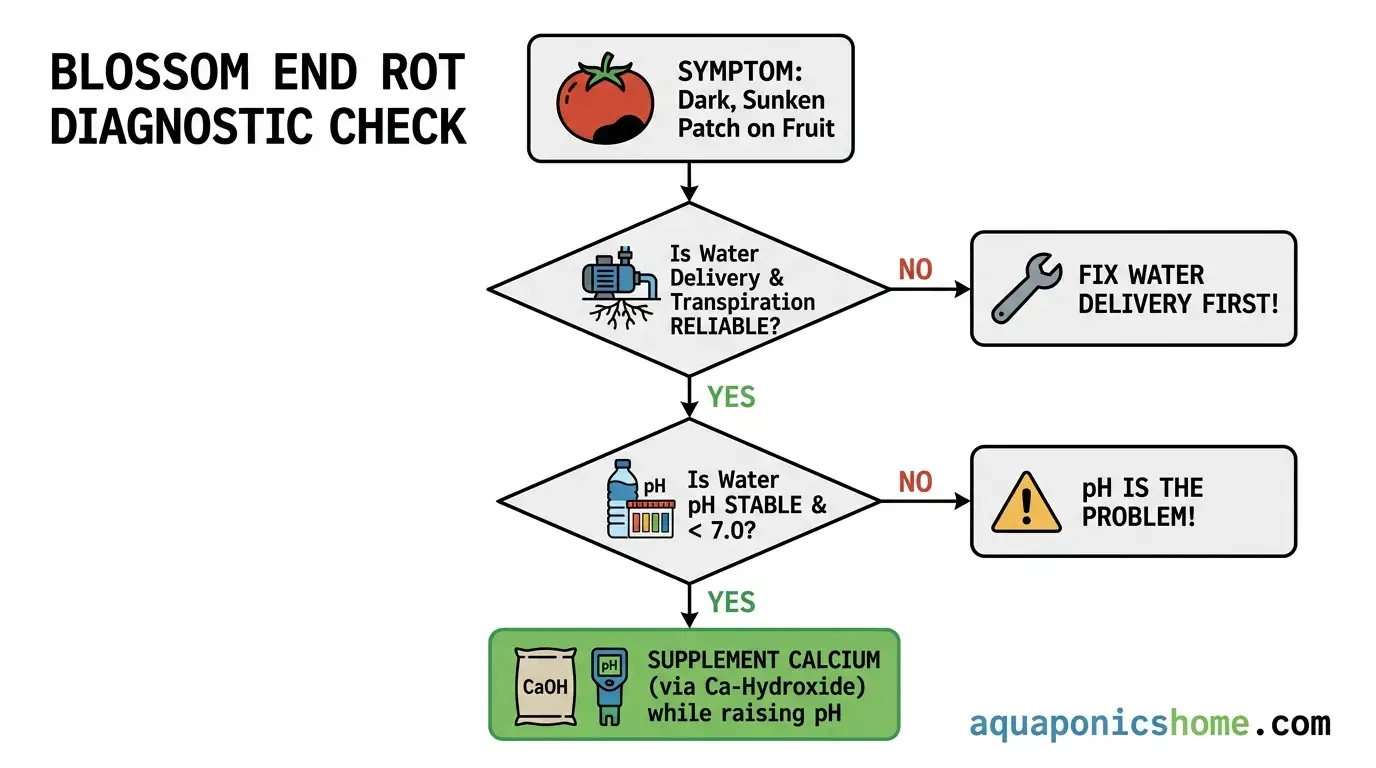
Many potassium and calcium pages skip this part. A tomato with blossom end rot does not automatically mean your water lacks calcium.
UConn’s Home and Garden Education Center article Put an End to Blossom-End Rot (Nora Doonan, June 2025, read 2026-09-25) calls it “a physiological disorder” caused by “insufficient calcium as a result of nutrient and water management challenges.”
It explains that calcium “relies on water flow through the xylem for transport through the plant,” that this flow is “driven by the process of transpiration” (water evaporating from leaves), and that “calcium is not redistributed from the leaves to the fruit.” The same article notes blossom end rot “can also affect peppers, eggplants, squash, and watermelons.”
What that means in an aquaponic system:
- Calcium moves with water. Anything that interrupts water flow through the plant can starve the fruit of calcium even when the tank has enough.
- An erratic pump or flood-and-drain cycle, roots that dry out between floods, or a clogged bed can all interrupt delivery.
- Very still, humid air slows evaporation from the leaves, which slows the water flow that carries calcium.
- Leaves take their calcium as the water passes. Once it is in a leaf, it does not travel on to the fruit.
So before adding calcium, check that the plant is getting steady, reliable water flow. A calcium supplement will not fix a pump that stops.
Potassium and Calcium Compete With Each Other
The UConn blossom-end rot article also notes that “high concentrations of ammonium, potassium, and magnesium” can impair calcium uptake because “they are all positive cations” competing at the roots. It is written about soil, but the principle carries over: these nutrients compete for the same way into the root.
This is why NMSU’s advice to alternate the two bases matters. Leaning hard on potassium hydroxide to push pH up, week after week, can crowd out calcium. Leaning only on calcium hydroxide can leave potassium short. Alternating keeps either one from dominating.
It also explains a frustrating pattern: adding more of one nutrient can make the other one look deficient.
How Supplementing Actually Works (and When You Cannot Do It)
Because potassium hydroxide and calcium hydroxide are bases, they push pH up every time you add them. That creates a limit that is easy to miss:
- If your pH is low or drifting down, adding them does two useful jobs at once: it restores pH and supplies potassium or calcium. NMSU Circular 680 says that when pH drops below 6.4, “a base in the form of calcium hydroxide or potassium hydroxide should be added to the system to bring it back up to 7.0.”
- If your pH is already at the top of its range, adding more base pushes it higher still. That can lock out iron and other nutrients that become less available at higher pH, and it moves the water away from the 6.8 to 7.0 compromise NMSU describes for fish, plants and bacteria. In that situation, the pH-up route is closed, and the question becomes a pH problem first, not a nutrient problem.
If your pH refuses to behave, the reasons are covered in why aquaponics pH keeps changing, and the buffering side (the water’s resistance to pH change) in aquaponics KH buffering explained.
Dose and handling: follow the label, add slowly
This article does not give an amount. Products differ in strength, systems differ in volume, and a sudden jump in pH is not something to spring on fish.
Use the amount the product label directs for your real water volume, add a small amount at a time, and retest pH before adding more. The practical method for moving pH gradually is in how to adjust pH in aquaponics without hurting anything.
Potassium hydroxide and calcium hydroxide are caustic chemicals. Follow the handling and storage directions on the product label and its safety data sheet, including any gloves and eye protection it specifies, and keep them away from children and pets.
What Not to Do
- Do not chase blossom end rot with more and more calcium before checking water delivery. UConn points first to water flow and transpiration.
- Do not add bases to a system whose pH is already high. Solve pH first.
- Do not use general garden fertilizers in water that holds fish. Use products whose makers state they are suitable for aquaponics or fish systems.
- Do not diagnose from one symptom alone. UConn cautions that “it is not always easy to identify nutrient deficiencies just by looking at a plant,” since symptoms overlap and more than one nutrient can be short. A lab plant tissue test, or advice from a local extension service, can confirm what the leaves suggest.
- If fish show distress after any addition, stop and test the water. For illness, contact an aquatic veterinarian or your local extension aquaculture service.
Quick Comparison
| Potassium | Calcium | |
|---|---|---|
| Moves inside the plant? | Yes (mobile) | No (immobile) |
| Where it shows first | Older, lower leaves | Newest leaves, flowers and fruit |
| Classic sign | Yellow then brown leaf edges | Curled young leaves, blossom end rot |
| Usual aquaponic source | Potassium hydroxide added to raise pH | Calcium hydroxide added to raise pH |
| First thing to check | Leaf pattern vs nitrogen shortage | Water delivery and airflow, then supply |
FAQ
Why do aquaponic systems run short of potassium and calcium?
Plant nutrients in aquaponics mostly come from fish feed, which does not reliably supply enough of either. NMSU Circular 680 explains that growers usually supply both by alternating calcium hydroxide and potassium hydroxide when raising pH.
Is blossom end rot in aquaponics always a calcium shortage?
No. UConn explains that calcium travels with water through the plant and is not moved from leaves to fruit, so an uneven water supply can cause blossom end rot even when there is enough calcium in the water.
How do I tell potassium deficiency from nitrogen deficiency?
Both start on older leaves. Potassium shortage yellows and browns the leaf edges, starting at the tip; nitrogen shortage causes a more general yellowing of the lower leaves with slow growth, according to UConn’s nutrient deficiency guide.
Can I add potassium or calcium when my pH is already high?
Not through potassium hydroxide or calcium hydroxide, because both raise pH further. Bring pH back into range first, then supplement when pH needs raising.
How much potassium hydroxide or calcium hydroxide should I add?
Follow the product label for your system’s water volume, add small amounts gradually and retest pH before adding more.