
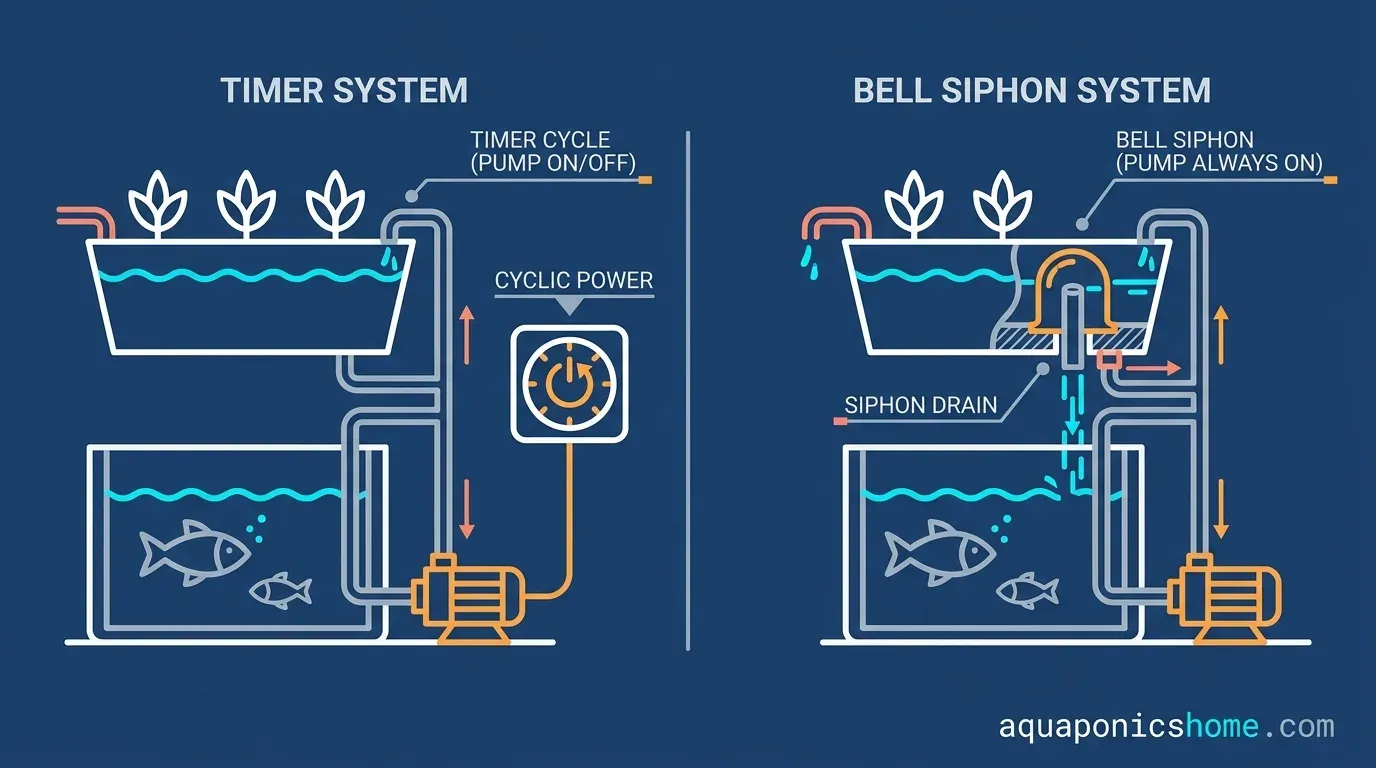
Flood and drain timer aquaponics uses a plain electrical timer, not a bell siphon, to run the grow bed cycle. The timer switches the pump on and the bed fills up to an overflow pipe. Then the timer switches the pump off and the bed drains back to the fish tank through a small drain hole.
There is no clever part that has to start and stop itself. That is why it suits people whose siphon never behaves. The trade-off is simple: a timer is easy to understand and adjust, but it takes away the steady water flow a fish tank gets from a pump that runs all the time.
This guide explains how the timer version works, what can go wrong with it, how it compares with a bell siphon, and how to decide which one fits your build.
Two Ways to Run the Same Cycle
In a media bed system, the grow bed is filled with gravel, expanded clay or similar media. Water floods the bed and then drains out again.
The University of Hawaii publication Construction of Automatic Bell Siphons for Backyard Aquaponic Systems (Fox, Howerton and Tamaru, CTAHR BIO-10, June 2010, read September 27, 2026) describes both options side by side. It says flood-and-drain cycling “can be controlled by electronic timers, which regulate the activity of water pumps, or by nonmechanical devices called automatic siphons.”
The same publication explains why the cycle matters in the first place: the media gives plant roots something to grow in, and it gives the nitrifying bacteria that convert fish waste a large surface to live on.
So both methods do the same job. The difference is what decides when the bed drains:
- Bell siphon: the pump runs all the time. The water level in the bed triggers the siphon, which empties the bed and then breaks and starts the fill again.
- Timer: the clock decides. The pump fills the bed while the timer is on, and gravity empties it while the timer is off.
If you want the full background on why media beds are the usual starting point, our guide to media bed aquaponics and why it is the default covers it.
How a Flood and Drain Timer Aquaponics Bed Is Plumbed
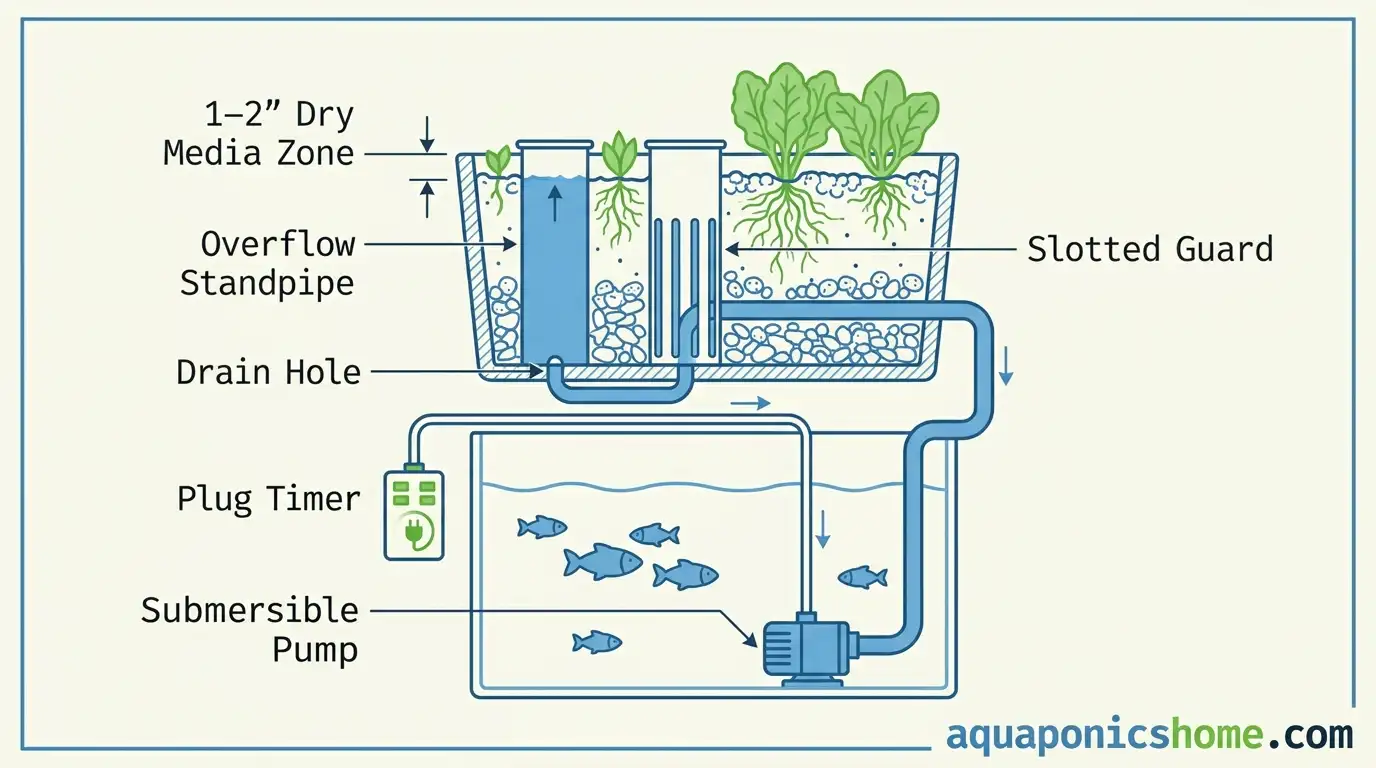
A timer-run bed usually has three parts in the drain area:
- An overflow standpipe. A pipe standing up from the drain fitting sets the highest water level. If the pump runs longer than planned, the extra water spills down the standpipe and back to the tank, and the bed does not overflow onto the floor. CTAHR’s guide notes that the maximum water level should stay 1 to 2 inches below the surface of the media, which stops algae and weeds growing on top. The same rule is sensible for a timer bed.
- A small drain opening at the bottom. A small hole or restricted outlet lets the bed empty slowly once the pump stops. It has to be small enough that the pump can still fill the bed faster than the hole drains it. If the hole is too big, the bed never floods.
- A media guard. A slotted or drilled pipe around the drain keeps gravel or clay away from the openings, so the drain does not clog.
The pump itself sits in the fish tank or sump, with a plug-in timer between the pump and the socket. That is the whole system. Nothing inside the bed needs to be airtight, tuned or trimmed.
Why Some People Choose the Timer
It is predictable
With a timer you can see exactly when the bed should fill and when it should drain. If the bed is full when it should be empty, you know the fault is in the drain, not in some mystery of siphon timing.
It removes the most common siphon headaches
CTAHR’s troubleshooting section lists the classic siphon faults: a siphon that “will not start” because a seal around the bell or snorkel is not airtight, and a siphon that “will not stop,” leaving water “constantly trickling out of the drain.”
A timer bed has neither problem, because it has no siphon to start or stop. If you have been fighting that trickle, our guide to a bell siphon that won’t siphon may fix it. The timer is the option for when you would rather stop fighting.
It is easy to adjust
Changing the cycle means changing the timer setting, not cutting pipe. That is useful while you learn how quickly your bed fills and drains.
Where the Timer Version Can Fail
A timer is boring, but boring is not the same as foolproof. Three weak points matter.
The pump is off for part of every cycle
This is the biggest difference and the one most comparisons skip. With a siphon, the pump runs all the time, so the fish tank always has water moving through it and falling back into it.
With a timer, the fish tank gets no return flow while the pump is off. If the returning water is the main way your tank gets oxygen, those off periods are a gap.
The answer is to aerate the fish tank on its own, with an air pump and air stone that run continuously and do not depend on the timer. Our guide to dissolved oxygen in aquaponics explains why this matters more than most beginners expect.
A stuck timer affects the plants
If the timer fails in the “off” position, the bed never floods again. Gravel does not hold water for long.
SRAC Publication No. 454, Recirculating Aquaculture Tank Production Systems: Aquaponics, Integrating Fish and Plant Culture (Rakocy, Masser and Losordo, Southern Regional Aquaculture Center, November 2006 revision, read September 27, 2026), warns that “Gravel retains very little water if drained, so a disruption in flow will lead to the rapid onset of water stress (wilting).”
If the timer fails “on,” the pump simply runs all the time. Then the overflow standpipe and drain opening are what keep the bed from flooding over.
The drain opening can clog
A small hole at the bottom of a bed full of roots and fish waste will eventually block. When it does, the bed stays flooded after the pump switches off.
That is not dangerous to the fish, but roots sitting in water that never drains lose the air the cycle is meant to give them. Check that the bed actually empties, not just that it fills.
Timer or Bell Siphon: A Plain Comparison
| Question | Timer | Bell siphon |
|---|---|---|
| What controls draining? | The clock switches the pump off | The water level triggers the siphon |
| Does the pump run all the time? | No, it cycles on and off | Yes |
| Moving parts in the bed? | None that need tuning | Bell, snorkel and airtight seals |
| Most common failure | Timer fails, or drain hole clogs | Siphon will not start, or will not stop |
| Fish tank return flow | Stops while the pump is off | Continuous |
| Adjusting the cycle | Change the timer setting | Change the flow rate, usually with a valve |
| Extra electrical device near water? | Yes, the timer | No |
Neither is universally better. The siphon keeps the fish side steadier, and the timer keeps the plant side simpler to understand.
How Long Should the Timer Run?
Be careful with the numbers you find online, because many of them are forum habits rather than tested guidance. The only extension figure we found for cycle length is for siphons.
CTAHR’s guide says that, in general, ebb-and-flow cycles in grow beds should be about 15 to 20 minutes “regardless of the size or volume of the grow-bed,” with the flow into the bed adjusted so the siphon starts, drains and stops within that time.
We found no extension publication giving a standard timer schedule, so we will not invent one. A sensible way to set yours:
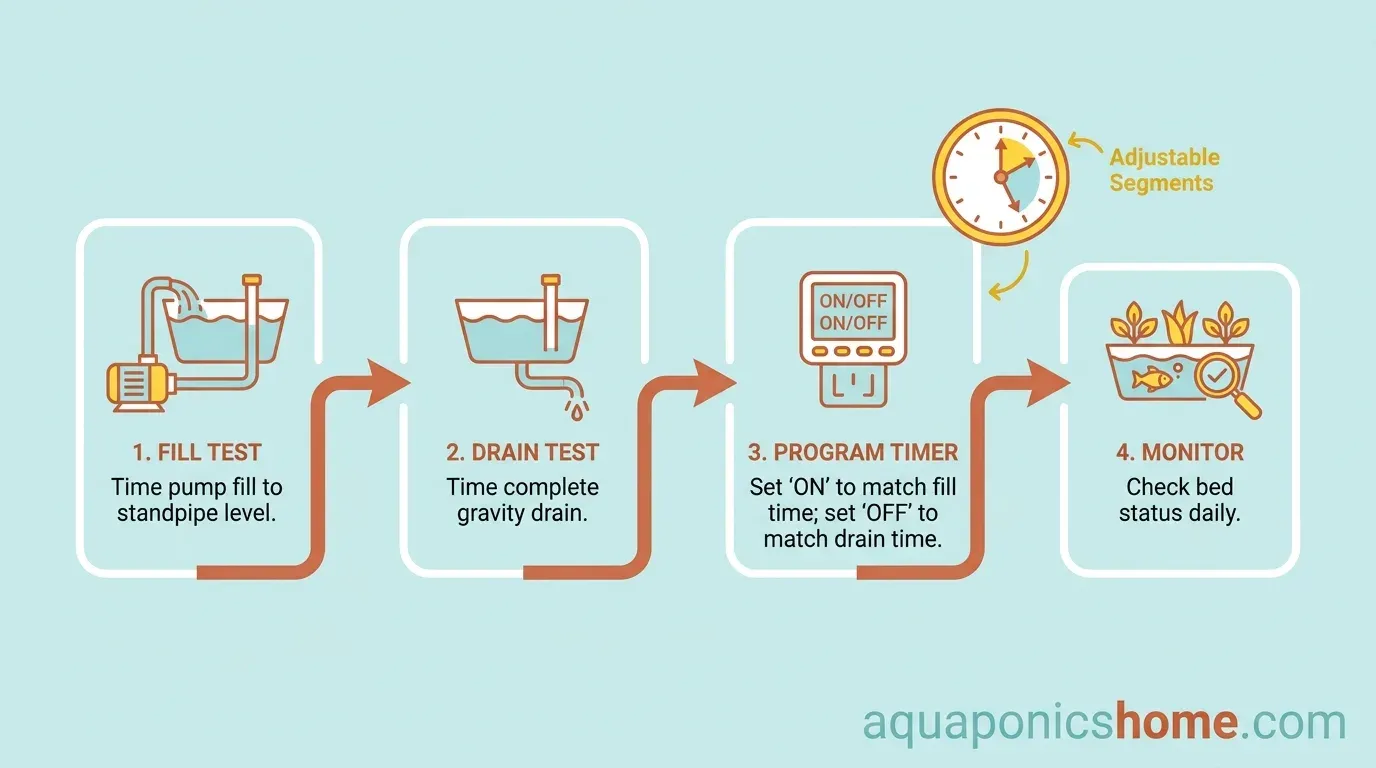
- Time the fill. With the bed planted and the media in, run the pump and time how long the water takes to reach the standpipe.
- Time the drain. Switch the pump off and time how long the bed takes to empty through the drain opening.
- Set the timer so both actually finish. The “on” period should be long enough to flood the bed fully, and the “off” period long enough for it to drain fully.
- Check the smallest step on your timer. Cheap plug-in timers often switch only in fixed blocks of time, so a timer that cannot go short enough may leave the bed flooded for too long.
- Check the pump manual. Some pumps are designed for continuous running. If yours will now start and stop many times a day, confirm that the manufacturer allows it.
Then watch for a few days. Plants that wilt between floods suggest the “off” period is too long. A bed that is still full when the next flood starts means the drain is too slow.
Safety: A Timer Is One More Plug Near Water
A timer adds another mains device beside a tank of water, so treat it the same way as the pump.
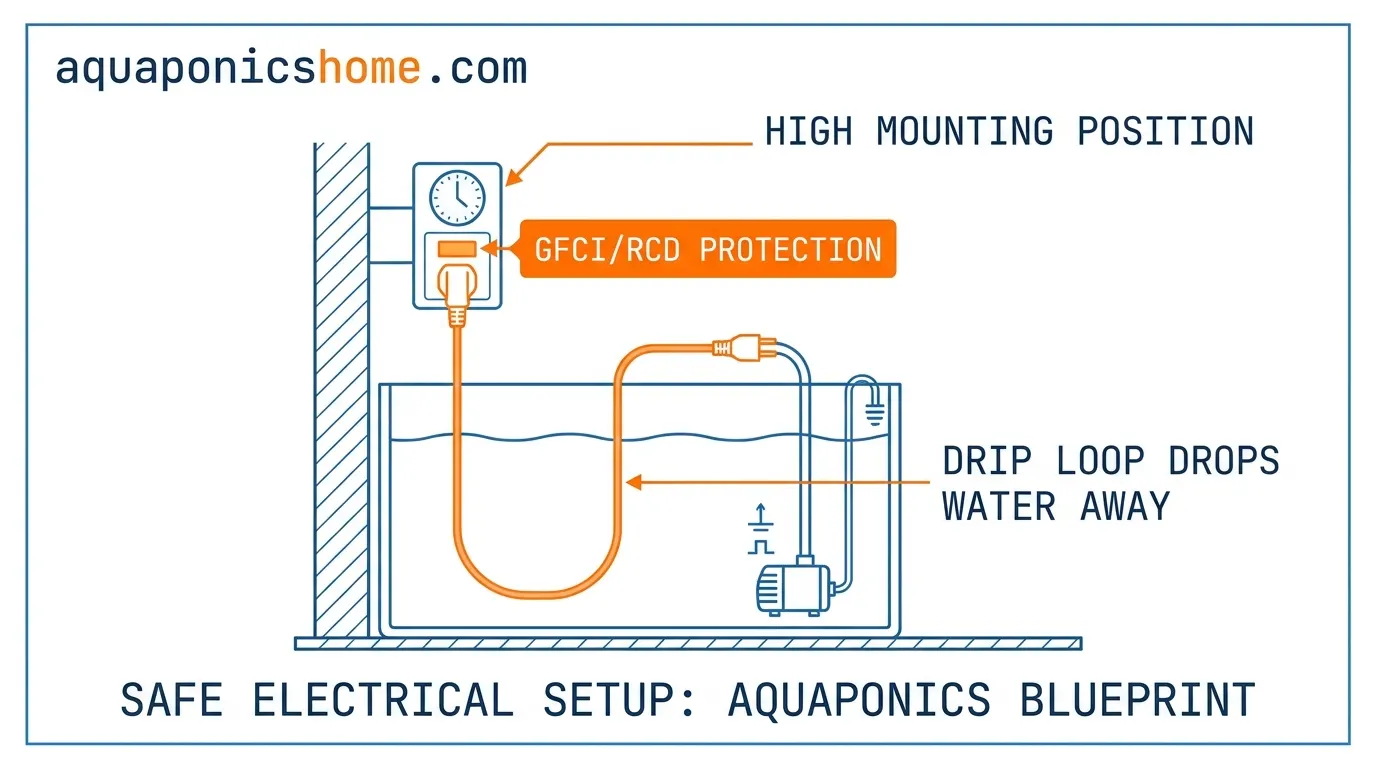
- Use residual current protection. The University of Washington’s GFCI focus sheet (April 2025) describes a ground fault circuit interrupter as a device “that shuts off power when it detects an imbalance in the electrical current flowing through it.” In the US it is called a GFCI. In the UK and many other countries it is called an RCD. A plug-in adapter version exists for sockets that are not already protected.
- Keep the timer high and dry, above and away from anywhere a leak or overflow could reach, never on the floor under the grow bed.
- Leave a drip loop. Let the pump cord dip below the timer and socket before rising to them, so water running down the cord drips off the low point.
Stop here if you are thinking about hard-wiring a timer, adding a socket or moving an outlet. That is work for a licensed electrician, and the rules differ by country.
Which Should You Choose?
Choose a timer if:
- Your siphon has never worked reliably and you want a system you can understand.
- You already run a separate air pump in the fish tank, so the pump’s off periods do not remove your main oxygen source.
- You are willing to check every day that the bed both fills and drains.
Choose a siphon if:
- You want the pump to run constantly and the fish tank to get steady return flow.
- You would rather not add another electrical device beside the water.
- You are happy to spend some time getting the siphon tuned.
Either way, the grow bed still needs a way to overflow safely when something goes wrong. Our guide to aquaponics leak and overflow protection covers that for both designs.
FAQ
Can I run flood and drain aquaponics with a timer instead of a bell siphon?
Yes. The University of Hawaii’s CTAHR guide describes electronic timers controlling the pump as one of the two standard ways to run flood-and-drain cycling. The other is automatic siphons. The bed needs an overflow standpipe and a small drain opening so it empties when the pump stops.
How long should my flood and drain timer be on and off?
We found no extension standard for timer schedules. Time how long your bed takes to fill and to drain, then set the timer so both complete fully. CTAHR’s guide gives about 15 to 20 minutes per cycle for siphon-driven beds, which is a useful comparison but not a timer rule.
Is a timer more reliable than a bell siphon?
It fails in different ways. A siphon can refuse to start or stop. A timer can stick, and a timer bed’s drain hole can clog. A timer is usually easier to diagnose, but it leaves the fish tank without return flow while the pump is off.
Do I still need an air pump with a timer system?
It is strongly advisable. When the timer switches the water pump off, the fish tank loses the water falling back into it. A separate air pump and air stone running continuously keeps oxygen going in during those periods.
Does switching the pump on and off damage it?
It depends on the pump. Check the manufacturer’s manual to confirm that frequent starting and stopping is allowed for your model before you rely on a timer.