
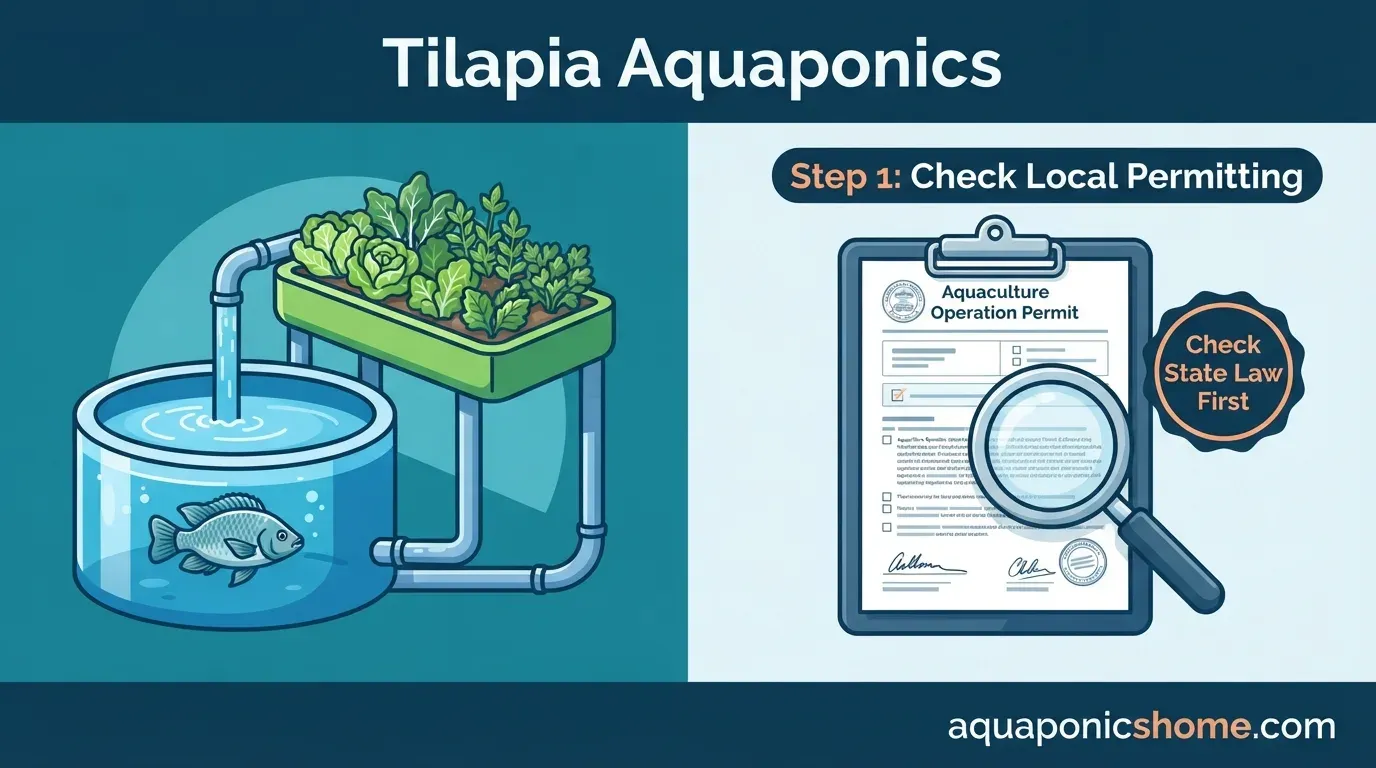
Tilapia aquaponics is the default setup in most guides for a real reason: tilapia tolerate crowded, nutrient-heavy water better than most farmed freshwater fish, eat ordinary pelleted feed, and grow quickly in warm water.
The part those guides skip comes first, though. Tilapia are native only to Africa, many US states restrict their transport and culture, and the rules can change by species, by region inside a state, and by whether you plan to sell.
So your first step is not buying fingerlings. It is asking your state fish and wildlife agency, or an extension aquaculture specialist, whether any tilapia species is allowed where you live, and under what permit.
This page covers why tilapia earned its place, what the legal check actually involves, the warm water tilapia need, and the breeding habit that surprises small-system owners. It does not tell you that you may keep tilapia. Only your own state or provincial authority can do that.
Why Tilapia Aquaponics Became the Default
The case for tilapia is built on tolerance. The Southern Regional Aquaculture Center’s fact sheet Tilapia: Life History and Biology (SRAC Publication No. 283, Popma and Masser, 1999, hosted by the University of Kentucky aquaculture program, read September 24, 2026) names tilapia’s tolerance of poor water quality and their ability to eat a wide range of natural foods as their main strengths for farming.
The same fact sheet states that tilapia are more tolerant than most commonly farmed freshwater fish of high water temperature, low dissolved oxygen and high ammonia.
In aquaponics, that tolerance matters because the whole point of the system is water rich in fish waste. A species that copes with that load forgives beginner mistakes a little longer than a fussier fish would.
It is not a license to ignore water quality, and it is not immunity. Tolerant means the margin is wider, not that the margin is gone.
Three other traits push tilapia to the top of every species list:
- Feed is easy to find. SRAC 283 notes that feeds for tilapia raised as food fish usually run 26 to 30 percent crude protein, and that where no tilapia-specific feed is available, a commercial catfish feed with 28 to 32 percent crude protein is appropriate in the United States.
- One species dominates the research. The fact sheet reports that more than 90 percent of commercially farmed tilapia outside Africa are Nile tilapia, so most published guidance is about a single, well-studied fish.
- It is a food fish people already buy. SRAC 283 notes that consumers like tilapia’s firm flesh and mild flavor, which suits a system meant to produce dinner as well as greens.
The Legal Problem Nobody Mentions
Most tilapia guides give legality a single line: check your local rules. That line is correct, but it undersells the problem.
SRAC 283 says it plainly in its own regulations section. Because tilapias are native only to Africa, many US states consider them exotic or non-indigenous species and have restricted their transport and culture.
The fact sheet’s advice to anyone planning to raise them is to check with state game and fish or natural resources agencies, or with extension fisheries and aquaculture specialists, to find out the legal implications before starting.
Why states restrict a fish sold in grocery stores
The concern is not the fillet on your plate. It is a live, breeding fish getting into local water. Florida’s Department of Agriculture and Consumer Services explains this in its Commercial Aquaponics: Rules and Regulations fact sheet (FDACS-P-01770, Rev. 12/25, read September 24, 2026).
Because the animals commonly used in commercial aquaponics are non-native to that state, it says, there are specific rules on their live possession, culture, transport and sale, and additional restrictions exist to prevent their escape, establishment and spread into the state’s natural waters.
Why “is tilapia legal in my state” has no one-word answer
That Florida fact sheet is a useful illustration of how detailed these rules get, even though it describes only one state and is not a ruling for anyone else. It states that most species of tilapia are either restricted or prohibited there.
It treats two named species and their hybrids differently depending on which of the state’s wildlife regions a farm sits in. It places other species in a restricted category that needs a registration plus a separate authorization, and it prohibits the rest.
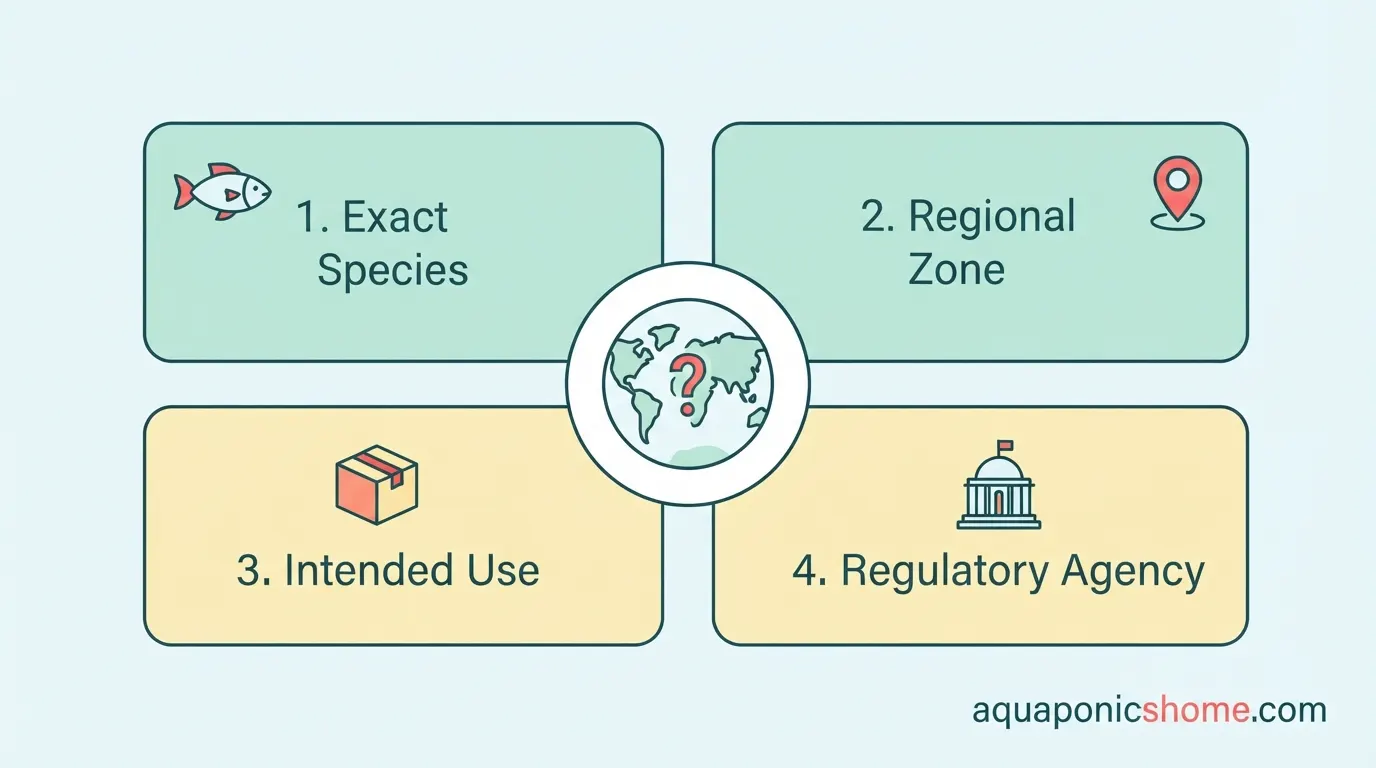
Read that structure, not the specifics, because the specifics belong to Florida. What it shows is that the legal answer can depend on four separate things:
- The exact species. “Tilapia” covers several species and many hybrids. A rule can allow one and ban another.
- Where you are inside the state, not only which state you live in.
- What you plan to do. Possessing, culturing, transporting and selling live fish can each carry a separate requirement.
- Who regulates it. Wildlife agencies, agriculture departments and food safety offices can each hold a piece of the answer.
Canada works through its own provincial and federal rules, which this page does not attempt to summarize. The same four questions still apply.
How to Check Before You Buy
Contact your state fish and wildlife agency (in some states the agriculture department handles aquaculture) or your land-grant university’s extension aquaculture specialist.
Ask these questions, and write down each answer with the date and the name of the person or document it came from:
| Question to ask | Why it matters |
|---|---|
| Which tilapia species, by scientific name, may be possessed alive here? | Rules are written by species, and SRAC 283 notes that crossbreeding and changing scientific names make tilapia hard to identify by appearance or label alone. |
| Does my location inside the state change the answer? | Some states treat regions differently. |
| Is a permit needed to keep fish for my own table, not for sale? | Personal possession and commercial culture are often regulated separately. |
| Is a permit needed to transport or receive shipped live fish? | Mail-order fingerlings involve shipping live animals, and states restrict transport as well as culture. |
| What am I allowed to do with fish I no longer want? | Release is the exact act these rules exist to prevent. |
Then ask the seller to put the species name on the invoice. A seller who cannot tell you which species you are buying cannot help you confirm whether it is legal where you live.
If the answer is no, stop there. Do not work around it with a hybrid or a different common name. And run the same check on any non-native species you consider next, because tilapia is not the only fish that appears on restricted lists.
The Warm Water Tilapia Need
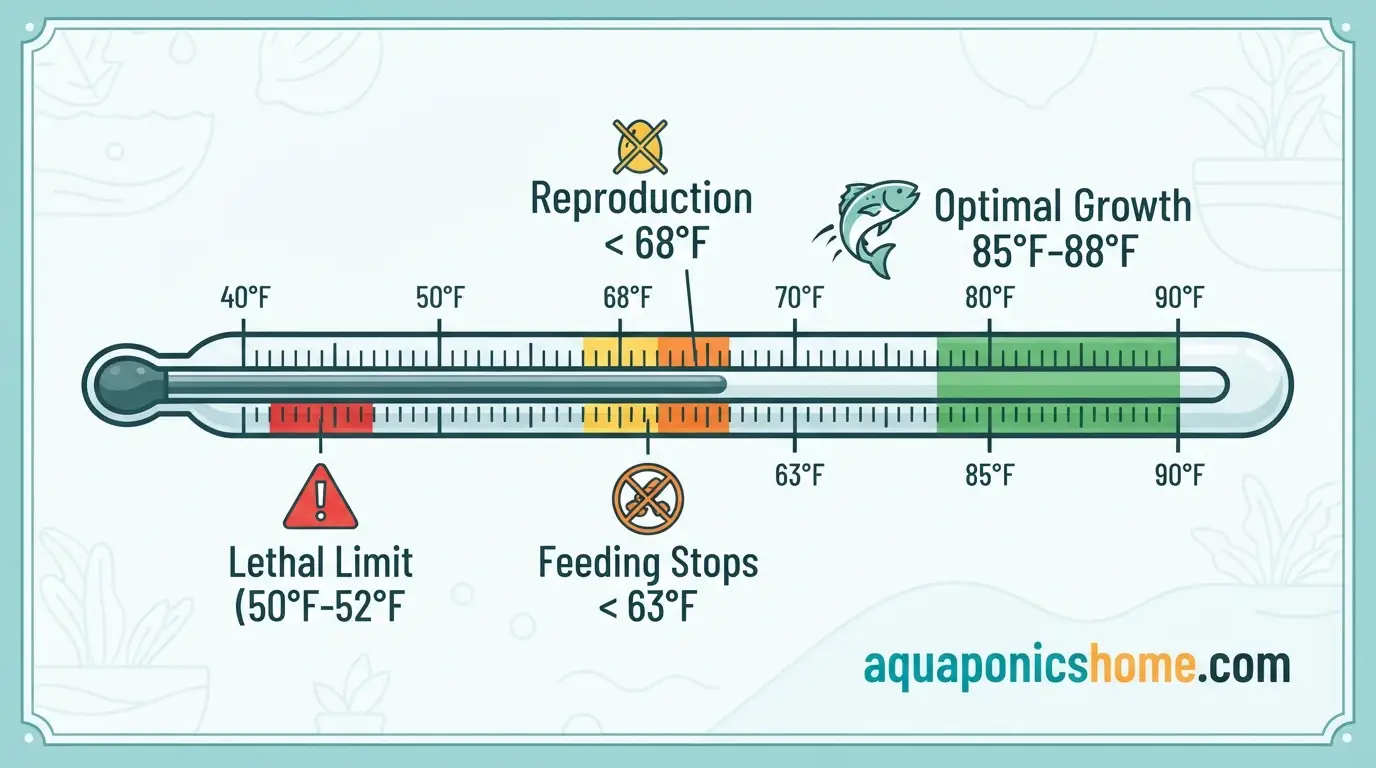
The second thing guides understate, especially for readers in the US and Canada, is how warm tilapia need to be. SRAC 283 calls tilapia’s intolerance of low temperatures a serious constraint for culture in temperate regions, and gives these figures:
| Water temperature | What SRAC 283 reports |
|---|---|
| About 85 to 88°F (29 to 31°C) | Optimal for growth; growth here is typically three times greater than at 72°F (22°C) |
| Below 68°F (20°C) | Reproduction does not occur |
| Below 65°F (18°C) | Disease losses after handling seriously constrain sampling, harvest and transport |
| Below 63°F (17°C) | Tilapia generally stop feeding |
| 50 to 52°F (10 to 11°C) for a few days | Lower lethal temperature for most species; blue tilapia tolerate about 48°F (9°C) |
For most readers in the US and Canada, that makes tilapia an indoor or heated fish for much of the year. A heater, a plan for when it fails, and a thermometer you actually read become part of the build rather than accessories.
Our guide to aquaponics water temperature explains why temperature moves oxygen, feeding and bacterial activity all at once, and why warmer water is not automatically safer water.
The Breeding Problem in a Small Tank
Tilapia breed readily, and in a small system that is a problem rather than a bonus. SRAC 283 describes how female Oreochromis tilapia hold fertilized eggs in their mouths until they hatch, and reports that under good growth conditions in farm ponds, Nile tilapia can reach sexual maturity at 5 to 6 months and 5 to 7 ounces (150 to 200 grams). Mozambique tilapia can mature younger and smaller still.
The outcome the fact sheet warns about is overcrowding and stunting: young fish multiply, compete for the same food, and the fish you meant to eat stay small.
The strategies it lists include raising only males (which, it notes, grow about twice as fast as females), stocking a predator fish, or separating eggs from the parents.
It describes several ways producers get mostly-male stock: sorting juveniles by hand, crossing two species that produce all-male offspring, or hormone treatment of newly hatched fry.
For a home buyer, the practical step is to ask the seller whether the fingerlings are sold as all-male or mixed sex, and how that was achieved. Even “all-male” batches can include a few females, and SRAC 283 notes that over a long grow-out, their offspring can mature and overpopulate a pond.
Surplus fish are also where the legal and welfare questions meet. Never release unwanted tilapia, fry included, into any pond, stream, lake or storm drain. Ask your state agency or extension office what your legal options are for extra fish.
What Tilapia Does Not Solve
Choosing a forgiving fish does not make a system forgiving. A few honest limits:
- Tolerance is not a substitute for cycling. Stocking any fish into a system with no working bacteria is the fastest way to lose them. Read how to cycle a system without killing fish before any fish arrive.
- These fish get big. SRAC 283 reports that in all-male pond culture under good temperatures, males generally reach about half a pound in 3 to 4 months, 1 pound in 5 to 6 months and 1.5 pounds (700 grams) in 8 to 9 months. A fish that tolerates crowding still needs room to reach that size, and small volumes swing in temperature and chemistry faster. The trade-offs are covered in small aquaponics tank size.
- Food safety is its own question. Eating fish and greens from the same water raises handling and hygiene questions the species choice does not answer. Start with whether food from a home aquaponics system is safe to eat.
- Illness is outside this page. This site does not diagnose fish disease or publish treatments. If your tilapia show signs of illness, contact an aquatic veterinarian or your state’s extension aquaculture service. In a food system, anything added to the water can end up in what you eat, which is one more reason to involve a professional first.
FAQ
Is tilapia legal to keep in home aquaponics?
It depends on the species, where you live, and what you plan to do with the fish. SRAC Publication No. 283 notes that many US states treat tilapia as exotic species and restrict their transport and culture. Ask your state fish and wildlife agency or an extension aquaculture specialist before buying.
Why is tilapia the most common aquaponics fish?
According to SRAC 283, tilapia tolerate poor water quality, high temperature and low dissolved oxygen better than most farmed freshwater fish, and they accept widely available pelleted feed. That makes them forgiving in nutrient-rich water.
Do tilapia need a heater?
In most of the US and Canada, for much of the year, yes. SRAC 283 reports that tilapia generally stop feeding below 63°F (17°C) and that the lower lethal temperature for most species is 50 to 52°F (10 to 11°C) over a few days.
Will tilapia breed in my aquaponics tank?
They can. SRAC 283 reports that Nile tilapia can mature at 5 to 6 months under good conditions, and overcrowding with young fish is a known problem. Many producers raise all-male stock, so ask your seller exactly what you are buying.
What should I do with extra tilapia?
Never release them into natural water or a drain. Ask your state agency or extension office what the legal options are where you live.