
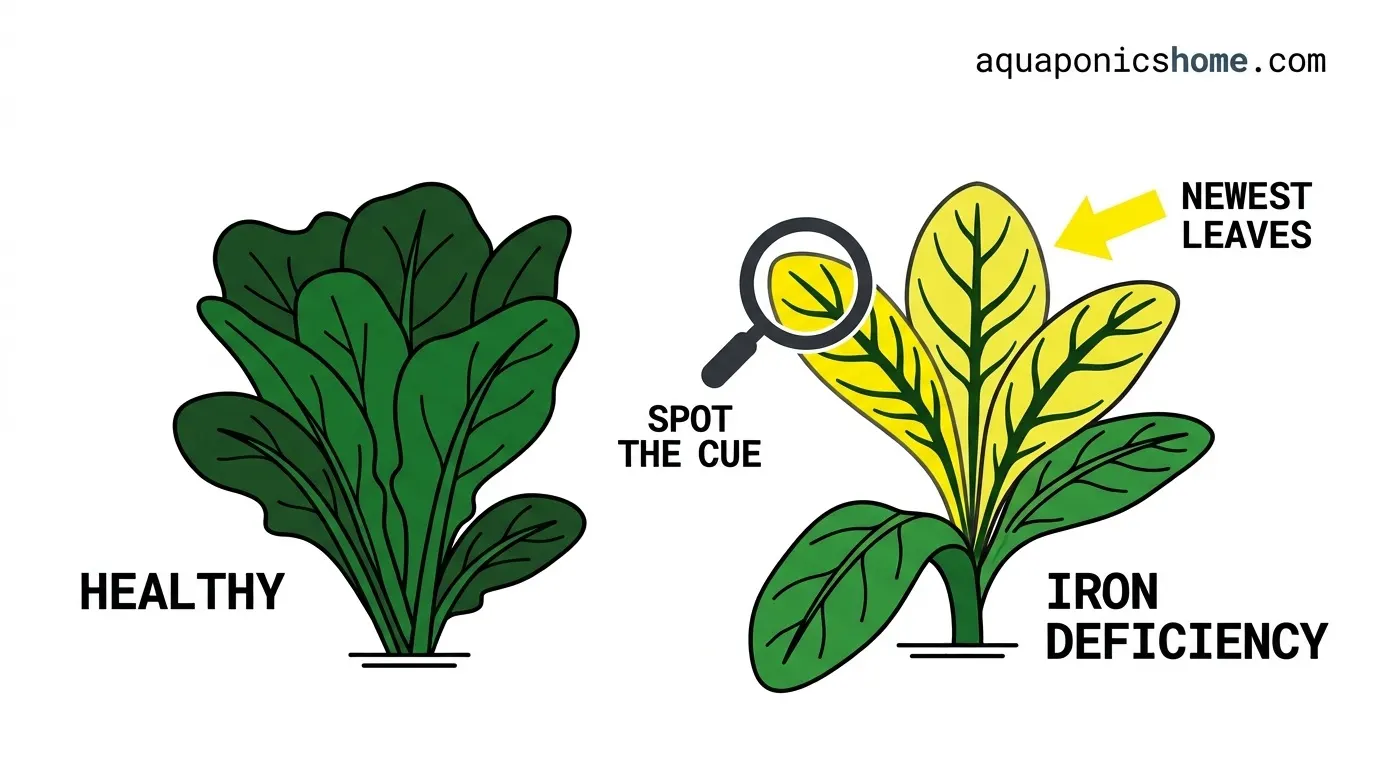
Aquaponics iron deficiency looks like this: the newest leaves at the top of the plant come in pale yellow while their veins stay green, and the older leaves lower down still look normal. It happens because fish feed supplies little iron, and because the iron that is in the water becomes hard for roots to take up as pH climbs.
The fix has two parts, in this order: check pH, then add a chelated iron product at the rate on its label. Adding iron without checking pH is a common reason the yellow never goes away.
This guide covers how to tell iron apart from the other causes of yellow leaves, why pH matters so much, which kind of iron to buy, and what not to do in a system that holds fish you plan to eat.
What Aquaponics Iron Deficiency Looks Like on the Plant
The textbook name for the symptom is interveinal chlorosis. “Chlorosis” just means a leaf losing its green. “Interveinal” means the loss happens in the flat part of the leaf between the veins, so the veins stand out as a green net on a yellow background.
The second clue is where on the plant it shows up. Iron does not move easily inside a plant once it has been used. When supply runs short, the plant cannot pull iron back out of old leaves to feed new ones, so the newest growth suffers first.
Illinois Extension horticulture educator James Schuster puts it plainly in the Illinois Extension guide to chlorosis (read 2026-09-25): iron chlorosis “starts on the younger or terminal leaves and later works inward to the older leaves.”
What to look for, in plain terms:
- Yellowing on the top or center leaves first, the ones that opened most recently.
- Veins that stay distinctly green while the leaf tissue between them pales.
- In a bad case, new leaves can come in very pale, close to white.
- Older, lower leaves that still look fine, at least early on.
Leafy greens such as lettuce and basil, and heavier feeders such as tomatoes, can all show it. Because leafy greens are what most small systems grow, it is often one of the first nutrient problems a new aquaponics grower meets.
Is It Iron, or Something That Looks Like Iron?
Several problems turn leaves yellow, and the fix for each one is different. The leaf position is the fastest way to narrow it down.
| What you see | Where it starts | More likely cause |
|---|---|---|
| Yellow between green veins | Newest leaves | Iron shortage, or iron locked out by high pH |
| General paling and yellowing | Oldest, lowest leaves | Not enough nitrate in the water |
| Yellow then brown along the leaf edges | Older leaves | Potassium shortage |
| Chlorosis that begins inside the plant | Older, inner leaves | Manganese or zinc, per Illinois Extension |
| Curling, then dead patches | Newest leaves | Calcium delivery problem |
Illinois Extension notes that manganese and zinc deficiencies “develop on the inner or the older leaves first and then progress outward,” which is the opposite direction from iron. That is useful: yellowing that starts on old leaves is probably not iron, and adding iron will not fix it.
The most important split is between iron and nitrogen. A general paling of the older, lower leaves usually points to a shortage of nitrate, which in aquaponics often means the system is young, lightly stocked or underfed. That is a different problem with a different fix, covered in why aquaponics nitrate runs low and how to raise it. Treating a nitrate problem with iron wastes product and time.
Visual diagnosis is a starting point, not proof. Two shortages can show up together, and a plant under general stress (cold water, low oxygen at the roots, recent transplanting) can yellow for reasons that have nothing to do with nutrients.
Why Aquaponic Systems Run Short of Iron
In a soil garden, iron comes from the soil. In aquaponics, almost every nutrient the plants get arrives through the fish: they eat feed, and their waste is broken down by bacteria into forms plants can use.
That works well for nitrogen. It works poorly for iron, because fish feed is made to feed fish, not to supply everything a bed full of leafy greens will use.
New Mexico State University’s circular Important Water Quality Parameters in Aquaponics Systems by Rossana Sallenave (NMSU Circular 680, revised June 2026, read 2026-09-25) lists iron among the nutrients that need to be supplemented in aquaponics, rather than expected from the fish. So an iron shortfall is not a sign you did something wrong. It is a normal, predictable gap in how these systems work.
The pH Problem: Iron That Is There but Unavailable
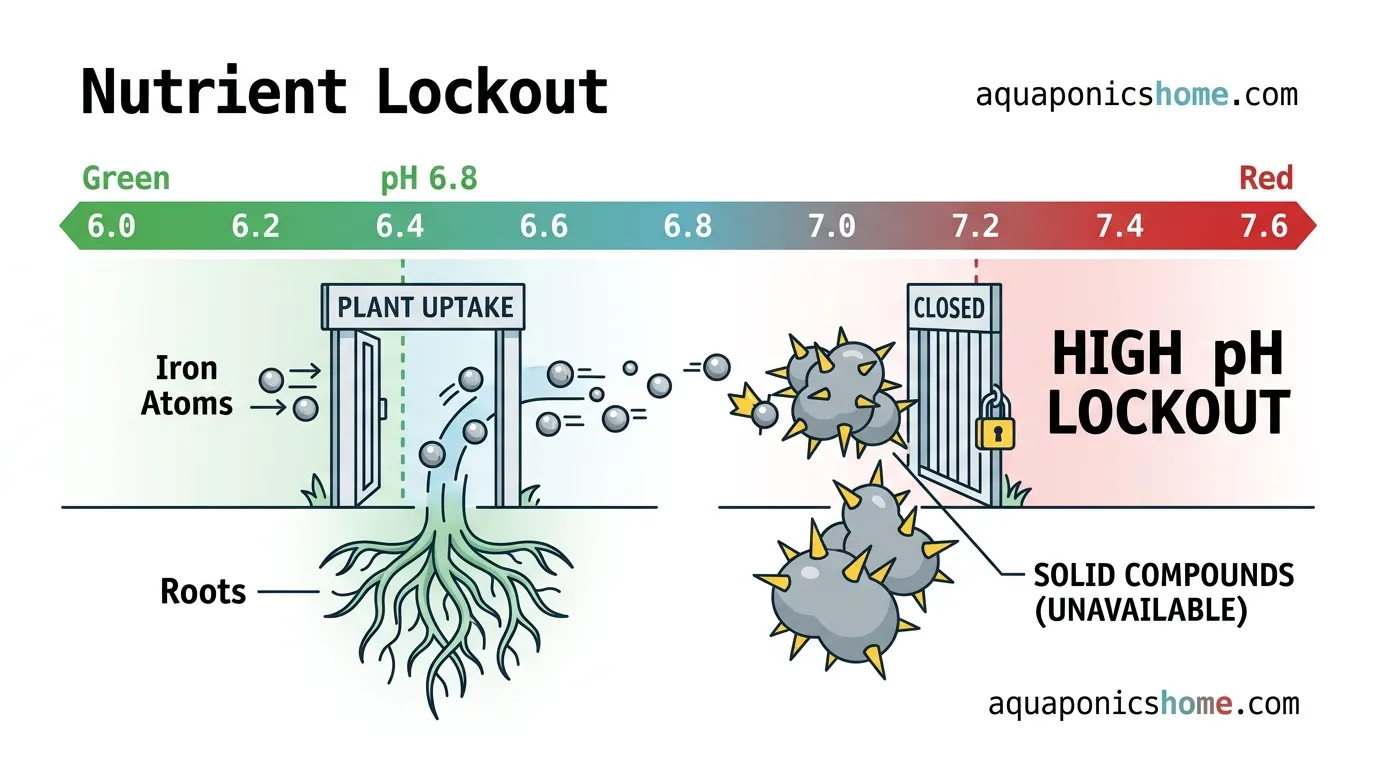
Many iron pages rush past this part, and it is the reason some growers add iron twice and see no change.
Iron has to be dissolved in the water, in a particular chemical form, for roots to take it up. As water gets more alkaline (higher pH), plain iron reacts with other things in the water and turns into solid forms that roots cannot absorb. The iron is technically still in your system. It is just locked away.
Illinois Extension, writing about soil, gives the thresholds: iron “becomes more insoluble as the soil pH climbs above 6.5 to 6.7,” and most plants can absorb it as a free ion only “when the pH is between 5.0 and 6.5.” Aquaponics water is not soil, but the relationship between iron and pH is the same basic idea.
Now compare that with where aquaponic systems are kept. NMSU Circular 680 describes the pH compromise between fish, plants and nitrifying bacteria (the bacteria that turn fish waste into plant food).
It notes that plants “grow best when pH levels are below 6.5,” that the bacteria “perform optimally at pH levels greater than 7.5,” and that the compromise that suits all three “is a pH of 6.8 to 7.0,” with 6.4 to 7.4 tolerable.
Put those side by side and the problem is obvious. The normal operating range of an aquaponic system sits right where plain iron starts to become unavailable. A system that drifts toward the top of its range can show iron symptoms even if iron was added recently.
That is why the first action is a pH test, not a purchase. If you have not tested in a while, the routine in our 10-minute weekly aquaponics water testing guide covers pH alongside the other numbers.
If pH is running high, the reasons it drifts and how to move it without shocking fish are covered in how to adjust pH in aquaponics without hurting anything.
Chelated Iron: What “Chelated” Means and Which Form to Look For
A chelate (say “KEE-late”) is an organic molecule that wraps around an iron atom and helps keep it dissolved and available to roots at a pH where plain iron would drop out. That is why aquaponics guidance points to chelated iron rather than rusty nails or other home remedies.
Chelated iron products are sold under abbreviations that name the wrapping molecule. The ones you will usually see on labels are:
- Fe-DTPA, the form NMSU Circular 680 recommends for aquaponics.
- Fe-EDTA, another widely sold chelate.
- Fe-EDDHA, a third form you will see in garden and farm supply.
The chelates differ in how well they hold on to iron as pH rises, which is why the form matters more in aquaponics, where the water runs near neutral, than in a system kept deliberately acidic.
When you shop, read the label for the chelate type, the percentage of iron in the product, and whether the maker states it is suitable for aquaponics or for systems containing fish.
How Much to Add: Let the Label Decide
This article deliberately does not give an addition rate. Products differ in iron content, systems differ in water volume, and a rate copied from one product onto another can be badly off.
Follow the rate on the specific product you bought, measured against your system’s real water volume, and add it the way the label directs.
A few general principles hold regardless of product:
- Know your water volume. Every label rate is per liter or per gallon. A guessed volume means a guessed dose.
- Add once, then wait. Existing yellow leaves often stay yellow. Recovery shows in the new leaves that open after treatment, so judge by new growth over the following weeks, not by the old leaves overnight.
- Do not stack products. Two iron products added together, or iron added on top of an all-in-one supplement that already contains iron, is how an overdose happens.
- Fix pH first. Chelated iron added to a system with badly high pH is the classic “added iron twice and nothing changed” story.
If you are unsure which product suits your fish and your setup, a university aquaculture or horticulture extension service near you can advise on local products and water.
What Not to Do in a System With Fish in It
An aquaponic system is shared between plants you will eat and fish that live in the water full time. Anything you add reaches both. That rules out some shortcuts that work in a pot of soil:
- No garden fertilizer “with added iron.” General plant feeds can contain ingredients not intended for water that holds fish.
- No rusty nails, steel wool or iron filings. They are not a controlled input, and iron in those forms is exactly the kind that turns solid and unavailable at higher pH.
- No foliar sprays running into the tank. If you spray leaves, anything that drips lands in the fish water.
- No guessing at “a little more.” If fish show signs of distress after any addition, stop adding and test the water. For a fast checklist, see aquaponics fish dying emergency triage, and for anything that looks like fish illness, contact an aquatic veterinarian or your local extension aquaculture service.
The standard applies to food safety too. Use only products whose makers state they are meant for food crops and fish systems, and follow any label instructions about harvest timing.
A Simple Order of Operations
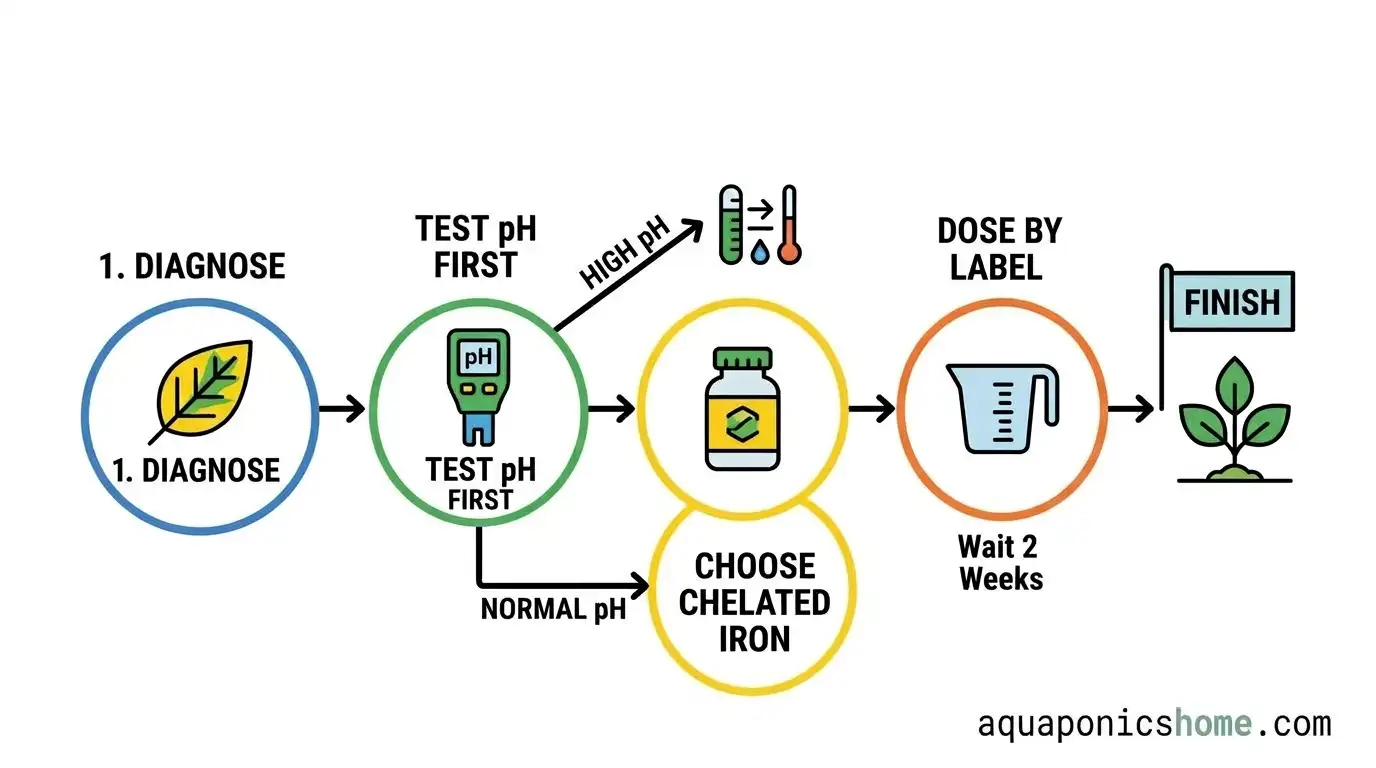
When new leaves turn yellow with green veins:
- Look at leaf position. New leaves with green veins point toward iron. Old leaves, general paling or brown edges point elsewhere.
- Test pH. If it is high in your system’s range, address pH before adding anything.
- Check the basics. Water temperature, root color and pump flow can all stress plants into looking deficient.
- Choose a chelated iron marked for aquaponics, and note the chelate type.
- Dose by the label against your real water volume, once.
- Watch the new growth over the next weeks before deciding whether to repeat.
That order is the whole method. The step people skip is step 2.
FAQ
What does iron deficiency look like in aquaponics?
New leaves at the top or center of the plant turn pale yellow while the veins stay green. Illinois Extension notes that iron chlorosis starts on the younger leaves and works inward, so older leaves usually look normal at first.
Why is my aquaponics system low in iron?
Most plant nutrients in aquaponics come from fish feed, and feed does not supply enough iron for a bed of plants. NMSU Circular 680 lists iron among the nutrients aquaponic systems need supplemented.
I added chelated iron and the leaves are still yellow. Why?
Leaves that already yellowed often stay yellow; look for greener new growth instead. If new leaves are still pale, check pH. At higher pH, iron becomes harder for roots to absorb, which can keep symptoms going after iron is added.
Which chelated iron is best for aquaponics?
NMSU Circular 680 recommends the chelate designated DTPA. Whatever you buy, check the chelate type, iron percentage and whether the maker states it is suitable for systems with fish, then follow the label rate.
Can I use rusty nails or garden fertilizer for iron?
No. Rusty nails are not a controlled input and their iron is the kind that becomes unavailable at higher pH, and general garden fertilizers are not made for water that holds fish. Use a chelated iron product labeled for aquaponics.