
In aquaponics, nutrient lockout means a nutrient is present in the water but the plants cannot take it up, and pH is the usual suspect.
Iron is the clearest example: as water becomes more alkaline, iron turns into forms roots cannot absorb, so the leaves can stay yellow no matter how much you add.
That is why the rule is simple. Before you add iron, potassium, calcium or any other supplement, test pH. If pH is out of range, fix pH first. Adding more product to a locked-out system wastes money and changes the water your fish live in.
If you added iron twice and nothing changed, this article is for you.
What “Nutrient Lockout” Actually Means
“Lockout” is grower shorthand, not a formal science term, but the idea behind it is sound. A plant can only absorb a nutrient when it is dissolved in the water in a form the roots can take in. Several things decide whether that happens, and pH (how acidic or alkaline the water is) is one of the most important ones you control.
When pH moves out of the range a nutrient likes, that nutrient can change form. It may react with other things in the water and become a solid that roots cannot use. The nutrient has not left your system. It has become unavailable. From the plant’s point of view, that looks exactly like a shortage.
That is the trap. The leaves look deficient, so the natural move is to add more. But if the problem is availability, not supply, adding more just adds more of something the plant still cannot use.
Why Aquaponics Is Especially Prone to It
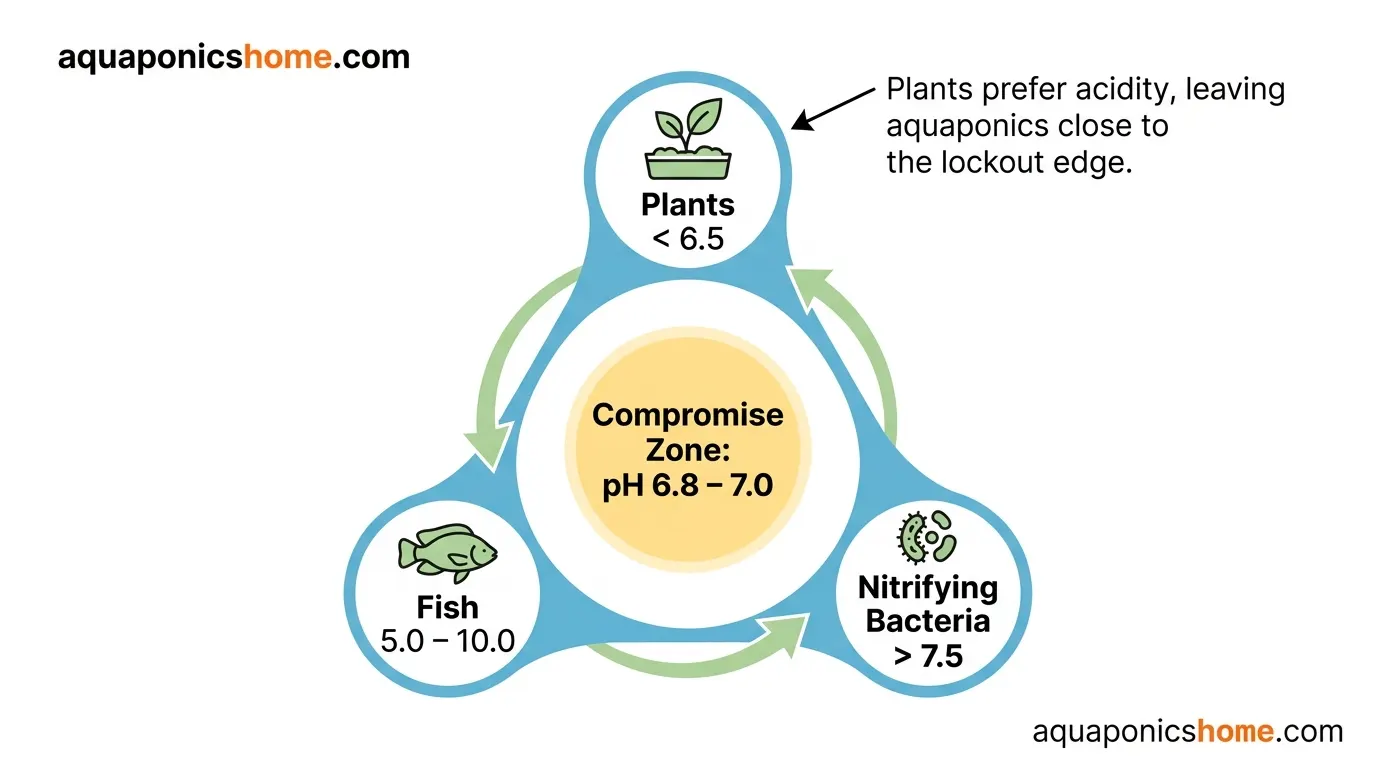
Many growing systems can set pH for the plants alone. Aquaponics cannot, because three living things share the same water: fish, plants and nitrifying bacteria (the bacteria that turn fish waste into the nitrate plants feed on). Each of them wants something slightly different.
New Mexico State University’s circular Important Water Quality Parameters in Aquaponics Systems by Rossana Sallenave (NMSU Circular 680, revised June 2026, read 2026-09-25) lays out the tension:
- Plants “grow best when pH levels are below 6.5.”
- Nitrifying bacteria “perform optimally at pH levels greater than 7.5 and basically stop working when pH levels fall below 6.”
- Tilapia, as one example of an aquaponic fish, “require pH to be in the range of 5.0 to 10.0.”
- The compromise that suits all three “is a pH of 6.8 to 7.0,” and “as long as the pH is maintained between 6.4 and 7.4 it will be tolerable to all three components.”
Notice where that leaves the plants. The compromise range sits above where plants do best. An aquaponic system therefore always runs a little closer to lockout territory than a plant-only system would. That is not a design flaw. It is the price of keeping the bacteria and fish healthy too. But it means small upward drifts matter more here.
For the full background on why different sources quote different pH targets, see aquaponics pH and why three sources give three targets.
The Iron Example: Present but Unavailable
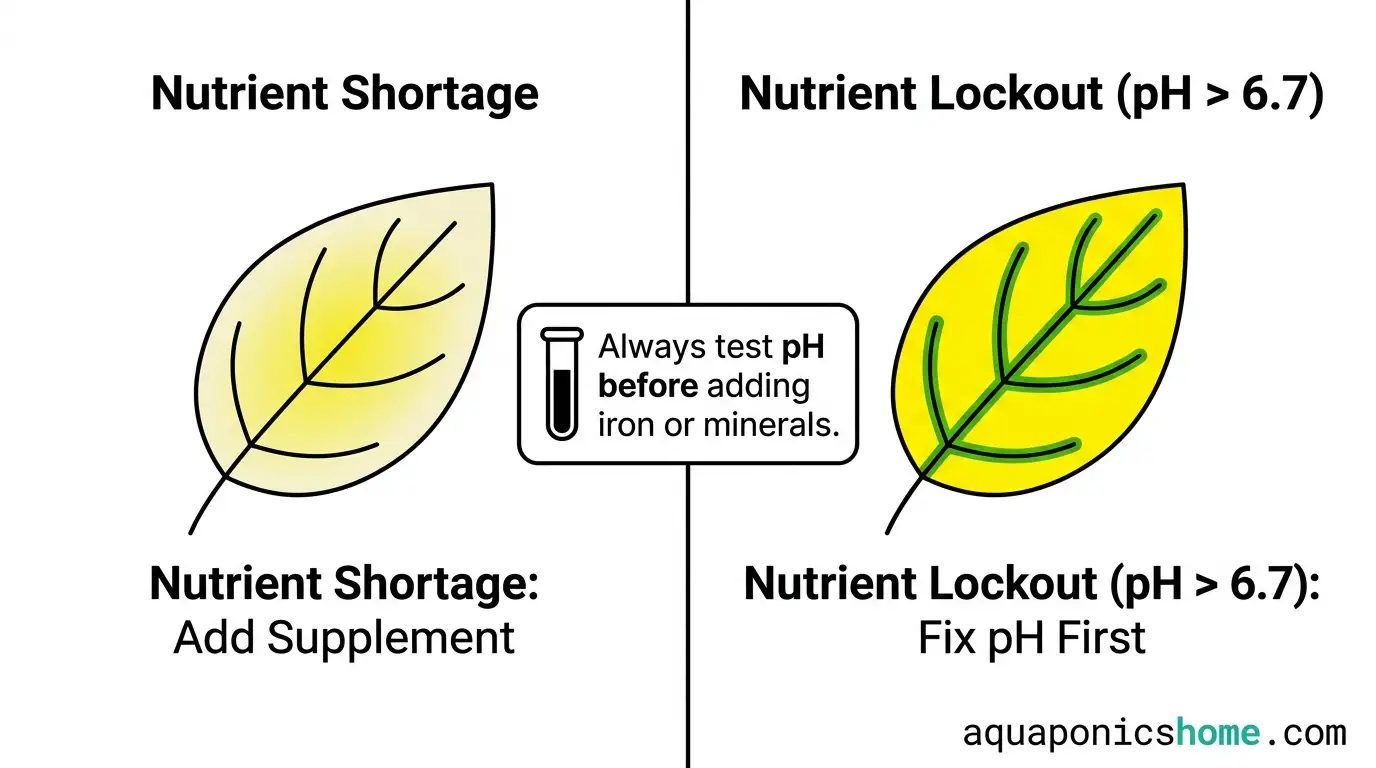
Iron is the clearest example of lockout in an aquaponic grow bed.
Illinois Extension horticulture educator James Schuster, in the Illinois Extension guide to chlorosis (read 2026-09-25), explains that iron “becomes more insoluble as the soil pH climbs above 6.5 to 6.7,” and that most plants can absorb iron as a free ion only “when the pH is between 5.0 and 6.5.” The guide is written about soil, but the underlying relationship between iron and pH is the same one that matters in a grow bed.
Put that next to the NMSU compromise range and the overlap is plain: a normal aquaponic pH is already at or above the point where plain iron starts becoming harder for plants to use. Drift upward and the problem grows.
The symptom is recognizable. Illinois Extension notes that iron chlorosis “starts on the younger or terminal leaves and later works inward to the older leaves”: new growth turns pale yellow while the veins stay green.
This is why aquaponic growers use chelated iron, a form wrapped in an organic molecule that helps keep it available at higher pH. NMSU recommends the chelate designated DTPA. But even chelated iron is best used when pH is where it should be.
The Low-pH Side: Lockout of the Nitrogen Supply
Lockout is not only a high-pH problem. At the low end, the issue in aquaponics is different: the nutrient supply itself slows.
NMSU notes that nitrifying bacteria “basically stop working when pH levels fall below 6.” Those bacteria are what turn fish waste into nitrate, the main plant food in the system. If they slow down, less nitrate is produced, and the plants go pale and slow on their older leaves, a pattern that looks like a nitrogen shortage.
Meanwhile, ammonia and nitrite that the bacteria would normally process can build up, which is a fish problem, not just a plant problem.
So a low pH can make the plants look underfed and put the fish at risk at the same time. Adding a plant supplement does nothing for either.
Your Supplements Change pH Too
This is the point that ties it all together, and it is why “check pH before you add anything” is literal advice.
Some of the most common aquaponic supplements are themselves pH adjusters. NMSU Circular 680 explains that “calcium and potassium will be supplemented when calcium hydroxide and potassium hydroxide are added to increase pH.” Those products raise pH every time you use them.
That creates two scenarios:
- pH is low or falling. Adding one of those bases corrects pH and supplies potassium or calcium at the same time. Good.
- pH is already high. Adding a base pushes pH higher, which can worsen iron lockout. You fix one symptom and deepen another.
In other words, the order in which you do things changes the result. Test first, and the pH reading tells you which supplements you can sensibly use today and which have to wait.
The Test-First Routine
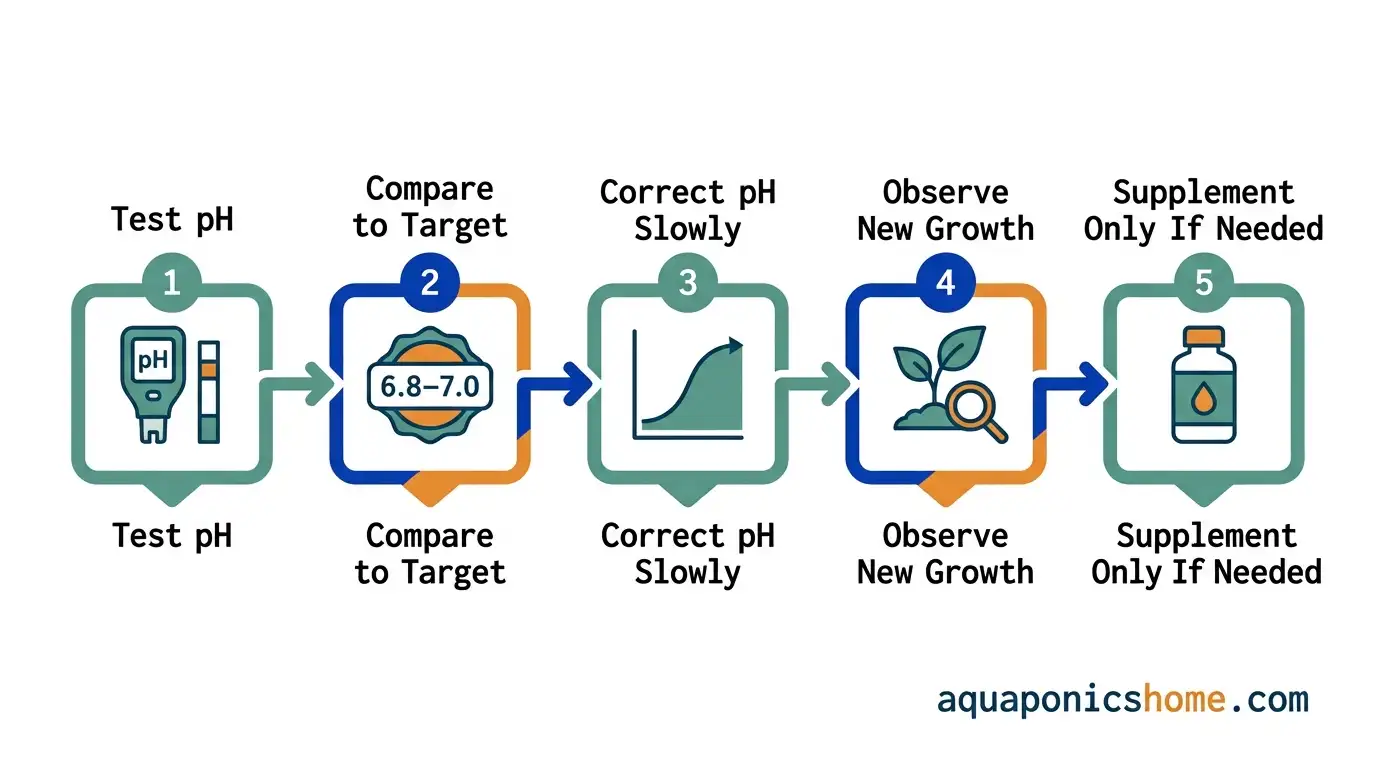
When leaves start looking wrong, work through this before opening any bottle:
- Test pH. Use a reliable test kit or a calibrated meter. If you are not sure your readings are accurate, the routine in our 10-minute weekly aquaponics water testing guide covers the basics.
- Compare with your target range. NMSU’s compromise range is 6.8 to 7.0, with 6.4 to 7.4 tolerable.
- If pH is out of range, correct pH first, slowly. Move it gradually, not in one big jump, and retest between steps. The method is in how to adjust pH in aquaponics without hurting anything.
- Wait for the plants to respond. Existing damaged leaves often stay damaged. Watch the new growth over the following weeks.
- Only then decide whether a supplement is needed, and choose one that suits your current pH.
- Follow the label for any supplement, using your system’s real water volume. This article does not give dose rates, because products and systems differ too much for one number to be safe.
If pH will not stay put no matter what you do, look at buffering (the water’s ability to resist pH change), covered in aquaponics KH buffering.
Signs You Are Dealing With Lockout, Not a Shortage
No single sign proves lockout, but these patterns point toward it:
| Pattern | What it suggests |
|---|---|
| You added a supplement and nothing improved in new growth | Availability problem, possibly pH |
| New leaves yellow with green veins, and pH is at the high end of range | Iron lockout |
| Older leaves pale, growth slow, and pH has been low for a while | Bacteria slowed, less nitrate reaching plants |
| Symptoms appeared after a pH-raising addition | The addition may have tipped pH too high |
| Symptoms across several plant types at once | A water-wide issue such as pH, not one crop’s needs |
Visual diagnosis can mislead. Different nutrient problems produce similar-looking leaves, and more than one can happen at once. A local extension service can help interpret symptoms and water tests for your specific system.
What Not to Do
- Do not keep adding the same supplement when the first dose did nothing. Test pH instead.
- Do not swing pH quickly to fix plant symptoms. Fish share the water, and a sharp change is a stress on them.
- Do not use garden fertilizers or pH products not intended for aquaponics. Anything you add reaches fish you may eat and plants you will eat.
- If fish show distress after any adjustment, stop and test the water. For illness, contact an aquatic veterinarian or your local extension aquaculture service.
FAQ
What is nutrient lockout in aquaponics?
It is when a nutrient is in the water but plants cannot absorb it, usually because pH has moved out of the range where that nutrient stays available. Iron at higher pH is the most familiar example.
What pH should an aquaponic system be to avoid lockout?
NMSU Circular 680 describes 6.8 to 7.0 as the compromise that suits fish, plants and bacteria, with 6.4 to 7.4 tolerable. Plants prefer lower, bacteria prefer higher, so aquaponics always balances between them.
Why did adding iron not fix my yellow leaves?
If pH is high, iron becomes harder for roots to absorb even when it is present. Check pH first. Also judge by new growth, since leaves that already yellowed often stay yellow.
Can low pH cause nutrient problems in aquaponics?
Yes, in a different way. NMSU notes nitrifying bacteria basically stop working below pH 6, which cuts the nitrate supply plants depend on and can let ammonia and nitrite build up.
Should I adjust pH or add nutrients first?
Test and adjust pH first. Some common supplements, such as potassium hydroxide and calcium hydroxide, also raise pH, so the pH reading decides which products make sense to add.