
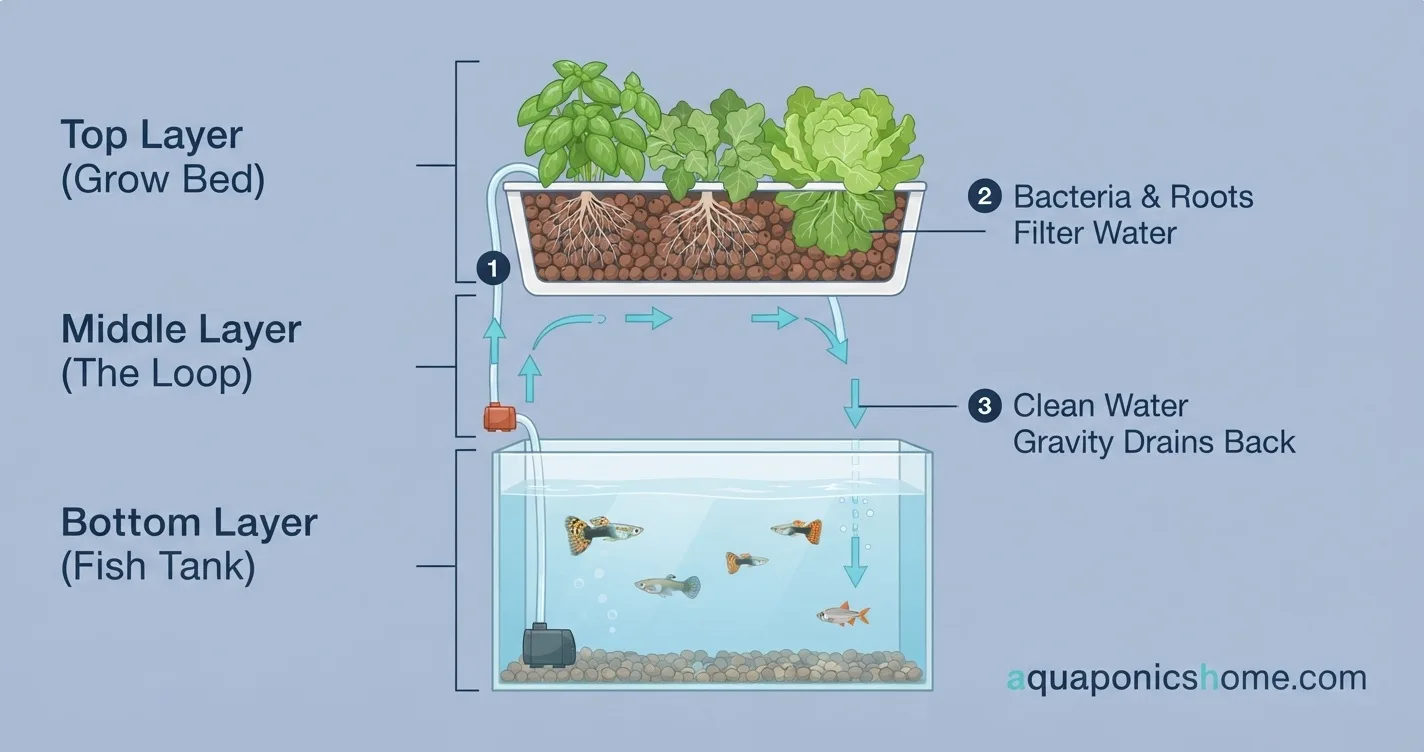
Yes, you can turn an existing aquarium into an aquaponics system. You add a grow bed above or beside the tank and a small pump that lifts water from the fish tank to the plants and lets gravity return it. The plant roots and the media in the grow bed do the filtering, so the fish waste feeds the plants and the plants clean the water for the fish. That is the whole idea. If your tank already holds fish, you also get a head start most beginners do not: the good bacteria that make aquaponics work are already living in your filter.
This is the lowest-barrier way into aquaponics, and it is where I started on my balcony here in Dhaka. My own systems run in plastic tanks and tubs rather than a glass aquarium, but the principles are identical, and a glass tank has one nice bonus: you get to watch the fish.
What you can (and can't) expect from a tank-top garden
Let me be honest before you buy anything. A converted aquarium is a small system. It grows herbs and leafy greens beautifully. It will not grow a crop of tomatoes or feed a family.
Here is the realistic scope:
| Grows well | Struggles or won't work |
|---|---|
| Lettuce, spinach, kangkong (water spinach) | Tomatoes, peppers, eggplant (heavy feeders) |
| Mint, basil, coriander, other herbs | Root crops like carrots or potatoes |
| Green onions, pak choi | Anything that needs deep soil |
The reason is simple. Leafy greens live on nitrogen, and a modest number of fish makes plenty of nitrogen. Fruiting plants need far more nutrients (plus potassium and phosphorus that fish waste is low in), so they usually disappoint in a small setup. Start with greens. You will get fast wins, and fast wins keep you going.
What you need to convert an aquarium
You do not need an imported kit. Everything on this list has a local substitute, which matters if you are shopping in a hardware market rather than online.
| Part | What it does | Local substitute |
|---|---|---|
| Aquarium, 40 liters or more | The fish home and water reservoir | Any existing tank; bigger is more stable |
| Grow bed | Holds media and plants above the water | Food-safe plastic tub or storage crate |
| Grow media | Surface for roots and bacteria | Washed gravel, LECA clay pebbles, or lava rock |
| Small submersible pump | Lifts water to the grow bed | Any low-wattage aquarium or fountain pump |
| Tubing | Carries water up and back | Standard flexible hose that fits the pump |
| A way to return water | Drains the bed back to the tank | Drilled overflow, or a bell siphon |
A note on media. Rinse it until the water runs clear before it goes anywhere near your fish. Media dust is one of the most common ways people cloud their tank and stress their fish on day one. This is boring and it matters.
Smaller systems cost less to run than most people fear, and you can stage the build over a few weeks. I break the numbers down by tier in the small aquaponics cost guide.
The build, step by step
You can do this in an afternoon.
- Rest the grow bed above or beside the tank. Above the tank saves space, which is the whole point on a balcony. If you rest it on top, make sure the frame or a shelf carries the weight; wet media is heavy.
- Rinse the media and add it to the bed. Fill to roughly 5 cm below the top so water never spills over the surface. Dry media on top discourages algae and fungus gnats.
- Set the pump in the tank and run tubing up to the grow bed. Point the outlet so it trickles into the media, not so it blasts a single spot.
- Build your return. The simplest is a drilled bulkhead or an overflow pipe set at the height you want the water to sit in the bed, letting the excess drain straight back to the tank. If you like a flood-and-drain rhythm, a bell siphon does that, but start simple. My first big failure was a siphon that stopped draining overnight and flooded the balcony. Simple returns fail safe.
- Turn on the pump and watch the water for an hour. Check that the bed fills, drains, and that the tank level does not drop too far. Adjust flow now, before fish and plants are depending on it.
- Plant into the media. Rinse the soil off seedling roots and nestle them into the pebbles. Seeds work too, sown shallow.
How strong should the pump be?
Aim to move the full volume of your tank at least once per hour. A 60 liter tank wants a pump rated for at least 60 liters per hour at the height it has to lift, and honestly a bit more, because pumps lose output as they push water up. The good news for an aquarium conversion is that the lift is short, so a small, low-wattage pump is usually plenty. Too strong is a real problem: a violent current stresses fish and can blow media around. You can always add a valve or a T-fitting to bleed off excess flow back into the tank.
The shortcut existing fishkeepers get: don't kill your bacteria
This is the part most conversion guides skip, and it is the most important thing on this page.
Aquaponics runs on nitrifying bacteria. They live on every surface in an established aquarium, especially inside your filter, and they convert toxic fish waste (ammonia) into nitrite and then into nitrate, the form plants actually use. A brand-new system has none of these bacteria, so it needs weeks of "cycling" before it is safe to stock.
If your aquarium already has healthy fish, you have already done that work. Your job during conversion is to not undo it. So:
- Do not rinse your filter media in tap water. Chlorine and chloramine in municipal water kill nitrifying bacteria. If you must clean filter sponges, squeeze them in a bucket of the tank's own water.
- Do not scrub everything at once. Over-cleaning is how I lost my first batch of fish years ago. I stripped the system so clean that I starved the bacteria, ammonia spiked, and the fish paid for it. Leave the biology alone.
- Seed your new grow bed. Take a handful of gunk from your established filter, or some of the old media, and tuck it into the new grow bed. You are moving a living bacteria colony into its new home. This is the single fastest way to get a converted tank stable.
- Always dechlorinate any top-up water before it touches the system, for the same reason.
If you are instead starting with a fresh, fishless tank, you cannot skip cycling, and rushing it is the classic beginner mistake. I walk through the safe way to do it in how to cycle without killing your fish.
Stocking: how many fish, and which ones
Forget the old "one inch of fish per gallon" rule. It is an approximation that falls apart quickly, because it is the fish's body mass and waste output that matter, not its length. A single fat goldfish produces far more waste than a school of small tetras of the same total length.
Use weight instead. The FAO's 2014 aquaponics manual works in kilograms of fish per volume of water and, for tanks under 500 liters, halves its normal figure to 1 kg of fish per 100 liters. Rutgers Cooperative Extension gives the same idea in US units, sizing a tank so there are 10 gallons of water for every pound of fish at maturity. Note the phrase at maturity: stock for the size your fish will grow into, not the size they are the day you buy them. One more reason an aquarium conversion suits ornamental fish rather than a crop you intend to eat, since the FAO does not recommend growing fish for consumption in anything under 500 liters at all.
For a converted aquarium, stock light. A lightly stocked tank is more stable, more forgiving, and easier to keep balanced than a crowded one. Fewer fish means fewer sudden ammonia swings, and in a small volume swings happen fast. The common rule of thumb for media-bed aquaponics is to roughly match your grow bed volume to your fish tank volume (about 1:1) and let the plants and fish grow into balance rather than maxing out the fish from day one.
On species, pick fish you will happily keep for years, because you will be looking at them daily:
- Small, hardy community fish (like guppies or small barbs) suit a modest tank-top system and gentle flow.
- Goldfish are wonderful waste producers, which plants love, but they get large, are cold-water fish, and quickly overload a small tank. They belong in bigger volumes than most conversions provide.
- Betta can work in a low-flow system, but a betta hates strong current, so keep the pump gentle and give it calm water.
Whatever you choose, feed lightly and only what the fish finish. Uneaten food rots, spikes ammonia, and is the hidden cause of a lot of "my water went cloudy" panic.
Three mistakes that kill tank conversions
- Pump too strong. A blasting current stresses fish and scatters media. Match the pump to the tank and dial it back with a valve if needed.
- Media dust. Unwashed gravel or pebbles cloud the water and irritate fish gills. Rinse until the runoff is clear.
- Light starvation. This is the one nobody warns you about. When you put a grow bed on top of a tank, the plants are often in shade. Herbs and greens need real light. On a balcony, place the system where it gets several hours of sun, or add a simple grow light above the bed. Plants that never see enough light stretch, pale, and stall.
A quick word on ready-made tank toppers
You will see all-in-one products that sit on a standard aquarium and turn it into a garden. They are a valid option if you want to skip the plumbing and do not mind paying for convenience. A DIY conversion using a tub and local media does exactly the same job for less and teaches you how the system actually works, which pays off when something goes wrong. I am not selling either one; choose based on your time, your budget, and how much you enjoy tinkering.
Where to go next
A converted aquarium is the perfect first system. Once it is running, the same fish-to-plant logic scales up to bigger balcony builds. If you want the full picture of small-space setups for renters and tight balconies, start with the balcony aquaponics guide, then come back here when you are ready to get your hands wet.
FAQ
Can I keep a betta in an aquaponics tank?
Yes, with care. Bettas dislike strong current, so keep the pump flow gentle and make sure the water stays warm. A calm, lightly planted tank-top system suits them.
Are goldfish good for aquaponics?
Goldfish produce a lot of waste, which plants love, but they grow large, prefer cool water, and overload small tanks fast. They work better in bigger systems than a typical aquarium conversion.
Do I still need to do water changes?
Less often than in a plain aquarium, because the plants remove nitrate as they grow. You will still top up for evaporation and should test the water regularly, especially in a small system where things can shift quickly. Treat occasional partial changes as normal, not as failure.
Kit or DIY: which should I choose?
A kit saves you the plumbing and looks tidy. A DIY build using a tub and local media costs less and teaches you how the system works so you can fix problems yourself. Both grow the same greens.
How long before I can eat the plants?
Fast-growing greens like lettuce and water spinach can be ready to harvest leaves within a few weeks of a healthy, cycled system settling in. Herbs take a little longer to fill out.
Pingback: Balcony Aquaponics: A Beginner’s Small-Space Guide - AquaponicsHome