
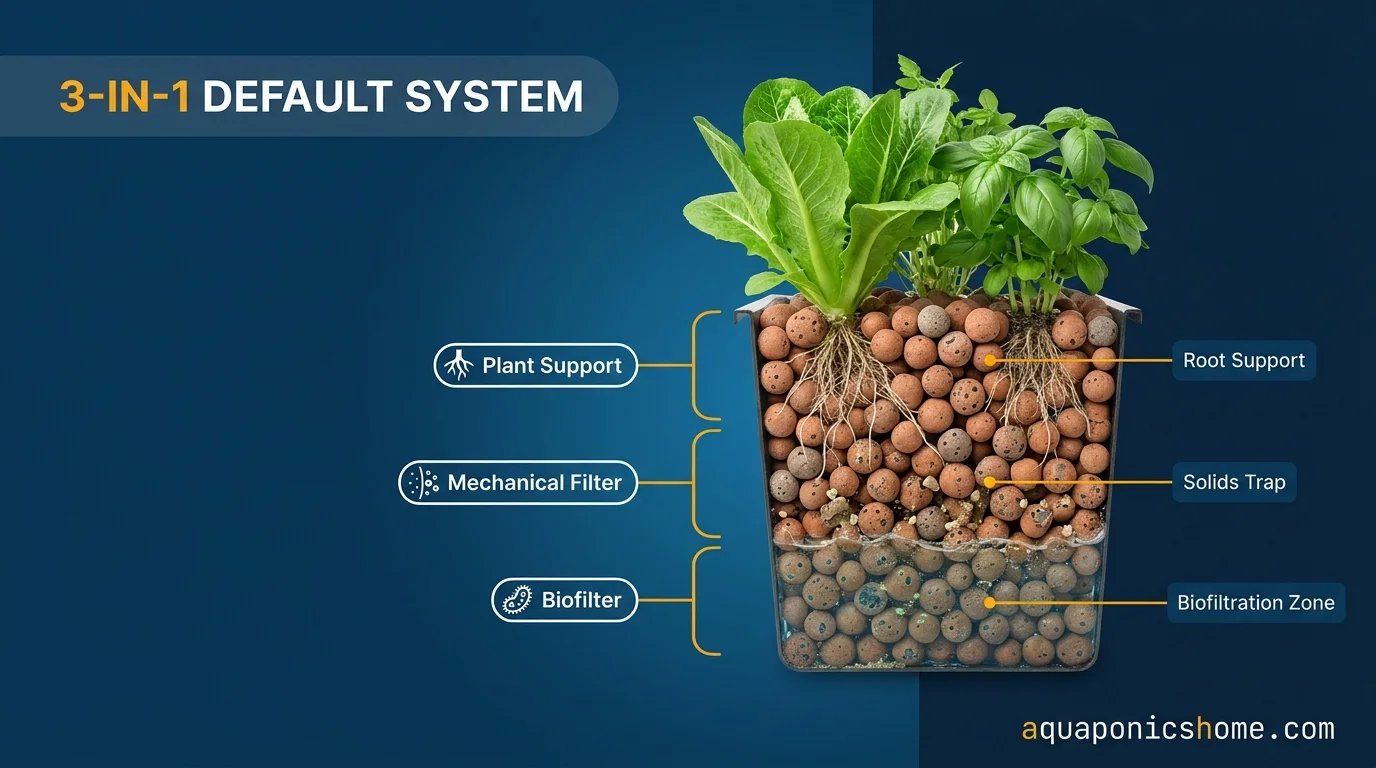
Media bed aquaponics is the default first design because one bed of gravel or clay pebbles does three jobs at once: it supports the plants, it traps fish solids like a mechanical filter, and its surface area houses the bacteria that turn fish waste into plant food. Other designs need separate hardware for at least one of those jobs. The catch is weight, slow solids buildup, and media you commit to once.
If you arrived here from the comparison of the four main aquaponics designs, you already have the verdict. This article is the reasoning behind it, and the part the verdict left out.
I run a media bed on a rented balcony in Dhaka, and I have rebuilt it twice. This is home ground for me, which also means I know exactly where it is annoying.
The three jobs a media bed does at the same time
Three separate things have to happen in any aquaponics system. A media bed is the only common home design where one component handles all three.
| The job | What it means in plain words | How the media does it |
|---|---|---|
| Plant support | Something must hold the plant upright and give roots somewhere to sit | The bed props the plant up the way soil would, without being soil |
| Mechanical filtration | Solid fish waste and uneaten food must be caught, or they rot in the water | Solids lodge in the gaps between the media as water passes through |
| Biofiltration | Bacteria must convert fish ammonia into nitrate, which is what plants can use | The rough, porous surface of every piece of media is where those bacteria live |
The FAO’s small-scale aquaponics manual (Somerville et al., 2014, FAO Fisheries and Aquaculture Technical Paper 589) puts it simply: the medium supports the roots of the plants, and the same medium works as a filter, both mechanical and biological. That is why the manual calls the media bed the simplest design.
Say that back to yourself as a shopping question. In a raft or channel system, you generally buy a separate solids filter and a separate biofilter. In a media bed, you buy gravel.
How the water actually moves through it
Most small media beds run on flood and drain, sometimes called ebb and flow. Water is pumped from the fish tank up into the grow bed until it fills, then drains back out, either on a timer or through a bell siphon (a passive drain that empties the bed by itself once the water reaches a set height).
The draining matters more than the flooding. When the water falls, air is pulled down into the gaps in the media. Nitrifying bacteria need oxygen to do their work, and so do plant roots. A bed that stays permanently flooded goes low on oxygen and starts producing the anoxic, dangerous conditions the FAO manual warns about.
Bell siphons are also where my worst night came from. Mine failed once and emptied a system across the balcony overnight, which is why I wrote about planning for the leak before it happens.
Why three jobs in one is exactly what a beginner needs
A first system fails at the joins. Every extra component is another thing to size wrongly, plumb wrongly, or forget to clean. Collapsing three functions into one bed removes two of those joins before you start.
The second benefit is quieter: buffer. A media bed carries a large bacterial population relative to a small fish load, because you have handed the bacteria an enormous surface to colonize. When a beginner overfeeds or skips a water test, that oversized colony absorbs some of the mistake instead of it becoming a spike. It is not immunity. It is slack, and beginners need slack.
That is the real reason the recommendation exists. Not because media beds grow better lettuce, but because they are harder to kill by accident. What the bacterial startup period demands of you is in cycling a system without killing your fish.
The catch, in three parts
Anyone who calls a media bed the easy option and stops there is selling something. Here is what you are signing up for.
It is the heaviest single object you will own
A grow bed full of saturated media is heavier than the same volume of water, because you have water in every gap plus the rock itself. Water alone is about 1 kilogram per liter, or 8.34 pounds per US gallon. Run that against a bed of any real size and the number gets serious.
I am not going to tell you what your balcony can carry, because nobody who has not seen your building can. That question belongs to a qualified structural engineer or to your building’s own drawings, and I explain how to get a real answer in how heavy a small aquaponics system actually is. If you rent, read it before you buy media.
Solids build up slowly, and you will not see it happening
The same trapping action that filters your water means the bed accumulates waste constantly. For a while the bacteria and the worms break it down and you notice nothing. Then drainage slows, water pools on the surface, and pockets of the bed go oxygen-starved.
The FAO manual gives thresholds where media beds stop coping alone: above a stocking density of 15 kilograms of fish per cubic meter of water (roughly 1 pound per 8 US gallons), mechanical filtration can be overwhelmed and the media risks clogging. It recommends adding a separate solids capture device above that density, or where feeding exceeds 50 grams per day for each square meter of grow bed (about 1.8 ounces per 11 square feet). Small home systems usually sit well under both. That is precisely why the design works at our scale and struggles at commercial scale.
The media is a cost you pay once and live with
Media is not a consumable you top up monthly, which is good. It is also not something you casually change your mind about, which is less good. Once a bed is full, planted and colonized, swapping it means emptying it, and emptying it means the problem in the next section. Choose before you fill, not after.
Depth is part of that commitment. FAO 589 reports that large fruiting vegetables want about 12 inches (30 cm) of media depth for enough root space, while small leafy greens manage on 6 to 8 inches (15 to 20 cm). A shallow bed is lighter and cheaper, and it quietly decides what you are allowed to grow.
The mistake that turned my forgiving system into a dead one
Here is the part almost nobody joins up.
Every guide tells you the media is the biofilter. Every guide also tells you that when a bed clogs, you dig the media out, rinse it and put it back. Both statements are true. Put together, they are a trap, and I walked into it.
Early on I decided my system looked dirty, so I cleaned it properly. Scrubbed, rinsed, made it look new. Within weeks the fish were dying and I could not work out why, because I had done the responsible thing. What I had actually done was wash away the bacterial colony living on every surface, and tap water is treated with chlorine or chloramine precisely to kill bacteria. My first batch of catfish did not survive that month.
The thing that makes a media bed forgiving is a living film you cannot see. It is not dirt. If a bed genuinely needs clearing, work in stages, disturb one section while the rest keeps running, and rinse with system water rather than tap water. I am not an aquaponics scientist, so for the nitrification detail I send people to Oklahoma State University Extension fact sheet HLA-6729, “Nitrification and Maintenance in Media Bed Aquaponics” (October 2021).
When a media bed is not the right default
It is a default, not a law. Skip it if the weight question comes back badly and you cannot get a structural answer you trust. Skip it if you are growing only fast-turnover leafy greens, where picking roots out of gravel every few weeks becomes the chore that ends the hobby, and where a raft or deep water culture setup fits better.
For most people starting small on a balcony, the trade is worth it. The full picture of running one in a rented flat is in the balcony aquaponics guide.
FAQ
Do I still need a separate biofilter with a media bed?
Usually not at small home scale, which is the design’s main advantage. FAO 589 reports that separate solids capture becomes advisable only once stocking density or feeding rate passes the thresholds quoted above, and a balcony system normally sits well below them.
Can I wash my grow media?
Wash it thoroughly before it goes into the system, when nothing is living in it yet. Once the system is running, treat washing as a last resort, do it in sections rather than all at once, and never rinse with untreated tap water, because chlorine and chloramine are there to kill exactly the bacteria you rely on.
How deep should a media bed be?
FAO 589 reports about 12 inches (30 cm) for larger fruiting vegetables, which need the root space, and 6 to 8 inches (15 to 20 cm) for small leafy greens. Depth is also weight, so decide it alongside the structural question, not after it.
Is a media bed too heavy for a balcony?
That depends entirely on your building, and no article can answer it for you. What is knowable is the arithmetic: water weighs about 8.34 pounds per US gallon, and saturated media weighs more than the water it displaces. Take those numbers to your building’s records or to a qualified structural engineer before you build.